RSS

Category Archives: Uncategorized

Zigzag Bladderwort is Multi-Peculiar

Utricularia subulata (U. cleistogama)

Lentibulariaceae


John and George walked in Savannas State Park in Jensen Beach, Florida yesterday.  Birding was the primary agenda.  The botanical treat was the wetland areas all abloom with yellow Ludwigias, Sneezeweeds (Helenium—wow, like a garden),   Tickseeds (Coreopsis),  Xyris, and carnivorous Bladderworts.     Some time ago in this blog we looked at the bladderwort trap so we’ll jump past that now.

The Zigzag Bladderwort,  presumably named for its zigzag stolon,  is kinky  in several additional ways:

First, it lives, not generally in standing water like the other local Bladderworts, but rather in moist soil, and trends a little weedy.    Look in disturbed moist depressions along wet foot trails.
Utricularia subulata 1

Zigzag Bladderwort as it looked yesterday. (First three photos by John Bradford.)

Second odd feature, Zigzag BW has by far the broadest distribution of any U.S. Utricularia, extending to Nova Scotia, to Lake Michigan, and to Tennessee.   You might ask, how does this delicate little wisp survive cruel ice and snow?    It creates subterranean “buds” able to survive tough times.
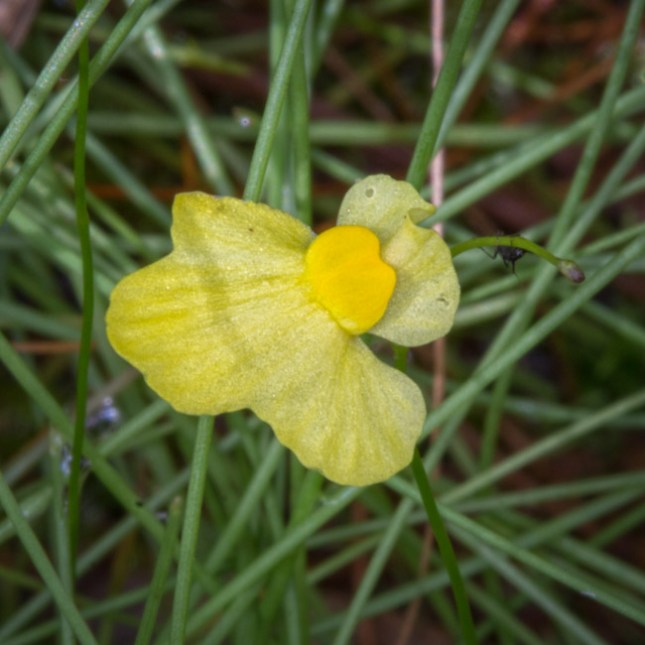
Utricularia subulata 3

ZZBW resembles a Snapdragon

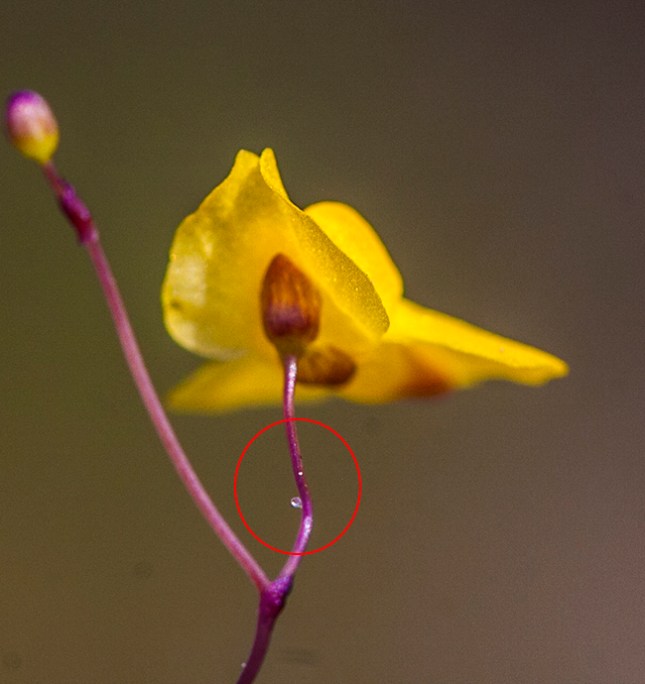
Odd item number three, “sticky dew drops” sometimes at branch points. Why would it do that?    Maybe to prevent ground-dwelling creepy-crawlies from messing with the blossom?    The droplets are super sticky stretchy, natural flypaper.
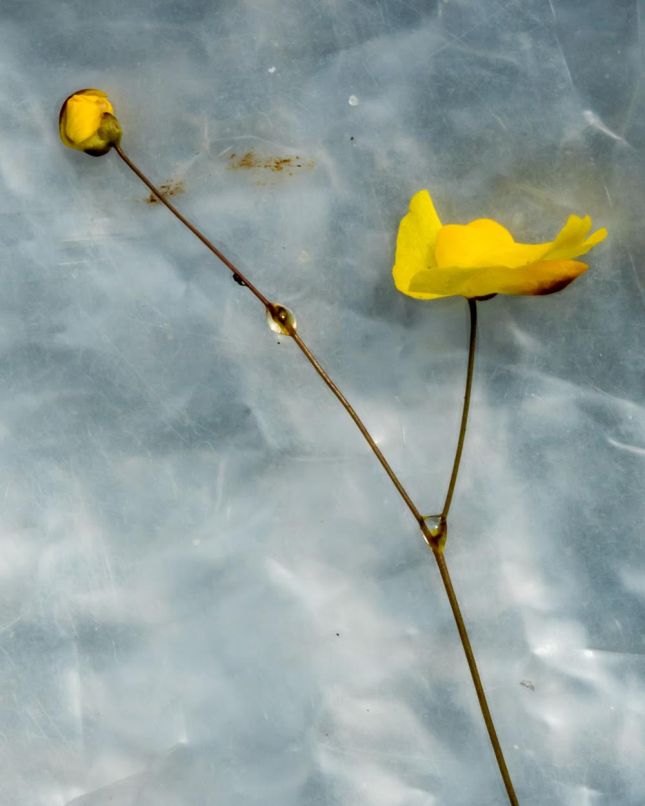
utricularia droplets

Note the sticky droplet.  These occur sometimes on the stems, where tiny insects (?) can be seen to crawl.  (Photo by John Bradford)

If you touch one and pull your finger away a strand stretch to connect your finger to the stem, like gum on a shoe.  The droplets could be extrafloral nectaries, ant feeders. However, the extreme  tackiness makes me vote for  bug-catcher.  A second level of blossom security is apparent.  Like a Snapdragon, the flower is closed at the mouth until a bee forces the two lips apart.
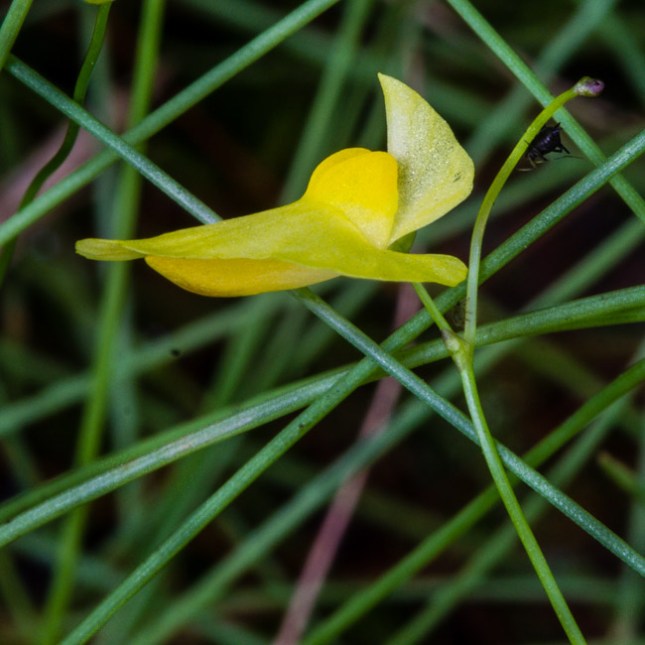
Utricularia subulata 4

Look closely—cooties!

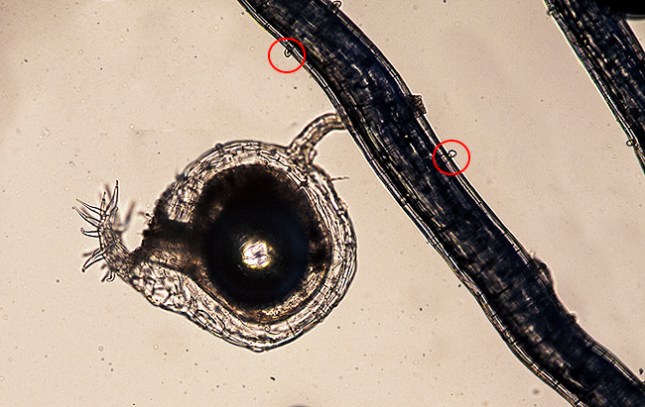
Peculiarity four, along the stem, including the subterranean stolon, there appear tiny polyps.  I don’t know what these are or why they exist.     Other species of Utricularia have gland-tipped hairs, and the bumps on U. subulata  look like eensie weensie plant hairs (marked with red circles in the photos).   Maybe they are glandular.
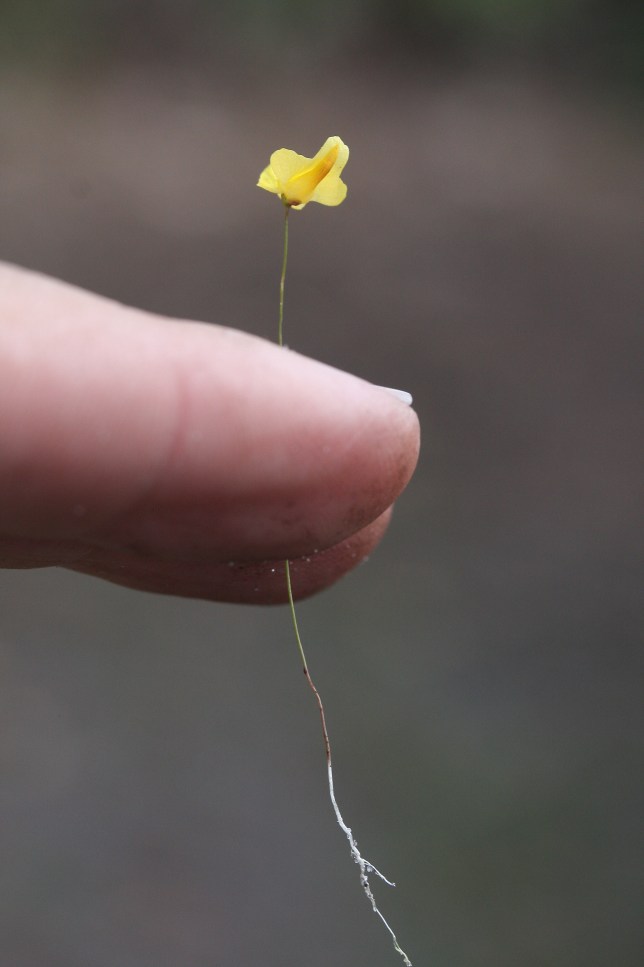
Utricularia whole plant

The entire plant.  It’s all flower!

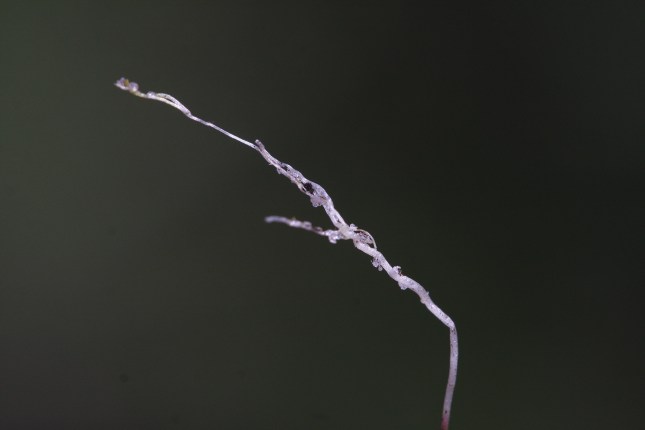
Weird item five, there are not roots.  The underground portion is stem (stolon), and there’s precious little of that.     It has a string of nearly microscopic bladder traps.   The aboveground stems are mere threads usually under 6 inches tall.    The leaves are puny and inconspicuous.  In short,  it is somewhere between awesome and mysterious that a rootless and nearly leafless plant can rustle up enough “fertilizer” nutrients and sufficient photosynthetic nutrition (carbohydrates) to crank out big booming blossoms.   There are factors in this equation we don’t yet know.  So read on to fill the gaps with speculation.
Utricularia underground

Stolon highly magnified, with traps.

Carnivory in plants is generally presumed to supply “fertilizer” nutrients, mostly nitrogen.   The Bladderwort traps do at least this.  Utricularia  traps come with glands to remove excess water from the closed chamber, and different glands to secrete enzymes into the trap and absorb the digested prey back out, like my stomach.  That’s all old-school.
utricularia subulata stem gland

“Hair” on stem.  There is another at the bottom of the picture.  I don’t know what these are about. Similar structures are on the stolon.

New research hints that the traps are complex little microbial ecosystems perhaps making surprise contributions beyond mere nitrogen.   Mainly, carnivory sometimes probably captures and contributes carbohydrate energy to the plant, that is, helps out surprisingly in the “photosynthesis” department beyond the expected “fertilizer” department.  Some Utricularia species actively feed symbiotic trap-dwelling microbes, which may help lure prey,  digest the victims, and  (here’s the stretch) somehow transfer carbohydrate energy stolen from the prey to the plant.  If true, that would help explain how the plant drums up enough carbohydrate-ish energy despite being underendowed photosynthetically.
utricularia subulata trap arrows

The trap under a microscope.  The trap entrance (left side) and its “welcome pricker thing” are to the left.   How the bristly pricker device helps capture victims in not clear.  It may trigger the door and/or attract/entangle tiny creatures?   “Hairs” on the stolon circled in red.

And one last oddity, number 7:  Sometimes obsolete (and current) names give clues about species biology.  The present name subulata, is based on the adjective “sublate,” meaning awl-shaped in reference to those inadequate-looking leaves.     The older name “cleistogama” is more revealing.  Cleistogamous (kliste-OG-ah-mus) flowers remain closed-up and secretly self-pollinate. These occur in today’s species either mixed with normal flowers or exclusively. A form with exclusively cleistogamous flowers was once named as a separate species, Utricularia cleistogama.
 
5 Comments

Posted by on March 13, 2016 in Uncategorized, Zigzag Bladderwort


Tags:

Sea Oxeye

Borrichia frutescens

Asteraceae

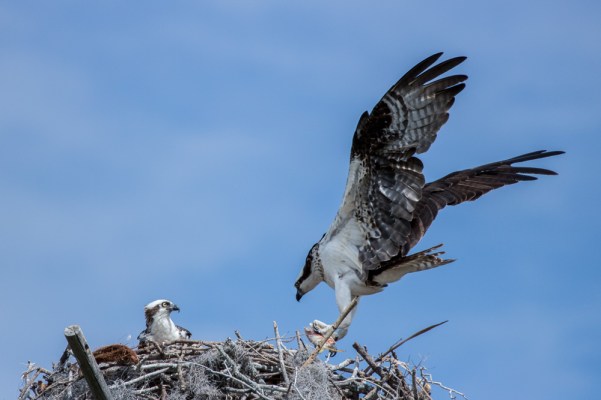
The main goal of John’s and George’s wilderness trip around Jensen Beach, Florida, today was birds.   Here is John’s shot of a handsome Osprey couple enjoying sushi near the Roosevelt Bridge.

borrichia osprey jb

Ospreys (All photos today by John Bradford)

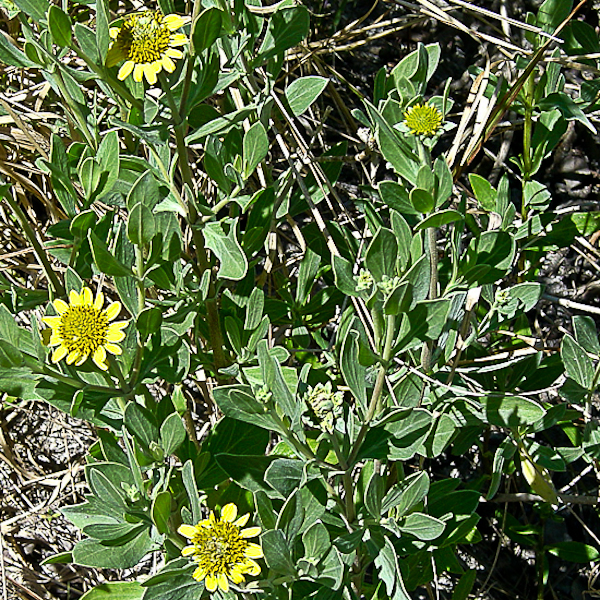
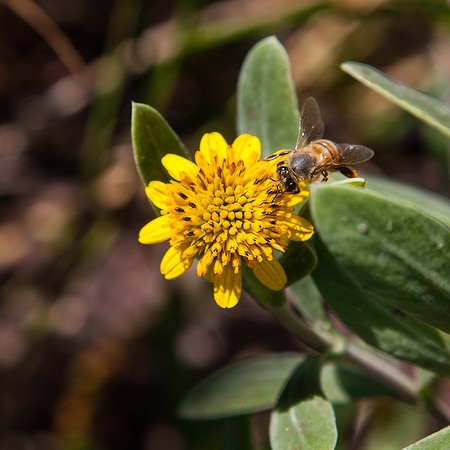
Below the Osprey nest,  blooming in the saline mud was a perennial wildflower favored by native plant landscapers*, for good reason:  spreading yet disciplined growth, compact dimensions, pretty gray-green foliage, and sunshine yellow flower heads.    The leaves are variably more or less succulent, with the puffiness influenced by the saltiness of the soil, apparently because the blades sequester excess salt in their tissues.    The plant is resistant to salinity, poor soils, and immersion, reportedly surviving 7 months under decaying flotsam.

Borrichia frutescens 2

Borrichia has only three species.    One is poorly known and oddly isolated in Peru.  The other two live in Florida and beyond.    Our local Borrichia frutescens differs from the other Florida species by having spine-tipped bracts on the flower head and grayish vs. mostly green leaves.   Where the two Florida species overlap south of here they form a hybrid called B. X cubana.      In general in the plant world hybrids often don’t thrive, unless they reproduce clonally, as in the present case.    Rhizomatous spreading allows B. x cubana to expand like a champ.  Although occurring wild, the hybrid can also arise via artificial crossing.

Borrichia frutescens 1

Members of the Aster Family often have a “medicinal” fragrance and associated bioactivity.  Interestingly, Borrichias have a cluster of related historical medicinal uses, usually as teas, centered on respiratory ailments.  Research has demonstrated antimicrobial powers.  Good thing.  They need an aresenal, as they seem to be more beseiged than Donald Trump.  These plants are hosts to fungi, nematodes, and insects, forming a tight little dinner club of who eats whom.  Let’s see about that.

Borrichia frutescens 5

A gall-forming midge Asphondylia borrichiae—which transmits fungi from stem to stem— is a parasite on Borrichia,*   usually raising just one gall per stem, yet potentially detrimental or lethal.   The severity of gall trouble diminishes with increasing salinity, which may help explain the salty habitats Borrichia favors, as refuges?  The midge has parasites (parasitoids) of its own, with at least four species of wasps laying lethal eggs in its gall-bound larvae.     The parasitoids cause an odd consequence requiring introduction of another plant having parallels to Borrichia frutescens:

Iva frutescens* looks like Borrichia frutescens (except in the flowers), occupies likewise salty habitats, has a similar U.S. geographic distribution, is in the same plant family, has the same last name (meaning shrubby), and  is a co-victim of Asphondylia borrichiae.     And here’s the kicker, as Florida biologist K. Stokes*  has explored.  Iva suffers less midge trouble when associated with Borrichia,  which may seem counterintuitive, since they both draw the pest.    But Borrichia suffers more, and thus spawns and spews the parasitoid pests to attack the midge on the grateful Iva.

————————————-

*Notes:

Where to acquire natives www.afnn.org

Iva frutescens CLICK

Abstract on the midge CLICK

Reference to Stokes CLICK


4 Comments

Posted by on March 4, 2016 in Sea Oxeye, Uncategorized


Tags:

Something Old, Something New, Something Borrowed, Something Blue

Skyblue Lupine

Lupinus diffusus

Fabaceae


[Fertilizer 101:  In descending order of abundance, plants need mostly nitrogen, much phosphorus, potassium, and several “minor” and “micro” nutrients, including prominently iron.  Nitrogen is abundant in the air, but microbes must convert that nitrogen gas to the nitrate and ammonium plants use.   Plants often have trouble acquiring phosphorus, because it does not flow in with water as nitrogen does.   The plant root or fungi associated with the root have to “go get” phosphorus.  Plants in scrub sand have automatic nutrient challenges in that ultra-poor soil.]

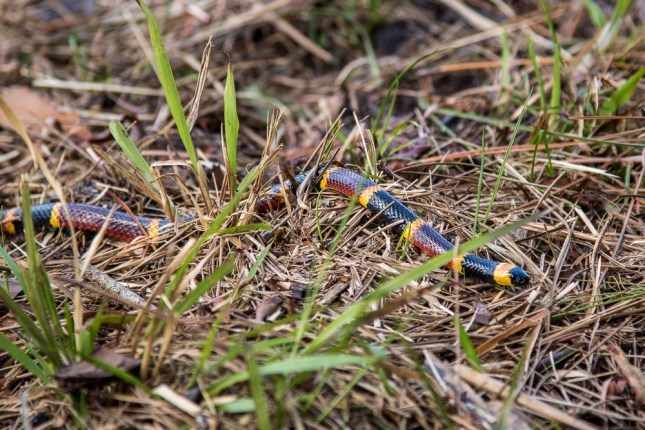
Out seeking eagles today, John jumped about 5 feet into the air, mumbling something about “red touches yellow.”

Eastern Coral Snake 1

Something yellow, something black sneaking up behind your back.  (Except where indicated differently, today’s photos by John Bradford.)

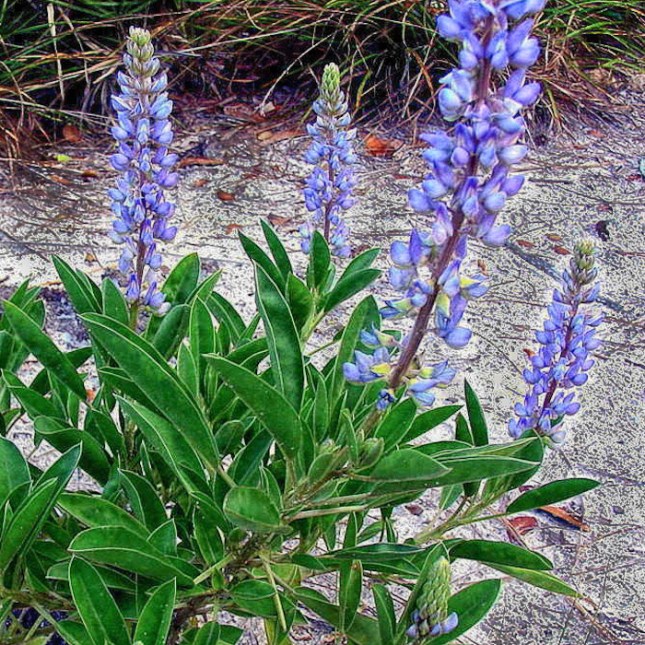
Near the sneaky snake we found the pretty plant of the day…Skyblue Lupine.   And here is its mystery:   out in the sugar sand scrub most plants look like they belong growing in a sun-cooked nutrient-deficient sandbox.    They tend to have tough demeanors.   Their gnarly adaptations are what make scrub fun to photo.   But Lupines, by contrast, look robust, green, lush, and perky.   How does the Lupine do it?    How does a Lupine on the sterile sand look like a Garden Club flower out of a nice fertilized flower pot?

Lupinus diffusus 6

Too spunky for a scrub plant!

There may be an answer or two.   It is a Legume, and Legumes have nitrogen-fixing bacterial root nodules to capture that atmospheric nitrogen   Nitrogen problem solved.   True and  nice,  but just the first chapter in a better story.  How bout the second-most limiting nutrient, phosphorus?

Here we must turn to other Lupine species and extrapolate speculatively.   Multiple hundred Lupinus species color the world, including the length of North and South America along the Rocky Mountains and Andes, and much more.  A handful decorate Florida, some native.  Only one is indigenous to South Florida, L. diffusus.    Now back to phosphorus.

Students from my classes, I hope might say, “symbiotic fungi help plants get phosphorus by digesting soil organic matter and sharing the booty with their host roots.”    But oh yea….that scrub soil has no organic matter, and Lupines do not have (or not much) helpful root fungi.    By the way, Lupines collectively are famous for tolerating terrible soils.   In their sterile ground they need a plan-B to get their P:

Back in the 80s botanists caught on to what were called “Proteoid Roots,” discovered first in the plant family Proteaceae.    Since then such roots have turned up in additional plants, making the newer name “Cluster Roots” better.   Cluster Roots look like a bottlebrush.    Guess what stimulates their formation?  Low phosphorus.   Guess what plants outside of Proteaceae can form them to counter low P?    Some Lupines, although as far as I know, L. diffusus remains unchecked, and we can’t dig it in a state park to see!

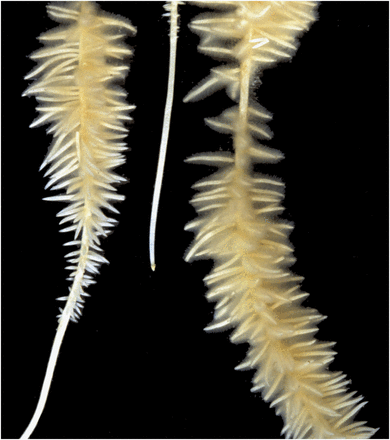
lupinus cluser roots ajb 10 263 2013 Michael Shane

Lupine Cluster Roots (Michael Shane, Am. Jour. Bot. 100: 263. 2013)

Cluster Roots are not mere brushes.  They are dynamic chemical factories.  The sorts of chemical activities associated with Cluster Roots occur as expected in Lupines with Cluster Roots.  And a little surprisingly, the “Cluster Root functions” turn up also in Lupines where Cluster Roots are unknown.   What are those magic functions?

First and foremost, they secrete citric acid (aka citrate) and similar compounds able to displace phosphorus from soil particles, busting P loose for the plant.   Reportedly as much as 1/3 of the photosynthetic product of some Lupines winds up as excreted  citric acid.  And it gets better:   Citric acid can free inorganic phosphorus, that is,  from soil minerals themselves, not just from (that absent) decaying organic matter.

Lupine roots release supplemental enzymes called phosphatases that liberate even more phosphorus while additional secretions adjust the soil acidity, probably to support  the phosphatase enzymes and/or to help bring in iron, which is sensitive to soil acidity.  But there’s a problem:

Soil microbes digest citric acid.  No worries, Lupines put out soil antibiotics to thwart the little pests.  That’s doubly useful because citric acid helps chaperone iron into roots.  Citric acid helps so much with iron and phosphorus uptake, some commercial fertilizers include it as an ingredient, sometimes hand-in-hand with potassium as potassium citrate.

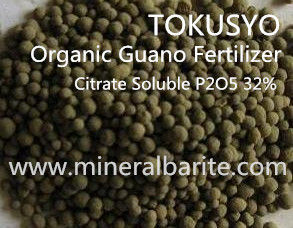
lupine fertilizer

Factories put citrate (citric acid) in the bag along with P (the P2O5 on the label above).  Lupines make their own citrate,  and borrow their P from the soil directly.

That’s a lot on nutrients.  So here’s the upshot.  All this helps explain something old, something new, something borrowed, and something blue.

Something old:

Lupines as crops date back thousands of years, valued for growth on poor soils.   Explained!

Something new:

Lupines are future crops precious in a starving world with poor soils to farm and phosphorus fertilizers becoming  expensive.

Something borrowed:

Phosphorus fertilizers are pollutants.   But Lupines merely borrow P from the soil, then give it back when plowed under,  even helping support other crops.  No polluting P added!

Something blue:

How many blue wildflowers are there?  (Few)

Lupinus diffusus 7

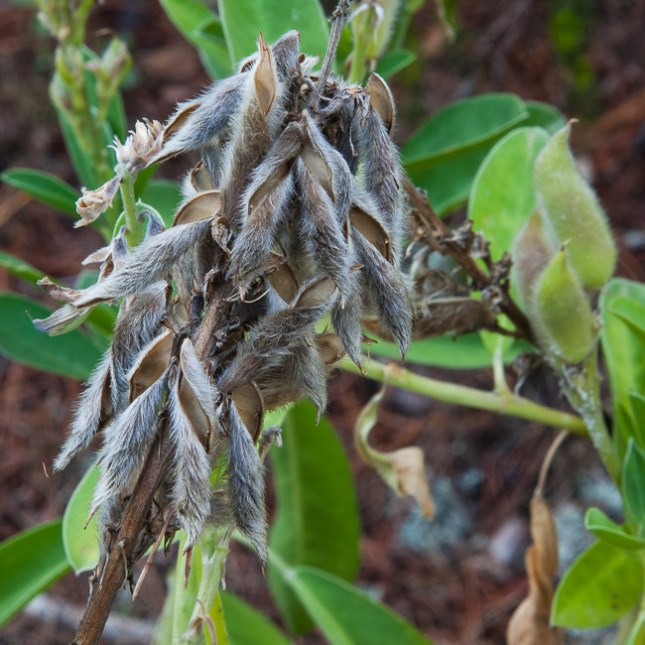
The pods are woolly.

 
14 Comments

Posted by on February 26, 2016 in Skyblue Lupine, Uncategorized


Tags: ,

The Hokey Pokey—Plant Style

No field trip this week.   Travel…so an early post from the lab instead wild plants from the forest.

Gadgets reveal how nimble plants are in responding to environmental cues.    Usually slowly but sometimes zippy…they wiggle, waggle, adjust, turn on and off metabolic processes, and reconfigure.    The complex interplay of chemical and electrical signals in plants is coming into better focus scientifically, and is astounding with no need to jump onto the goofy “plant intelligence” bandwagon.   Plant are far more dynamic than we tend to think traditionally.   But intelligent?—get real.

In this blog there has already been a good bit of attention to leafy behavior:

Succulence:  CLICK

Shade leaves and variegation: CLICK

Nyctinasty (folding at night): CLICK

So today, more of all that with the help of time lapse photography condensing stretches of hours to seconds.

That many plant collapse leaves at night is clear to anyone with a flashlight.   Daytime movements are more surprising.    The relationship between foliage and sunbeams and shadows is not merely a matter of “collect all the sun you can.”    There are three strikes against such simplicity:

  1. Excess light hitting a leaf can diminish photosynthesis, even damage the leaf.
  2. Bernie Sanders would agree that if the elite leaves at the top of the plant grab all the light, those below get cheated. If Ronald Reagan had debated Bernie though, The Gipper might have contended that top leaves let light trickle down.    Foliar positional adjustments through the day can optimize the light economy.   Not too much for those greedy CEOs,  and not too little for the struggling rank and file.
  3. A plant’s response to any one environmental condition is intertwined with other factors. For example, a leaf on a sunny day is at risk from too much light per se, and also from heat.   Only about 1% of the light striking a leaf powers photosynthesis, most of the rest converts to heat.   Leaf temperatures often read well above the surrounding air temperatures.   Stresses come hand in hand.

Now the stage is set so we can look at daytime leaf adjustments to light conditions by reversible movements.

Light-Tracking Leaves

Some plants orient their leaf blades to track incoming light.   Think of a solar energy facility keeping its panels aimed at the sun.   Leaves able to orient to face the sun can gather angled light early and late in the day, or from a low-hanging winter sun.  They maximize photosynthesis when the sun is indirect, and they may reorient away from it when overhead and too intense.

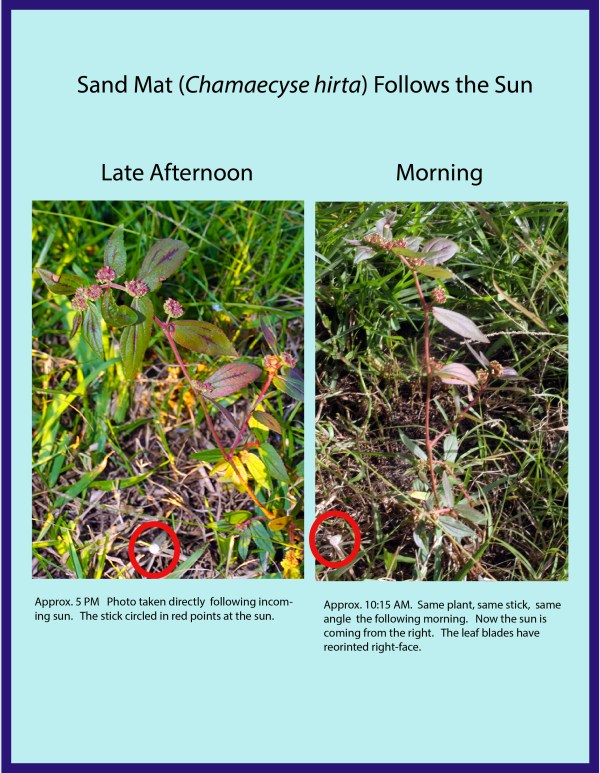
This Sand Mat was photographed in late afternoon, then again the next morning.  At both times the leaf blades faced the sun directly,  morning and night.  The afternoon photo follows the sun in directly onto the faces of the blades.  The morning photo along the same line defined by the afternoon sun shows the blades now tilted to face the morning sun.

Chamaecyse late and early

Strongly sun-tracking leaves sometimes reveal their adjustments by what I call the “Egyptian dance” position…the blades on the side of the stem toward the sun with tips down, in contrast with those across the stem from the sun with tips up.

egyptian dance

Left side up, right side down


Chamaecrista egyptian 2

Left side up, right side down


Vertical Leaves

Leaves that orient more or less vertically can take in plenty of angled sun morning,  evening, and winter, and may or may not face the mid day sun.  Desert plants, such as agaves, and many plants in bright hot places have vertical leaves.

The vertical arrangement allows light to penetrate deep into the plant.   In some species upper foliage may be vertical (and/or small), while lower leaves at risk for under-exposure are more horizontal (and often larger).

Lyonia vertical

Staggerbush vertical blades

solidago leaf sizes

Small leaves on top, big ones below

Cupping

One way to adjust to the spotlight is by reorienting part of the leaf, by cupping,  that is, tilting the edges inward all around.     Interestingly, in this Desmodium the variegated region is the central portion of the blade unable to tip into a sloped configuration, the one zone under continuous heavy illumination.  (Variegation may in part exist to protect leaf surfaces from excess light intensity.)

DEsmodium cupping

Cupped with variegation at the center.

Bacon Leaves

A made-up term today   A walk in any hot sunny scrub quickly reveals a common phenomenon in many species: leaf blades twisted, held at varied angles, and undulate-crisped like fried bacon.  Crazy leaves.    Some meadow,  marsh, or desert-ish plants do it too.  Pathological conditions can cause curling but we’re not talking about that here.    So can severe drying.  But bacon leaves in sun-drenched habitats appear to be adaptive.   Those wacky twists, turns, curves, bends, and curls prevent full frontal sun exposure yet at the same time assure a good measure of exposure at any moment, no matter where the sun is.    As the sun moves across the sky the plant is always catching a tan somewhere but a blistering sunburn nowhere.

Maybe more importantly, foliar contortions prevent the full force of the wind from sweeping water away directly from the blade surface.  The convolutions are partial windscreen.

The wavy leaves may offer a compromise between “normal” and “desert” structure.  Sun-protection and wind protection, yet also broad surfaces for gas exchange, evaporative cooling, and sun-gathering.

The crinkled configurations could be hard-wired and evolutionary.  Or a growth response.  Or reversible short-term adjustments.  Or a mix.  (Or none of these things.) Designing experiments to find out would be easy.

Chrysopsis sun seabranch

Bacon leaves on golden-asters


Dancing in the Sunlight

Leaves tracking the sun.  Before becoming interested in the topic I assumed that, well, the sun-trackers turn to follow the sun across the sky.    Not untrue, but way too simple.  Time lapse photography of several species reveals how complex the sun-influenced leaf movements can be.   In most species I’ve photographed there’s a fancy dance between leaf blades and sun.

In the Erythrina time lapse below, the camera faces south as the sun crosses the sky all day from east to west, left to right.   You might agree the overall average drift is subtly left to right, but that is obscured by constant adjustment with all the blades waving in sync to and fro in a solar current.   (The time lapse was indoors with no wind.    When the same plant was placed in constant light there is no movement.)

Dance: CLICK

Is it possible to use light to reorient leaves?  Yes.  This green bean  sat in the dark with light coming first from the left, then the light did a 180 to directly from the right.  CLICK

I wonder if the leaves move on a night with a bright full moon.


5 Comments

Posted by on February 18, 2016 in Daytime leaf movements, Uncategorized


Tags:

Twirly Little Tendrils

Fridays with three meetings don’t leave much time for field trips, so today’s exploration was a potted windowsill luffa during the proceedings.   Not native, but it’ll help keep you clean and exfoliated.  And it leads quickly to natives.

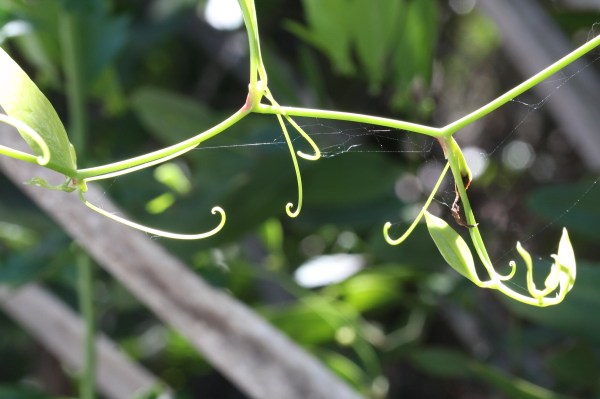
Luffa has magnificent tendrils, as my colleague Maura Merkal suggested photographing.   And we did.  Tendrils are the little twist-tie “wires” you see plants use to cling and grab.    They don’t get much attention, probably because they are boring.  But boring doesn’t stop me.

Tendrils

Smilax tendrils.  All photos except the final four (below the diagram) by John Bradford.

Tendrils tend to look alike, but here is the cool part (if you have a low threshold for cool):  they evolved separately and repeatedly in plants utterly unrelated to each other, and from different organs.     The same but not the same.    Is that remarkable?   The same need to cling and climb forced organs of divergent origins to the same outcome.   Shall we now tie into native tendril examples, featuring (mostly) native plants:

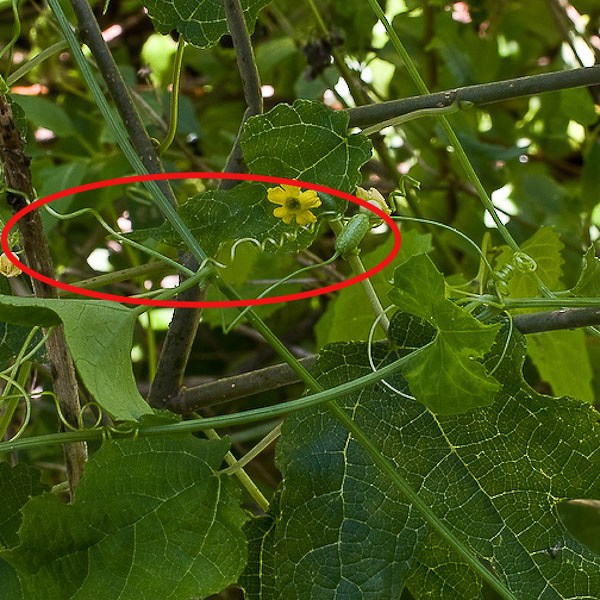
In some plants the tendrils are branches, for instance:

Creeping-Cucumber (Melothia pendula and other members of the Cucurbit Family)

tendril melothria pendula ai

and

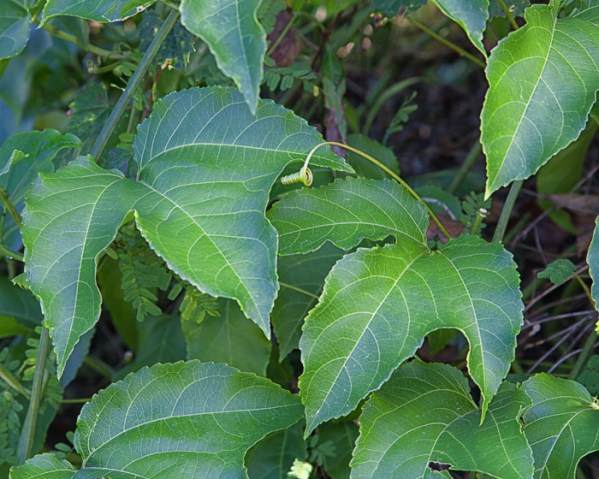
Passionflower (Passiflora species)

tendril passiflora edulis

Passiflora edulis (not native, escaped). The curly tendril is a delicate branch rising above the leaf.


In others the tendril is the tip of a (compound) leaf, for example:

Four-Leaf Vetch (Vicia acutiflora, and other legumes).  The rare native Tiny Peavine (Lathyrus pusillus) farther north in Florida offers a great example of a tendril as part of a leaf.  CLICK  (So does a regular garden pea.)

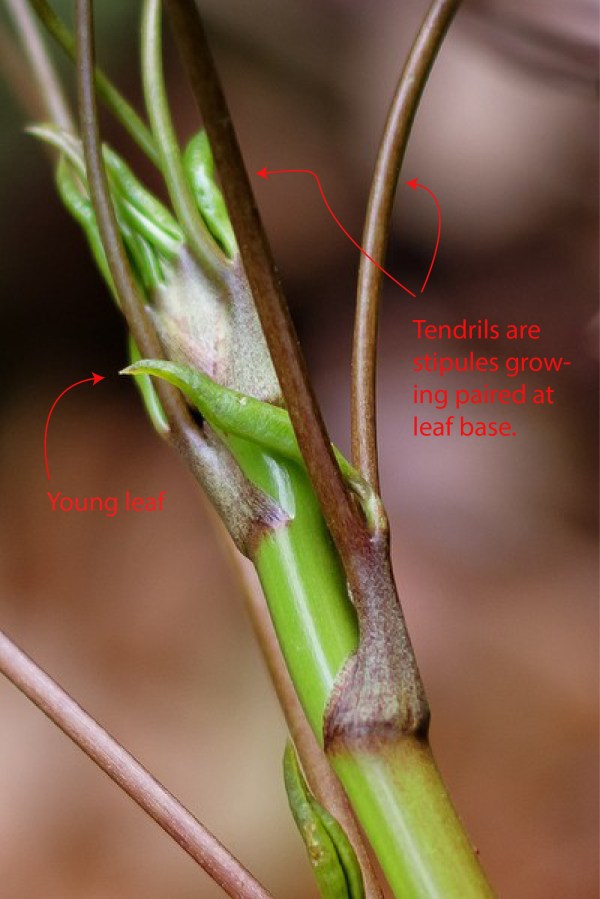
Tendrils can be stipules (paired outgrowths at leaf base), with a case in point being:

Smilax (Smilax species)

tendrils smilax1 ai

The two tendrils in this Smilax are growing from both sides of the leaf attachment.  They are stipular tendrils.


And tendrils can be stem tips, probably  modified inflorescences, with the prime example being:

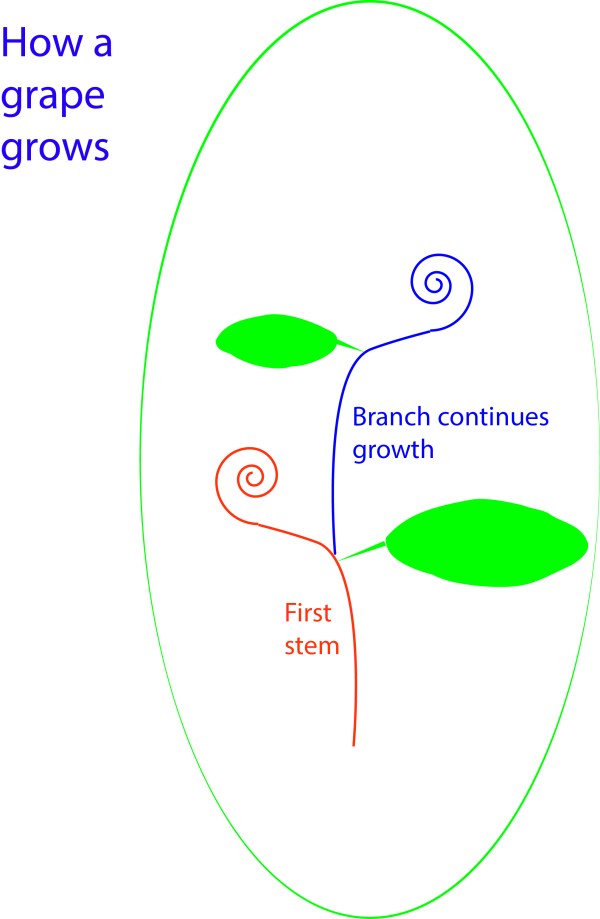
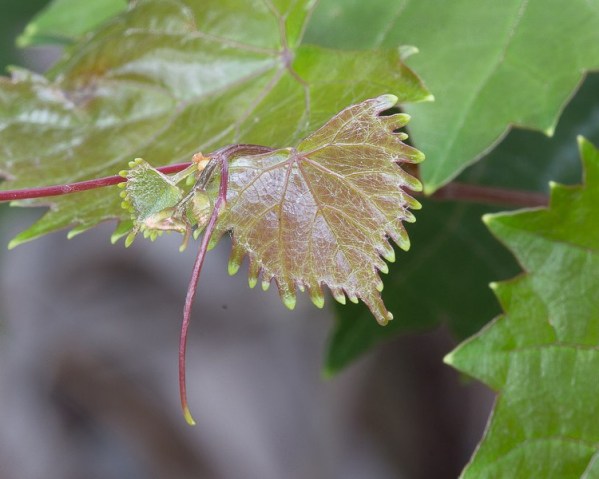
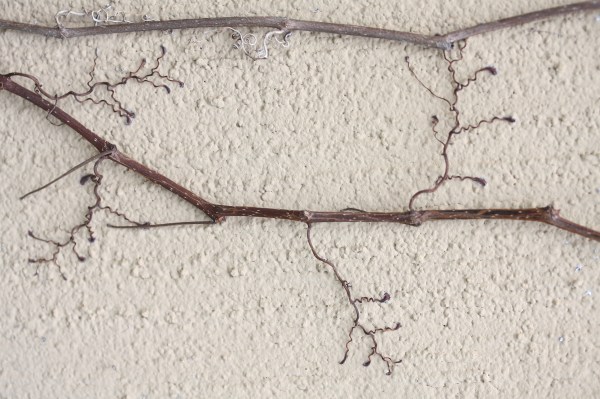
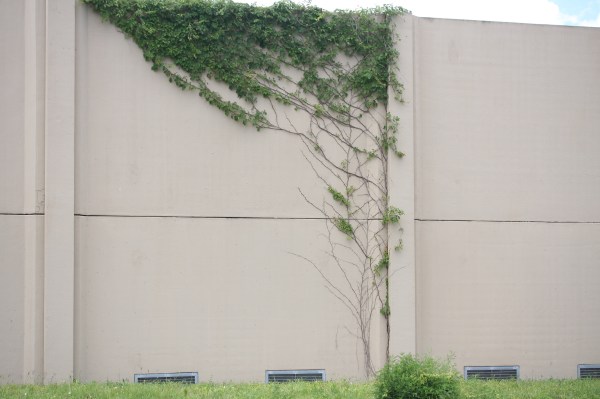
Grapes and their relatives.  Interpreting tendrils in the Grape Family involves a little guesswork.   The tendrils are opposite the leaves.   Most botanists interpret the tendril as the branch tip, and the growth continuing beyond the leaf-tendril to be a branch, even though the branch looks like the main stem.   That new branch ends with its own tendril, and so on and so forth.

tendril grape model


tendril vitis

Grape

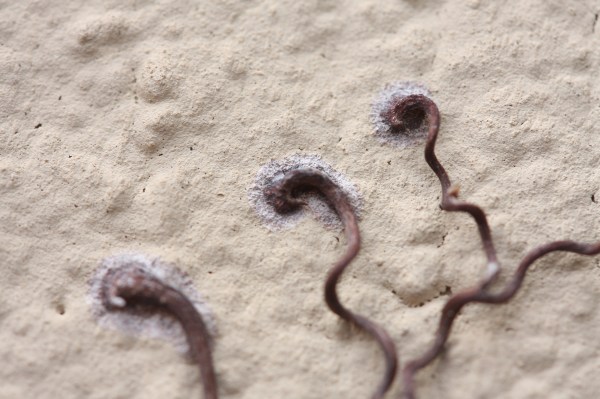
Grape Family tendrils have a rare or unique (?) ability.  They secrete water and salts from their tips.   This secretion may underlie the ability of Virginia Creeper (Parthenocissus quinquefolia) to form clinging sticky pads at its tendril tips.

Tendrils close Parthenocissus

Tendrils medium ParthenocissusTendrils far Parthenocissus

But what about the luffa?  CLICK to see its tendril in action (6 hours condensed to a few seconds).


10 Comments

Posted by on February 12, 2016 in Tendrils, Uncategorized


Tags:

Florida-Rosemary

Ceratiola ericoides

Ericaceae


The local white sand scrub was at its best today, sunny yet cool, with fresh growth and flowers, including white Innocence (Houstonia procumbens) and Sky Blue Lupine (Lupinus diffusus).    Although not near its peak, also with flowers was Florida-rosemary, a curious shrub.

Is it related to culinary rosemary? No

Does it smell like kitchen rosemary, no not at all, contrary to assertions all over the Internet.   (Here we have a great example of how BS can spread on the Internet.)

So why is the Florida species called rosemary?  A superficial resemblance, convergent evolution.

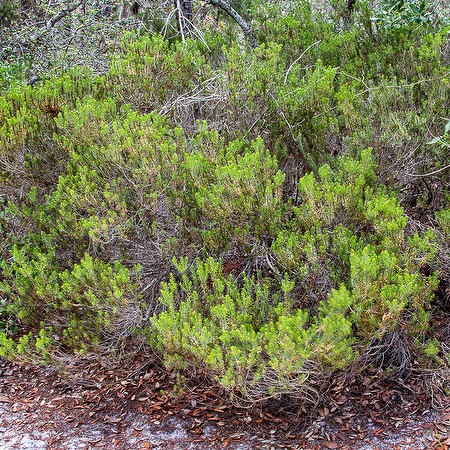
Ceratiola ericoides 5 far

Florida-rosemary.  All photos today (except halo) by John Bradford.

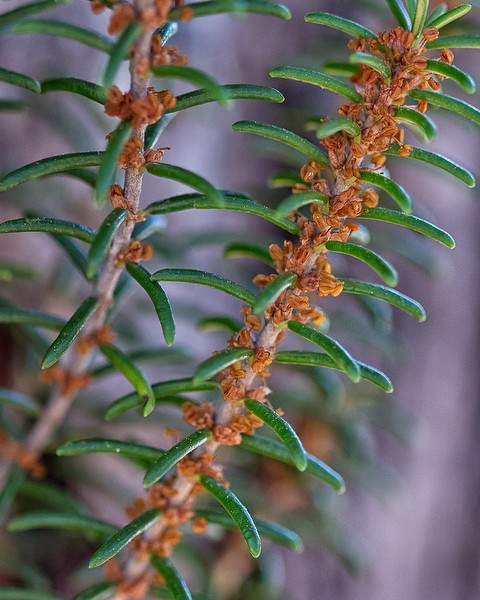
To my eye, Florida rosemary looks more like a conifer than a Mediterranean herb.  Its leaves are stiff, thick little “needles” arranged stiffly on vertical branches.  The little succulent leaves are an adaptation for life in the highest driest most exposed white (or occasionally yellow) sand scrub soils.   Deserts evolve succulents and needle-leaved plants, so hereya go.

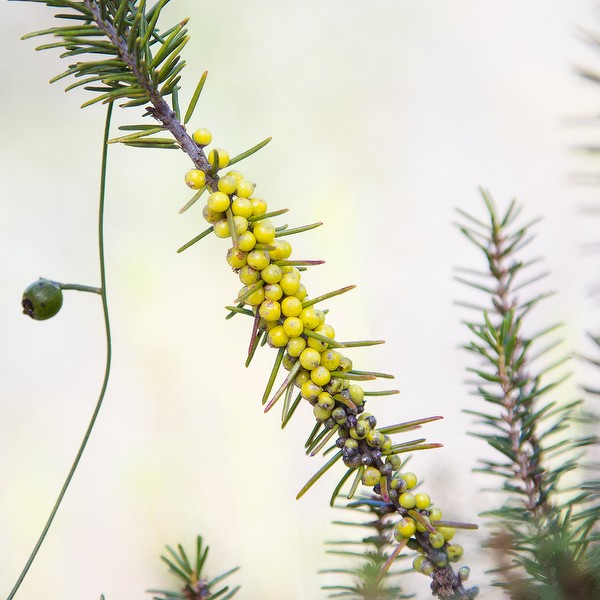
ceratiola druits

Leaves and fruits (not today)

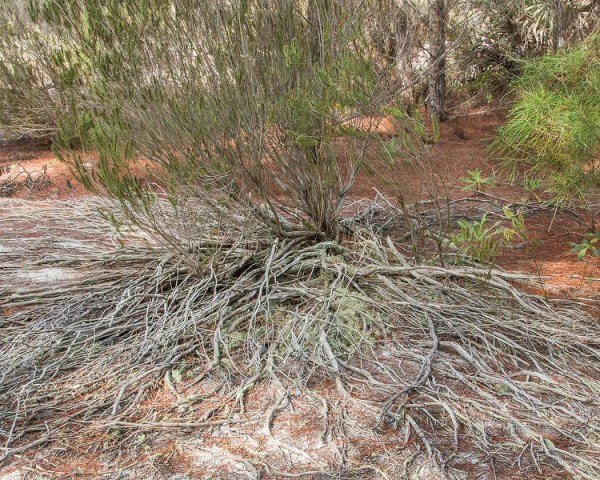
If you survive on high, super-drained, nutrient-poor sugar sand, is it better to have deep penetrating vertical roots to drill down to wetter layers, or to have widespread shallow horizontal roots?    Depends, I guess.   Saw palmetto has such deep roots they have “air pipes” built in.    Rosemary goes the opposite direction, its roots splayed out horizontally like an octopus on ice.   A little erosion exposes them.

ceratiola roots

Lotsa shallow roots


Having a moat of your own shallow roots has advantages.  Obviously you catch every drop of water and maybe even nutrient-bringing dust, debris, and rainwash as it arrives.    And there’s more:

Florida rosemary is one of the more famous allelopathic plants known to botany.  Allelopathy is the ability to poison the competition directly, or indirectly by interfering with microbes or nutrient availability.  Those roots undermining potential competitors undoubtedly help spread the chemical warfare.

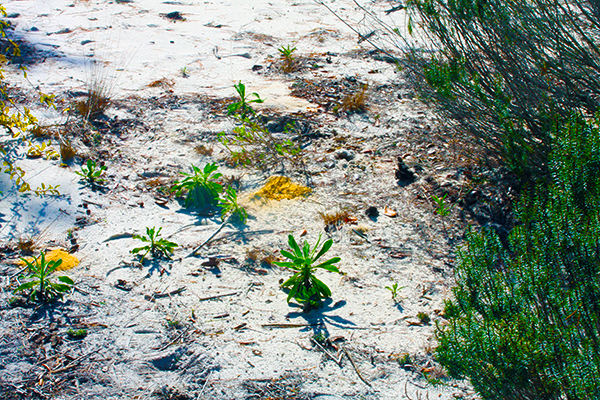
Ceratiola chemistry is complex, and no doubt there’s still much to discover.   One of the more intriguing tricks up its sleeve is production of a compound called ceratiolin.   In the presence of light (stay tuned on that) ceratiolin transforms into a natural herbicide called hydrocinnamic acid.  Researchers have shown rosemary extracts to prevent germination or early growth of its frenemies, and rosemary in scrub enjoys splendid isolation, with a vegetation-free “halo” around the base.

Ceratiola halo

Keep out!   The rosemary on the right has a vegetation-free zone around the base.

Recently, biologist Cody Gale and colalborators related the nocturnal habits of the Rosemary Grasshopper (Schistocera ceratiola) to ceratiolin.   It seems if the grasshopper is out by day, the ceratiolin it ingests would turn by light exposure to hydrocinnamic acid, giving the buggie a tummyache.   I have a weird small-world personal connection to this insect.  One of the co-discoverers of the hopper in 1928, Theodore Hubbell, was a personal friend of my grandfather’s, who lived in Florida.   As Hubbell said, “Finding a new bug in the Florida scrub … gives me as much thrill as a hunter gets from bagging a deer.”

The grasshopper lives its life exclusively on Florida-rosemary, when young camouflaged as a rosemary leaf, and when older, camouflaged as the stem.  Check it out, by clicking here.

The grasshopper is not the only exclusive insect.  Also restricted to Florida rosemary is its own Leafhopper (Alconeura bisagittata), and a deeper curiosity, a small bug (Hemipteran) known as Keltonia balli.  It lives its simple life on the male flowers, eating the pollen. (The plants are separate male and female with the flowers small and non-showy.)

ceratiola male

The male flowers, how it looked today

Walking the scrub on a hot day presents a pleasant aroma, which I’m pretty sure comes from the rosemary.  Chemists have not ignored it.  The part that gets me wondering is why the aromatic volatilizations differ substantially seasonally.   If generalized reports of wind pollination with no pollinators to attract are accurate, could the seasonal emissions have to do with repelling pests?    Or, to stretch uncomfortably, with inter-plant signaling? That phenomenon is known.

I’d be scratching my head trying to think of another local plant with three insects all its own.

 
4 Comments

Posted by on February 6, 2016 in Florida-Rosemary, Uncategorized


Tags: , ,

Forked Bluecurls

Trichostema dichotomum

Lamiaceae

John and George took to the scrub today in Seabranch State Park near Hobe Sound, Florida.  Sunny but nippy The recent rains have made the lichens soft, the spiders hide, and scrub plants grow new “spring” basal growth.    The only two species showy-flowery today were American Nailwort and Bluecurls.   Both are pretty little curiosities.  The Bluecurls is showier, so it gets to glory.

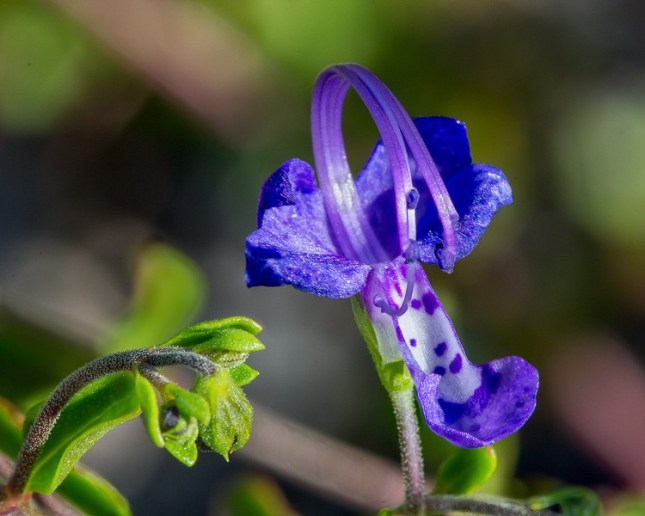
tricho protruding stigmas

Bluecurls.  The style (longest unit in the curled cluster, shaped like a fish hook, upper right) greets the bee first. All photos today by John Bradford.

Handbooks generally describe Forked Bluecurls as annual, and no doubt it is often, but possibly not the whole story.    Today new growth was rising around the bases of last year’s stems, growing from deep taproots, making the plants at least in today’s experience what I’d call scrub perennials, several species there behaving identically.  Forked Bluecurls seems remarkably lightly studied, given its good looks.    Most Trichostema species live in the arid West, and have received more attention there.  So now hear this:  today is interpretative and based on the botany of other Trichostema species.    This is my speculative extrapolated “take,” not established fact.

Beyond the coloration, the outstanding attribute is a set of long curled (pollen-making) stamens and one  longer (pollen-receiving) style reaching out the front door of the flower.   The outreach may seem an obvious adaptation to dust  pollen on the back of a bee, but there’s more to think about.    First of all, why the bee’s back?   The bee does not have a back-scratcher, and can’t remove the pollen burden.

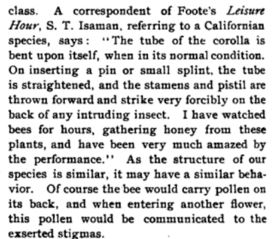
And why the long down-curled configuration?   Here is how an observer in the 19th Century described the similar flowers in California Trichostemas:

Trichostema Meehan

See the bee CLICK (on similar California Trichostema)

Early when the flower is open, the stigma (pollen-receiving organ) sticks out just a little more than the stamens.    Makes sense—pick up incoming pollen from the arriving bee before depositing new grains on it.  True of many flowers. Okay then.

But as the flower ages, the stamens and style continue curling inward into a position where bee-pollination can’t happen.  Self-pollination has been reported in our local species and in other Trichostemas.   I think, and this parallels many other plants, the severe incurling represents a back-up mechanism, plan B, self-pollination after giving the bees first dibs.

tricho leverage

The calyx (green cup below the blue petals) has the back edge raised.  The flower can bend to greet the bee but it can’t bend back.

Trichostema is an appealing mint, complete with a pleasing minty fragrance to the fuzzy-sticky leaves.   Some mints share a trick with likewise strongly bilateral orchids…twisting their flowers 180 degrees, called resupination.   The Bluecurls flower looks like an orchid  (or vice versa if you are not an orchid chauvinist). Trichostema twists in an unusual way with apparent unusual “purpose.”

The calyx (small green cup around the base of the flower) has five triangular lobes on its rim:  three together and long, and two together and short.   (In most mints the three long are on the floor side of the horizontal calyx and the two shorter ones at the roof side.)

When the blossom is at its early peak for pollination it stands nearly vertical.  The three long calyx lobes stand behind the blossom as the bee approaches, forcing the blossom and the curling sex organs to bend forward onto the bee as it rests on the dotted landing-lip.    Those three tall lobes, like fingers behind a basketball in a freethrow force the action forward.

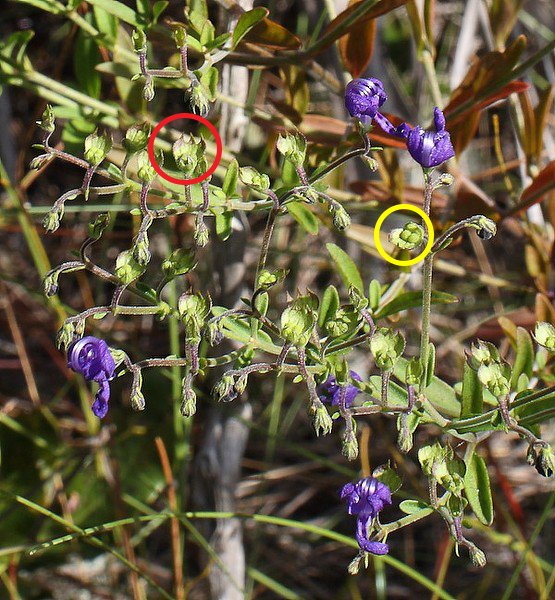
tricho late marked

Late flowers.   The stamens and styles are curled into an embrace, presumed self-pollination.    The calyx in the red circle recently lost its petals; the three long calyx lobes remain erect in back.  The older calyx in the yellow circle has the three lobes now repositioned into the diving board position with the seeds about to take the leap.

Then their role and position changes.    After pollination, the blue petals drop away leaving the calyx containing four “seeds” (nutlets).   To keep these from falling out prematurely, and to give them a springboard (almost literally) at the right time, perhaps when a raindrop strikes, the cupular calyx twists 180 degrees relocating the three long calyx lobes to the doormat position and the two short lobes as an awning over the door.   The seeds roll out onto the 3-lobed diving board.

 
4 Comments

Posted by on January 29, 2016 in Uncategorized


A Rolling Stone Actually Can Gather Moss

moss samantha humphreys

Photo by Samantha Humphreys

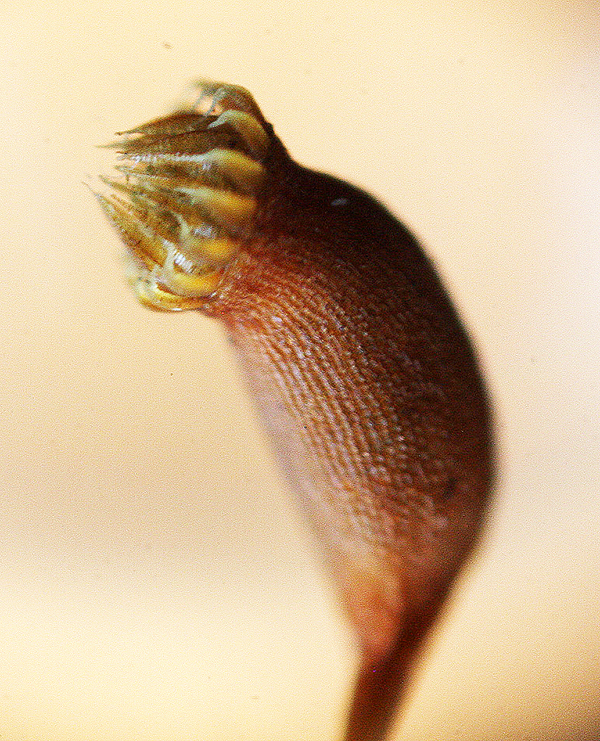
Mosses look ferocious under a microscope with hideous teeth. Good thing they are small, and never known to bite. The teeth, called the peristome teeth, regulate spore release, opening and closing in response to humidity changes. The entire moss life cycle is out in left field, but we can’t do it all today.   To take that turn on your own, BITE HERE

Peristome Cypress Creek Swamp

Peristome teeth

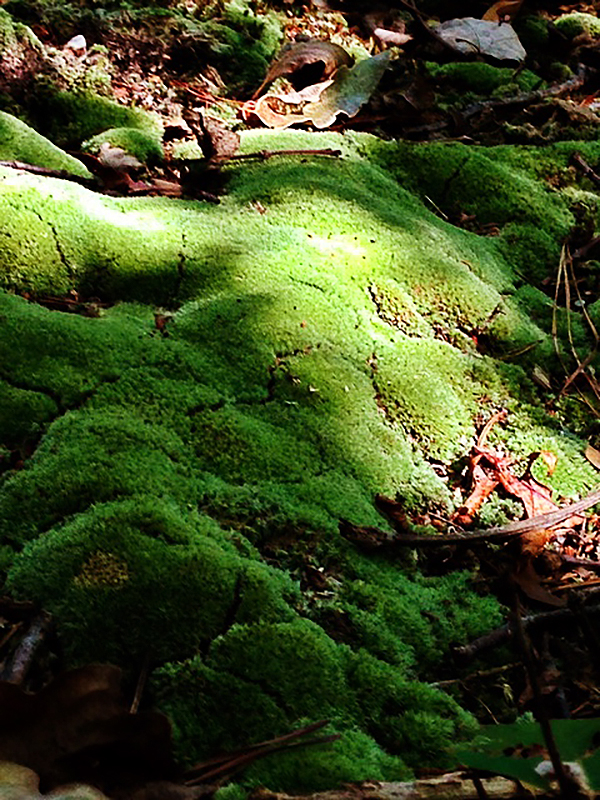
So what’s the big deal about that mossy magic carpet? For obvious starters, the rug insulates tree roots, retains moisture, cuts erosion, and sequesters nutrients.   No surprise tree roots sometimes congregate under mosses. Moss removal sometimes impacts the trees above.

Mosses are nutrient catchers.   Although they can obtain nutrients from soil, they have no roots or veins, and soil-absorption is merely one trick in their book. Mosses absorb nutrients also from direct exposure to rain water, mist, stemwash, dust, puddles, and poodles.   Rainwater arrives with dissolved nutrients, and percolating through the leafy tree canopy can enrich the drizzle. Direct nutrition allows mosses to colonize tree trunks, rocks, sand, and other places where others dare not grow.

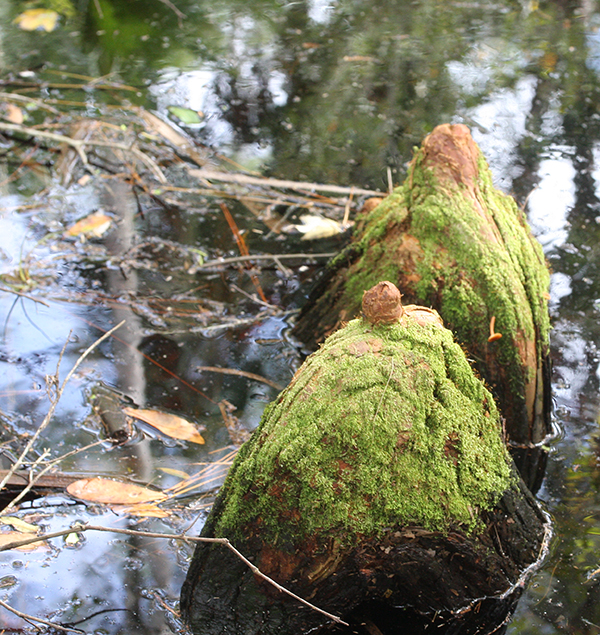
In Florida mosses love palm and cypress trunks, presumably enjoying the nutrition washing down.   Palm trunks are a little spongy. Bald cypress, being deciduous, allows sunbeams down to the moss zone, and in a swamp. Mosses favor swamps.  The tips of cypress knees grow above their mossy green jackets.

cypress knees

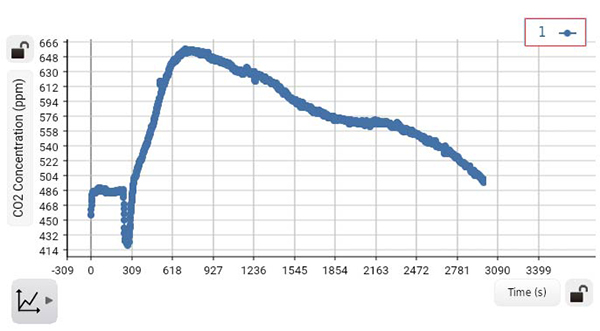
Mosses hold water for long spells but eventually dry out into suspended animation. They are resurrection plants.   Upon re-moistening they pop awake in seconds—repeat—in seconds—experiencing an adrenaline rush plant physiologists call a respiratory burst.   In the wink of an eye a remoistened moss starts heavy breathing before photosynthesis takes charge.   (Some of  the earliest in the first seconds burst of carbon dioxide release may be nonmetabolic expulsion of carbon dioxide.    This can occur even with dead paper.)

moss dry 2 tablet 600

Respiratory burst, moss on a palm trunk on the PBSC campus.   Horizontal = seconds.   Vertical = carbon dioxide released (respiration).  Seconds 1-300 the moss was dry.   It was soaked with water at 300 seconds.  Immediately there is a big burst of carbon dioxide, peaking at around 625 seconds when photosynthesis seems to take over and start using more carbon dioxide than the plant is producing.

Nitrogen is the main nutrient and presumably most limiting.   How mosses obtain nitrogen is more subtle than mere manna from heaven. Nitrogen fixation (capture from the air) in nature can involve many species of microbes and associated plants, most famously legumes.   Mosses get their fix too. Certain species have symbiotic relationships with nitrogen-fixing photosynthetic (cyano)bacteria. Usually the bacteria live on the surface of the moss.   In some sphagnum mosses the bacteria inhabit the hollow leaf cells we’ll discuss momentarily.

moss iceland pat bowman

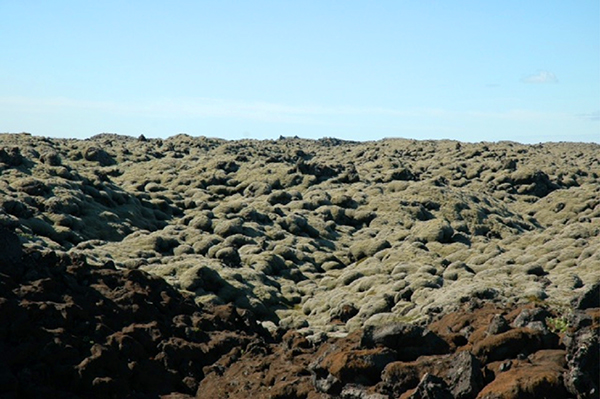
Moss in Iceland (by Pat Bowman)

Bear urine and decaying fish are reported sources of moss nitrogen.   How about dead bugs? In Iceland expansive rocky or icy areas lie under moss. Where does that nitrogen originate? Reportedly from nutrient-rich geothermal springs, these breeding gazillions of midges who swarm out over the mosslands and become fertilizer.

Icelandic mosses do something even weirder than eating bugs…they form “glacier mice,” rolling stones literally gathering moss.   A small stone on the surface of a glacier can grow a covering of  moss. It blows around, the mossy covering resisting freezing to the ice. The expanding mouse becomes a rolling planet inhabited by invertebrates: springtails, nematodes, and tardigrades. Probably the microinvertebrates among the moss leaves help churn nutrient turnover. Does the wandering mouse sweep up dead gnats as it rolls? That would be active hunting by a plant! Beats a sedentary Venus Flytrap any day!

Springtails, nematodes, and tardigrades…oh my…are typical moss-dwellers most anywhere mosses abide. The invertebrates dry out with the moss, and everybody slumbers until it rains again.   Tardigrades look under the microscope like  6-legged bears, and are called “water bears.” Mosses are their most famous habitats. Tardigrades may be the toughest animals on earth, having extreme tolerances in terms of salinity, drying, freezing, heat, and more.

Tardigrades alter their DNA when they go into their suspended dry phase, and upon resurrection they repair their DNA. It seems that millions of years of DNA repair has perhaps allowed genes from bacteria, fungi, and plants to enter the tardigrade chromosomes. Some of the tardigrade indestructability comes from the microbial genes they’ve adopted. There are more creatures. Mosses host nematodes, and mites that look like micro-crabs.

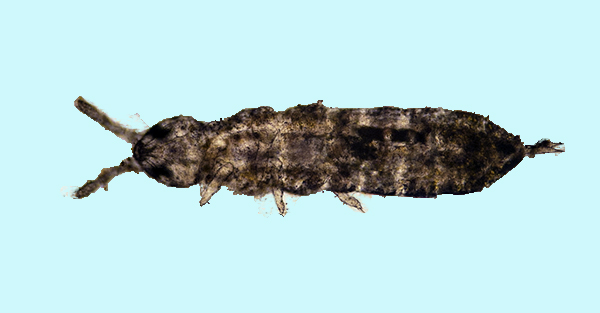
Springtails abound. Springtails are jumpy little insects primitive even by insect standards.   They pay their dues for a happy hoppy home by shuttling sperm from one moss to another.   The plants put out scents that influence the spermy little varmints, harnessing their hopping ever-so usefully.

springtail cropped2

This springtail came bounding out of a moss during preparation of today’s blog.

How does a moss make a monospecific lawn? To begin with competition is reduced in mossish extreme habitats. Many can creep and root, and they propagate from broken bits and pieces. Spores repopulate the carpet continually. Some have microscopic breakaway clonal units to go forth and multiply, and even lie dormant like seeds in the soil. Sometimes ants help with relocation. Mosses suffer little pest damage. Their anti-pest poisonous ways extend to inhibiting other plants. Sabotage is a good way to reduce competition.

moss carpet pat bowman

Moss carpet in VA.  (By Pat Bowman)   Probably under a foot of snow tonight (both of them).

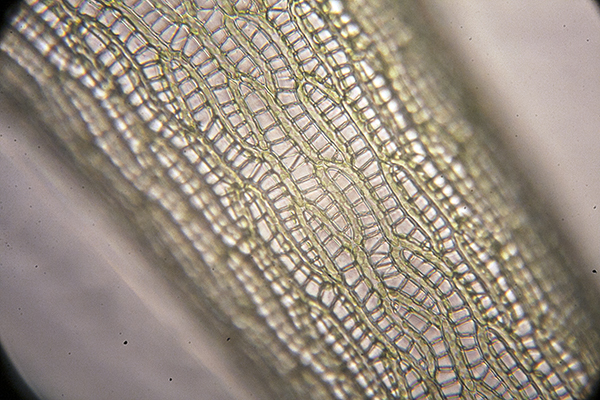
Perhaps the most familiar moss to humans is sphagnum. It is the peat of bogs and peat moss.   It is where mummified pickled people turn up. It has served as bandages and diapers due to absorbency and antibiosis.   Peat is a staple in horticulture because it breaks down slowly and is extremely water-retentive. The ability to hold water comes from a network of big empty cells, each having a small opening.   The cells fill slowly and empty slowly, like holding a soda bottle underwater.

Sphagnum cells 600

Sphagnum.  Green cells mixed with empty hollow cells.

You may have gotten this far feeling that mosses are cute, or primitive, or maybe fun to grow. All true. Nice little plants. But don’t belittle a moss, for it may help us keep our cool.   Consider this, sphagnum is super-abundant in parts of the globe.   Peat bogs tie up enormous quantities of carbon dioxide. Biologist Chris Freeman at Bangor University is advocating a GMO sphagnum able to fight global warming.   What will they think of next?

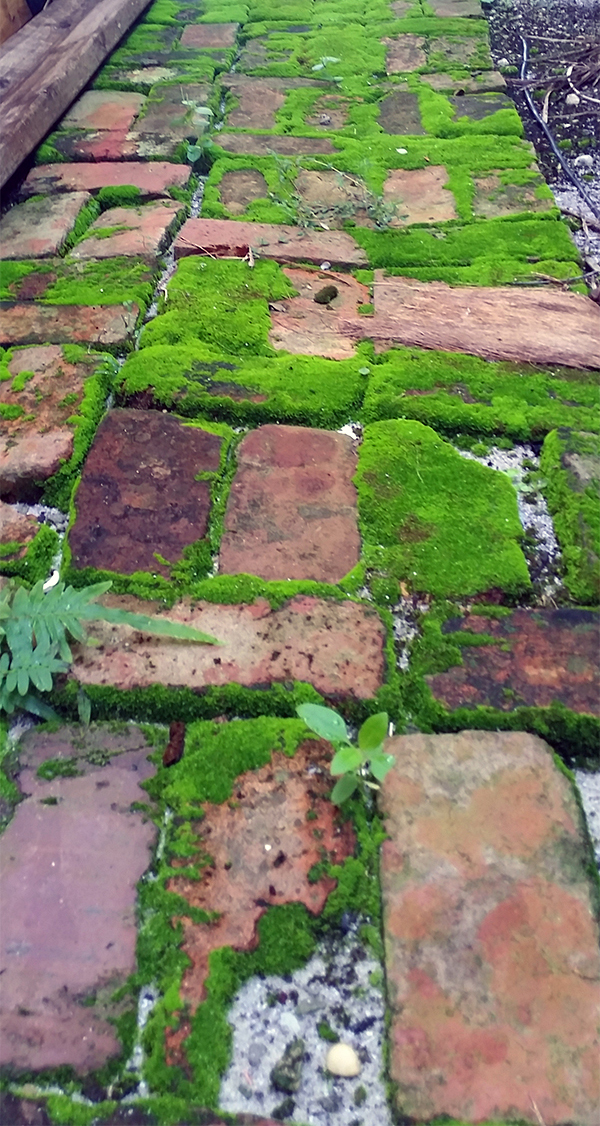
Not a moss


7 Comments

Posted by on January 22, 2016 in Moss, Uncategorized


Canadian Horseweed Does the Twist

Conyza canadensis

Asteraceae

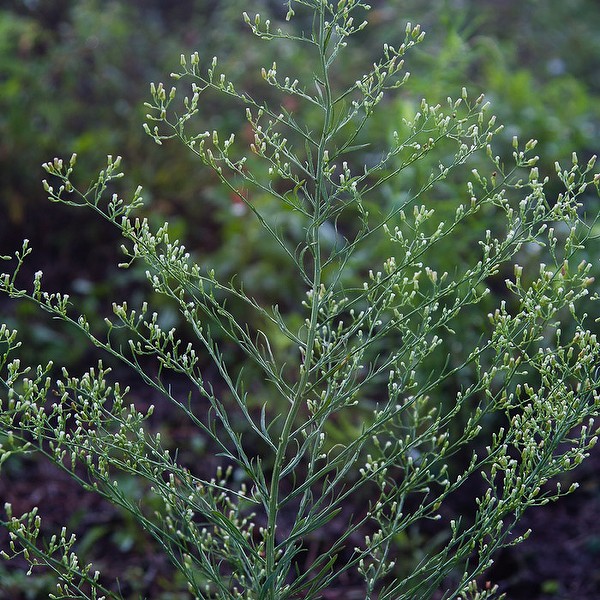
Today’s fieldtrip aborted…due to tornado warning? Ya gotta be kiddin me! A freakin’ twister. So my afternoon turned toward a different direction…looking into the recent listing of glyphosate (RoundUp) as a probable human carcinogen.   I’m not expressing opinions here other than, “well ain’t that interesting.”  This nice friendly blog is not for un-fun head-hurting controversy, so let’s merely ask how does RoundUp interface with a twister.

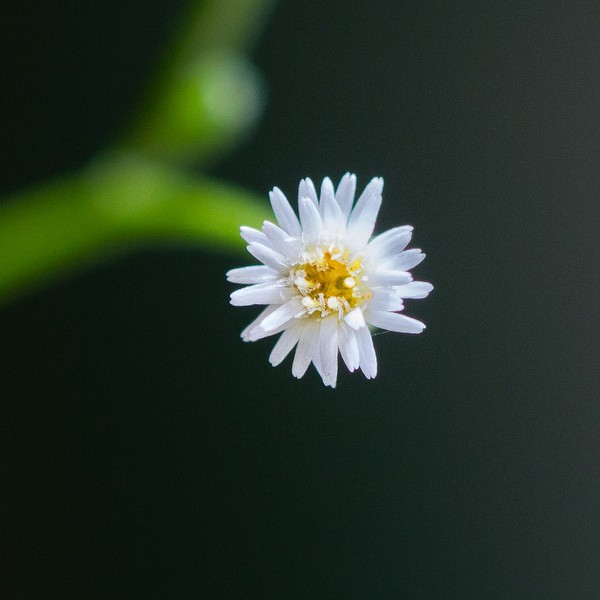
It is astonishing that weeds can evolve resistance to herbicides, survival of the fittest!   A lot have turned RoundUp-resistant, with one of the most resistant of the resistant being a native weed that’s everywhere and still overlooked…Canadian Horseweed. When I say everywhere, I mean everywhere: in every vacant lot, in every Florida county, in every U.S. state (yes, Alaska and Hawaii), in every Canadian province or nearly so, and almost surely on every continent except Antarctica. Yet who’d know it on sight? It looks like “weed,” although up close the flowerheads have beauty.

conyza far

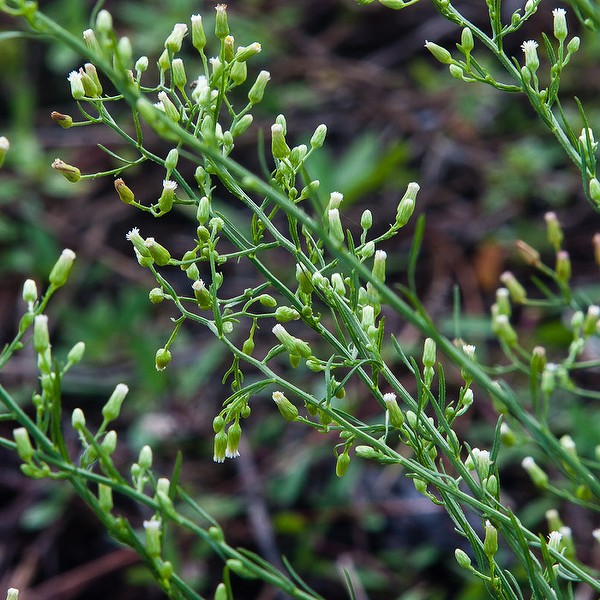
All photos today by John Bradford

RoundUp resistance has turned up in this species across the U.S. and beyond. And that reveals some weird observations and questions.   First up, if resistance is so widespread geographically, did it evolve once and spread, or did it evolve multiple times in many places?  I don’t know but will vote for “lots of times.”   Convergent evolution at work.

The plot thickens.   Anybody attuned to GMO controversies dreads genetically introduced RoundUp resistance genes spreading from crops to weeds, making Superduperweeds.   But look what happened here…the weed did not receive resistance from a GMO crop, but rather cooked it up on its own.

And then it transferred resistance to another species, not crop to weed, but weed to weed by interpollination. Conyza canadensis shared resistance by hybridizing with Conyza ramosissima. The hybrids are more RoundUp resistant than the parent.
And there’s more.   How often do non-native invasives breed with native species?   Examples are few,  but there are hints in the literature of our native C. canadensis mixing genes with C. bonariensis, an invasive species called Asthmaweed here in Florida.
conyza side

So funny how one thing leads to another with strange twists. RoundUp resistance evolving in Canadian Horseweed reveals interspecific transfer of the resistance gene (but not as feared, from a GMO crop!). Attention to this brings up another fear come true: probable genetic pollution of a native by an invasive, although in weeds where nobody would notice or care.
conyza flower

 
8 Comments

Posted by on January 15, 2016 in Canadian Horseweed, Uncategorized


Tags: , ,

Pickerel Weed is Stylish

Pontederia cordata

Pontederiaceae

Relevant review of basic flower structure: POLLINATE HERE

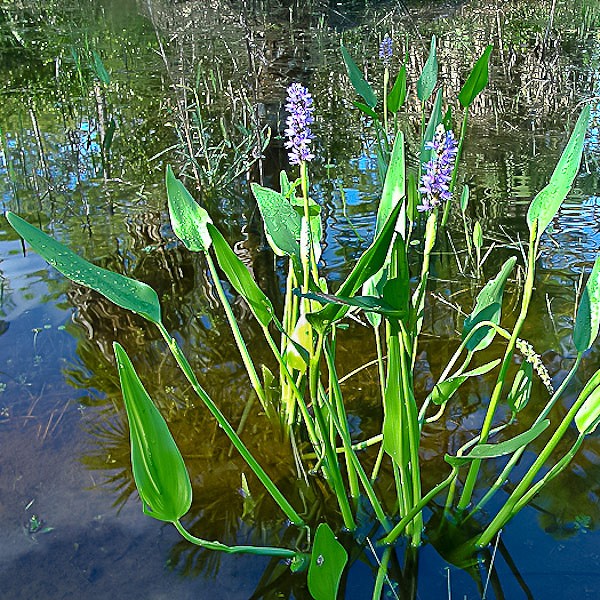
Fieldtrip rained out yesterday, so in honor of the drizzle, here’s a wet weed in flower a little this week. Pickerel Weed is one of those South Florida beauties familiar also to frosty northerners, My earliest recollections of it come from maybe age 10 along Canadian lake shores and rivers.

pontedaria cordata far

Pickerel Weed (by John Bradford)

Funny how aquatic plants, Sagittaria, Wild Rice, Water-Chestnut, Cat Tails, and many more provide so much starchy food.   Pickerel Weed has served as sort of a “grain,” the seeds nibbled like nuts or ground for meal. But….reinforcing my usual spirit, please don’t eat nature…note that one of the few historical medicinal uses is as a pre-European oral contraceptive. “We’ve been living natural and all  out here off the grid but just can’t make a baby.”


Pontederia cordata fruits

Immature fruits (JB)

And some nature-eaters have suffered allergic mishaps and even intoxication, not to mention whatever water pollution sequesters in the plant.

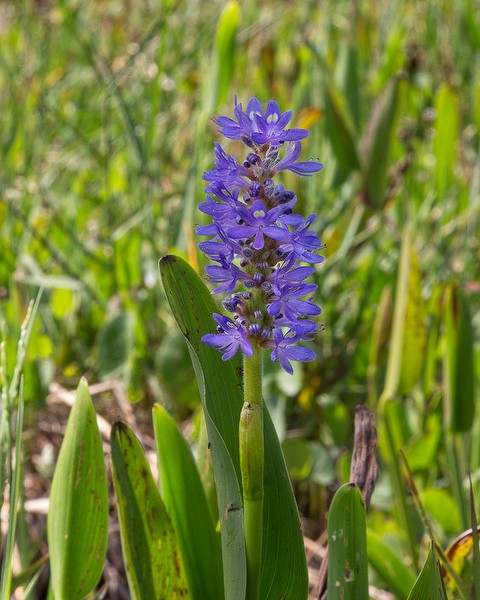
pontederia cordata close

By JB

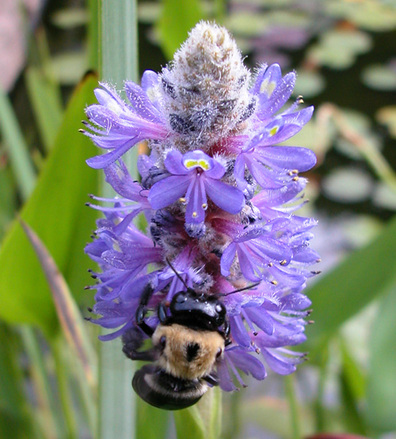
A bee by name of Dufourea novaeangliae likes Pickerel Weed, gathering pollen for its brood exclusively or nearly so from those purply-blue blossoms. The bee burrows into stream or lake shores near the PW. Not too surprisingly, the bee’s geographic range is similar to that of the plant, which, however, has a broader distribution, especially to the south.   Additional visitors include several more types of bees, butterflies, moths, and even hummingbirds.  The preferred customers are Bumblebees.

pontederia palmer cook

Bumblebee loves PW (by Palmer Cook)

Bumblebees engage in a type of foraging called traplining, where they visit the same traps (food sources) repeatedly. The stops around the trapline itinerary must provide awards over an extended period.  The PW flower spike makes hundreds of single-day flowers during its long life, with some opening anew each morning as old ones become fruits. A patch of pickerelweed offers flowers for the entire season, with that big yellow spot on blue background apparently advertising, “open for bees-ness!”

open


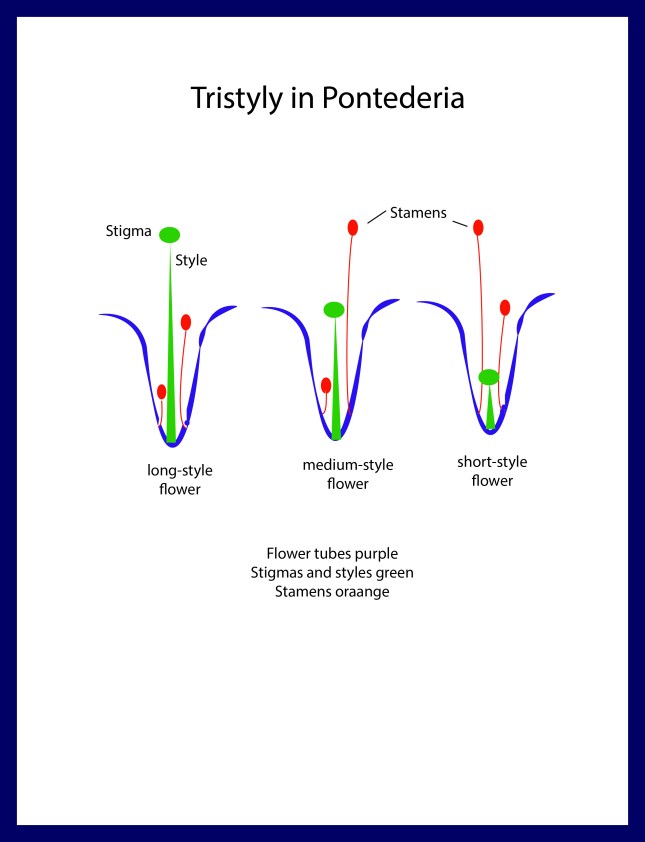
So far, ho hum, that’s all textbookish, but also a nice buildup to the good stuff, so here we go. The flowers have an unusual characteristic called tristyly (TRY-style-ee), that is, they come with styles in three different lengths on different individuals.   Helpful reminder: the style is the elongated part of the floral female unit, receiving pollen on its tip. Stamens make the pollen, likewise at their tips.   So then, different flowers on different individuals with styles of different lengths receive pollen at different depths in the flower: outside the entrance, at the entrance, and deep within.

This may seem like this “wherever you drop off the pollen” flexibility accommodates many different pollinators, from ones who flutter outside the door, to those who push right on in. No doubt true.    But there’s more to it.

Remember, it takes two to tango, and the stamens come in three lengths also.   Now pay attention: Each flower has stamens of the two lengths that do not match the style length of that flower. Huh?   Let’s say you have a short-style flower, then the stamens are of the middle and long lengths only, sans shorties.   Got it?   What are the stamen lengths in the mid-styled flowers? Answer, short and long.   Another way to look at it is that each flower has three positions, short, middle, and long. One position is occupied by the style; the stamens occupy the other two positions.

pontederia - Copy

Review:

Long style: stamens middle and short

Mid-length style: stamens long and short

Short style: stamens middle and long

But why?   To avoid self-pollination.   If a long-styled flower also had long stamens, those long stamens would deposit pollen onto the adjacent long styles in the same flower. Additionally the long stamens would dab pollen onto pollinators positioned to brush back off on long styles of other flowers on the same plant. Self-pollination is severe inbreeding, not good in humans, in Golden Retrievers, or in Pickerel Weeds.

And chew on this: a rhizome-connected colony of Pickerel Weed is one big sprawling individual genetically speaking, even if it looks like separate plants, so any pollen transfer within that extended colony is self-pollination.  With the no-stamens-at-the same-length-as-the-style policy, the pollinator must carry pollen to a different genetic individual for effective cross-pollination. A long-styled colony must receive pollen from mid-styled or short-styled colonies. Cross-breeding is enforced just like island-dwellers court spouses from different islands.

Confusing? Naw, with tristyly you don’t pollinate your own flowers even though all the while you’re catering to diverse pollinators. Pretty slick for a swamp weed.

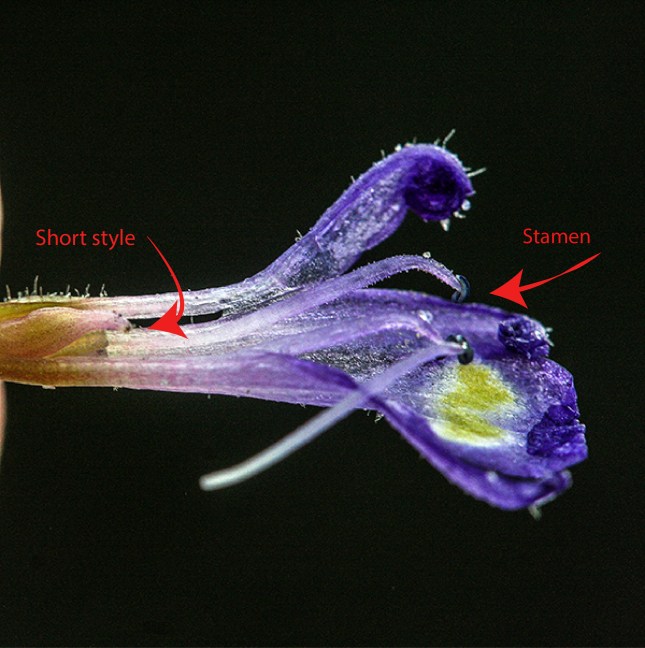
short style 4.jpg

Short style flower.  Two stamens visible (one damaged)

 
10 Comments

Posted by on January 9, 2016 in Pickerel Weed, Uncategorized


Tags: , ,