Ceratiola ericoides
Ericaceae
The local white sand scrub was at its best today, sunny yet cool, with fresh growth and flowers, including white Innocence (Houstonia procumbens) and Sky Blue Lupine (Lupinus diffusus). Although not near its peak, also with flowers was Florida-rosemary, a curious shrub.
Is it related to culinary rosemary? No
Does it smell like kitchen rosemary, no not at all, contrary to assertions all over the Internet. (Here we have a great example of how BS can spread on the Internet.)
So why is the Florida species called rosemary? A superficial resemblance, convergent evolution.
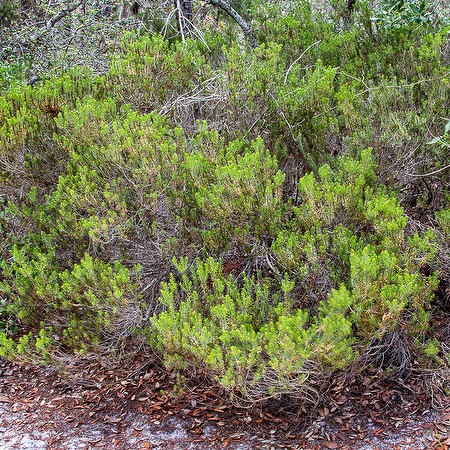
Florida-rosemary. All photos today (except halo) by John Bradford.
To my eye, Florida rosemary looks more like a conifer than a Mediterranean herb. Its leaves are stiff, thick little “needles” arranged stiffly on vertical branches. The little succulent leaves are an adaptation for life in the highest driest most exposed white (or occasionally yellow) sand scrub soils. Deserts evolve succulents and needle-leaved plants, so hereya go.
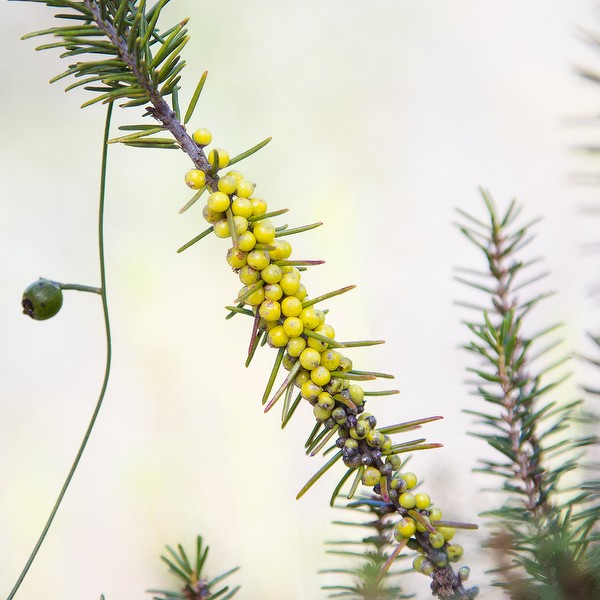
Leaves and fruits (not today)
If you survive on high, super-drained, nutrient-poor sugar sand, is it better to have deep penetrating vertical roots to drill down to wetter layers, or to have widespread shallow horizontal roots? Depends, I guess. Saw palmetto has such deep roots they have “air pipes” built in. Rosemary goes the opposite direction, its roots splayed out horizontally like an octopus on ice. A little erosion exposes them.
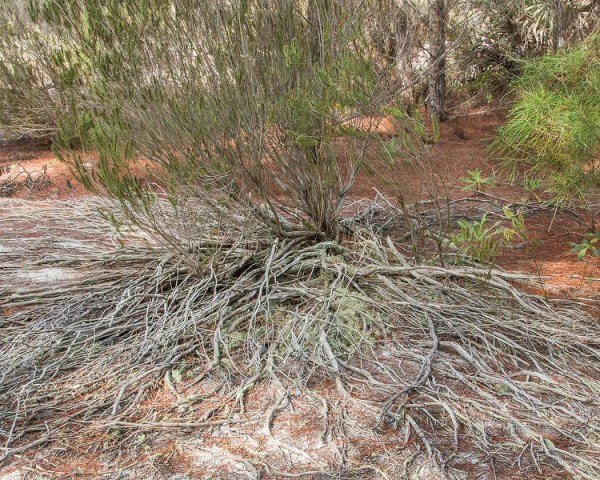
Lotsa shallow roots
Having a moat of your own shallow roots has advantages. Obviously you catch every drop of water and maybe even nutrient-bringing dust, debris, and rainwash as it arrives. And there’s more:
Florida rosemary is one of the more famous allelopathic plants known to botany. Allelopathy is the ability to poison the competition directly, or indirectly by interfering with microbes or nutrient availability. Those roots undermining potential competitors undoubtedly help spread the chemical warfare.
Ceratiola chemistry is complex, and no doubt there’s still much to discover. One of the more intriguing tricks up its sleeve is production of a compound called ceratiolin. In the presence of light (stay tuned on that) ceratiolin transforms into a natural herbicide called hydrocinnamic acid. Researchers have shown rosemary extracts to prevent germination or early growth of its frenemies, and rosemary in scrub enjoys splendid isolation, with a vegetation-free “halo” around the base.
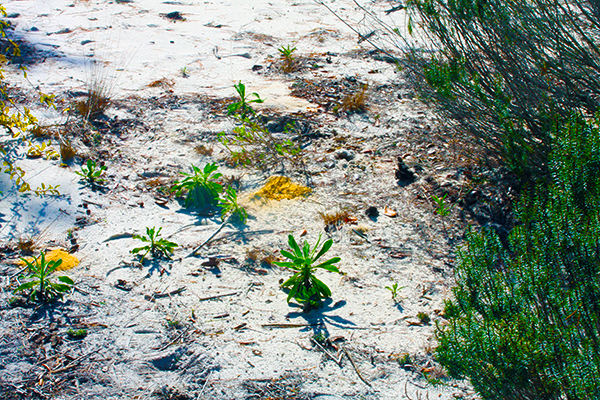
Keep out! The rosemary on the right has a vegetation-free zone around the base.
Recently, biologist Cody Gale and colalborators related the nocturnal habits of the Rosemary Grasshopper (Schistocera ceratiola) to ceratiolin. It seems if the grasshopper is out by day, the ceratiolin it ingests would turn by light exposure to hydrocinnamic acid, giving the buggie a tummyache. I have a weird small-world personal connection to this insect. One of the co-discoverers of the hopper in 1928, Theodore Hubbell, was a personal friend of my grandfather’s, who lived in Florida. As Hubbell said, “Finding a new bug in the Florida scrub … gives me as much thrill as a hunter gets from bagging a deer.”
The grasshopper lives its life exclusively on Florida-rosemary, when young camouflaged as a rosemary leaf, and when older, camouflaged as the stem. Check it out, by clicking here.
The grasshopper is not the only exclusive insect. Also restricted to Florida rosemary is its own Leafhopper (Alconeura bisagittata), and a deeper curiosity, a small bug (Hemipteran) known as Keltonia balli. It lives its simple life on the male flowers, eating the pollen. (The plants are separate male and female with the flowers small and non-showy.)
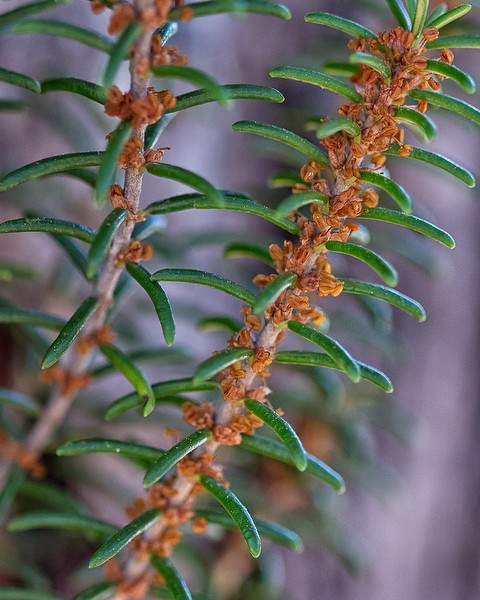
The male flowers, how it looked today
Walking the scrub on a hot day presents a pleasant aroma, which I’m pretty sure comes from the rosemary. Chemists have not ignored it. The part that gets me wondering is why the aromatic volatilizations differ substantially seasonally. If generalized reports of wind pollination with no pollinators to attract are accurate, could the seasonal emissions have to do with repelling pests? Or, to stretch uncomfortably, with inter-plant signaling? That phenomenon is known.
I’d be scratching my head trying to think of another local plant with three insects all its own.
 John Bradford
 George Rogers
 George Rogers
 Dee Staley
 Treasure Coast Natives

