Fridays with three meetings don’t leave much time for field trips, so today’s exploration was a potted windowsill luffa during the proceedings. Not native, but it’ll help keep you clean and exfoliated. And it leads quickly to natives.
Luffa has magnificent tendrils, as my colleague Maura Merkal suggested photographing. And we did. Tendrils are the little twist-tie “wires” you see plants use to cling and grab. They don’t get much attention, probably because they are boring. But boring doesn’t stop me.
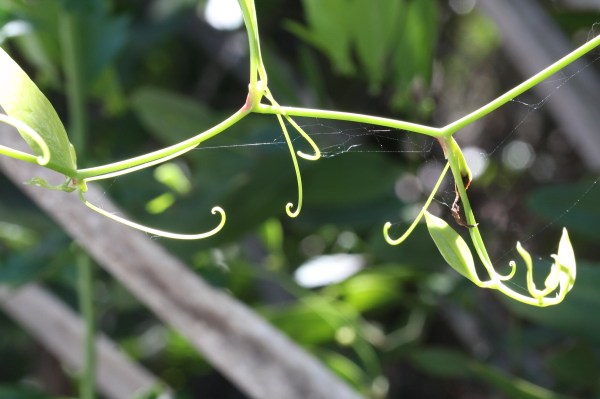
Smilax tendrils. All photos except the final four (below the diagram) by John Bradford.
Tendrils tend to look alike, but here is the cool part (if you have a low threshold for cool): they evolved separately and repeatedly in plants utterly unrelated to each other, and from different organs. The same but not the same. Is that remarkable? The same need to cling and climb forced organs of divergent origins to the same outcome. Shall we now tie into native tendril examples, featuring (mostly) native plants:
In some plants the tendrils are branches, for instance:
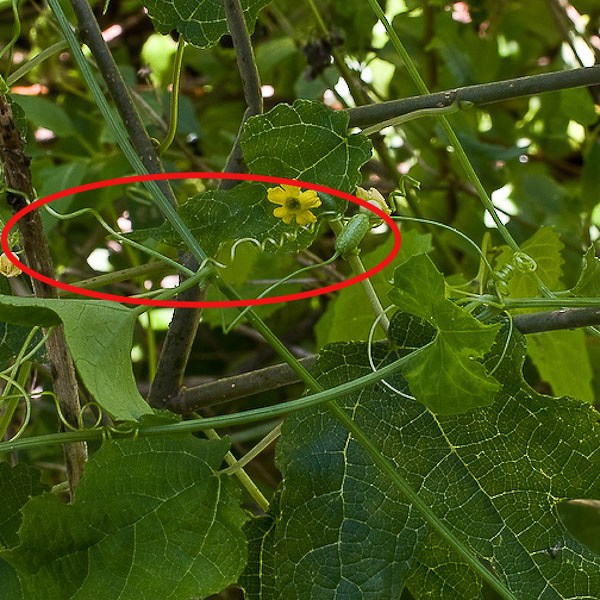
Creeping-Cucumber (Melothia pendula and other members of the Cucurbit Family)
and
Passionflower (Passiflora species)
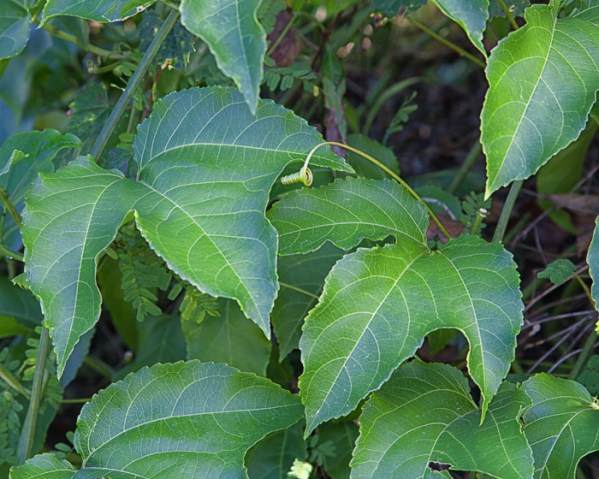
Passiflora edulis (not native, escaped). The curly tendril is a delicate branch rising above the leaf.
In others the tendril is the tip of a (compound) leaf, for example:
Four-Leaf Vetch (Vicia acutiflora, and other legumes). The rare native Tiny Peavine (Lathyrus pusillus) farther north in Florida offers a great example of a tendril as part of a leaf. CLICK (So does a regular garden pea.)
Tendrils can be stipules (paired outgrowths at leaf base), with a case in point being:
Smilax (Smilax species)
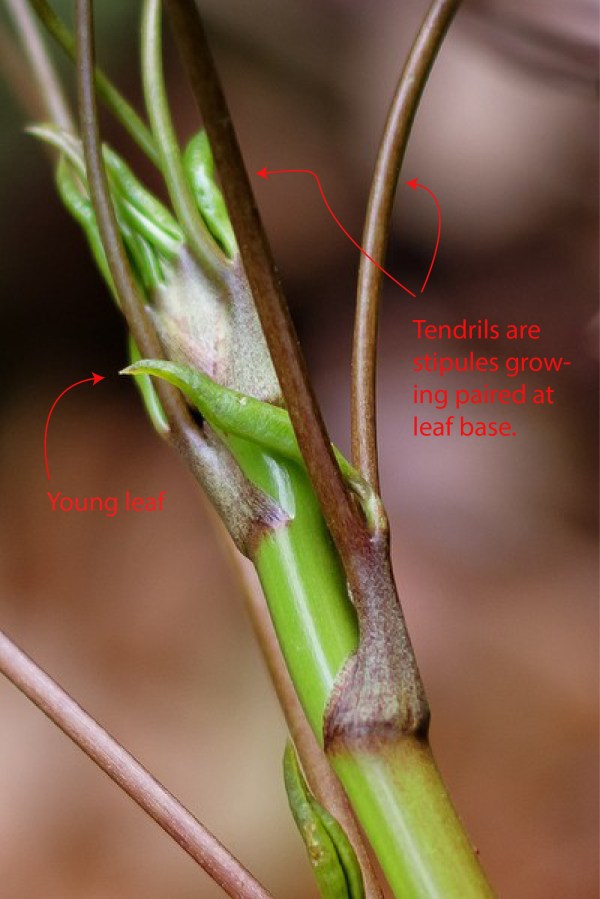
The two tendrils in this Smilax are growing from both sides of the leaf attachment. They are stipular tendrils.
And tendrils can be stem tips, probably modified inflorescences, with the prime example being:
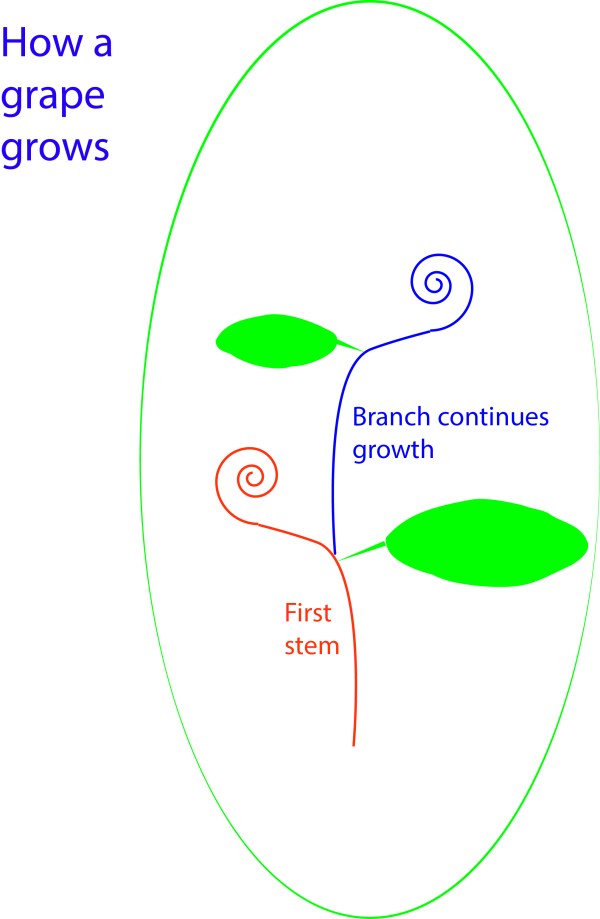
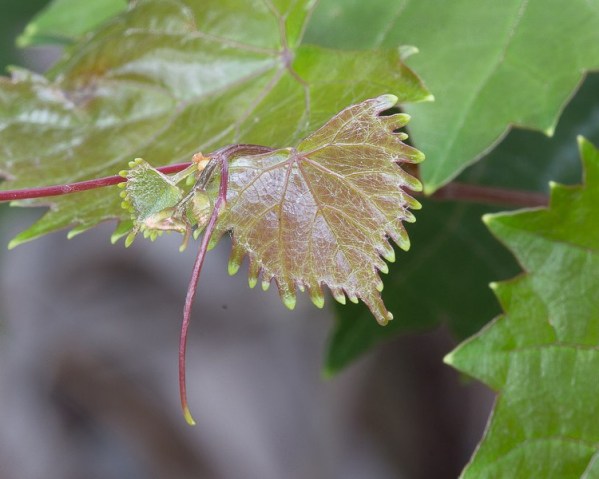
Grapes and their relatives. Interpreting tendrils in the Grape Family involves a little guesswork. The tendrils are opposite the leaves. Most botanists interpret the tendril as the branch tip, and the growth continuing beyond the leaf-tendril to be a branch, even though the branch looks like the main stem. That new branch ends with its own tendril, and so on and so forth.
Grape
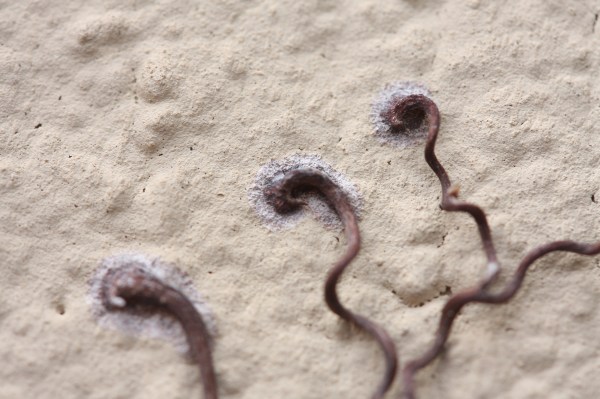
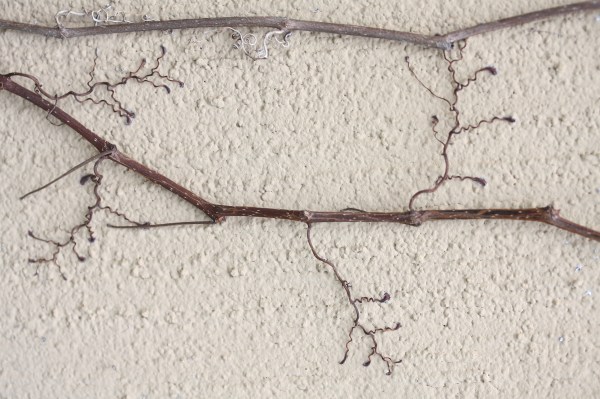
Grape Family tendrils have a rare or unique (?) ability. They secrete water and salts from their tips. This secretion may underlie the ability of Virginia Creeper (Parthenocissus quinquefolia) to form clinging sticky pads at its tendril tips.
But what about the luffa? CLICK to see its tendril in action (6 hours condensed to a few seconds).
 John Bradford
 George Rogers
 George Rogers
 Dee Staley
 Treasure Coast Natives
