Borrichia frutescens
Asteraceae
The main goal of John’s and George’s wilderness trip around Jensen Beach, Florida, today was birds. Here is John’s shot of a handsome Osprey couple enjoying sushi near the Roosevelt Bridge.
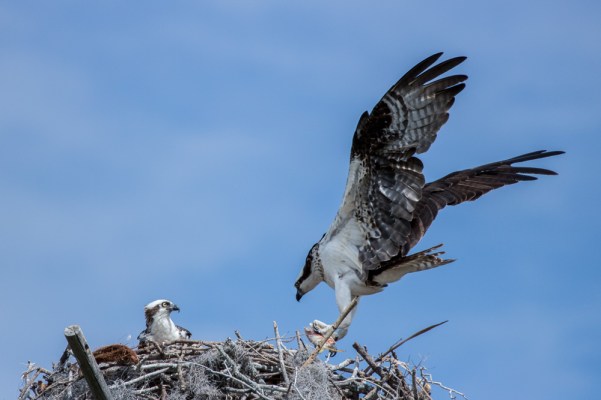
Ospreys (All photos today by John Bradford)
Below the Osprey nest, blooming in the saline mud was a perennial wildflower favored by native plant landscapers*, for good reason: spreading yet disciplined growth, compact dimensions, pretty gray-green foliage, and sunshine yellow flower heads. The leaves are variably more or less succulent, with the puffiness influenced by the saltiness of the soil, apparently because the blades sequester excess salt in their tissues. The plant is resistant to salinity, poor soils, and immersion, reportedly surviving 7 months under decaying flotsam.
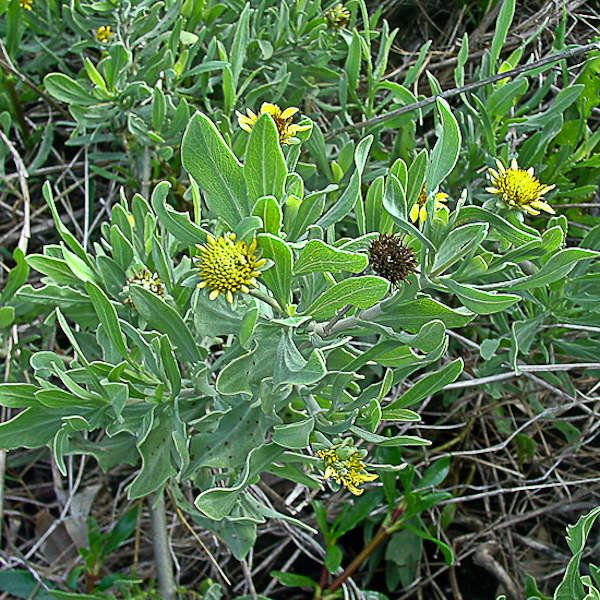
Borrichia has only three species. One is poorly known and oddly isolated in Peru. The other two live in Florida and beyond. Our local Borrichia frutescens differs from the other Florida species by having spine-tipped bracts on the flower head and grayish vs. mostly green leaves. Where the two Florida species overlap south of here they form a hybrid called B. X cubana. In general in the plant world hybrids often don’t thrive, unless they reproduce clonally, as in the present case. Rhizomatous spreading allows B. x cubana to expand like a champ. Although occurring wild, the hybrid can also arise via artificial crossing.
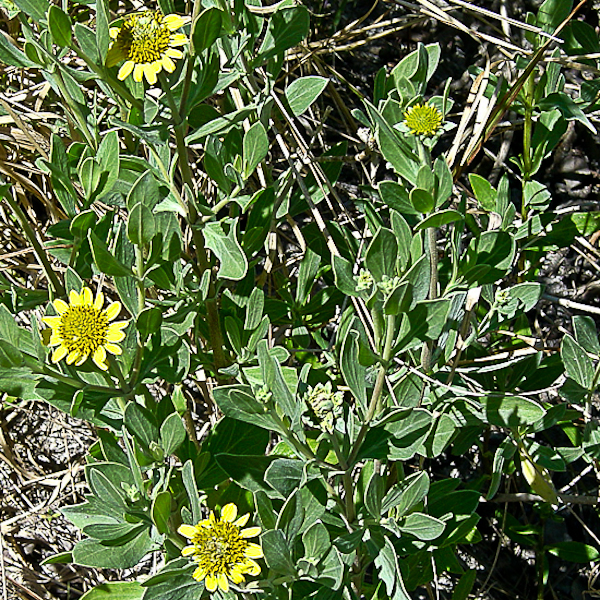
Members of the Aster Family often have a “medicinal” fragrance and associated bioactivity. Interestingly, Borrichias have a cluster of related historical medicinal uses, usually as teas, centered on respiratory ailments. Research has demonstrated antimicrobial powers. Good thing. They need an aresenal, as they seem to be more beseiged than Donald Trump. These plants are hosts to fungi, nematodes, and insects, forming a tight little dinner club of who eats whom. Let’s see about that.
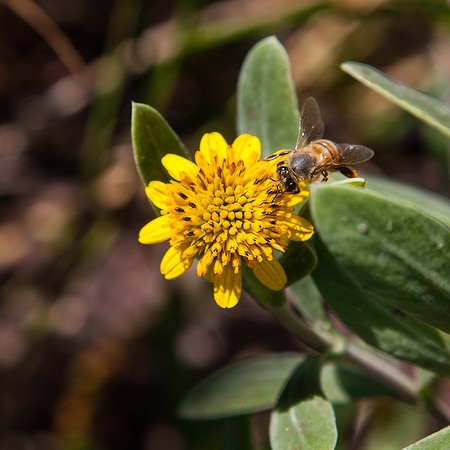
A gall-forming midge Asphondylia borrichiae—which transmits fungi from stem to stem— is a parasite on Borrichia,* usually raising just one gall per stem, yet potentially detrimental or lethal. The severity of gall trouble diminishes with increasing salinity, which may help explain the salty habitats Borrichia favors, as refuges? The midge has parasites (parasitoids) of its own, with at least four species of wasps laying lethal eggs in its gall-bound larvae. The parasitoids cause an odd consequence requiring introduction of another plant having parallels to Borrichia frutescens:
Iva frutescens* looks like Borrichia frutescens (except in the flowers), occupies likewise salty habitats, has a similar U.S. geographic distribution, is in the same plant family, has the same last name (meaning shrubby), and is a co-victim of Asphondylia borrichiae. And here’s the kicker, as Florida biologist K. Stokes* has explored. Iva suffers less midge trouble when associated with Borrichia, which may seem counterintuitive, since they both draw the pest. But Borrichia suffers more, and thus spawns and spews the parasitoid pests to attack the midge on the grateful Iva.
————————————-
*Notes:
Where to acquire natives www.afnn.org
Iva frutescens CLICK
Abstract on the midge CLICK
Reference to Stokes CLICK
 John Bradford
 George Rogers
 George Rogers
 Dee Staley
 Treasure Coast Natives