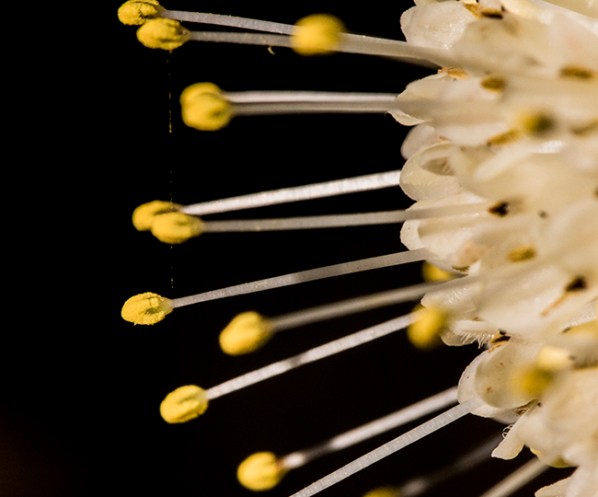
Campsis radicans (Campsis means curved, perhaps the stamens. Radicans means rooty.)
Bignoniaceae
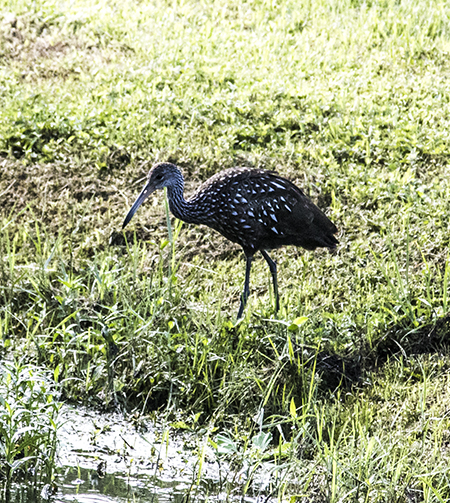
John and I today continued exploring of the Kiplinger Natural Area in Stuart, visited by a curious Limpkin.
It must be August, with the Goldenrod evoking the summer meadows of childhood. Among the botanical treats in bloom now is the colorful Trumpet Creeper vine, so showy and “exotic” for a native species. Those orange trumpets look like something out of a TV special on the Amazon. Trumpet-Creeper is in the same family as many garden selections, such as African-Tuliptree, Tabebuias, and Garlic-Vines.
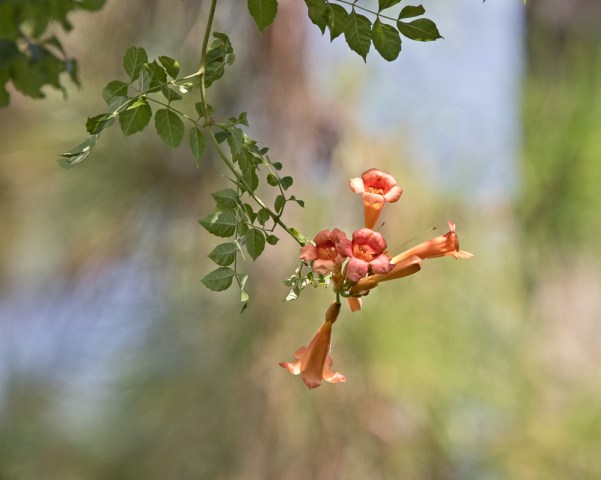
TC by JB
We’re near the southern end of its range which covers most of the eastern U.S., as well as westward and north into Canada perhaps due to human activity. There are only two Campsis species on Earth, one in Kiplinger, the other limited to eastern Asia and almost identical to ours. That’s all there is, there ain’t no more. Such eastern-North America/eastern-Asia sister-species splits are well known in biology, exemplified most dramatically by another pair: American Alligators and Chinese Alligators.
Gardeners please note: the vine is aggressive, high-climbing, toxic, and irritating to the skin.
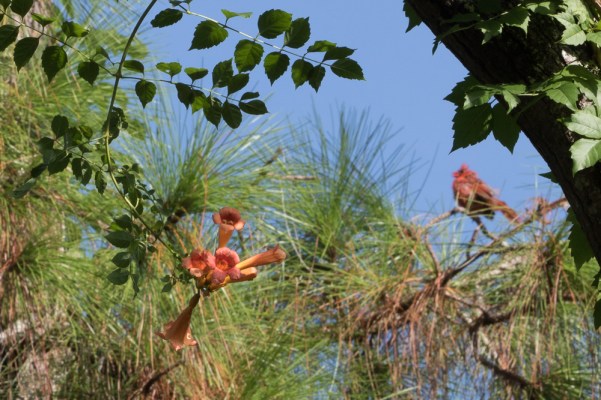
By John Bradford
Trumpet Creeper is uncommon in South Florida outside of cultivation, and the reason may be our shortage of hummingbirds, the main pollinators. Extra visitors include bees and butterflies, but studies have shown a threshold of about 400 pollen grains to cause fruit formation, and pollen from the same plant does not work. In short, a job for a big hungry hummingbird, not a little lightweight bee or butterfly.
Although tough to pollinate, Trumpet Creeper is easy to propagate. At Palm Beach State College, we grow it from segments of roots. Thus in nature the vine can probably establish wherever root pieces go, a useful trick in, say, a floodplain where the ground can break apart and float away.
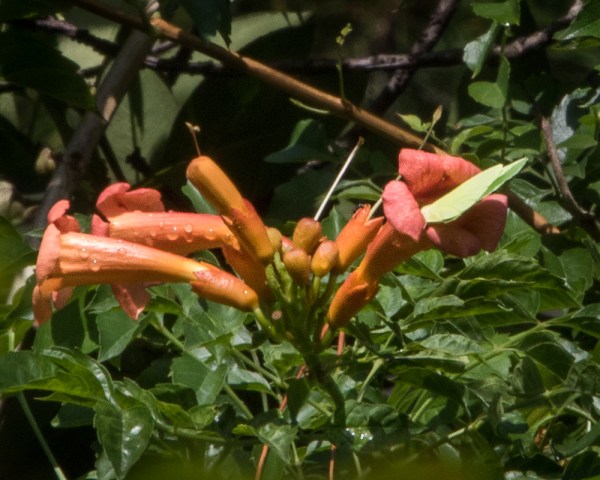
Hey, I can’t reach the nectar! (JB)
The stems are odd in structure. Resembling Poison Ivy, they climb a host tree using tiny clinging roots like centipede feet. Trumpet Creeper is a structural parasite, reaching great heights freed of the need to make strong supportive wood. Many readers know that normal woody plants have a green cambium just under the bark to expand the girth of the stem by making strong new wood to the inside as well as new bark to the outside. Trumpet Creeper, by contrast, makes extra sugar-conducting tissue at the inner core of the stem where there would be wood in a self-supporting species. In other words, stealing outside support allows the selfish vine to concentrate on fueling rapid growth rather than holding itself up. (Know anybody like that?)
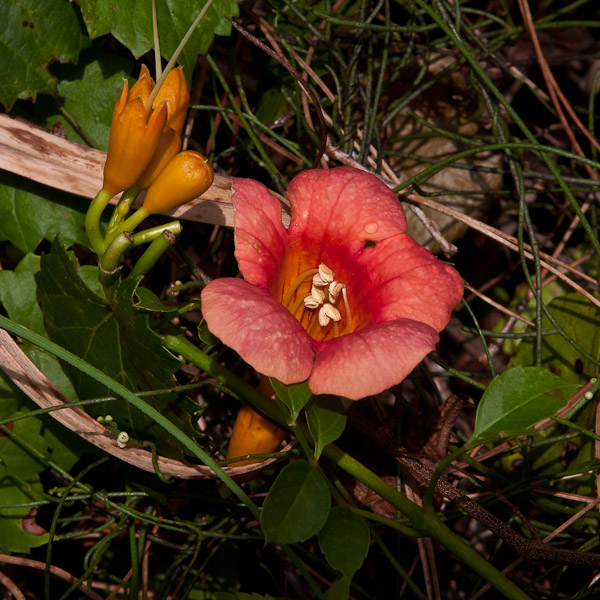
By JB
The flowers make enough nectar to feed a bird. Everybody likes nectar. Those blossoms are to nectar thieves what a bank is to bandits. Banks need tough guards. Trumpet Creeper has armed guards too. To pay its sentries the flowers have nectaries on the outside at the base (on the calyx). They look like blisters, and feed belligerent ants who presumably protect the nectar-laden floral base from any varmint that may nip a hole and swipe the sweets.
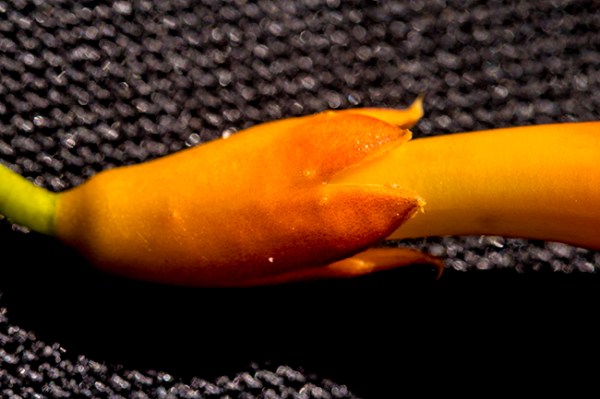
Little ant-feeder blister glands on the outside of the flower base

 Treasure Coast Natives