RSS

Author Archives: George Rogers

Unknown's avatar

About George Rogers

Florida botanist

Pineland Chaffheads

Pineland Chaffheads

Carphephorus carnosus  CLICK

Asteraceae

 Carphephorus carnosus has a striking appearance, the slightly succulent leaves mostly at the plant base,  in low rosettes, often crowded in sizable patches, stiff and knife-shaped.  The appearance suggests a desert species, or maybe something from a rock garden.

The geographic distribution is interesting too.  Restricted more or less to central Florida,  the species occurs in pinewoods, prairies,  and low open usually moist habitats.  These habitats are hardly the desert/rock garden just mentioned, except in a seasonal sense.   The habitat  are places of periodic fire,  of blazing sun,  and of  poorly drained sandy soils where conditions flip-flop between seasonally  soggy and seasonally xeric.     
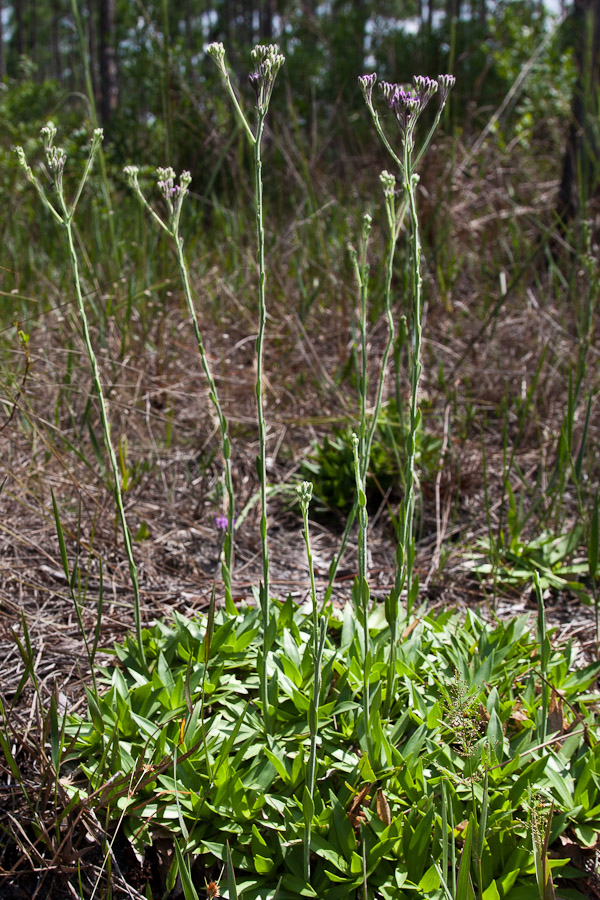
Carphephorus carnosus in early September

The plants seem highly adapted to fire.  The dense patches of low rosettes appear to be fire-resistant:   low and tough, out of harm’s way from blowing flames and blowing winds.  The congested leaf islands formed by the crowded rosettes appear to  offer flame-proofing like buffalo in a ring.  The edges may fry, but the inner reachers are protected.  The plants have a hard knotty core to which they can burn back or die back in the dry season, to regenerate fresh leaves in the summer months,  culminating with flowering in the safe rainy autumn.  Turning briefly to a related species,  Carphephorus paniculatus is not just fire-tolerant, but also fire-dependent.  The latter species has been documented to decline by 75% after three decades of fire protection.  This is probably true of C. carnosus as well.  These pioneer species with parachute “seeds” (achenes) can blow readily into recently burned areas.

Species of Carphephorus are glandular, with the fragrance champion being C. odoratissimus, “Vanilla-Leaf,” with vanilla-scented foliage.    The most obvious explanation for the aromatic essences is protection from herbivores.  Although the fragrance suggests vanilla, it differs chemically from the natural orchid extract.  The volatile essences from C. odoratissimus are a mix of sesquiterpenoids (these  are common in Asteraceae), miscellaneous other compounds,  and, primarily,  coumarin, which can smell like vanilla.   Coumarin is scattered among diverse plant families as a feeding deterrent;  among other effects, it suppresses livestock appetites, and converts into a toxic anticoagulant, making it useful in modern human pharmacology.

These plants undoubtedly have ecological secrets relating to their harsh habitats.   Their beauty comes in large part from their stark toughness topped with rich purple flower heads.   This post is the outcome of a trip to Jonathan Dickinson State Park by John Bradford and George Rogers.  John took the photo.
 
Leave a comment

Posted by on September 3, 2011 in Pineland Chaffheads


Tags:

St. Andrew’s Cross

St. Andrew’s Cross St. John’s Wort

Hypericum hypericoides

Clusiaceae

Every time I (G. Rogers) think about St. John’s Wort my mind jumps to a business wonder.  Near my parent’s home in Brevard NC is Gaia Farms CLICK where roadside weeds are spun into gold, or at least ground up and bottled.  Lots of weeds, apparently lots of gold, and yes, Gaia carries one of the mainstays of herbal remedies, St. John’s Wort (Hypericum perforatum, a different species of Hypericum than today’s species).

Species of Hypericum as folk remedies date back into antiquity.  Once upon a time back when spells and curses were pesky, Hypericum served as witch-repellent.   In modern times we are more troubled by depression than hexes, and the herb sells as depression-repellent.  Also there is interest in it as a potential antiviral drug.   We do not have the expertise to pronounce on the efficacy or safety of Hypericum products, but we do have a strongly developed general skepticism of witch-cures.

Like many plants with a medicinal history, there is toxicity. These plants when ingested photosensitize the skin, making it susceptible to sun damage, potentially fatally so.  There’s a nod to this in the Gaia instructions: “Avoid excessive exposure to UV radiation (e.g. sunlight, tanning) when using this product.”   Hypericum species poison livestock, especially cattle.

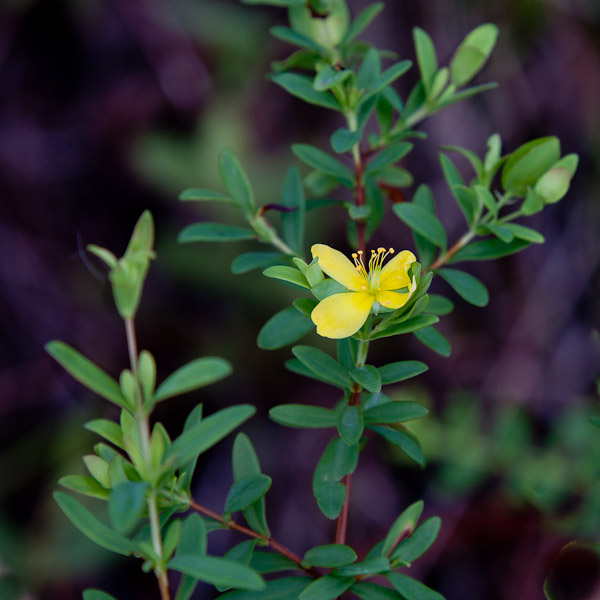
All this medical schooling is a prelude to John’s and George’s opening-day-for-archery-hunting exploration of the Corbett Wildlife Management Area Hungryland Slough.  We kept our heads down on the swamp boardwalk.  Prominently in bloom was St. Andrew’s Cross, Hypericum hypericoides.

Hypericum hypericoides

Hypericum is a big genus of over 400 species, with a few dozen growing wild in Florida.  Identification hints for St. John’s Worts generically are yellow flowers having 4 or 5 free petals and stamens that you can count.  The opposite leaves are freckled underneath with tiny black or translucent spots as seen with a hand lens.  One the more abundant species, dominating local “Hypericum marshes,” is Peelbark St. John’s Wort (H. fasciculatum), which has shredded reddish bark and five petals.  Our own Hypericum hypericoides distinctively combines four petals with two styles in the flowers on a shrubby frame bearing sessile more or less elliptic leaves.  (Our other locally present four-petal species have three styles.)

How did the common name for Hypericum hypericoides become “St. Andrew’s Cross,” while a separate species Hypericum crux-andreae (St. Peter’s Wort) seems to have a natural claim on the former name?  Even with references to three different saints, you can’t fix the world in one blog.   (This account comes from a collaborative effort by John Bradford and George Rogers.  Saint John took the photo.)

 
Leave a comment

Posted by on August 27, 2011 in St. Andrew's Cross


Tags:

Button Rattlesnake Master

Button Rattlesnake Master

Eryngium yuccifolium

Apiaceae

Today John Bradford and George Rogers  wandered through the Sweetbay Natural Area adjacent to the Palm Beach North County Airport.  The area is named for the Sweetbay Magnolia (Magnolia virginiana), but this post will feature a much odder plant that was in full bloom today.

Sweetbay in August

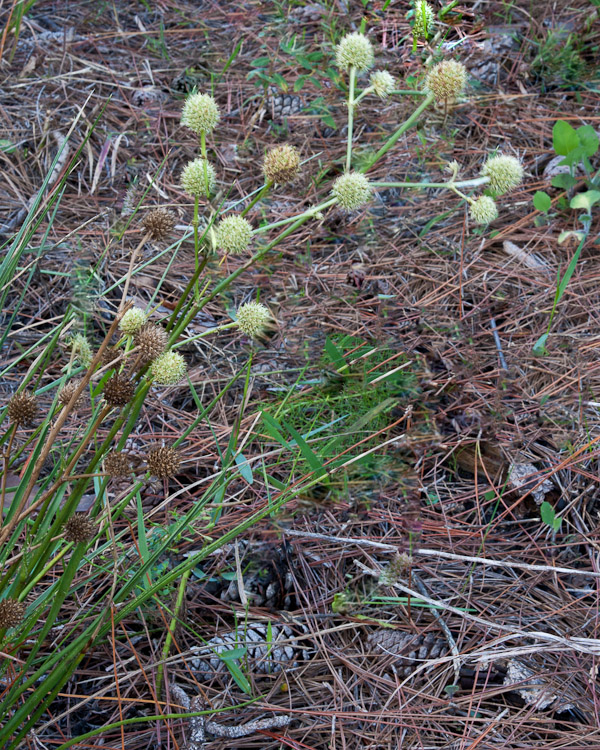
What plant looks like a yucca straight from the desert, has white flowers packed into congested heads like so many other locally abundant species, and smells like carrots when bruised?   The Button Rattlesnake Master:  Eryngium yuccifolium.  The globe-shaped heads of small white flowers resemble those of Buttonbush (Cephalanthus occidentalis) and Buttonweed (Spermacoce verticillata, not native).  All three were in flower in close proximity.  It would be interesting to know how much overlap they have in flower visitor species.  Probably much.   Many species visit the Eryngium.

Being a member of the Carrot Family (Apiaceae), it comes by the carrot smell honestly.  And, yes, the plant has a taproot.  The long skinny leaves look more like those of a Monocot (such as a true yucca or a grass) than the Dicot this species is.  Around here the plants reach about three feet tall.

Eryngium yuccifolium

Eryngium yuccifolium is odd and beautiful enough to be a garden plant, and it is, being started readily from seeds.  The  species is distributed across the southern and central U.S. from Florida to Minnesota  in diverse wet and dry habitats ranging from limestone glades to pinewoods to tall grass prairie, all demanding the characteristic of requiring durability, especially to withstand fires—burning pine woods in the South and burning prairies in the mid-West.  When the top fries or dies, regeneration comes from the taproot.

Why the name “Rattlesnake Master”?   According to some accounts, Native Americans rubbed the pulverized root onto the hands to gain mastery over rattlesnakes.   (Relevantly somehow, on a prior visit to Sweetbay we encountered a pygmy rattler at the very site where the Eryngium grows.) According to other reports, the name has to do with historical uses to treat snakebites.   Extracts from Eryngium roots reportedly reduce inflammation, so the snakebite treatment is a folk use with potential extension into modern pharmacology.

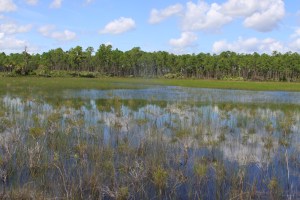
Maturation of the flowers is protogynous (pro-TOJ-eh-nus), that is, female first.   The stigmas poke out early between the petals, with the flower remaining otherwise closed.  The closed petals hold the stamens in.  Eventually the petals spread, the stamens emerge, and it is male-time.  The male and female phases overlap, and the flowers are self-compatible, resulting in high seed production.  Neat system-eh?   The flower is receptive to outside pollination before it can pollinate itself.  If there is no outside pollination, then the flower self-pollinates as Plan B. (This post is a collaborative effort by John Bradford and George Rogers. JB took the plant picture. GR took the scenic vista.)

 
2 Comments

Posted by on August 19, 2011 in Rattlesnake Master


Tags:

Dogs Beware of the Leafless Swallow-Wort!

Leafless Swallowwort

Cynanchum scoparium

Apocynaceae

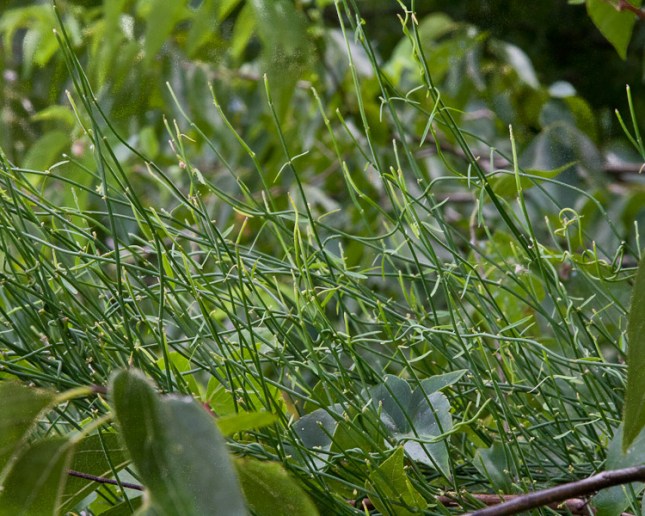
An older synonym for this plant contains the wonderfully apt genus name Amphistelma, meaning “surrounding wreath.”  You’ve got to see it to appreciate the name.  This garland-forming vine, which becomes leafless with age, wraps and smothers its host, as botanist John Kunkel Small noted in his Flora.  The intertwined stems twist together in parallel resembling those twiggy grapevine wreaths in arts and crafts stores.  Too bad about changing nomenclature, because the less descriptive prevailing name now, Cynanchum, merely means dog-choker, relating to the handle “dogbane” applied to related species.  The name “swallow-wort” embraces multiple plants in the Milkweed Family and beyond.  It may allude to toxicity.


Wandering deeper into the speculation zone, the tendency toward leaf loss with advancing age is an apparent adaption to the vine’s changing circumstances along life’s journey.  Youngsters are leafy, as any proper hammock-understory upstart should be.  But eventually the vine climbs a host plant, breaks forth into the sunny overstory, and sheds its leaves, taking on a more xeriphytic, stem-photosynthetic, low-water-loss active adult lifestyle.  Sometimes it resembles the likewise leafless parasitic Lovevine.


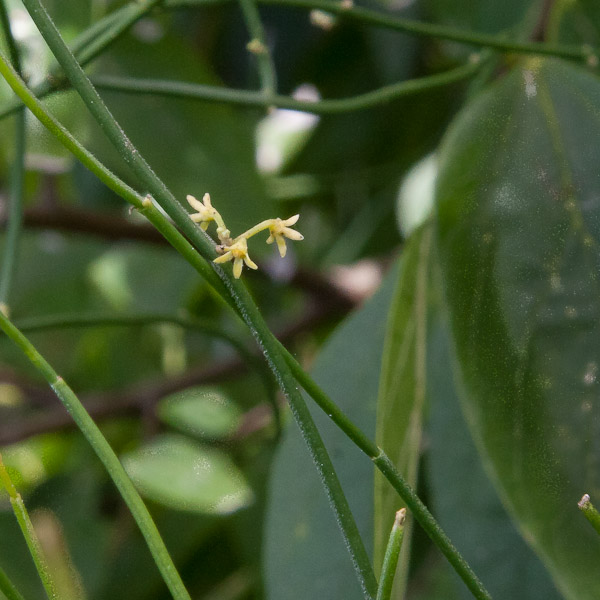
Close examination of the small flowers shows them to be Milkweed-ish, that is, having the pollen clumped into packages known as pollinia.   Packaged pollen transfers thousands of grains in a single pollination event.  Not many plants achieve this – with Orchids and Milkweeds (defined broadly) being prominent examples.

The tornado-shaped blossoms have partial barricades at the throat, limiting penetration to the “right” pollinators, whatever they may be.  Butterflies?  Inquiring minds need to know.  Bees and wasps are the only reported pollinators of Cynanchum species known to us, but it is a large genus, and the reports are few and Afro-centric. We prefer butterflies as the prime suspects for those “witch’s hat” flowers, but the truth remains to be seen.

We are dealing with an important insect nursery plant.  The larval guests include the Faithful Beauty Butterfly, first described in Cuba.  Note the species name Composia fidelissima, which predates Fidel Castro, and probably refers to the loyalty of the caterpillar to its vine.  Also in the picture, with details unclear, are the Queen Butterfly and other members of the Monarch Group (subfamily), which  become toxic  from their youthful escapades on Cynanchum scoparium.

The “Giant Milkweed Bug” (Sephina gundlachi) too enjoys today’s vine as its sole breeding host.  Weirdly enough, the mama bug oviposits onto the host plant rather than directly onto the vine.  The bug’s warning coloration is much the same as the Monarch Butterfly and its kin.  This is a possible example of Mullerian Mimicry in which two different noxious creatures mimic each other, reinforcing the effect of their “bug off”  (aposematic, if you will) coloration, much like the black leather, studs, chains and insignia of unrelated motorcycle gangs.

Mullerian Mimic

CLICK

CLICK AGAIN

The double pods split open to release “parachute” seeds, as in most “Milkweeds.”  (This post is a collaborative effort by John Bradford, Billy Cunningham, and George Rogers exploring the eastern shore of Lake Okeechobee. JB shot the pictures, except for the badass.)

 
Leave a comment

Posted by on August 12, 2011 in Leafless Swallowwort


Tags:

Swamp Dogwood at the Dump

Swamp Dogwood

Cornus foemina

Cornaceae

With Billy still in North Carolina,   John and George changed venues from the east shore of Lake Okeechobee to the east shore of the Palm Beach County Solid Waste Authority.  Seriously,  take a hike at the dump!

CLICK

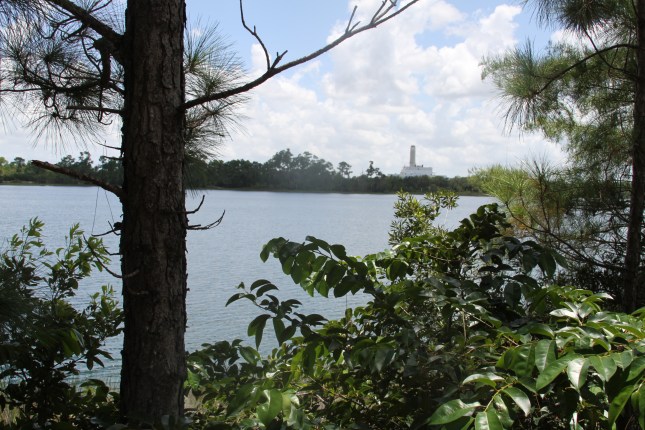
Scenic Lake Altman at the Landfill, No Fishing, Waste-to-Energy Plant in the distance. Photo by GR.

The flora and critters there are diverse and interesting, so picking a featured species was controversial.   The Swamp Dogwood was in full bloom, making it necessary to address the question of why Dogwood is called Dogwood.  Now, if you believe what you find on Google, it comes from “dag” wood, because the wood made “daggers,” or cattle prods.  That is credible because the wood is hard, tough, and pretty.     George carves archery bows, and made one of a stave of Pacific Dogwood.  Took months, and yielded a beautiful bow, which snapped in a brittle moment, perhaps a victim of Anthracnose?  (See below.)   The wood has served for tennis racquets and heads of golf clubs.  George worked long ago as a commercial loom operator and owns (but can’t find) an antique dogwood loom shuttle tough as nails.

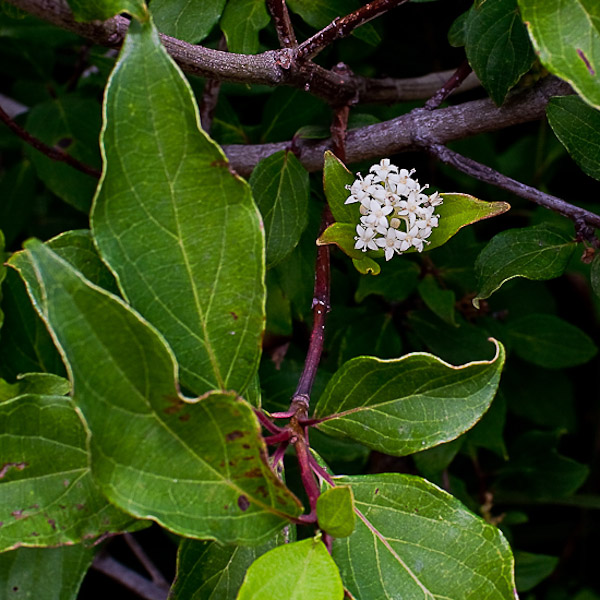
Cornus foemina by JB

Dogwoods are examples of the once-continuous forest around the northern hemisphere, broken up over the eons by climate and environmental change leaving  pockets of floristic similarity especially in eastern Asian and in the eastern U.S. with additional remnants in Europe and occasionally along the U.S. Pacific Coast.  Dogwoods inhabit all of those places.  Four species are native to Florida, only one in our area.

The genus Cornus has about 60 species.   Perhaps the most famous and showiest is the Flowering Dogwood, Cornus florida, which does occur in Florida.  This gorgeous species and others suffer  from an introduced destructive fungal “Dogwood Anthracnose” disease.  The disease appeared first in the Pacific and in the Northeast in the 70s and early 80s.  By the early 90s, Dogwoods in some areas were devastated.  So far—as far as we know—the fungus has spared Florida.

Here is a little trick to identify Dogwoods in the field.   First of all, most species have opposite leaves with beautiful curved veins.  Snap a leaf and gently pull the two pieces apart.  In Dogwoods thin threads will cross the gap and bind the two halves together.

Today’s species, Swamp Dogwood, has white starry flowers in showy clustered, followed by more or less blue “berries” (drupes)  not fit for human consumption but is food for the birds and wildlife. (This post is a collaborative effort by John Bradford and George Rogers.)

 
Leave a comment

Posted by on August 6, 2011 in Swamp Dogwood


Tags:

Devil’s Claw Will Gitcha!

Devil’s Claw

Pisonia aculeata

Nyctaginaceae

Here’s a trivia question for flower-buffs: What do Devil’s Claw Vines in the forest, Bougainvilleas at the hotel, Four O’Clocks in the garden,  Blollies on the dunes,  Beach-Peanuts on the sand, and Red Spiderlings in the rough have in common?

You guessed it—they are all members of the Nyctaginaceae family.  And that gem underscores the importance of learning plants by families, not just one at a time.  If you know some of these species, do you see the family resemblance?   The Devils Claw leaves and branching pattern look like Bougainvillea.  A lot of Nyctaginaceae have colorful bright reddish-purplish pigments—Bougainvillea, Four O’Clock,  Beach-Peanut,  Red Spiderling,  even the Blolly fruit.    The colorful “flowers” have no petals.   The colorful parts are bracts, that is, modified leaves associated with the flowers.    There are also sepals, and the fused sepals can make a tube, this often tightly enclosing the one-seeded fruit.

In today’s plant as the sepals enclosing the fruit have odd rows of protruding glands to help the fruit cling to passing animals.  They are are gummy-sticky.

Recurved claws

The name Devil’s Claw  comes from scary back-curved spines.   We know the pain from recent ankle-bleeding experience.    But why have curved spines for self-defense when straight bayonets are more to the point?     Perhaps reverse-curvation helps the vine cling to its host trees.  Hurricane country,  after all.  Under ideal conditions, Devil’s Claw can graduate from its lowly clinging vine status to full-blown treehood.

The plants are either male or female, that is, they are dioecious, and the male and female flowers differ.   The male flowers are bowl-shaped and yellowish;   the females  are narrower,  more constricted, with a comical brushy stigma resembling the tuft on Jeff Dunham’s friend Peanut.  (Huh?  Just Google Image it.)

Male flowers

Devil’s Claw occurs throughout much of the American Tropics, including South Florida, and now extends around most of the warm-climate world,  no doubt due to artificial introductions.  (This post is a collaborative effort by John Bradford and George Rogers on the east shore of Lake Okeechobee.  JB took today’s pictures.)

 
2 Comments

Posted by on August 4, 2011 in Devil's Claw


Tags: , , , ,

Santa Maria Feverfew Packs a Punch

Santa Maria Feverfew

Parthenium hysterophorus

Asteraceae or Compositae

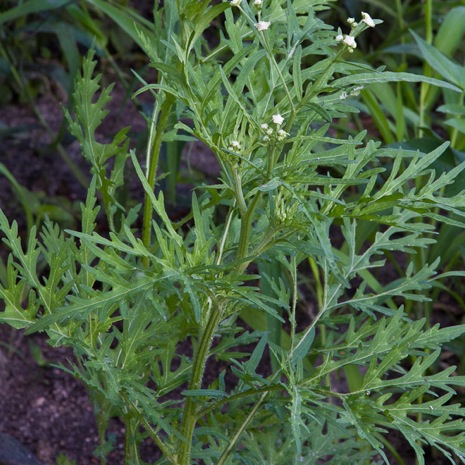
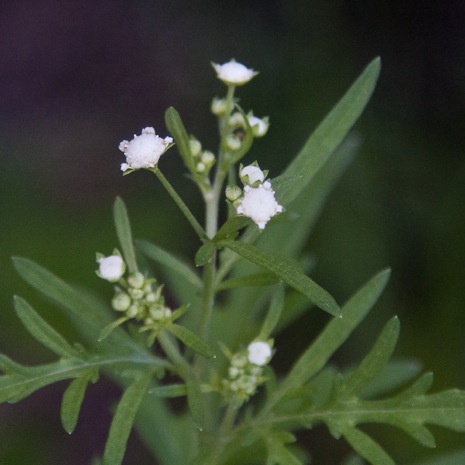
Parthenium (Today's photos by JB)

Continuing our exploration of the eastern shore of Lake Okeechobee today, John and George wallowed in invasive exotics, eating guavas, tripping over Syngonium vines, and admiring the tallest Johnson Grass we’ve ever seen.  (Billy is in North Carolina.)  Part of the fun was spotting one isolated little Coontie, which is native.  Has it been there a millennium? Did Native Americans bring it?  Did a seed float across Lake Okeechobee in a storm?  Does it date from someone dumping garden refuse?  Why is a Cycad the opening act for a post on Parthenium anyhow?  Well, they are both bioactive and toxic.

Let’s get on-topic.  An intriguing non-native plant loitering around the agricultural field borders is Santa Maria Feverfew (Parthenium hysterophorus), probably native from Mexico to South America.  It is now a worldwide weed, which tends to obscure the precise point of origin.

A clue to the strange brew within, the foliage has a distinctive odor when you crush it, which is a bad idea, as the itchy-scratchy sap can raise a few blisters.  Despite the hazard, it is fun to sniff weedy members of the Composite Family, because they tend to contain sesquiterpenoid lactones.

Huh?  Back up a second here.  Terpenoids (TURP-ah-noids) are usually pleasantly fragrant botanical essences, such as pine, lemon,  citronella,  and menthol.  They are based on 10-carbon “terpene” chains.  Just as a sesquicentennial is  150 years, a sesquiterpenoid (SES-kwa-turp-ah-noid) is a terpenoid-and-a-half, that is 15 carbons, and the term “lactone” (LACK-tone) refers to specific molecular configuration beyond the scope of our little e-chat. All right now,  don’t get hung up on the chemistry—the point here is what the chemicals do.   Sesquiterpenoid lactones tend to have a characteristic bitter or medicinal odor, not necessarily unpleasant, and, although found in multiple plant families, they are the flagship anti-herbivory arsenal of Composites, including Feverfew.  Parthenium contains a medicine cabinet of sesquiterpene lactones as well as other toxins.  The best-known lactone in today’s species is named for it, parthenin.

Pretty little snow white flower heads on Parthenium. It looks better than it smells.

Sesquiterpenoid lactones are a veterinarian’s (and butcher’s) nightmare.  Especially hard on sheep and goats, they’re not so great for cattle and horses either.  The compounds attack vegetarians in varied nasty ways—they are neurotoxic, and able to bind to animal tissues interfering with varied functions, and prone to cause digestive lesions.  They cause “spewing sickness,” where the animal can drown in its own vomit.  These toxins spoil the meat of livestock who eat them.

And here is an odd effect with possible benefits in human medicine: antimicrobial activity.  What would a plant do with antibiotic capability?  Apparently the sesquiterpenoids interfere with the microbe symbionts in the animal rumen, adding even more injury to the error of eating the wrong weed.

The compounds have insecticidal characteristics too, harnessed in some regions where Parthenium helps with flea control.

A fine line separates scary poison and useful medicine.  Species of Parthenium have served historically against diarrhea, bacterial infections, malaria (some partheniums are called “wild quinine”), female troubles, pain, and fevers.   But watch out, Parthenium derivatives reportedly damage human chromosomes.

If you are a plant, who do you want to suppress in addition to hungry grasshoppers and goats?  Answer: competition from other weeds.  One study showed parthenin, mentioned above, to thwart germination, to diminish the chlorophyll content, and to sabotage enzymes in a species of Ageratum.  Maybe it has commercial value as a natural herbicide, but we don’t really want to handle it!

The botanical name is just plain odd.  The name Parthenium is of debatable origins that we’ll ignore.  The weirder part, hysterophorus means womb-bearing.  What was Linnaeus thinking?  Not clear, but the flower heads do look like the ends of the fallopian tubes.

Many members of the Composite Family contain latex.  A related species, Parthenium argentatum, is the source of the rubber substitute guayule.

What a plant: it’ll cure your cooties, mutate your offspring, make the goat barf, give a horse a crummy in his tummy, sour the lamb vindaloo, irritate your skin, and self-weed the garden.  Yet it looks so white-flowery innocent by the side of the canal.  (This post is a team effort by John Bradford and George Rogers.)

 
Leave a comment

Posted by on July 30, 2011 in Santa Maria Feverfew


Tags: , , , , ,

Sugarberry

Sugarberry
Celtis laevigata
Cannabaceae

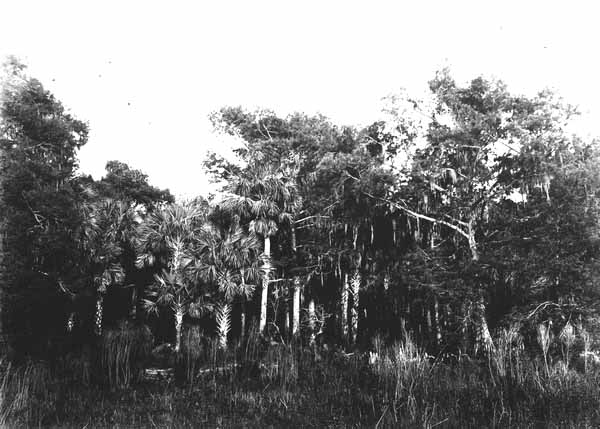
Yesterday (July 22) we braved 90-degree heat, ear-tickling gnats, and spider webs resembling fishnets to explore the wooded area along the east rim of Lake Okeechobee near Pt. Mayaka . The biggest trees are Bald Cypresses which are older than the Hoover Dike, but they appear to be past their prime, thanks no doubt to the de-swampification of the lake perimeter by the dike, rim canal, and surrounding sugar fields. And there are plenty of awesome Strangler Figs, mixed with the occasional Mastic.

East shore of Lake Okeechobee as John Kunkel Small encountered it before we did. Photo by JKS.

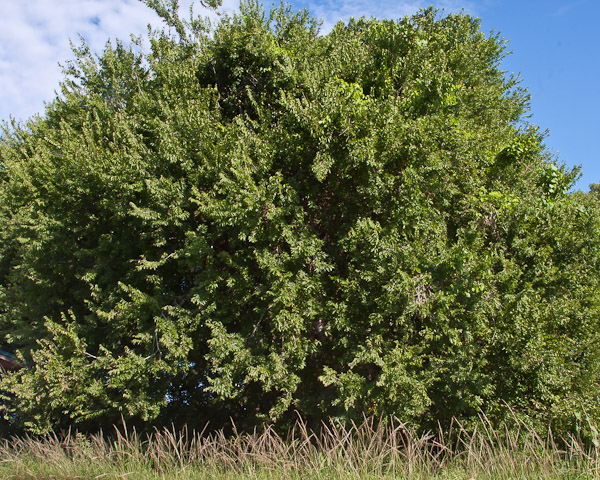
The new kids on the block are Sugarberries taking over with the coverage and vigor of Melaleucas, but Sugarberries are native members of hardwood hammock communities. They are an example here of “natives gone wild.” In an unnatural disturbed habitat it looks like they can romp. Underscoring that effect is an adjacent monoculture carpet of Pepper Vine (Ampelopsis arborea) extending unchallenged from the forest edge to the edge of the rim canal.

Sugarberry. (All contemporary photos in this post by JB)

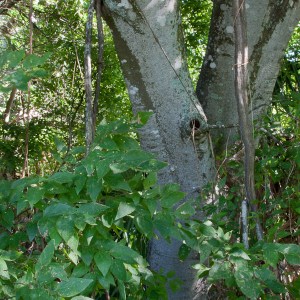
Sugarberry ranges across much of the southern U.S., extending southward into Mexico in scattered localities. Celtis is a large widespread genus, containing also the well known Hackberry (Celtis occidentalis). These plants have resemblances to Nettles, Elms, and Trema, a messy circle of kinship when it comes to family classification. Varied slicings, dicings, and clusterings have yielded different family definitions and ever-changing family assignments for Celtis over the years. In our era of precision DNA-guided classification, it looks like the Ganja Family, Cannabaceae, may be the family of choice. Please don’t smoke the Celtis, but do enjoy its sweet little fruits. Sugarberry and similar Tremas have been called “Nettletrees” in the past. The leaves look somewhat like those of nettles, and a more interesting similarity is in the flowers. The stamens are bent like a trap spring, and at the moment of truth, they straighten BAM! and fling the pollen explosively.

Warty bark

Sugarberry is easy to recognize, with vaguely triangular leaves having lopsided bases. The bark is distinctively warty, which may be contagious to tree-huggers.

Those sweet pea-sized fruits pack their entire flavor into a cheap thin layer around a massive stone. It almost seems like bait and switch to the hungry birds who no doubt expect more flesh in exchange for dispersal services.  Around the world many peoples have valued the sweet flesh and ground fruit stone as foods, medicines, and condiments, often dried and pulverized. Native American names for the fruity pebbles translate loosely as “crunchy.” The relationship of Celtis to pre-European Floridians ran deep. Celtis iguanaea and C. pallida in Florida occur more or less exclusively, or at least preferentially, on Native American middens, and speaking of historical value, the bendable wood makes good bows, and it serves flexibly in basketry.

Crunchy fruit snacks

Sugarberry has a place in modern landscaping too. It is “the” tree of the Jupiter Post Office, and is especially noteworthy there producing thousands of seedlings covering the lightly maintained “lawn,” demonstrating how this species can go postal, given a chance.

This report is a collaborative effort by John Bradford, Billy Cunningham, and George Rogers.

 
9 Comments

Posted by on July 24, 2011 in Sugarberry


Tags:

Hog Plum

Hog Plum, Tallowwood
Ximenia americana
Ximeniaceae

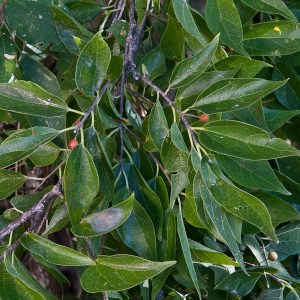
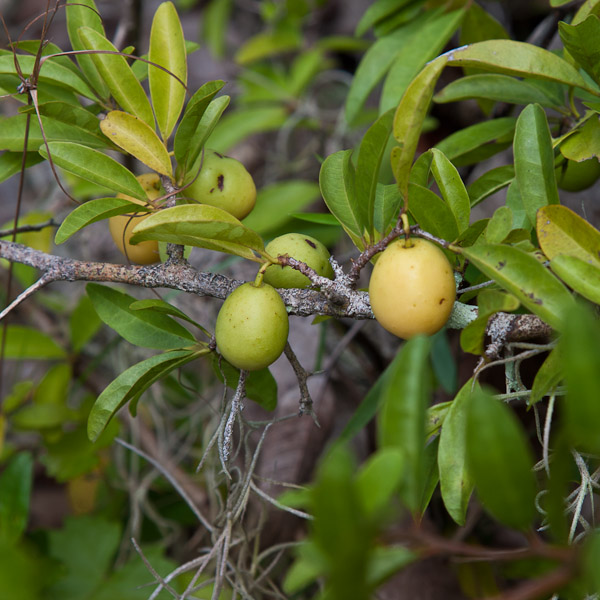
How many Florida native species are worldwide?  Few, and Hog-Plum is one, occurring in sandy windblown places, often more or less near the sea, from Florida to Australia.  The fruits float, apparently over long times and over long distances, and birds probably help get them around.  The name “Hog Plum” is confusing because a plant better known under that name is Spondias mombin, which has a similar orange drupe.  In parts of its range Ximenia americana is important in the kitchen and in the pharmacy.  For instance, in Cameroon it is cultivated for raw fruits, for fermented drinks, and for its combustible oil.  The seeds contain cyanide, limiting the culinary value of the oil, which nonetheless seems to have cooking applications, as well as uses in personal grooming.  Reported medicinal uses for products from this thorny shrubby species are numerous, including treatment of scars, worms, leprosy, and sexual problems, hopefully not simultaneously.  Ximenia caffra is a related African species likewise grown for its edible fruits and for the abundant oil in its seeds.

Hogplum fruits

A second oddity of Hog Plum is that, like several other scrub species, it is a partial parasite, ripping off the roots of neighboring plants.  Additional scrubbish species of similar inclinations in our area include Black-Senna (Seymeria pectinata), Love Vine (Cassytha filiformis), and Graytwig (Schoepfia schreberi aka S. chrysophylloides).  Parasitism is an apparent adaptation to life in nutrient-poor sands.

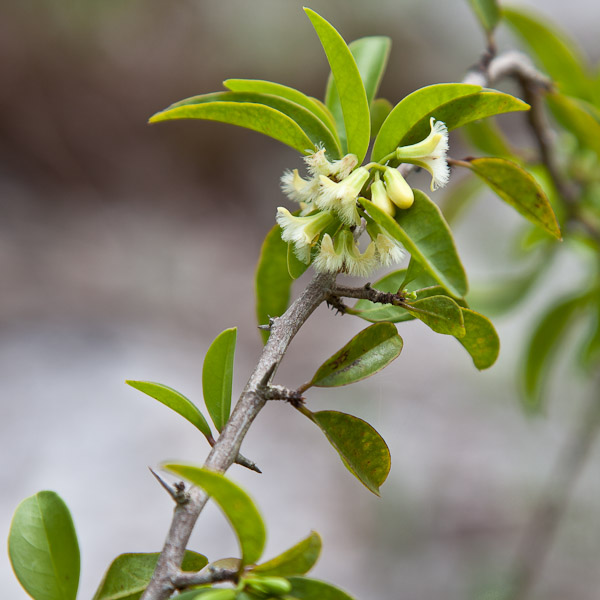
Hogplum flowers in July

The flowers are oddly bearded on the inner surface, probably to exclude unwelcome nectar thieves while allowing “proper” bee pollinators, and/or the hairs may be tactile nectar guides to visiting bees.  Honeybees are reported to be effective pollinators, although some very limited fruit-set occurs even with pollinator exclusion. [This post is a collaborative effort by John Bradford, Billy Cunningham, and George Rogers]

 
6 Comments

Posted by on July 20, 2011 in Hog Plum


Tags: , , , ,