Sugarberry
Celtis laevigata
Cannabaceae
Yesterday (July 22) we braved 90-degree heat, ear-tickling gnats, and spider webs resembling fishnets to explore the wooded area along the east rim of Lake Okeechobee near Pt. Mayaka . The biggest trees are Bald Cypresses which are older than the Hoover Dike, but they appear to be past their prime, thanks no doubt to the de-swampification of the lake perimeter by the dike, rim canal, and surrounding sugar fields. And there are plenty of awesome Strangler Figs, mixed with the occasional Mastic.
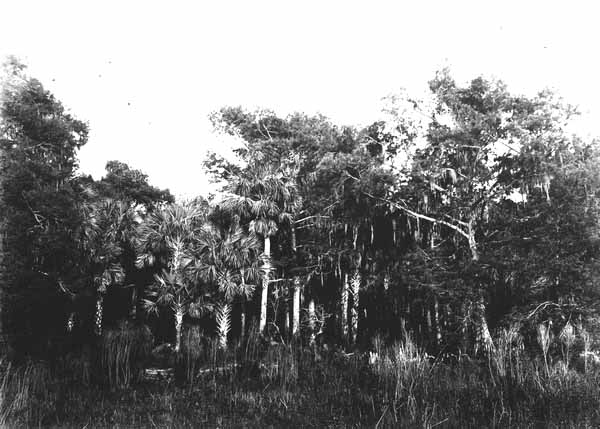
East shore of Lake Okeechobee as John Kunkel Small encountered it before we did. Photo by JKS.
The new kids on the block are Sugarberries taking over with the coverage and vigor of Melaleucas, but Sugarberries are native members of hardwood hammock communities. They are an example here of “natives gone wild.” In an unnatural disturbed habitat it looks like they can romp. Underscoring that effect is an adjacent monoculture carpet of Pepper Vine (Ampelopsis arborea) extending unchallenged from the forest edge to the edge of the rim canal.
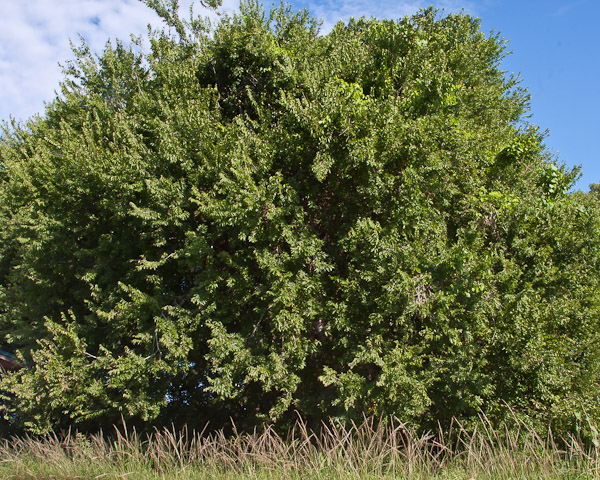
Sugarberry. (All contemporary photos in this post by JB)
Sugarberry ranges across much of the southern U.S., extending southward into Mexico in scattered localities. Celtis is a large widespread genus, containing also the well known Hackberry (Celtis occidentalis). These plants have resemblances to Nettles, Elms, and Trema, a messy circle of kinship when it comes to family classification. Varied slicings, dicings, and clusterings have yielded different family definitions and ever-changing family assignments for Celtis over the years. In our era of precision DNA-guided classification, it looks like the Ganja Family, Cannabaceae, may be the family of choice. Please don’t smoke the Celtis, but do enjoy its sweet little fruits. Sugarberry and similar Tremas have been called “Nettletrees” in the past. The leaves look somewhat like those of nettles, and a more interesting similarity is in the flowers. The stamens are bent like a trap spring, and at the moment of truth, they straighten BAM! and fling the pollen explosively.
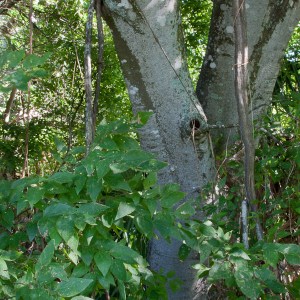
Warty bark
Sugarberry is easy to recognize, with vaguely triangular leaves having lopsided bases. The bark is distinctively warty, which may be contagious to tree-huggers.
Those sweet pea-sized fruits pack their entire flavor into a cheap thin layer around a massive stone. It almost seems like bait and switch to the hungry birds who no doubt expect more flesh in exchange for dispersal services. Around the world many peoples have valued the sweet flesh and ground fruit stone as foods, medicines, and condiments, often dried and pulverized. Native American names for the fruity pebbles translate loosely as “crunchy.” The relationship of Celtis to pre-European Floridians ran deep. Celtis iguanaea and C. pallida in Florida occur more or less exclusively, or at least preferentially, on Native American middens, and speaking of historical value, the bendable wood makes good bows, and it serves flexibly in basketry.
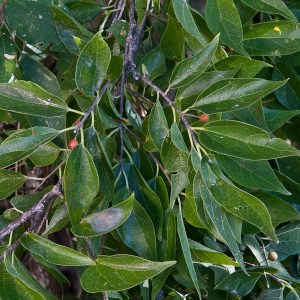
Crunchy fruit snacks
Sugarberry has a place in modern landscaping too. It is “the” tree of the Jupiter Post Office, and is especially noteworthy there producing thousands of seedlings covering the lightly maintained “lawn,” demonstrating how this species can go postal, given a chance.
This report is a collaborative effort by John Bradford, Billy Cunningham, and George Rogers.
 John Bradford
 George Rogers
 George Rogers
 Dee Staley
 Treasure Coast Natives