RSS

Author Archives: George Rogers

Unknown's avatar

About George Rogers

Florida botanist

Caesarweed

Caesar Weed

Urena lobata

Malvaceae

A joyous week of going native.  Tuesday evening it was fun to bore the West Palm Beach Chapter of the Florida Native Plant Society with my yada yada yada presentation, such an energized and cheerful group.  Then this morning John and I joined ecologist Arnaud Roux for a sunny slog through Jonathan Dickinson State Park soggy shores to prepare an upcoming professional workshop on grassy plants.  We enjoyed the Blue Curls, Roselings, Chaffheads, Liatris and so much more as pretty as a state park brochure.
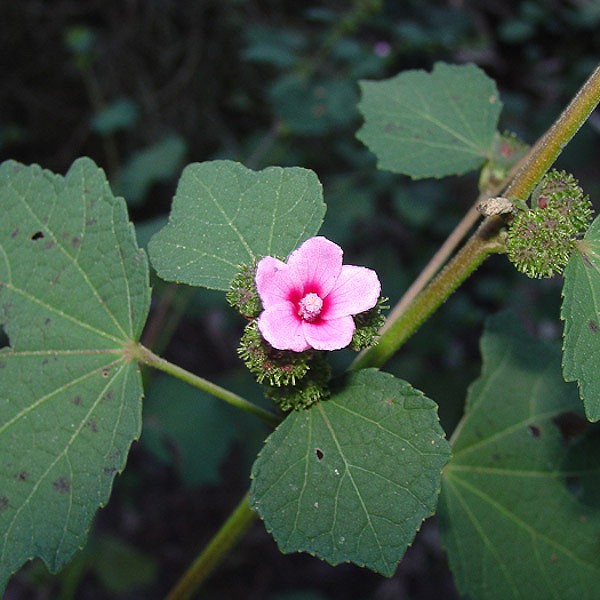
The pink "mini-Hibiscus" flower (by John Bradford).

The pink “mini-Hibiscus” flower (by John Bradford).

So many lovely native wildflowers, so let’s talk about a Category I invasive exotic weed stuck in your socks.  You don’t live in Florida long before meeting Caesarweed.  Even if you never encountered its pink “Hibiscus” flower, its burrs have encountered you.  The sock-stickers are segments of the fruit, which comes apart like slices of VELCRO pie.  They arrive home in your pants cuff, liberate themselves in the Maytag, and transfer amusingly to your wife’s apparel.
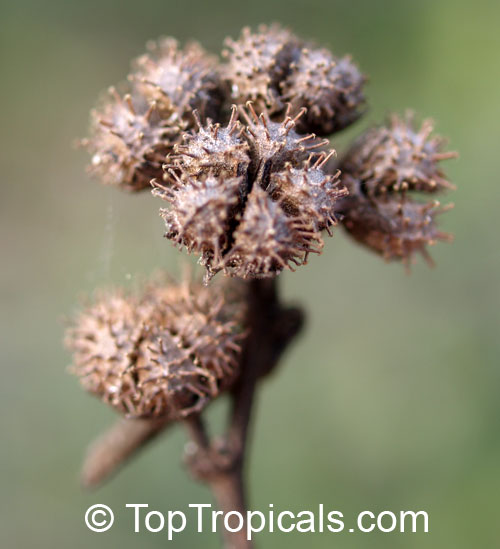
VELCRO pie.  By Top Tropicals (permitted use)

VELCRO pie. By Top Tropicals (permitted use)

Clinging may help explain the enormous range of this around-the-world weed of unclear origins, possibly in or around Tropical Asia.  Florida has been home since at least the 1800s.  Like many weeds, Caesarweed enjoys the company of humans as we create disturbed habitats, disperse its bristly hitchhikers in our spouse’s delicates, and enjoy its useful attributes.

As with so many widespread plants, the traditional medicinal uses are too many to list and actually a bit boring, although if you suffer “windy colic,” forget that medicinal marijuana, this is the weed for you.

Horticulturists are familiar with urease as an enzyme in soil microbes critical for transforming the natural decay product (or commercial fertilizer) urea into plant-useful ammonia/ammonium.   You can buy “urease inhibitors” to ration the conversion.

NitroGainUI-logoR

Caesarweed has urease in its seeds, clearly giving them a kickstart at germination time.  Urease-enhanced plant seeds are not rare, but even so, I dig the idea of a powerweed equipped with its own fertilizer-making enzyme.  So often weeds have special means of establishment after their relocational skills plop them in strange new worlds.

Speaking of special adaptations, flip over a Caesarweed leaf.  At the base on the main veins are glands, apparently to feed protective ants.
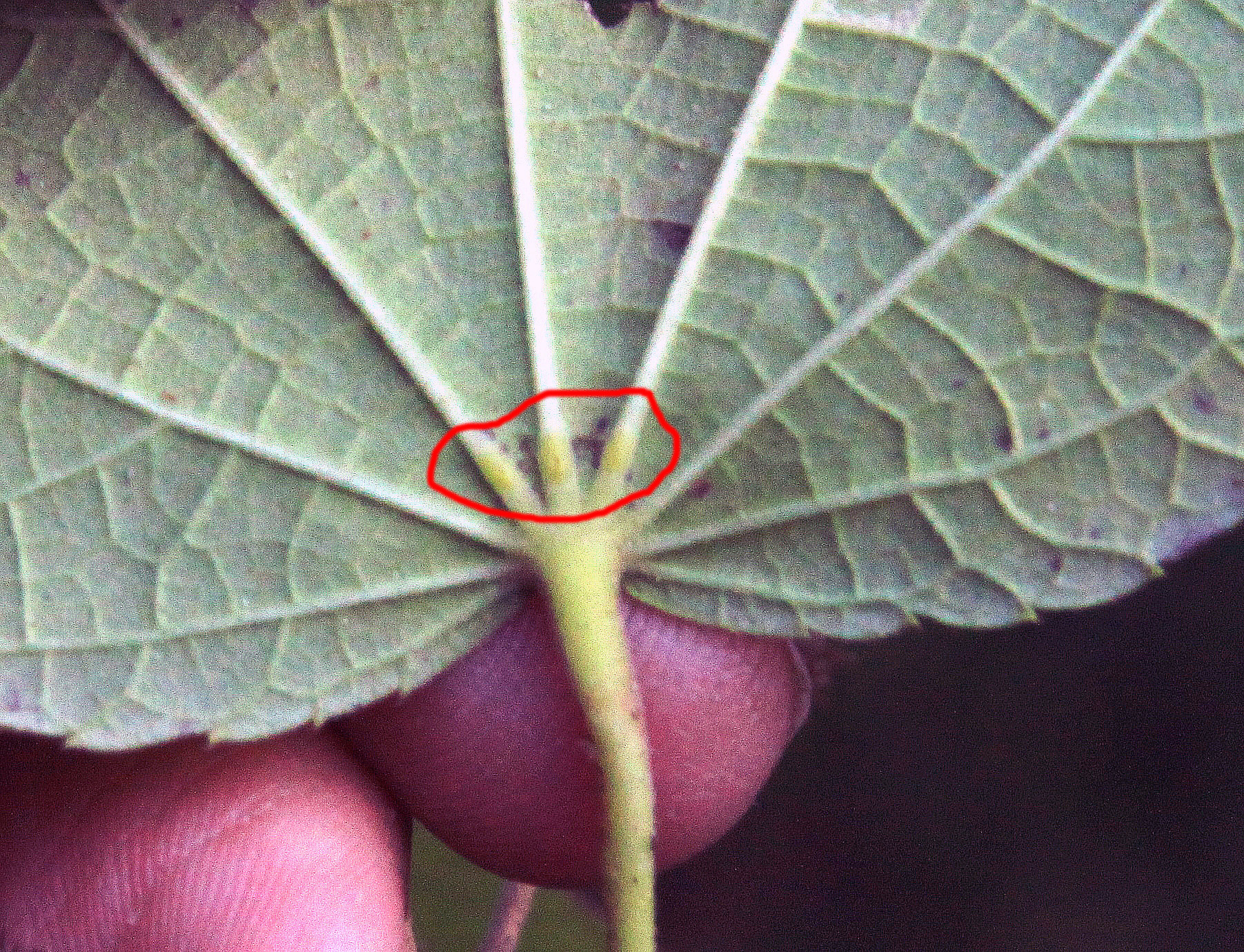
The leaf glands.  Apologies for the crummy focus. Don't blame John...my bad.

The leaf glands. Apologies for the crummy focus. Don’t blame John…my bad.

Beyond historical and modern medicinal interests, humans cultivate Caesarweed for fibers up to a yard long.    Not a huge surprise really, as the Hibiscus Family is a fibery bunch: Cotton, Kenaf,“Indian Hemp,” and more.  While some parts of the world are trying to figure out how to discourage Caesarweed’s growth, others research ways to boost germination rates and enhance growth as a commercial crop, especially in Africa where the plant acquires the name Congo Jute.  Before synthetics, Florida used to be a fiber growing and testing center.  It would be fun to know if Casaerweed had any participation in that.
 
10 Comments

Posted by on September 19, 2014 in Caesar Weed


Tags: ,

In a Lather Over Sudsy Snakewood

Asiatic Snakewood

Colubrina asiatica

Rhamnaceae

As John and George go about our Friday botany biz, sometimes near the sea—especially in the Hobe Sound Wildlife Refuge—we trip over an odd and different-looking woody plant known as Asiatic Snakewood.  Although a small number of native species of Colubrina live in southern-most Florida, our local Colubrina is Asiatic Snakewood, an invasive exotic stinker, but an interesting stinker.  It thrives in some coastal strand habitats, crowding rudely into hammocks and mangrove areas.   Every invasive has its tricks, and one of those earns Snakewood its name; the stems reportedly grow over 30 feet per year, snaking around, rooting where they touch the soil.  It’s really no fun ranting about the invasion,  so for now let’s try to know thy Snakewood.

Snakewood at Hobe Sound.  Today's photos by John Bradford.

Snakewood at Hobe Sound. Today’s photos by John Bradford.

Inquiring minds might ask how it got from its presumed origins around Tropical Asia to the Hobe Sound Wildlife Refuge nature trail.  Two main possibilities stand out (a combo of the two seems likely).

  1. Maybe humans brung it, at least to the Caribbean in the 9th Century or before.
  2. Maybe the seeds floated or came by bird delivery.

Colubrina Close JB

To look at possibility # 2 first, this species gets around!  Let’s say it originated in Tropical Asia, yet it is regarded as native in Hawaii, and decorates the tropical world from Africa to Australia and beyond.  The seed journey begins when the fruit explodes.  Pop.  The seeds like to float in saltwater.  A skeptic might now wonder, “well, if it migrates aggressively, perhaps it managed to get around all the way to the Caribbean and Florida on its own.  Wouldn’t it then be native, technically speaking?”   (And of course Global Warming could lend a hand.)  We’re unlikely to see anyone make that case.  I think we can all agree human activity probably had something to do with it. (Or then again, maybe you disagree.)

Which brings us to arrival scenario #1 (we’ll conveniently ignore many other human-mediated but inadvertent and boring possibilities).  To appreciate possibility #1, a little background is relevant.  Snakewood has a laundry list of traditional medicinal applications, and those long snake-sticks can be woven.  The species is chock-full of bioactive chemicals, the most famous being what are known as saponins.  Saponins are widespread in the plant world, and some plants make a lot.  Another name for Colubrina asiatica is “Latherleaf,” because saponins froth in water, and our species is sapono-tastic.  The sudsiness has served humankind, and there’s another benefit: saponins snuff fish.  A multi-use weed!  You can take a little Colubrina down to the river, launder your drawers and enjoy a seafood lunch.

 
6 Comments

Posted by on September 13, 2014 in Asiatic Snakewood


Tags: ,

Chapman’s Oak

Chapman’s Oak

Quercus chapmanii

Fagaceae

On Friday John and George explored a corner of Seabranch State Park near Port Salerno, Florida, previously unpenetrated by us, a big area of scrub more mature with larger Oaks and Pines than many other local scrub areas.

The Prairie Clover (Dalea feayi) was pleasingly in bloom.

Feay's Prairie Clover Friday 9/5/14.  All photos today by John Bradford.

Feay’s Prairie Clover Friday 9/5/14. All photos today by John Bradford.


The Yellow Garden Spider was enjoying the day.

What's a tuffet?

What’s a tuffet?


If we’re going to feature Chapman’s Oak, we better establish who was Chapman?  Alvin Wentworth Chapman (1809-1899) witnessed most of the 19th Century, remaining active to age 90.  He was a physician and founder of modern Florida botany.  Back then doctoring and botany often occupied the same soul.  (Come to think of it,  my own father was a physician-and part-time naturalist.)

Chapman's Oak

Chapman’s Oak


I believe many species distinctions we use in modern manuals date back to Dr. Chapman’s antebellum (1860) Flora of the Southern United States, setting up subsequent generations of addition and refinement in 20th Century floras.  Originally from Massachusetts and a Union sympathizer in the Civil War, Chapman lived most of his long productive life isolated in Apalachicola.

Most local scrub areas host Chapman’s Oak, and in Seabranch State Park this species is abundant, in fruit, big by local standards, and striking with two special eye-catching features:

Feature #1:  Galls as big as ping pong balls and as red as apples, before turning brown.

Gally-gee---they resemble apples

Gally-gee—they resemble apples


Eye-catcher #2:  Super-glossy-reflective leaves.  Chapman’s Oak has some of the larger leaf blades found in the sun-drenched scrub habitat where the general tendency in most plants is toward reduced leaf sizes.  You’d think those big Chapman solar panels might cook and dehydrate in the scrubby sunbath, and we’ll see in a moment that to be the case in a limited way, but I’d like to think that reflective surface offers protection.  We usually think of big leaf blades as typical of shade, so maybe Chapman’s Oak straddles the best of both worlds:  expansive blades for life in a mature scrub under the shade of Pines, and at the same time protected when un-shaded.  This is mere speculation—the prerogative of the individual who types the blog.

Chapman's Oak leaves and acorn

Chapman’s Oak leaves and acorn


Several species of Oaks grace our local scrubs, and they are an interesting committee.  We won’t sort out here how to tell them apart (for help see Lesson 3 in our online class), but some general remarks may interest a reader or two.

Would you expect a cluster of Oak species living in the same habitat in the same place to be closely related?  They are mostly just the opposite—a highly disparate group all thrust together.  Think of a bunch of new neighbors getting acquainted around the pool in a recently built Florida condo complex (perhaps built where scrub once was).  The first conversation topic over frosty Coronas at the meet & greet is, “where are you from?” —- “We’re from Syracuse,”  “I came here from Philadelphia,”  “Minneapolis,”  “Argentina,” etc.    Same thing with the Florida scrub-dwelling Oaks.  They all came to Seabranch State Park from different directions, different relationships, different histories.  How’d they all get together in the same scrubby sandbox?  Fairly remarkable, so Floridian, and just like human Floridian transplants, they have their own subtle climate preferences, especially with respect to differences in soil water on that scrubby sugar sand.  We’ll return to that.

You can divide the local Oaks into three distinct species alliances, the Red Oaks, the White Oaks, and the Live Oaks.

Representing the Live Oak species group, in Seabranch, we met Sand Live Oak (Quercus geminata) and Dwarf Live Oak (Q. minima).  From the Red Oak Guild was pretty Myrtle Oak (Q. myrtifolia).  Chapman’s Oak alone hails from the White Oak gang.

Today it is all about Chapman’s Oak.  Wonder why it is so rare in cultivation?  Apart from any necessary symbiotic microbial partners, its soil moisture preference is under 7%!  (Sand Live Oak, by comparison which is cultivated prefers over 12%.)  Chapman’s Oak, perhaps by dint of longevity, can extract water from fairly deep scrub soil, recorded down to over 6 feet.  It initiates leaves during the early rains of Spring, having them in place during the long hot summer and early autumn.  As the dry season rolls around, Chapman’s Oak is particularly prone to have those oversized leaves dehydrate internally…drier than any of several scrub species measured.   Remember our worries above how big leaves may dry out.  They seem to, to a point, but under protected control, on schedule, and basically okay.  Mother N watches over her Oaks.

Chapman’s nearest relative, as revealed by DNA, is the so-called Bastard White Oak (Q. austrina).  BWO inhabits more-northern Florida and beyond on soil with more moisture.  In short, you might interpret Chapman’s Oak as a heat-seekin’ dry-lovin’ derivative of its bastard northern cousin.

——————————————————————————————-

Note:  Technical data largely from article by J.  Cavender-Bares and collaborators.  Phylogenetic Overdispersion in Floridian Oak Communities. Am. Naturalist 163:  823-843. 2004.

 
6 Comments

Posted by on September 7, 2014 in Chapman's Oak


Tags: ,

Cabbage Palms – Even Our Best Friends Have a Secret or Two

Cabbage Palm

Sabal palmetto

Arecaceae

Saturday morning it is, and how relaxing it is to relax!  This week classes started at PBSC; so did John’s and my “MOOC” on Native Plants.  In the first week of school broad topics set the academic context, one of those topics was persons of historical environmental interest in Florida.  Few had the super-human powers of John Muir, arguably most famous for founding the Sierra Club in California (and for inventing an alarm bed to toss you out of the sack in the morning).  One of the many reasons I like him is our shared  view of nature through just one eye.  On his Thousand Mile Walk to the Gulf through still-smoldering Civil War rubble, John M. hiked across Florida via Gainesville with a layover ill at Cedar Key not long before fatherhood, the High Sierra, and enviro-glory.

The 1000-mile walk included a boat ride.  He landed at Fernandina as a lonesome, hungry, and frostbitten Wisconsonite to find an uplifting thrill upon spotting his first palm.  In his words:

It was while feeling sad to think that I was only walking on the edge of the vast wood, that I caught sight of the first palmetto in a grassy place, standing almost alone. A few magnolias were near it, and bald cypresses, but it was not shaded by them. They tell us that plants are perishable, soulless creatures, that only man is immortal, etc.; but this, I think, is something that we know very nearly nothing about. Anyhow, this palm was indescribably impressive and told me grander things than I ever got from human priest.

sabal palmetto cypress creek1

I’m more jaded.  The grand thing my backyard Cabbage Palm says is, “clean up my fallen debris.”  But looking back a few years, I recall excitement as a northern kid peering out the back seat window through a cloud of my Dad’s pipe smoke and spotting that first palm tree upon arriving on a Florida vacation.  (Don’t they plant some at the state line?)

The geographic distribution covers most of peninsular Florida, truncated abruptly along a line across North Florida, with razor-thin ribbons extending along the Gulf Coast in the Panhandle, and far up the east coast to North Carolina in the Caribbean too.

As Florida’s state tree, Cabbage Palms are known well as sources of fiber and thatch, as having the persistent leaf bases harboring epiphytes and creatures, as feeding berries to wildlife and ancient humans, and as having their terminal buds (“hearts”) tasty and apparently responsible for the name “Cabbage” Palm.

Now for something less generally familiar—a feature known in plant nurseries and studied biologically in the 90s by biologists K. McPherson and K. Williams (see esp. Am. Jour. Bot.  83: 1566-1570. 1996).

Cabbage Palm flowers by John Bradford.

Cabbage Palm flowers by John Bradford.

Young Cabbage Palms face a rough world… hurricanes, flooding, drought, frost, shade, hogs, rampaging hippos, and fire.  That’s all pretty threatening if you have just one growing bud.  Consequently they and additional palms evolved a secret adaptation.  After germination, the trunk does not rise and prosper like a normal plant.  Instead, it burrows downward, sometimes as deep as a meter, before executing a U-turn to eventually come forth above the ground.  The growth is J-shaped with trunkless leaves jutting above the ground surface. (The related Sabal minor most often hides its trunk permanently below ground or nearly so.)

We’re not talking about a momentary delay.  The belowground trunk establishment phase reportedly takes usually 30-60 years or more under wild conditions (maybe 7-20 years in favorable cultivation).  The trunk from a seed germinated when I was peering out that car window in 1960 may just be breaking ground now.  A stand of Cabbage Palms can be wiped out above-ground and recover just dandy from others still in the subterranean trunk phase.  Or seen differently, starting a Cabbage Palm stand from seed will require patience.  Plant the seeds while you are young for your gray-haired grandchildren.

Sabal palmetto

 
10 Comments

Posted by on August 31, 2014 in Cabbage Palm


Tags: , ,

With a honk honk here and an oink oink there, Old MacDonald had some Goose Grass and Sow Thistle

…and Barnyard Full of Superweeds, ee-i-ee-i-oooooo

Sow Thistle (Sonchus oleraceus)

Canadian Horse Weed (Conyza canadensis)

Goose Grass (Eleusine indica)


But first a note on our Native Plants On-Line MOOC.  The class has filled with 60 apprehensive victims, and is therefore closed.  We expect to offer it again maybe in the winter.  


A pretty weed distributed throughout all of sunny Florida has earned the distinction of being the newest addition to the International Survey of Herbicide Resistant Weeds worldwide list of glyphosate-resistant  weeds.  Glyphosate is the active ingredient in the world’s top herbicide, better known as Round-Up.   Our newly crowned Round-Up-Resistant (R-U-R) superweed is number 28 on the Survey’s hit parade dating back to 1996.   And it is Common Sowthistle (Sonchus oleraceus).

Sonchus asper (similar to S. oleraceus) .  All photos today by John Bradford.

Sonchus asper (similar to S. oleraceus) . All photos today by John Bradford.

Not that Florida is under-represented by prior R-U-R title holders.   Also in our state natively or just visiting  are: Spiny Amaranth (Amaranthus spinosus), Tropical Sprangletop Grass (Leptochloa virgata),  Jungle Rice Grass (Echinochloa colona),  Sour Grass (Digitaria insularis),  Johnson Grass (Sorghum halepense),  Ragweed (Ambrosia artemisiifolia),  Narrow Leaf Plantain (Plantago lanceolata), Canadian Horseweed (Conyza canadensis and a related resistant cousin),  Goose Grass (Eleusine indica), and a couple of bit-players.   In other words, a big chunk of the world’s R-U-R species are right here in our own back yards.  Literally.

And that’s where it gets extra-interesting.   If you do not want these in your own back yard, the day may be fast approaching where your turf grass is a Round-Up-Resistant selection, so all you have to do is lay on the Round-Up to eliminate any weeds that have not joined La Résistance.   There exist some GMO Round-Up-Resistant turf grasses now, although there have been annoying problems with the resistance genes spreading a few miles from test plots, even to other species.  To my very limited Google-influenced knowledge these turf species have not come onto the market, and they are not for South Florida anyhow.

Immortal Canadian Horseweed

Immortal Canadian Horseweed

Of course Round-Up Ready commercial crops, including a lot of cotton, have been around a generation, leading to massive Round-Up applications, helping us get those R-U-R weeds.  (Interestingly, btw, whatever you think about GMOs,  herbicide contamination, and whatnot, did you know Round-Up adds unwelcome yucky-poo phosphate to the environment?)  Many weeds have evolved resistance¹ to many other herbicides; in fact, efforts are in progress to develop crops resistant to additional weed-killers, even nasty old infamous 2,4-D and more.  But today’s topic is Round-Up Resistance so let’s stay on topic.

I don’t want to delve into the politics of Round-Up and GMOs. Doing that would take all night, and the blog world is loaded with it.  If you are interested, there is a relevant article in this week’s New Yorker magazine (8/25/14, p. 46, “Seeds of Doubt”).   So just a few more words in our plant blog on the green things.

Canadian Horseweed scoffing in the face of  wimpy Round-Up

Canadian Horseweed scoffing in the face of wimpy Round-Up

My first brush with Goose Grass, on the R-U-R list, was in approximately 1995 as a golf course weed.  At that time and place, at an expensive Caribbean resort,  the control measure of choice was the herbicide MSMA, where the A stands for arsonate, as in arsenic.  Arsenic is not nice stuff, unless you want to murder somebody gradually, and arsenic in the soil, presumably from MSMA, caused a flap in Wellington not long ago.  That flap was odd—we spew it all over the golf course over umpteen years, then it makes the papers when somebody !!!OMG!!! detects arsenic in the soil.    That’s like dumping molasses on the floor and detecting sticky. Back to plants:

Canadian Horseweed is a superweed to know and love just about everywhere. We usually just step on it in passing, or mow it down, or spray it, or curse it, but please show it some respect.  You don’t tug on Superman’s cape.  Horse Weed was ahead of its time achieving R-U-R superweed status in 1999, and merely 5 years later the resistant strain had spread to a dozen states.  Another decade has gone by, and the R-U-R Horse Weed spans a dozen nations from Brazil to China.  That’s just one weed and one herbicide and one decade.  Use your imagination for the rest of the story.

Canadian Horseweed, kinda pretty if you give it a chance

Canadian Horseweed, kinda pretty if you give it a chance

¹How do you evolve a superweed?  It’s Darwinian survival of the fittest.  Take a big cornfield, douse it with Round-Up to kill 99.9% of the weeds.   The remaining 0.1%, hmmmmm, seem to have some natural Round-Up resistance.  (Round-Up interferes with an enzyme, so the tiny minority of resistant plants may have genetically a slightly different enzyme or a slightly different cellular physiological environment or slightly less ability to allow the poison to penetrate.)  That small number of naturally resistant plants can make a lot of seeds of course, so the 0.1% expands.    Repeated years of applying Round-Up to the same field with the ever-growing resistant population gives repeated years of such intense artificial selection for resistance.  It builds up.  One day the weed-killer just isn’t doing the trick.  An approach to delay that day is to leave some areas near the crop fields unsprayed, so the non-resistant weeds there will cross and dilute the resistance of the spray-survivors.   The mechanism for evolving superweeds is how you wind up with antibiotic resistant bacteria too.


6 Comments

Posted by on August 23, 2014 in Superweeds


Virginia Swamp Mallow, Pretty in Pink and Diesel Powered

Kosteletzkya pentacarpos (better known as K. virginica)

Malvaceae

Kosteletzkya - John's photo. Can you pronounce it?

Kosteletzkya – John’s photo. Can you pronounce it?

Yesterday John and George hankered for scrub, so we wandered the dunes of Hobe Sound National Wildlife Refuge across the Intracoastal Waterway from the Isle of the Rich and Famous, none of whom read this blog.  An extra bonus of HSNWR, even if tough to see, is a brackish coastal pond nestled among the desert dunes.  Decorating the wet oasis is a pretty shrub fond of brackish wetlands, Virginia Swamp Mallow.

The flat fruit. Photo from Ladybird Johnson Wildflower Center.

The flat fruit. Photo from Ladybird Johnson Wildflower Center.

The shrub looks like a Hibiscus and is related, differing by having the woody capsule squashed flat, and splitting to release the seeds along the middles of the seed chambers as opposed to splitting at the edges.  No doubt every reader will remember this gripping detail!

Spotting Virginia Swamp Mallow is a treat, standing tall with big eye-grabbing pink blossoms.  The flowers exemplify textbook hummingbird-pollination, and the hummingbirds do hum there.  But life never obeys the textbooks.  Bee and butterfly visitation are reported too.  More interestingly, the flowers have a self-pollination backup system.  If the birds and bees disappoint, the stigmas (the five pollen-receptive knobs visible in the photo below) curl down to the pollen-producing anthers (the yellow organs below the stigmas) and take care of business independently.  Floral closure at the end of the day helps with the selfies.

The blossom, by John Bradford. The stigmas are the five lobes at the tip of the central column.  These are surrounded by hundreds of yellow anthers  along the column shaft.

The blossom, by John Bradford. The stigmas are the five reddish lobes at the tip of the central column. These are surrounded by hundreds of yellow anthers along the column shaft.

Bioengineers like self-pollinated salt-tolerant species.  The hungry world has expanding areas of under-utilized salinized (salty) soil, and brackish irrigation water is increasingly plentiful though obviously not applicable to many crops.  Problem?  Opportunity?  One forgiving salt-tolerant crop is today’s Kosteletzkya; its seeds are miniature oil wells.  Black gold!  Texas tea!  Lucrative opportunity!

A recent U.S. patent is dedicated to improving and farming Kosteletzkya and reaping diesel juice.  As a side thought, there must be a fine line between freely farming a posie and squeezin’ its seeds, and enforcing a patent claim onto the little gushers!  (Maybe someday we’ll have Roundup-Ready Swamp Mallows.)

One place where the squeezin’ occurs, at least at an experimental level, is coastal China with spreading tidal marshes where you can generate green fuel using crowd-pleasing flowers, stabilize the soil, and empower diesel-fueled migratory fowl.

Now for the daydreaming.   That today’s pinkie oozes oil is no surprise, given a close relationship to cotton, as in cottonseed oil.  And, speaking of China, they already grow much cotton there.  Cottonseed oil is in the diet in parts of China, where it has caused temporary (I hope) male sterility.  Or to the glass-is-half-full crowd, a potential male oral contraceptive.  So on top of all the other wonders, could a Hobe Sound swamp bush loaded with unsaturated fatty acids have a future as Newman’s Own Reduced-Baby Salad Dressing?  Call my patent attorney!

——————————-

——————————-

——————————–

A tree house, taken in Las Vegas last week in honor of our blog friend Uncle Tree, and his wonderful and popular poetic blog Uncle Tree’s House.

Treehouse

 
9 Comments

Posted by on August 16, 2014 in Kosteletzkya, Virginia Swamp Mallow


Tags:

Bloodberry

Bloodberry, Rouge Plant, Pigeon Berry, Turkey Berry, Baby Peppers

Rivina humilis

Phytolacccaceae (or Petiveriaceae)


[Because I’m leaving on a trip instead of our usual Friday field outing tomorrow, the blog goes up a day early today and may not appear next week.  (I may fail to reply to or to approve commentary, but John might chime in.)  Here is a link to our upcoming free on-line class.]

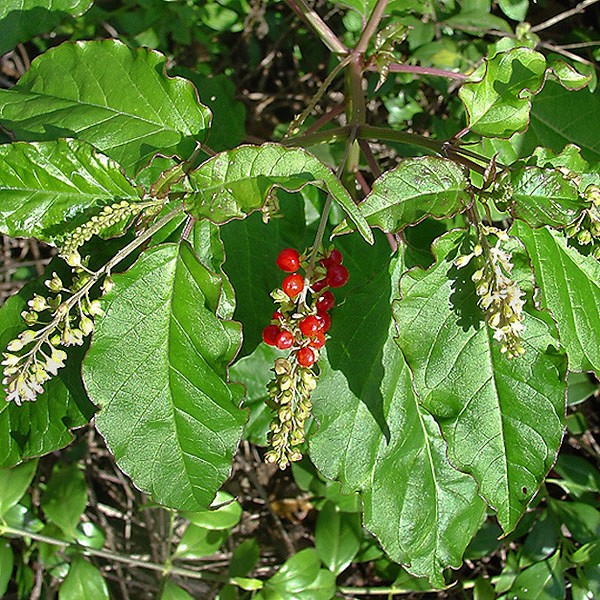
No nature enthusiast overlooks the curious Bloodberry.  You see those scarlet “baby peppers” everywhere, and I mean everywhere, around the world with ecological tolerances as broad as they come: dark dank shade, sun-baked beachside dunes, soggy inland hammocks, and more.  Famed wood anatomist Sherwin Carlquist noticed the internal wood structure to indicate adaptation to dry conditions despite frequent encounters in moisty places.  Part of our berry’s life strategy seems at a glance to be tolerance for drought and salinity once established, allowing a full reproductive cycle in spots with a flippy-floppy wet-dry cycle.  Knowing that, Bloodberry as a (riparian) Arizona wildflower or pest in arid South Africa is not surprising.

Bloodberries (by John Bradford)

Bloodberries (by John Bradford)


The original natural native boundaries are tough to pin down for weeds, in today’s case probably from the southern U.S. down deep into tropical America and the Caribbean.  The red-berried wonder now spans the warm climate world, and here is a case where our well-behaved local wildflower is an invasive menace scattered on the other side of the globe.

How does BB jump those miles?  Answer #1:  Those scarlet berries are bird candy.  Back to that in a moment.  Answer #2:  Who’d be surprised if this often-coastal plant floats a bit. More on that momentarily.   Answer #3:  Gardeners see it as a shade-tolerant dash of color, and who’d be surprised if ancient folks had a hand in relocation too…those red berries are striking and have ethnobotanical histories, especially, according to botanist Dan Austin in treating diarrhea.

Are the berries safe to eat?  No.  Commercial interest in this question stems from the possibility of using the juice as food coloring.  The red pigments are akin to those in beets.  Laboratory rats tolerated the juice, short-term…but leave these plants out of the kitchen!  They are related to pokeweed, which has subtle toxins effective at minute concentrations, which makes me nervous about Bloodberry.  But who needs subtlety and low concentrations?  A little Google-tickling reveals poisonosity.  Question answered.  (Gardeners and nibblers take note.  The dangerous berries might appeal to children.)  By the way, keep the cow away, the toxins taint the moojuice.

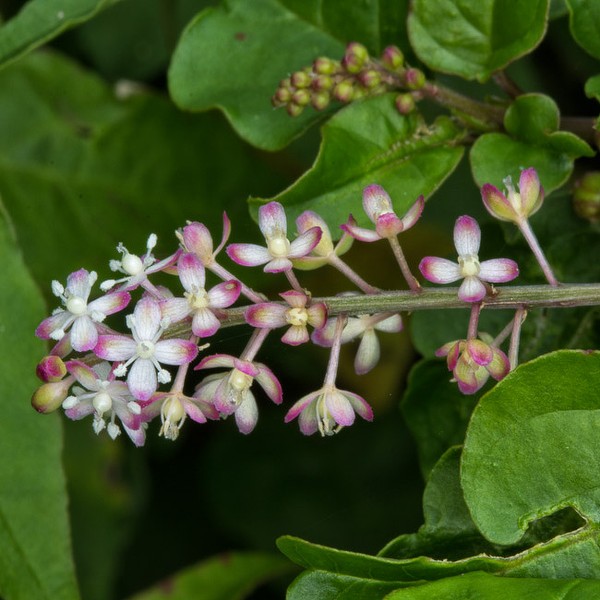
The flowers (by John Bradford)

The flowers (by John Bradford)

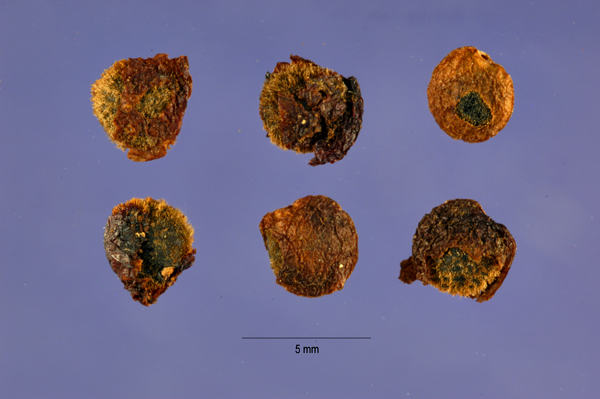
Every plant has its weird point.  And here it is, drumroll please:  The seeds are hairy.  Big wup!  No, hang on, that’s not it, so here is the weird part—the hairs are not really hairs; they are the inner layers of the fruit wrapping the seed coat in inflated bumps.  That’s so contrived there must be a good reason for the contrivance.  We can speculate:

Often small seeds and seedlike fruits—especially in moist habitats—have varied bumps, lumps, and “hairs.”  Flotation help?  Devices for clinging to muddy bird legs for dispersal?  Padding?  Protection? Nobody really knows, probably all of the above in varied doses depending on the species.  If we take those bloody berries to be essentially bird-dispersed, my guess is that the bubble wrap protects the seed’s passage through a bird, grinding gizzard and all, just like bubble wrap protects a glass bowl’s passage through Fed-Ex.  And once the seed pops free of the bird, maybe a little extra flotational padding helps the pretty and poisonous species invade exotic places.

The bubble wrap seeds (U.S. National Seed Herbarium photo)

The bubble wrap seeds (U.S. National Seed Herbarium photo)

 
10 Comments

Posted by on August 7, 2014 in Bloodberry


Tags: ,

Grass Roots Movement

Fire Ants and Native Plants

Solenopsis invicta  

Formicidae

Today John and George skipped northward to St. Lucie County to wade through Paleo Hammock, a beautiful site with Water Hickories, meadows of weird Garlic Weed, ancient Native American mounds, distant thunder, and water up to your ankles.

There are so many lovely beautiful species there, why in the world write about the most detested species on Earth…the imported invasive Fire Ant!?  Boo!

By JB

By JB

If you can rise above old grudges, however, they are mighty interesting.  John had fun stirring them up with a stick.  POKE HERE   Fire ants and their associates extend last week’s theme of unexpected twists and turns in why plants (and ants, and sucking insects) wind up where they do.

Often fire ant1 mounds are centered conspicuously around the bases of fibrous-rooted plants, frequently Grasses.  Of course this raises a chicken and egg question:  which comes first, the ant mound or the Grass? Does the ant plant the Grass in the ant mound, or does the ant colony build its mound around the preexisting Grass clump?

Fire ant mound around Eragrostis grass. Cell phone photo.

Fire ant mound around Eragrostis grass. Cell phone photo.

Speculative answer:  The Grass probably comes first, as we see it, because the clump is “always” rooted dead-center in the mound.   If the mound came first, we’d expect the grasses to sprout at different points on the mound, not necessarily the bulls eye.  But if the mound is built around the established Grass, the clump is “ground zero,” and its radiating brush of roots may help define the mound dimensions.  (Maybe)

Let’s pretend Grass-came-first is correct, then why would Fire Ants build around it? (Related question:  Why are they such turf pests?)

Here are possible answers with mixed fact and speculation:

1. NEST REINFORCEMENT.  The Grass could provide ant nest-reinforcement against wind and water, maybe even a little shade.  And more interestingly…

2. FOOD. Fire ants are omnivores.  Although usually thought of as predators, they need plant-based carbs, including roots (fact), and (speculation) possibly root exudates. So maybe the Grass roots are a salad bar right in the nest. And the plot thickens…

3.THIRD PARTIES. Fire ants tend tiny sucking insects underground or at the root crown as sources of sugary honeydew (fact).  Turf managers are aware of associations between fire ants and subterranean aphids on grass roots.  The honey-makers include mealybugs and root-dwelling aphids.  These tiny root-hugging micro-cows seem to have much to do with the fire ant- plant friendship. Read on…

A broad 1994 study of mealybugs showed the little suckers to pester 250 families of plants.   The most-infested family was—and this may surprise you—the Grass Family, with mealybugs bugging 585 Grass species.  If I were a fire ant trolling for a mealybug, I’d start with a Grass. And even more to the point…(the point being involvement of sucking insects)…

In 2011 biologist Shawn Wilder and collaborators in Arizona showed honeydew from diverse sucking insects to boost fire ant colony development, evidently enhancing their competitive ability and fostering their geographic spread. And more specifically…

In 2012 and 2013 Biologist Aiming Zhou and collaborators documented a win-win relationship between fire ants and an invasive crop-pest mealybug named interestingly, Phenacoccus solenopsis.  It’s a love triangle.   The ants get sweet tasty honeydew from the mealybugs and possibly additional root benefits from the plants.   The mealybugs get a safe home, and are ant-tended and spread around.  And the plants enjoy protection from the most ill-tempered creatures on earth, as well as possible soil enhancements.  The relationship helps the fire ants drive away native ants.  The Phenacoccus solenopsis mealybug is an infamous cotton pest, and it occurs in Florida, living on roots and also above the soil line on many host plants, including Grasses.

By JB

By JB

So what exactly is going on here and now with fire ants,  Grass plants, and probably sucking insects is not clear.  What a fertile area for research for a motivated student with tall waders and an EpiPen.  There aren’t many competing researchers, and who needs to travel to exotic field sites when compelling ecological relationships are playing out right in the back yard?

Photos below added Aug. 25 (taken 8/24) a few weeks after the blog was posted.  These photos show the bases of sterile grass plants (Eustachys petraea?) in the center of an ant mound.  The ants were small, reddish, and belligerent.  Probably Fire Ants but no certainty.   The grass bases are infested with mealy bugs. (On a nearby Eragrostis spectabilis centered in an ant mound there were scale insects in the same position.)

Mealybugs at base of grass plant in ant mound near Jupiter FL.

Mealybugs at base of grass plant in ant mound near Jupiter FL.

More from the same ant mound.

More from the same ant mound.

—————————————

1We’re no ant experts.   Perhaps we see also mounds from other small reddish grumpy ant species. But if it walks like a Fire Ant, quacks like a Fire Ant, and burns ankles like a Fire Ant we’re calling the critters fire ants. Do not trust us.

 
6 Comments

Posted by on August 1, 2014 in Fire Ants


Tags:

Seeds of Change

Seeds of Change

Today John and George were so busy putting the finishing touches on our upcoming Native Plants MOOC (yea, it’ll be mobbed).  We didn’t take much field time, except to look at something you see every day but ponder once a decade—native woody plants coming up seemingly isolated where you don’t expect to see them.

That led to some thought on why plants wind up growing where they do.  Oh, I know the answer!   The wind, or a bird, or a bear in the woods drop a seed, and the seed grows.  Got it, but events aplenty happen between the bird ingesting the seed and a tree grows in Brooklyn.  Nature does not work in a human time and space.

For starters, that seed had to arrive from somewhere.  Maybe merely across the creek, or then again, perhaps from across the sea.  There are plenty of transoceanic examples, and the Bottle Gourd stands out.  The species has an archaeological history widespread in the Americas dating back 10,000 years and in Asia almost that long.   Botanists have debated for decades how this species could seem to be native around the ancient world so long ago.  It did not originate twice, on both sides of the Pacific.  Did very very ancient people move it thousands of miles?  One notion is that Easter Islanders took it westward to the Old World.  Another idea is that the first Native Americans brought it from Asia.  Or maybe it floated a few thousand miles.  To test the bobber theory, researchers floated some for about a year in sea water, and let them sit another six years;  the seeds sprouted like new.  Take home lesson:  seeds get around.

So then, the seeds arrived from somewhere near or far, and now they can grow.  Hold on, not so fast.  How long a delay between arrival and growth?   Maybe the season is not right this month.  Maybe conditions aren’t right this century.  How about another thousand years?  Seeds can be patient, and can await environmental cues, such as disinterrment.  In 1879 Professor William Beal at Michigan State University buried in glass jars seeds of several wild species, leaving a time capsule experiment that remains running.  The seeds are tested at intervals, and some remain willing despite attrition.  Going back farther, barley seeds from King Tut’s tomb reportedly sprouted in modern times, although the claim is disputed.

Free of dispute, Canna seeds 600 years old from an Argentinian grave spawned pretty new Cannas.  And their circumstances were weird.  The Canna seeds from the grave were inside walnuts.  Ancient biotechnicians understood how to insert Canna seeds into immature living walnuts, allowing the nuts to mature into rattles.  In 2012 30,000-year-old seeds of a Carnation relative buried (by squirrels) in Russia grew like Rip Van Winkle awakening.  That’s probably the all-time seed nap record.

Native Florida Canna.  Were its seeds 600 years old? (By John Bradford)

Native Florida Canna. Were its seeds 600 years old? (By John Bradford)

Right, so the seeds came from places unknown, then they waited patiently in the soil seed bank.  Now it is time to boogie!  The seed sprouts dutifully, and hello world!  Hello drought, hello shade, hello sun, hello frost, hello competition, hello drowning, hello bugs, hello fungi, hello hungry bunnies.  The perils facing a tender green sprout remind me of leaving home at age 18!

Obviously the conditions must be suitable—that goes without saying doesn’t it?  Probably, but even that boring observation gains interest if the seedling’s establishment requires relationships with other species.  (We’ll come back to this next week.)   It also becomes more interesting if the overall conditions are changing…oh for example, let’s say by Global Warming.  Just this year the Sunshine State figured in an eye-opening example.  In the Proceedings of the National Academy of Science, January 2014, biologist Kyle Cavanaugh and collaborators applied 28 years of satellite imagery to discern, as they say in their own title, “poleward expansion of mangroves is a threshold response to decreased frequency of extreme cold events.”   Where a mangrove might sprout has shifted in just 28 years.  That’s not my lifetime, but that of my son.

Mangrove headed north! (By John Bradford)

Mangrove headed north! (By John Bradford)

Today we looked at a lonesome Gumbo Limbo sapling with its secret history,  a single Pineland Pinweed 10 miles from any known others, and where did that baby Hercules Club come from?  A little imagination beyond “bird dropping” makes it more fun.  Maybe the guilty birds were the last flock of Carolina Parakeets in 1920.   Who can say it ain’t so?

Hercules Club (by John Bradford)

Hercules Club (by John Bradford)

 
11 Comments

Posted by on July 25, 2014 in Uncategorized


Orange-ya Glad for Wasps, Bats, and Potatoes?

Two Leaf Nightshade (Twin Leaf Solanum)

Solanum diphyllum (FL Exotic Pest Pant Council Cat. II invasive exotic)

Solanaceae

Today John and George enjoyed the mangrove swamp at Peck’s Lake near Hobe Sound, a short boardwalk long on biodiversity, including wasps.  We had one of those wasp experiences I sorta like—wasps can be our pals.   (Stockholm Syndrome.)  We somehow riled up the hive, and 133 (I counted) wasps stormed out with gusto and buzzed our heads in a friendly but earnest warning.   We took the hint with equal gusto, and nobody got hurt.

All plant photos today are Solanum diphyllum by John Bradford.

All plant photos today are Solanum diphyllum by John Bradford.

As I arrived at the parking lot, John was already photographing the plant of the day…Two Leaf Nightshade, a member of the genus Solanum, with several additional species in Florida, including spuds.  With odd mismatched leaf pairs and highway-worker-vest orange fruits in pretty clusters, Solanum diphyllum gathers a lot of “likes” on its Facebook page.  You could spot those clustered little oranges from a helicopter.

John was shooting this photo as I arrived on the scene, July 18 at Pecks Lake.

John was shooting this photo as I arrived on the scene, July 18 at Pecks Lake.

The species is native to Mexico and Central America, and like a good weed (and as a garden species) it is scattered elsewhere in the warm climate world, maybe with a helping hand from Global Warming and gardeners in addition to wild creatures.  Today’s invasive exotic decorates the shores of the Intracoastal in Hobe Sound and likewise decorates the shores of the Nile in Egypt, where it fascinated Egyptian biologist Fatma Hamada of the South Valley University  as much as it fascinates us.  Hamada’s 2013 doctoral dissertation is a monograph on Solanum diphyllum, looking into everything from its beautiful internal anatomy to its cytotoxicity against human cancer cell lines. (so, no, those fruits are not for us to eat).

The "orange blossoms"

The “orange blossoms”

One of her findings was particularly intriguing.  Many plants of arid or salty places protect themselves from drought and salinity by accumulating extra dissolved materials in their tissues.  This is true of our Solanum, and here’s the good part: adjustably.  Apparently, and in need for more research, the plant build ups anti-drying compounds when dry, and later secretes the stuff from the leaves when dry times abate.  Maybe.  Another “maybe” is what seem to be patches of natural “sunblock” embedded in the leaf surface.  This little weed has some stuff goin’ on!   Now back to those fruits oranger than an orange.  Univ. of Miami bat expert Dr. Theodore Fleming described (citing earlier work in South American tropical forest) bird-dispersed fruits to be mostly white, black, red, blue, or purple in contrast with mammal-dispersed fruits predominantly orange, yellow, brown or green.  (Please no e-mails:  These are broad perceived trends—with overlaps and exceptions.)

So is Solanum diphyllum mainly a mammal berry?   Probably, although its dispersal in Florida with almost no fruit-eating bats implicates helpful birds and maybe a quadruped or two.  Research in the shrub’s native Mexico proves fruit eating bats to carry the seeds, not necessarily to the exclusion of birds or others of course.  Quibblers may raise a hand, and say, “bats are blind as a bat, so ixnay on the orange uit-frays.”  But recent research reveals increasingly sophisticated vision in bats, including living color.  Here is a quote (2001) from bat biologists Jorge Ortega and Ivan Castro-Arvellano on the Jamaican Fruit Bat widespread in the native haunts of the Two Leaf Nightshade:  “A. jamaicensis uses vision and olfaction to find fruits with brilliant colors and strong odors.”  By the way, bats don’t like getting tangled in twigs at night.  Note how the fruit clusters are presented for EZ access. Now back to Egypt, where as we already know, the Nightshade grows up and down the Nile.   Guess what was first discovered at the Great Pyramid of Giza, and flutters nocturnally up and down the Nile (and far beyond).   The Egyptian Fruit Bat.   Could it be that the corresponding Nile distributions of the Solanum and the bat are mere coincidence?   A connection might seem tempting to contemplate if Egyptian Fruit Bats go for orange-colored fruits.  Who knows?

Egyptian Fruit Bats at the midnight buffet. (From animal.memozee.com)

Egyptian Fruit Bats at the midnight buffet. (From animal.memozee.com)

 
15 Comments

Posted by on July 19, 2014 in Two Leaf Nightshade


Tags: , , ,