Bloodberry, Rouge Plant, Pigeon Berry, Turkey Berry, Baby Peppers
Rivina humilis
Phytolacccaceae (or Petiveriaceae)
[Because I’m leaving on a trip instead of our usual Friday field outing tomorrow, the blog goes up a day early today and may not appear next week. (I may fail to reply to or to approve commentary, but John might chime in.) Here is a link to our upcoming free on-line class.]
No nature enthusiast overlooks the curious Bloodberry. You see those scarlet “baby peppers” everywhere, and I mean everywhere, around the world with ecological tolerances as broad as they come: dark dank shade, sun-baked beachside dunes, soggy inland hammocks, and more. Famed wood anatomist Sherwin Carlquist noticed the internal wood structure to indicate adaptation to dry conditions despite frequent encounters in moisty places. Part of our berry’s life strategy seems at a glance to be tolerance for drought and salinity once established, allowing a full reproductive cycle in spots with a flippy-floppy wet-dry cycle. Knowing that, Bloodberry as a (riparian) Arizona wildflower or pest in arid South Africa is not surprising.
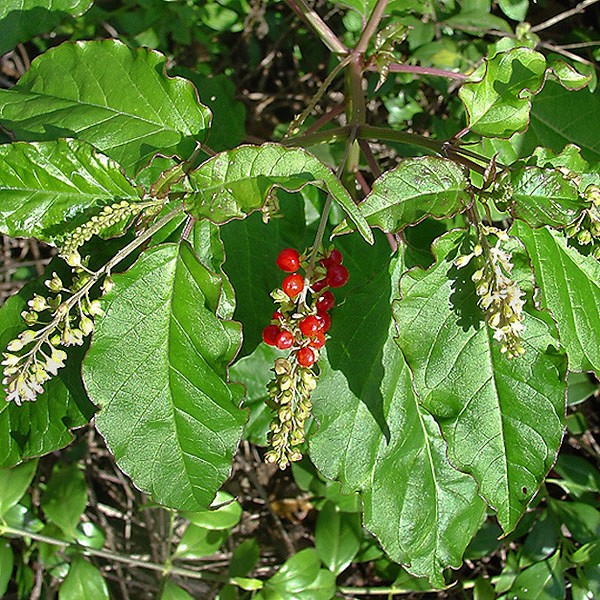
Bloodberries (by John Bradford)
The original natural native boundaries are tough to pin down for weeds, in today’s case probably from the southern U.S. down deep into tropical America and the Caribbean. The red-berried wonder now spans the warm climate world, and here is a case where our well-behaved local wildflower is an invasive menace scattered on the other side of the globe.
How does BB jump those miles? Answer #1: Those scarlet berries are bird candy. Back to that in a moment. Answer #2: Who’d be surprised if this often-coastal plant floats a bit. More on that momentarily. Answer #3: Gardeners see it as a shade-tolerant dash of color, and who’d be surprised if ancient folks had a hand in relocation too…those red berries are striking and have ethnobotanical histories, especially, according to botanist Dan Austin in treating diarrhea.
Are the berries safe to eat? No. Commercial interest in this question stems from the possibility of using the juice as food coloring. The red pigments are akin to those in beets. Laboratory rats tolerated the juice, short-term…but leave these plants out of the kitchen! They are related to pokeweed, which has subtle toxins effective at minute concentrations, which makes me nervous about Bloodberry. But who needs subtlety and low concentrations? A little Google-tickling reveals poisonosity. Question answered. (Gardeners and nibblers take note. The dangerous berries might appeal to children.) By the way, keep the cow away, the toxins taint the moojuice.
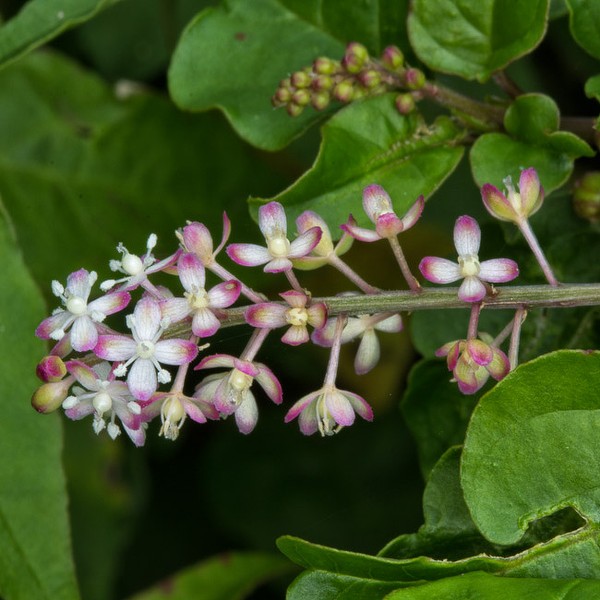
The flowers (by John Bradford)
Every plant has its weird point. And here it is, drumroll please: The seeds are hairy. Big wup! No, hang on, that’s not it, so here is the weird part—the hairs are not really hairs; they are the inner layers of the fruit wrapping the seed coat in inflated bumps. That’s so contrived there must be a good reason for the contrivance. We can speculate:
Often small seeds and seedlike fruits—especially in moist habitats—have varied bumps, lumps, and “hairs.” Flotation help? Devices for clinging to muddy bird legs for dispersal? Padding? Protection? Nobody really knows, probably all of the above in varied doses depending on the species. If we take those bloody berries to be essentially bird-dispersed, my guess is that the bubble wrap protects the seed’s passage through a bird, grinding gizzard and all, just like bubble wrap protects a glass bowl’s passage through Fed-Ex. And once the seed pops free of the bird, maybe a little extra flotational padding helps the pretty and poisonous species invade exotic places.
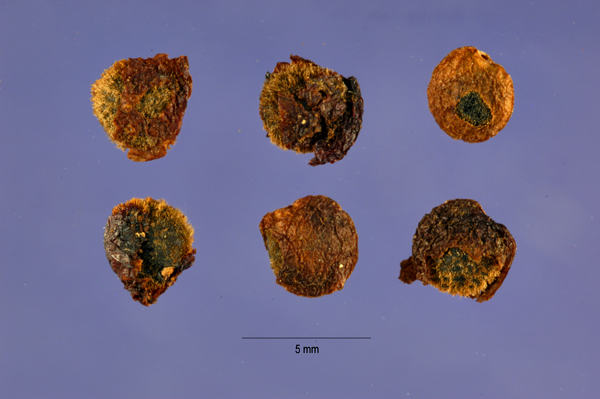
The bubble wrap seeds (U.S. National Seed Herbarium photo)
 John Bradford
 George Rogers
 George Rogers
 Dee Staley
 Treasure Coast Natives