RSS

Category Archives: Uncategorized

Using Natives in the Landscape

By Jayme Rieuf

Note from G. Rogers:  This essay is by horticulture student Jayme Rieuf, written during the Corona downtime.   This is so true, and so well written, I felt moved to share it on the blog. Thank you JR.
Using native plants could arguably be the most valuable thing one can do for their landscape for many reasons. Native plants are classified as a species that occurs naturally and thrives in an area in which it originally evolved. Native plants in any given area, state or every country differ. To begin native species are in fact better conditioned to the local environmental conditions. An example of this would be Forestiera segregata also known as Florida Privet that has adapted to sustain in Florida’s hot sandy soils. Native plants on average use less water because they are established to conditions of the area. This saves water which is considered a very valuable resource.
Species that are grown in their native environment usually are not in need of as much assistance from crutches like fertilizer, pesticides or even excessive watering patterns. In convential landscaping most often pesticides are over used or wrongly applied, which can actually kill beneficial insects which may be doing good for your plants. Not to mention how terrible pesticides can be for the environment and the one handling the product. With native species the minimization of these products means less runoff into oceans, streams and even our drinking water, which improves water quality for humans and animals. But this also reduces risk to humans for the long term with less handling, inhaling etc. of such toxic products.
Maintenance is lower in Native vs. Conventional landscaping because mowing, trimming etc. is not needed as frequently, which helps reduce use of non-renewable resources but also protects our water and air quality. As the world evolves the importance of air quality is increasing. Air quality is protected with reduced emissions of air pollutants caused by things like the gasoline from mowers, leaf blowers etc. Natives definitely reduce maintenance. Landscaping with natives is a positive for the environment by making an area healthier and introducing diversity of seed spreaders and pollinators alike. Luring in different species of birds, butterflies and other insects and animals adds to the beauty of one’s property and helps out others. This also proves to be an opportunity to educate our neighbors or friends on ways they can improve their own landscape saving time and energy. That may even encourage some balance of landscape designs to add a touch of coordination between properties.
The most valuable reason for using native species in your landscaping is the fact that it saves you money, because they practically take care of themselves. Native species evolve for survival over many years. They have adapted and will continue to adapt to our ever-changing conditions. Native species are valuable to landscaping for a number of reasons, if people understood more about the advantages of going for a native landscape they may be more opt to do so. That is the beauty of choice however, some people are high maintenance like their lawns. Taking this natives class has honestly given me such an appreciation for the species that are actually “meant to be here”.
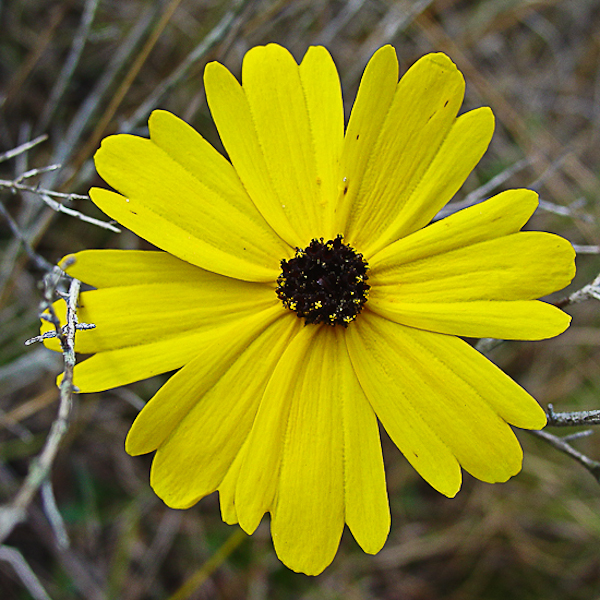
Coreopsis gladiata 3

photo by John Bradford
 
4 Comments

Posted by on April 4, 2020 in Uncategorized


Brookweed

Samolus ebracteatus

(Samolus comes from an ancient name for a related species.    Ebracteatus means there are no small leaves mixed with the flowers.)

Samolaceae

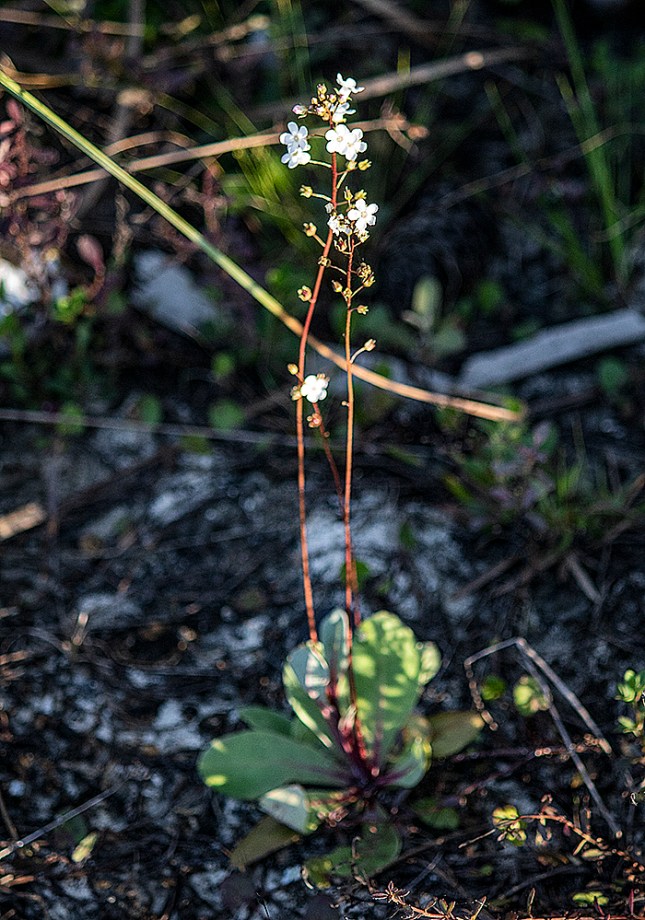
There’s a special “breed” of wildflower that I love to see and ponder…species that start their lives in water and then wind up high and dry as the season dried out, often very dry…from one extreme to the other.  Such wet-to-dry types always have interesting tricks up their sleeves.  “Brookweed” is a semi-misnomer for today’s species.   Yes, you can find it in brooks, but you can also find it in dry deserts where water had accumulated previously, in salt marshes, and, in Palm Beach County, on dry sand baking in the sun.   It favors alkaline conditions.   Today you’d never know it has anything to do with “brooks.”

Samolus ebracteatus in dappled sun

The leafy rosette at the base looks like something straight out of Arizona, with thick, succulent, waxy-looking  leaves  in a twisty rosette with some red sunscreen.  The rosettes of most plants have leaves that lie flat against the ground—think of a thistle or a dandelion.  But the brookweed rosette has the leaves contorted so that they tend to face the sun edge-on rather than the more normal face-on, the contorted  configuration cutting down on direct solar radiation at mid day, and at the same time maximizing wind exposure, allowing cooling.

samolus ebracteatus on cam ranger

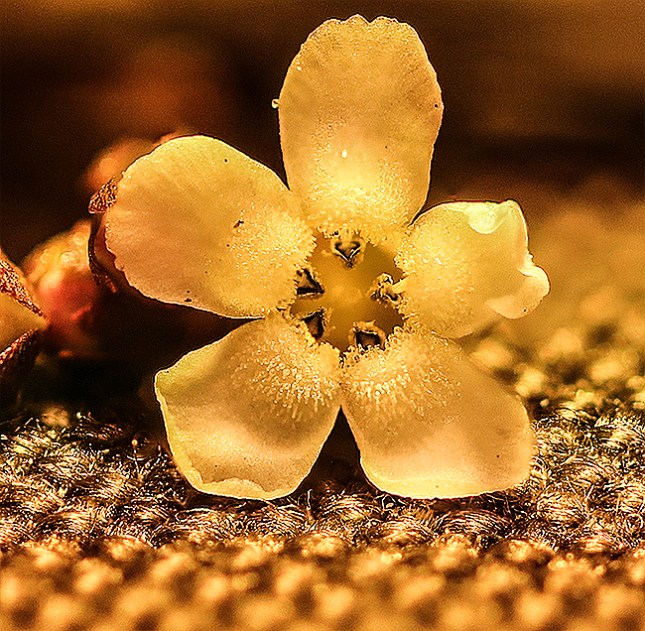
The white flowers are about ¼ inch in diameter on short stalks arrayed along a long wand.  They mature from the base upward as the wand grows, so as the season progresses the plant keeps making new flowers over a long time period while lower down fruits mature from the older flowers and release seeds. The entire reproductive cycle occurs all at once.

Seen from the side,  the flower looks like a tiny vase.  The upper rim of the vase is lined on the inside with five pollen-producing anthers mixed with fuzz.   The pollen-receptive style rises straight up from the vase floor. As the style rises it passes through the ring of fuzz and anthers which cover the tip of the style (the stigma) with pollen. That pollen germinates and completes the sexual cycle, all contained within the same flower.  No need for the birds and the bees.

samolus above green1

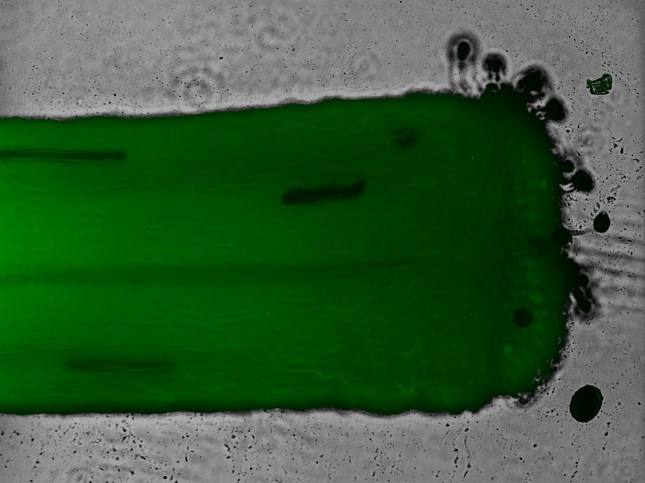
Style and stigma with self-pollen germinating.

That last statement is maybe a little over-stated.  Despite the self-pollination, bees and butterflies do visit the flowers.  Perhaps they bring a little outside pollen just to shuffle the genetic deck a bit.

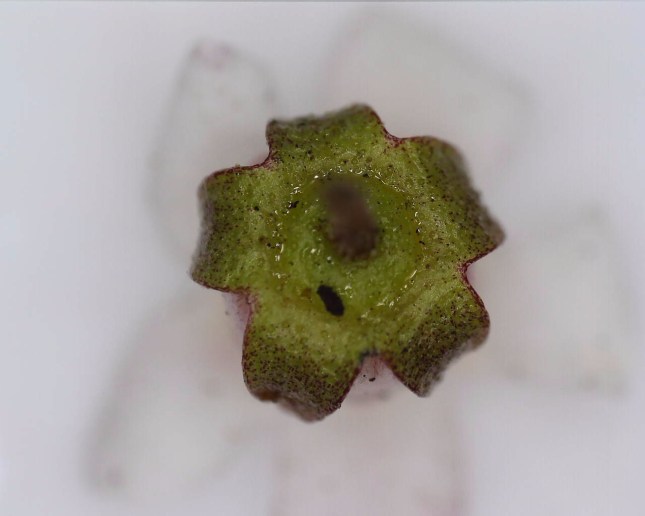
There’s one more weird thing.   On the outside of the flower at the base, there is a donut of glistening wet material around the “bottom of the vase” surrounding the point where the flower stalk is attached.   A mystery.  Can’t imagine the shimmering gel attracts or feeds pollinators who could not get at it down and outside.    I suspect it is “flypaper” to prevent little crawling insects from bothering the blossom.

200403172614863

Sticky ring around the base of the flower

 
3 Comments

Posted by on April 3, 2020 in Samolus, Uncategorized


Tags: ,

Bladderworts High and Dry Where Bladders Don’t Belong

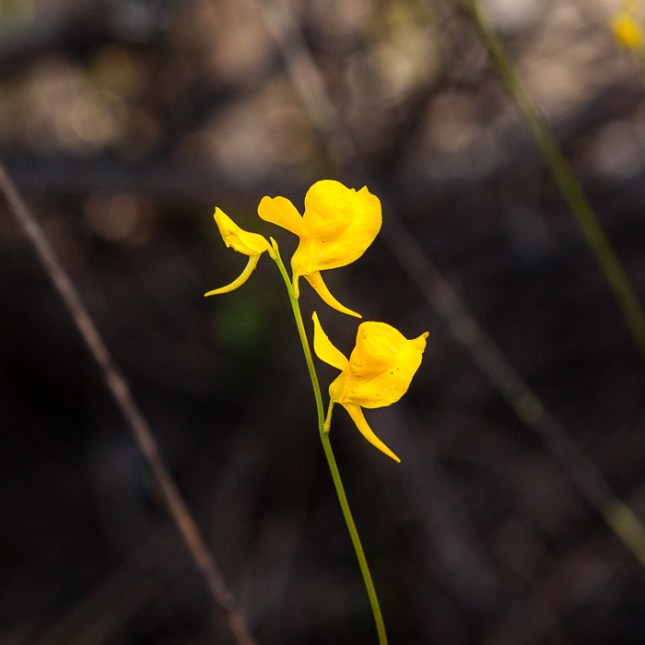
Utricularia cornuta

(A utricle is a bladder. Cornuta means horned, referring to the spur on the flower.)

Lentibulariaceae

ut corn 2

Horned Bladderwort by John Bradford.

Many wildflower enthusiasts are familiar with Bladderworts, species of Utricularia.    Utricularias are generally thought of as aquatic carnivorous plants dangling microscopic suction traps in the water.  The traps have trigger hairs and a trap door. When a minute swimming arthropod bumps the trigger, the trap sucks the victim in for lunch. That is documented richly on the Internet so no need for more here.

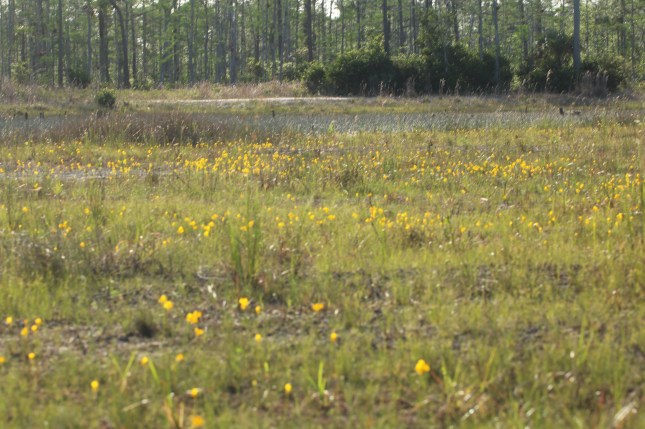
What has been interesting me this week is Utricularia growing in moist sand, often by the thousands in drifts of yellow.    Any questions? Question 1:  What pollinates a hundred thousand bright yellow blossoms all glorious at once in a couple acres?  That’s a blog for another day.

IMG_2064

Question two is the topic for today:  How can an aquatic water-filled bladder catch water-borne prey while stuck in sand?  There has to be more to the story. There is, some of it well known, some mysterious.   As the pundits say, “let’s unpack it.”

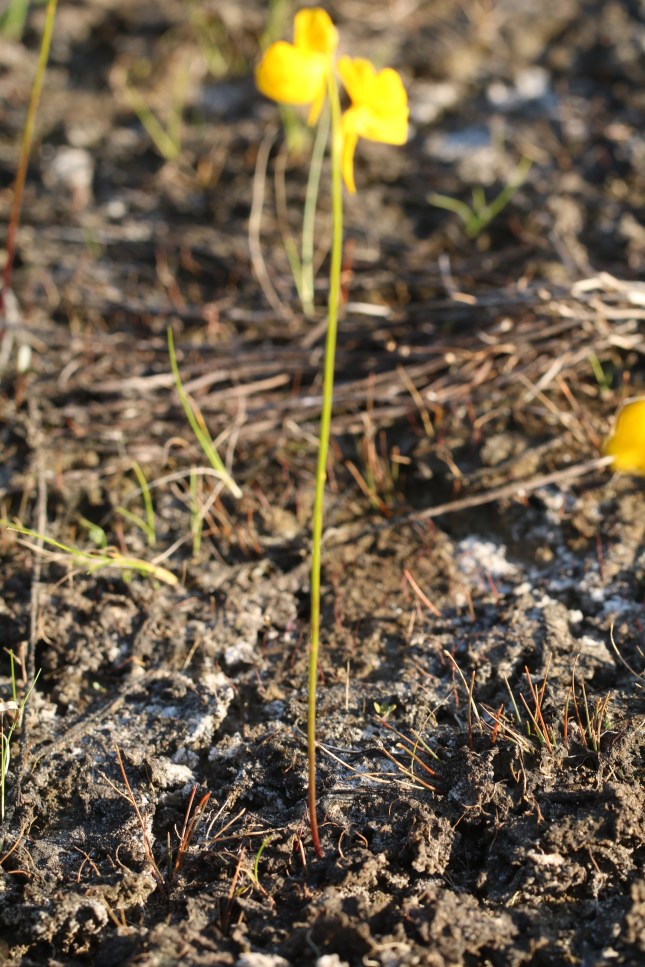
First of all, don’t the plants root in the sand? No—Utricularia has no roots, although we will soon see leaf-ish structures functioning much like roots.

But let’s stay above ground a moment.   Plants typically need to photosynthesize, and that is a job for leaves.  But where are the photosynthetic leaves?  The plants look like a bare stalk with a flower out of focus on top.

IMG_2109

utricularia cornuta snorkel stems 1

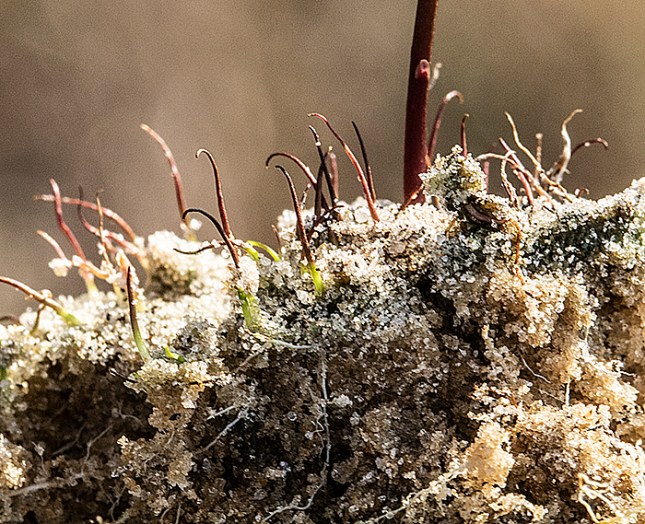
Vertical pins rise from the leafy mesh below the surface.

Just below the soil surface stringy leafy segments form a horizontal mesh, think of a smashed plate of spaghetti.  From that mesh millions of pin-sized segments rise vertically from the soil into the light of day.  The collective surface area of countless pins is substantial, like the microvilli in an intestine. They are green or partly red (sunscreen? damage?) and probably allow for photosynthesis, and conceivably help aerate the leafy portions below the surface, especially during flooding.    Room for research here!

A growing literature is revealing the idea of the trap feeding the plant by catching and digesting prey as simplistic.   The traps seem to be micro-ecosystems unto themselves.  CLICK

Trap-dwellers include microscopic protists, such as ciliates, bacteria, fungi, algae, and so-called bluegreen “algae.” Bluegreen “algae” are photosynthetic cyanobacteria often able to “fix nitrogen,” that is, convert atmospheric nitrogen to fertilizer.

The microbes manufacture nitrogen fertilizer inside the trap, you say?   Isn’t the main point of the carnivorous plant to obtain nitrogen from breaking down the insect victims? And photosynthetic bacteria inside the trap provide the same benefit without bloodshed?   Yes, if not studied adequately yet.

OK then, nitrogen-fixing cyanobacteria live inside the trap, possibly contributing to the plant’s nitrogen nutrition, what about outside the trap?   Not a new idea.  Botanists have recorded cyanobacteria clinging to the outsides of traps in the water.

So now think about that comparatively dry meadow of sand-dwelling utricularias.   Could  cyanobacteria in the sand be enriching the soil, maybe replacing the need for aquatic bug-catchery?

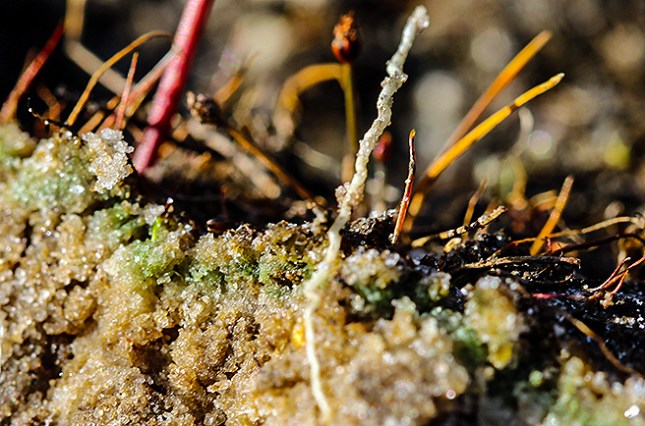
A close look at a population of Utricularia on “dry” land shows them mostly to rise from a thin surface carpet of periphyton, although not always, and there’s more to the picture.  Under the Utricularia is a blue-green living layer a fraction of an inch under the ground surface.   It looks like a miniature seam of coal.

utricularia gtreen band

A living blue-green seam in the soil

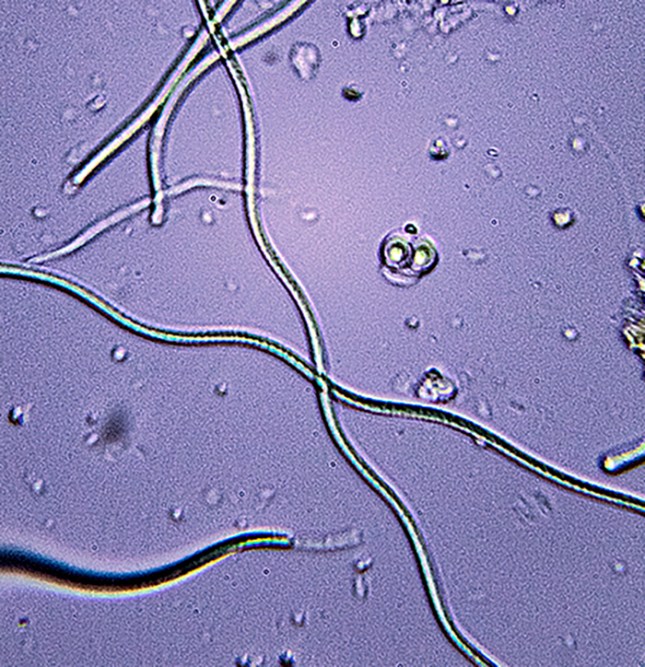
With room for more data (!), I suspect the land-living Utricularia is deriving nitrogen and possibly additional nutrition from the subsurface blue-green layer.  A look at that layer with a microscope shows it to consist in large part of, you guessed it, cyanobacteria.

utricularia cysnobacteria3crop

Cyanobacteria from the blue-green layer at the base of a Utricularia.

The plants form a thick brushlike mass  of rootlike leaves usually just below the green layer, or sometimes branching directly into it too.   The false roots can have traps, which exist to absorb nitrogen.   But who said it has to come from within?  Traps bathed in nitrogen fixed by a living soil layer of Cyanobacteria might as well absorb it from the outside as well.


2 Comments

Posted by on March 27, 2020 in Uncategorized, Utricularia cornuta


Tags: , ,

Sweet Shaggytufts

Stenandrium dulce

(Stenandrium means narrow anthers.  Dulce means sweet, probably in reference to the flowers although I detected no fragrance today.)

Acanthaceae, the Acanthus Family

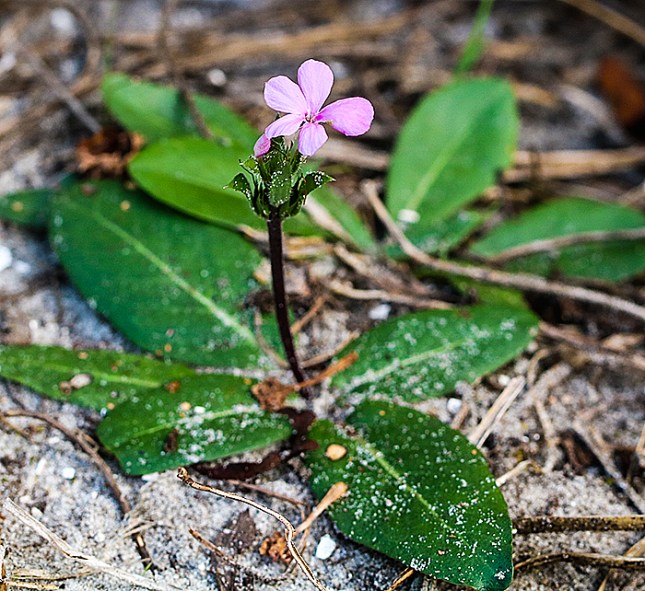
For a variety of reasons I’ve let the blog lapse in recent months.  But here we are with isolation time for  nature.  So today I took to the Covid-free swamps to re-find a large population of Sphagnum to help with a friend’s research effort.   Plans take odd turns.   Out of the shrubbery scampered a big mother feral hog with cute baby(ies) and stood her ground in the path making grumpy snorty sounds, so I headed in a different direction, passing Sweet Shaggytufts during my craven retreat.   Now that’s a pretty species you don’t see every day, or every decade.

Stenandrium plant

We live near its northern limit, in Georgia, from which the plant extends southward to Chile.   Ask three observers what the natural habitat is,  and you will get three different answers.  It is one of the several species occurring locally that live like toads…starting out in water and ending up high and dry, often very dry.  Despite being semi-“aquatic” Stenandrium turns up on hot sun-baked sand, such as it did today, even in deserts and similar circumstances.  It spans both extremes, which is not unusual in South Florida.  Additional amphibians coming to mind include Brookweed (Samolus ebracteatus),  Hornwort (Mitreola petiolata), Small Butterwort (Pinguicula pumila),  and Oakleaf Fleabane (Erigeron quercifolius).

Stenandrium forms rosettes flat on the ground, often lots of rosettes, apparently from self-seeding.   It likes open space with no competitors and reportedly can  maintain its social distance by making natural herbicides.

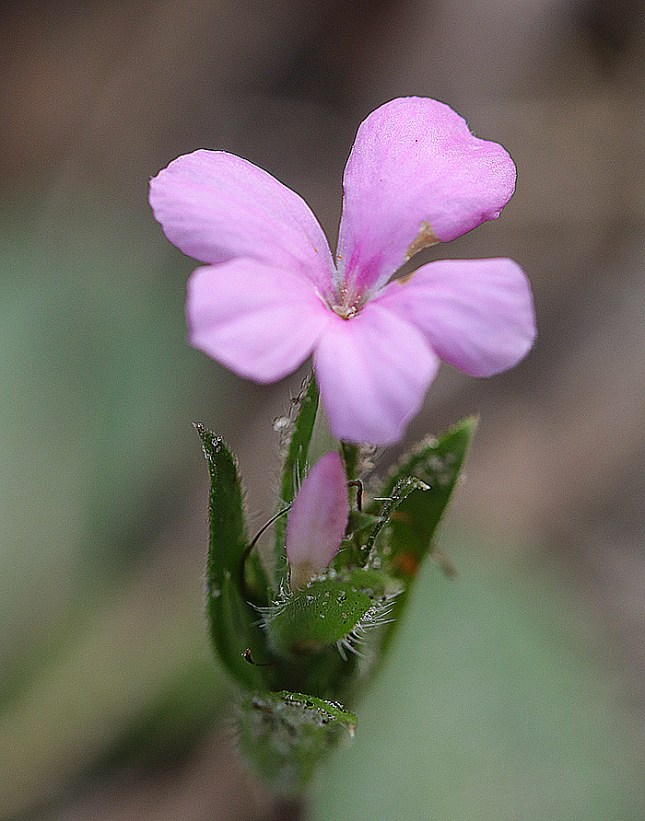
stenadrium flower oblique

Today’s flower is a member of the large family Acanthaceae where the vast majority of species have microscopic pointy crystal-like structures in their leaves, called cystoliths.   Nobody knows what cystoliths are good for, although discouraging herbivores is a distinct possibility.  Stenandrium is in the small branch of the family without cystoliths, and (to speculate shamelessly) I wonder if the absence of cystoliths allows it to host the Definite Checkerspot Butterfly larva.  Perhaps the missing cystoliths force the  need for protection using the insect-feeding deterrent called benzoxazine. (Many caterpillars have the ability to tolerate and sequester toxins from the host plant.)  Don’t eat the weeds.

Even in 2020 what pollinates those pretty pink flowers is unknown.    Birds, wasps. and bees do not fit.  Moths are possible.  Butterflies seem most likely, and it would be fun to sit in the Shaggytuft patch awhile and see what flutters along.  I might just try that…although waiting for pollinators requires more patience than fishing.  Neither fish nor butterflies care about your timeframe.

 
14 Comments

Posted by on March 22, 2020 in Stenandrium, Uncategorized


Tags: , ,

Wild Coffee and Friends—Tropical Species Coping in Florida

Psychotria nervosa

(Psycho refers to a person’s health and spirit, reflecting medicinal perceptions for some members of the genus. Nervosa refers to the sunken curved leaf veins.)

Rubiaceae, The Coffee Family


Wild Coffee is an abundant native shrub popular in landscaping. So pretty!   To dispose quickly of an old question, no, it is not coffee that is wild.   The connection of Wild Coffee to Dunkin’ Donuts is merely a superficial resemblance to a true coffee plant and membership among several thousand other species in the vast Coffee Family, along with Ixora, Pentas, Mexican “Clover,” Snowberry, Firebush, and many additional familiar plants.    The genus Psychotria itself has over 1500 species,  and includes a prime ingredient in hallucinogenic ayahuasca.   This has nothing to do with our Florida shrub which gives no high, is not edible, and can reasonably be presumed to be toxic.  Wild Coffee is a terrific example of a mechanism to promote cross pollination called heterostyly described several years ago in this blog.  CLICK

After a hiatus of some 8 years, here  now is a different oddity of Wild Coffee, one repeated among the Rubiaceae.    A little context will help:

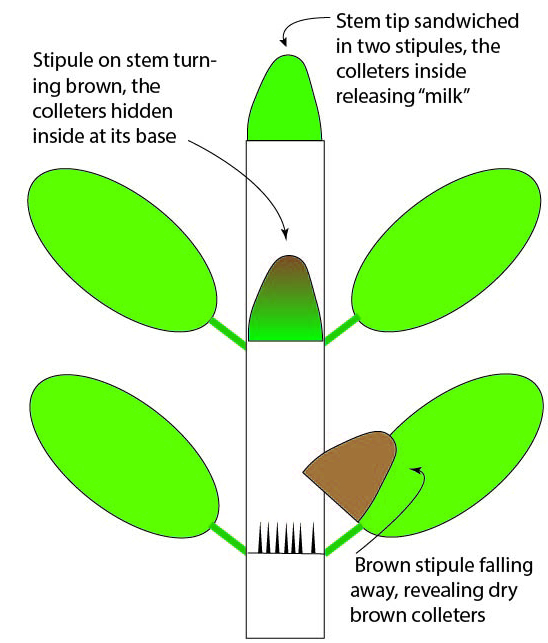
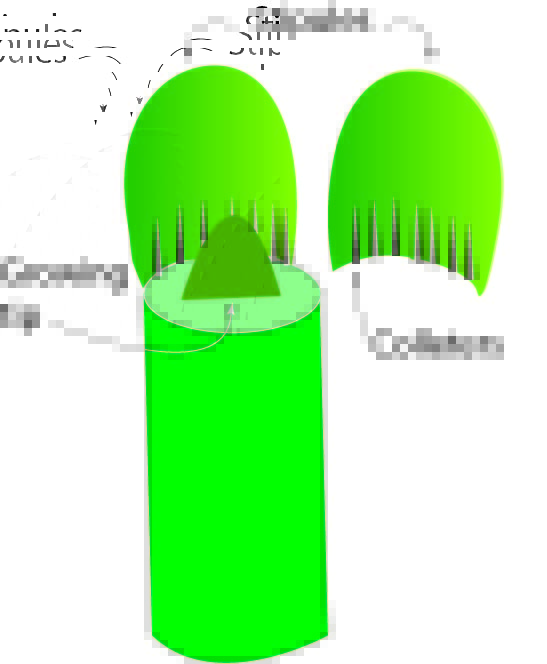
Stipules  are outgrowths in some plants where the leaves join the stem.

The Coffee Family has a peculiar sort of stipules, called interpetiolar stipules, which are flaps connecting the bases of the paired leaves.  Each leaf pair has on both sides of the stem a pointed or rounded (or fringed) stipule rising up and pressed against the stem.

Print

At the tip of the stem two stipules cover the growing tip.  Think of two hands clasped in prayer with an egg (the growing tip) between them.

stipules opened with gradient

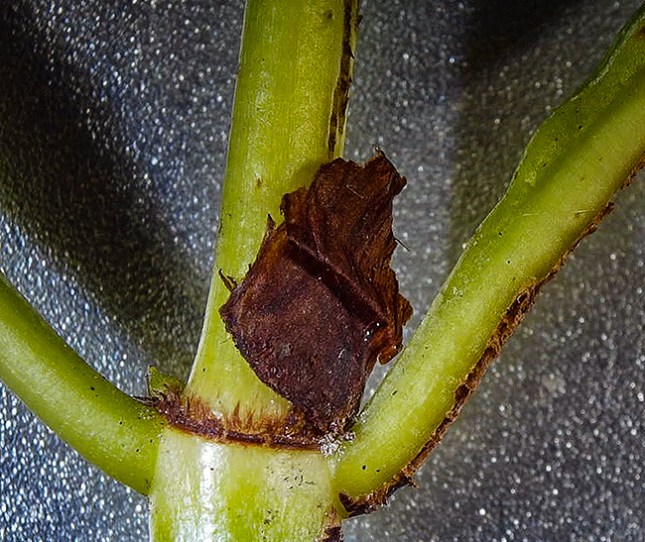
Now the interesting part.   On the base of the inner face of each stipule is a row of finger-shaped organs called colleters (CALL-eh-ters).   You can see older brown or black colleters between leaf bases along the stem where aging stipules have dropped off.

Psychotria old stipule

Old stipule falling off. Colleters from its inter face visible as brown hairs between the leaf bases.

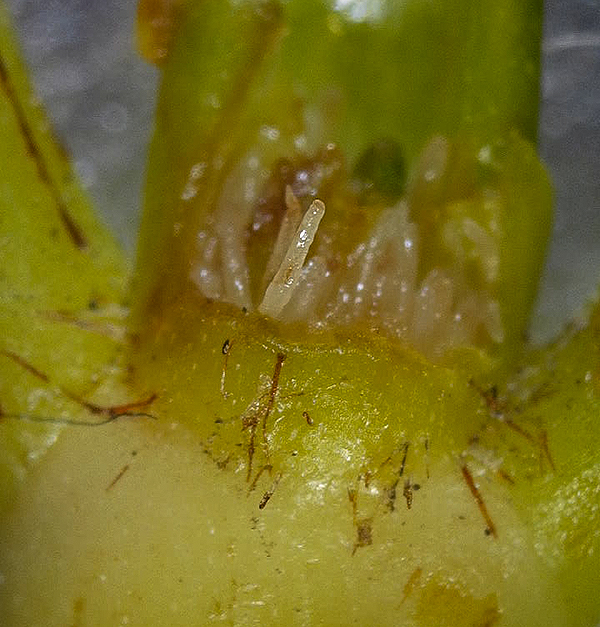
In the stem tip, by contrast, the colleters are fresh, white, and secreting a sticky fluid the color and consistency of Elmer’s Glue which fills the chamber between the stipules.

Psychotria white colleters

Fresh colleters at stem tip during secretory phase.

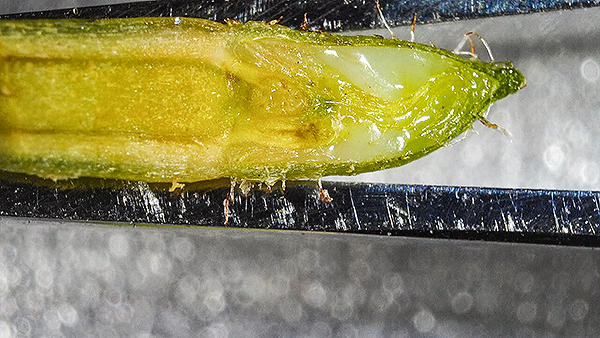
Psychotria cut tip

Wild Coffee stem tip sliced open.  Note the white fluid mixed with the immature leaves.

Botanists have speculated on the function of the fluid. Given that it surrounds the tender growing tip, the standard interpretation is it protects the tip.  Okay, but personally I think that’s not the whole truth.   As the stipules part and young leaves come forth the young leaf blades are wrinkled and sticky with the white fluid.   Seems to me that the crinkling delays direct sun or wind exposure on the emerging leaves, and that the persistent fluid may add protection from drying until the leaves mature a bit.

Time to broaden the perspective.  Wild Coffee is a tropical species with a northern extension, growing from  hot South America to frosty Duval County (Jacksonville area).   Interesting that a tropical species with a toe into the nasty “north” has a well protected growing tip.  Plants that evolved in cold climates generally have bud tips encased safely under tiny bud scales to get through the winter.    A tropical plant penetrating into harsher climates has to have “its own” protection.

Now don’t get me wrong, I’m not suggesting that the plant developed the fluid-filled stipules in response to its high-latitude expansion.   Fact is, many tropical plants have various devices to protect their tips from sun, drying, insects, wind, infections, and more.   Perhaps some of those protective mechanisms help certain tropicals expand into climates harsher than where they originated.  Like cool counties in Florida.    Tropical plants extended into Florida face tough conditions beyond cold.   Without a statistical study, I think it safe to say that most of our tropical species live near the warmer yet windier and saltier coasts.   And in addition to chilly temperatures we have plenty of blazing heat, dry times, fungi, bugs, wind, and tough livin’.

Let’s look at some additional tropical species with northern limits in Florida and see about their bud protection:

Strangler Fig, Ficus aurea, grows from Central America to Volusia County (Daytona).  Its growing tip hides under a thick nose cone formed by the stipule on the topmost leaf.

Ficus bud

Strangler fig nose cone (stipule) at stem top covering bud.

Red Mangrove, Rhizophora mangle, growing all around the tropical world and extending north to the Florida Panhandle (and rarely farther), likewise has a giant slime-filled nose cone over its bud.

Seagrape, Coccoloba uvifera, is a third species with a bud tip nose cone.   It reaches from South America to Flagler County (a little south of St. Augustine). (For those familiar with botanical terminology, the cone is the ocrea.) The cone is filled with a clear gel that might add protection in the bud phase or perhaps by “varnishing” the baby leaf as it grows forth.

Seagrape bud

Sea Grape nose cone over tip bud, sliced to reveal gel.   Object rising on the right is a leaf base.

Pond Apple, Annona glabra, extending north to Brevard County from South America, has its tender tip hidden beneath the base of the topmost leaf until new growth pushes off the protective older leaf.

Annona bud

Pond Apple. Leaf stalk (green) completely covers stem growing tip.

We could go on, but that will get boring, especially because the point here is that this is something fun to explore, not to list.

 
4 Comments

Posted by on December 20, 2019 in Uncategorized, Wild Coffee Stem Tip


Jack in the Bush Goes (Almost) Pollen-less

Chromolaena  odorata

Asteraceae


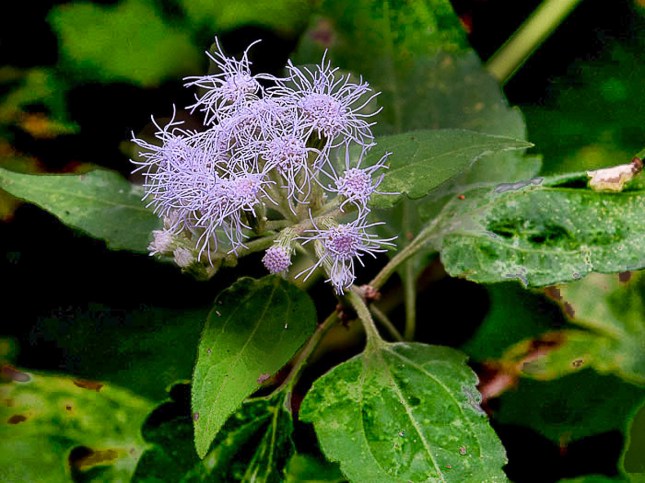
Across vast areas around the warm-climate world, including Florida, lives Jack in the Bush, a huge, raggedy, hairy, smelly,  weak-stemmed weed up to 10 feet tall, often leaning on other plants.   The leaves often look bedraggled, and they suffer often from leaf miners.

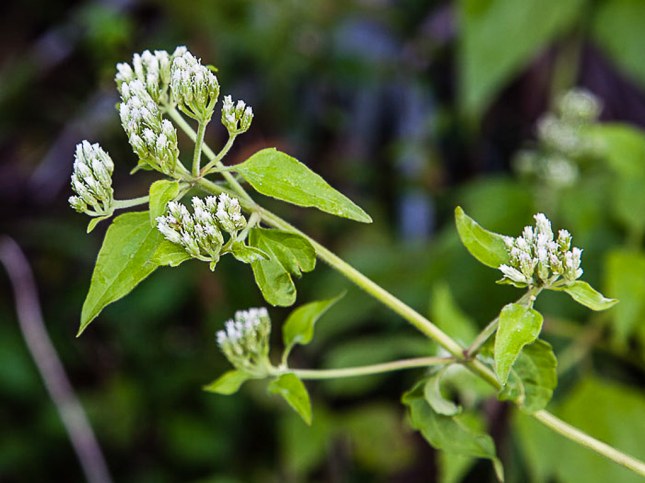
The flower heads start out white and wind up borderline pretty and pinkish, fuzzy, with long protruding stigmas.   They attract several species of butterflies as well as additional insects.  Notice I did not say insect “pollinators,” because the bug visits are pointless to the flower…there is almost no pollen.

chromo2

Jack in the Bush, white phase. Both photos today by John Bradford.

Members of the Aster Family generally share a common basic pollination plan.   The flowers have 5 male pollen-making anthers joined edge-to-edge into a tube with pollen released into the hollow inside of the tube.  The female style then rises up through that tube and either pushes pollen out like a plunger ahead of its  two pollen-receptive stigmas, or the style drags pollen out of the tube using a “bottle brush” below the stigmas.  Jack belong to the bottlebrush type.    Its long style rises dramatically from the anther tube exposing two big long stigmas just asking to be pollinated.  Below the stigmas on the style is the bottle-brush where there ought to be pollen.   Only problem is, there’s almost none.  What’s up with that?

chromolaena jb

Mature flowers. The long threads are stigmas on the styles.

Knowing a plant to be a worldwide weed is a red flag to look for some ability to reproduce rampantly without benefit of separate individuals of the same species.   That is, for a pioneer to be able to make seeds all alone. There are many such mechanisms, and one is to make eggs that do not require sperm, or in more botanical terms, viable seeds bypassing pollination.

True of today’s species.  Jack in the Bush has six sets of chromosomes instead of the usual paired chromosomes we think of as normal.  Extra chromosome sets are not rare in plants, and have different consequences in different species.   Normal paired chromosomes matter during formation of eggs and sperms.    Our chromosomally abnormal weed cannot make pollen, at least not much of it.   So how does it spread like a weed?   No problem,  the extra chromosome sets do not prevent egg formation,  In fact, just the opposite, eggs form needing no pollination.  The embryos are clones of the mother plant.

Probably all the Jack in the Bush in Florida is probably one big genetic clone.  The butterflies love it nonetheless.

 
3 Comments

Posted by on December 15, 2019 in Uncategorized


Red Mangrove Embryos Bob Bob Bobbin’ Along

Rhizophora mangle

(Rhizophora means root bearing.  Mangle is Spanish for mangrove.)

Rhizophoraceae

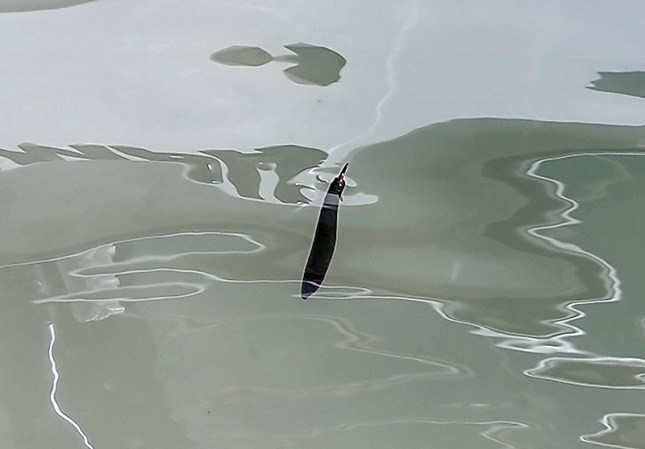
Red Mangroves astound in many ways. One of the is the embryo.   The Red Mangrove embryo bobbing in the sea looks like a purposeful eel swimming vertically with its head above water.  Before getting far into the swimming, a few words on the embryo’s nuts and bolts.

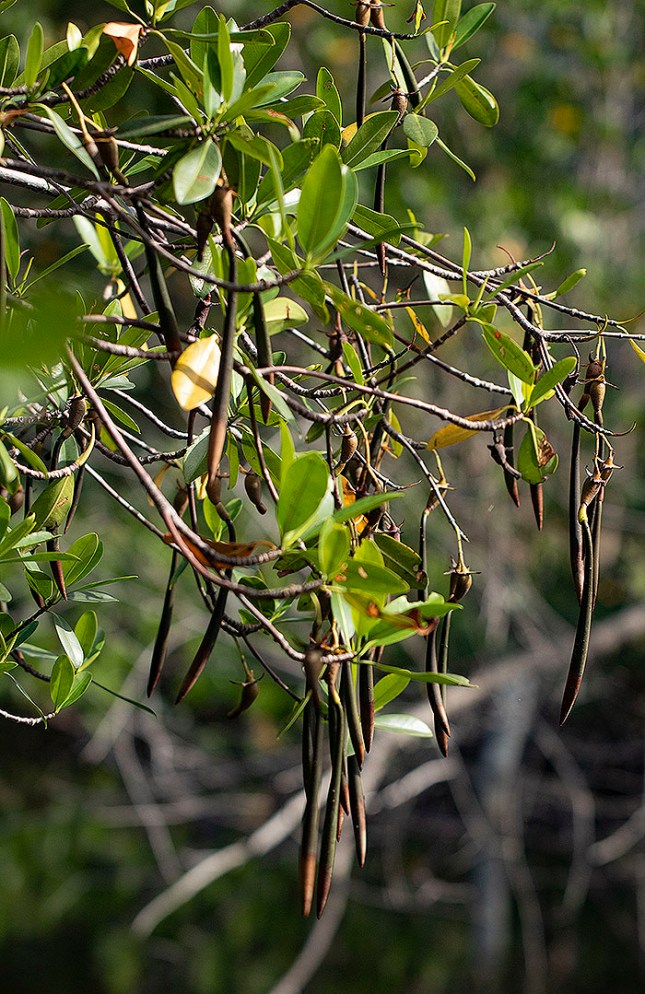
A normal fruit on any other plant contains one or more seeds, and each seed in that normal plant houses a tiny embryo destined to grow into a new oak tree or orchid.    But Red Mangrove is not normal.   It makes a small rusty-leather fruit the size of a strawberry containing two seeds., one of them surviving.   So far so good, but now it gets weird.  The seed sprouts while the fruit still dangles from the parent tree.  The resulting embryo, resembling a large green bean, grows forth from and eventually dwarfs its fruit and may reach about a foot long and a half-inch in diameter dangling from the tree, the original fruit forming a brown cap around the green embryo’s attached upper end.

rhizo embryos on tree

Embryos looking like green beans hanging on the parent tree.  The fruits are the brown caps at the upper ends of the embryos, which will soon drop free leaving the fruits behind on the tree.


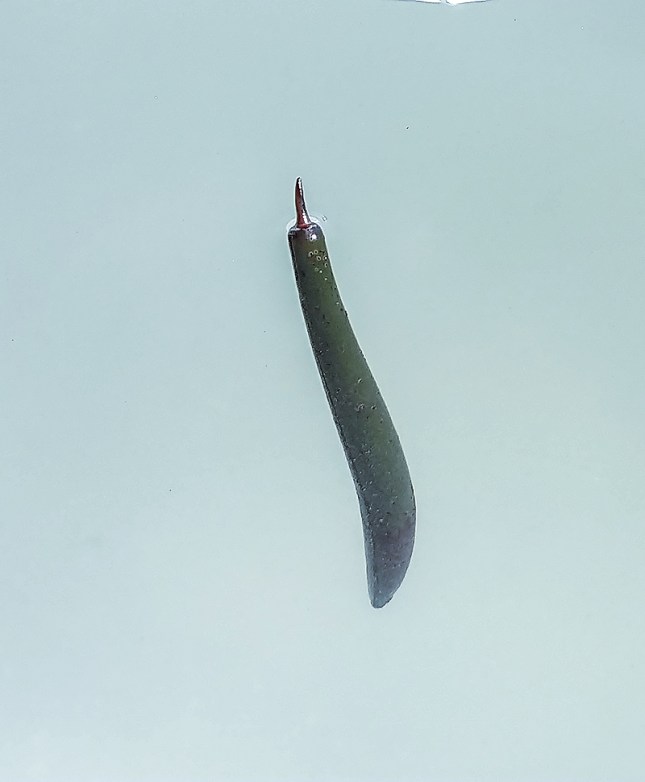
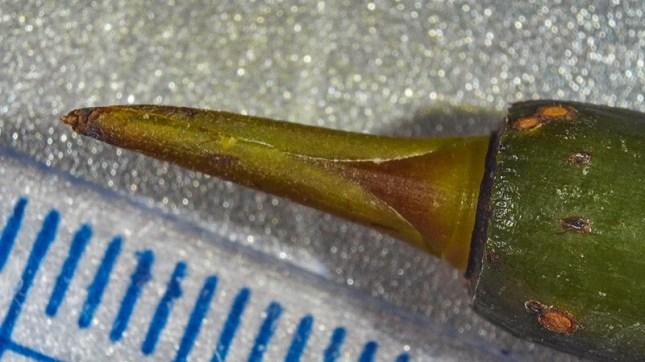
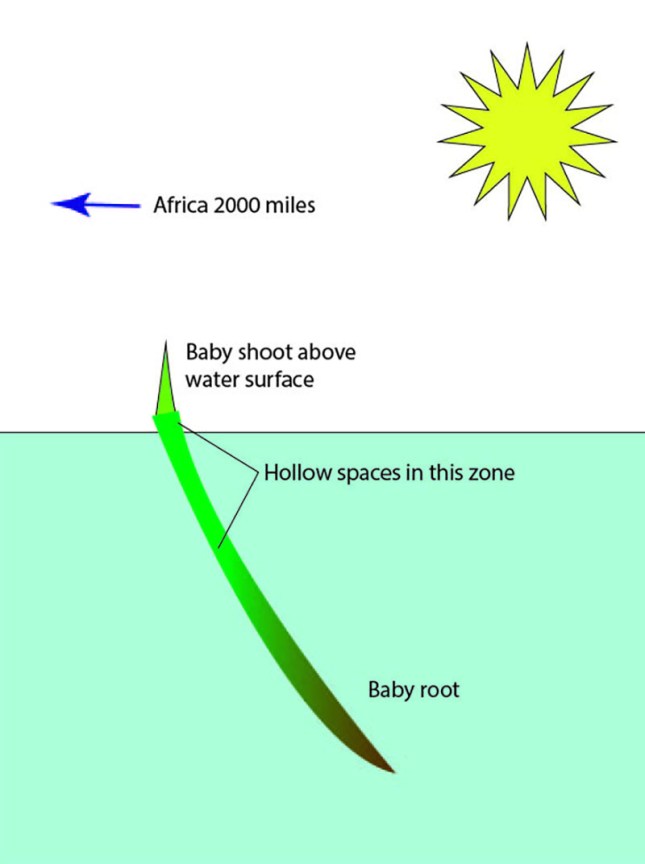
When it finally comes time to go float to a new beach, the embryo breaks free, leaving its topmost parts (the cotyledons) behind within the fruit.   The part that falls into the sea then is an enormous root (hypocotyl) vertical below the water line with a little pointy tip exposed above the surface.  The pointy tip is the beginning of the top part of the future tree, the embryonic leaves, stems, and trunk.

rhiz4afloat

Embryo floating in the Atlantic Ocean.

rhiz1

rhiztop

The pointy tippy top.

Why does the bottom end stay down while the top end stays up?    Not only is the bottom thicker, it also fails to have something the top possesses…open hollow airspaces.  The spaces clearly give the top end buoyancy, and perhaps have an additional role in gas storage and exchange.

Rhizembryoslice neartop

Hollow spaces seen when the top part of the embryo is sliced open.

Here is the kicker.  The floating embryos cross oceans.   Their cruise can reportedly last a year.   For all those months the sojourners do not merely dormant and sleep their way across a thousand miles.  Rather, it looks like they live and breathe along the way.   Even when the root end down in the water turns brown, the upper end remains green and has chloroplasts.   There must be a reason the little swimmer keeps its head above water, no doubt the same reason I do…life support, gas exchange.   Those little submarines have circled the earth bobbing along with their  snorkel tops peeping above the waves.

Print

 
5 Comments

Posted by on November 8, 2019 in Uncategorized


Narrowleaf Yellowtops is a Pollen Pusher

Flaveria linearis (Flavus is Latin for yellow.)

Asteraceae


Must be October, the Yellowtops glow goldenrod autumn,  rich canary yellow in wet meadows and beyond.  They’re a friend to many pollinators.  Fact is, it is fun to get among the plants and see what visitors show up.

Flaveria linearis 2

Photos by John Bradford
No need to linger on a boring point of physiology, but it is my duty to point out that this species is an intermediate in terms of C3-C4 photosynthesis.   The first, C3, is “normal” photosynthesis, typical of temperate plants.   The second, C-4 photosynthesis, is a biochemical and anatomical specialization typical of many tropical plants.   A plant has to be one way or the other, or does it?

Three native Flaveria species grace Florida:  Two are intermediate C3-C4. They are F. linearis and F. floridana which DNA shows to be a narrowly distributed Gulf Coast offshoot of the widespread F. linearis.  What’s interesting is that F. linearis ranges into cooler north Florida and into the hot tropics.  Is that the benefit of having mixed temperate-tropical photosynthesis?

Flaveria linearis 1

Our third native species, F. trinervia, is not closely related to the other two.  It is C4 and evidently a South Florida visitor from a worldwide tropical distribution…with surprising (brief?) cool-climate extensions.
Members of the Aster Family often dish out pollen in more complex and intriguing ways than are conspicuous at first glance.  So it is for Narrowleaf Yellowtops. The flowers are reluctant to release pollen until an insect comes probing and stomping.  Bug-pokes cause the little blossom to push out pollen within seconds of contact.   Watch it happen in the brief video below where a fake insect provokes pollen expulsion.

Pollen-pushing video. Be patient, the action is episodic and subtle:  PUSH HERE

 
1 Comment

Posted by on October 11, 2019 in Narrowleaf Yellowtops, Uncategorized


Redroot Roulette

Carolina Redroot, Lachnanthes caroliniana

(Lachnanthes means woolly flower.)

Haemodoraceae

Carolina Redroot is famous for its namesake red roots.   Been there, done that:  CLICK

This wetland bleeder hangs around where feral hogs snuffle the earth.   Correlation does not show cause, however.   Do the hogs seek out the redroot?  Do they spread it?   Or does the plant happen to grow in mudholes hogs fancy for other reasons? I don’t know. And for this moment, I don’t care, because what I wish to discuss are the unusual flowers, visited at least by bees, wasps, and butterflies.

The butterflies come for nectar, and perhaps the bees come mainly for pollen.  Somebody is going to have to sit a long time in a marsh with camera, binoculars, and bug net to tell the full story of Lachnanthes pollination.

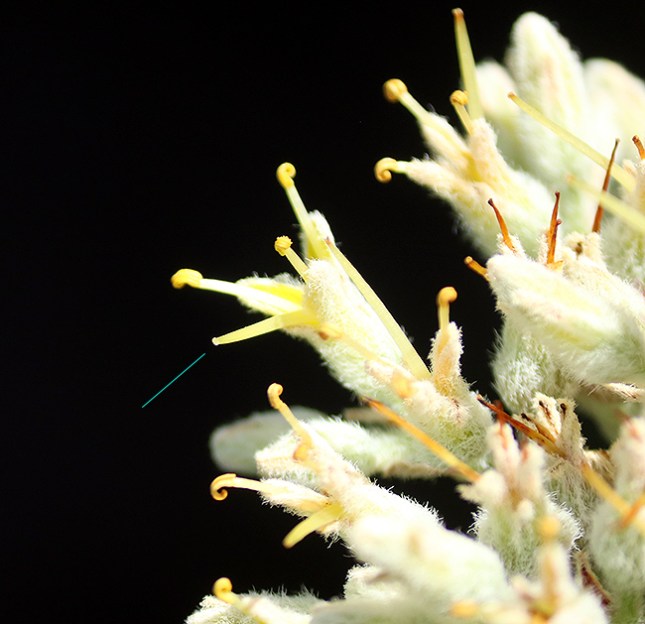
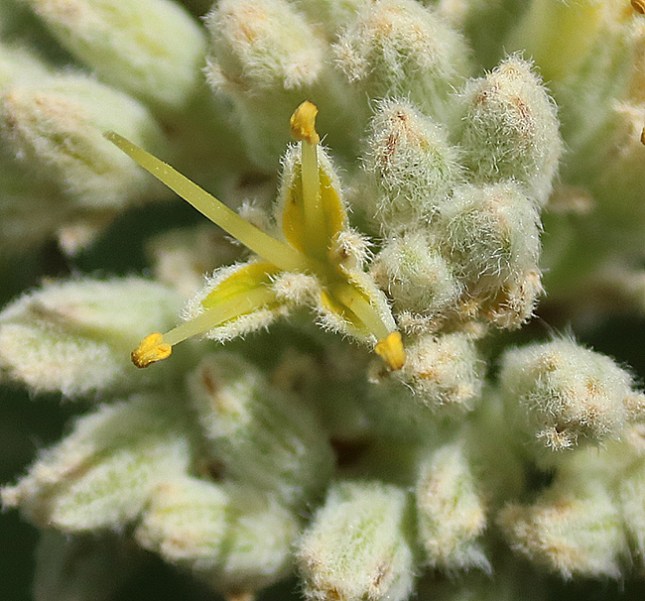
What’s  weird about the flowers is that seen from the side the style with its pollen-receiving stigma is bent outside of the floral center, at about the same height as the pollen-releasing anthers.

Lachnanthes stigma to side marked

Side view of woolly flowers. Anthers are dusty yellow. Stigma marked with blue line.

Lachnanthes top down good use

Flower from above. Three anthers yellow. Style green angled up and left.

Seen from above, the stigma juts out to the side about as far as the likewise bent anthers do.  Picture the flower as a clock face.  In the photo above the anthers are at 12, 5, and 7 o’clock releasing dusty yellow pollen.  The green style with pollen-catcher stigma at its tip is at 10 o’clock.      The stigma is in a spot where you’d reasonably expect an anther. Within an inflorescence, the bent stigmas point in every direction.

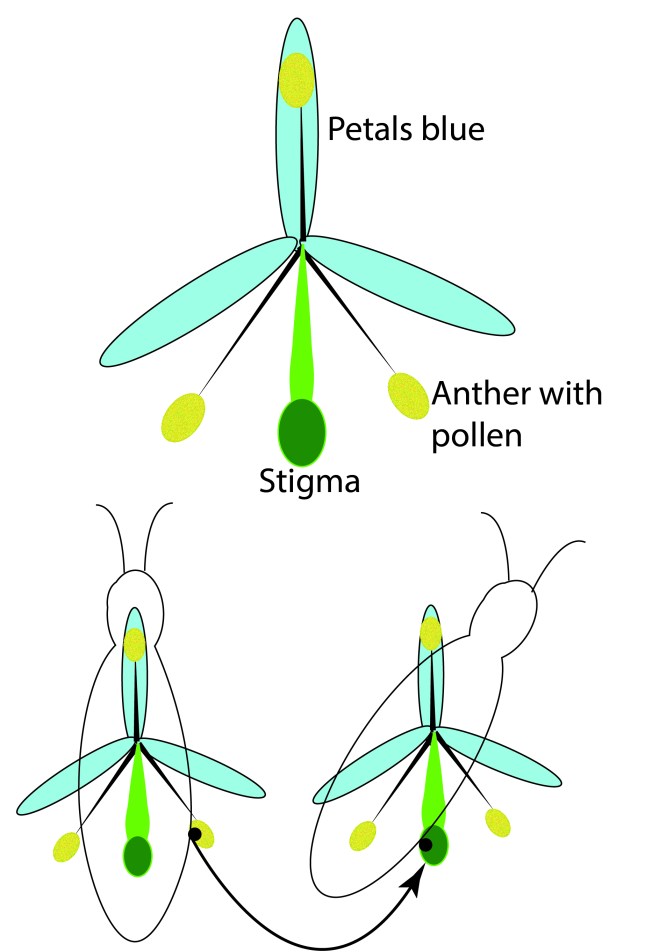
What’s up with that?  One answer, not original with me, is that the stigma is out of the way of all the sundry pollinators, but it seems there is more to it.  Given that the stigma occupies an “anther position,” an insect visitor is as likely to contact the stigma as any single anther.   Visitors approach the flowers oriented variably.   Spot on the insect pollen-dusted on a different flower will occasionally hit the stigma spot.  Twenty-five percent of the flower touches will be pollen drop-off, the other 75 percent will be pollen pick-up from the insect’s standpoint. This presumably accomplishes two things:

Accomplished thing 1. Accommodation of the diverse floral visitors.   All manner of bees, wasps, butterflies, and who knows what can play redroot-roulette, even perched on one flower  sipping nectar from another, or while feeding vertically as well as horizontally.

Accomplished thing 2. The roulette system may help promote cross-pollination. The incoming pollen is scattered on various insect body points from past visits to other flowers.  The different pollen-pickup points on the insect may carry pollen from multiple flowers.   The pollen deposited on a stigma is equally likely to have come from any of many flowers, all depending on where the roulette wheel stops.   A great system for mixing genes.

Lachnanthes disgram 2

Redroot roulette.   The insect in the diagram picked up pollen on its right side and deposited that pollen on the next flower it visited.  Perhaps on its next stop it will drop off pollen from its left side, or from its chin.

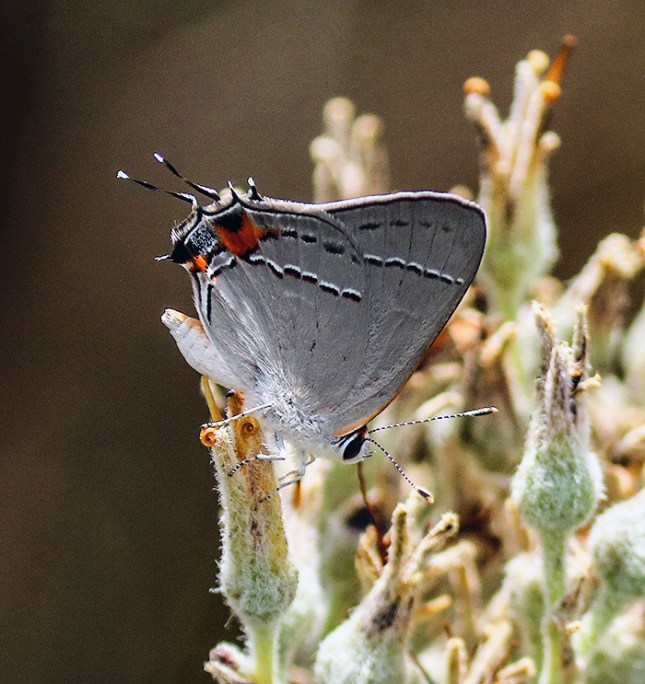
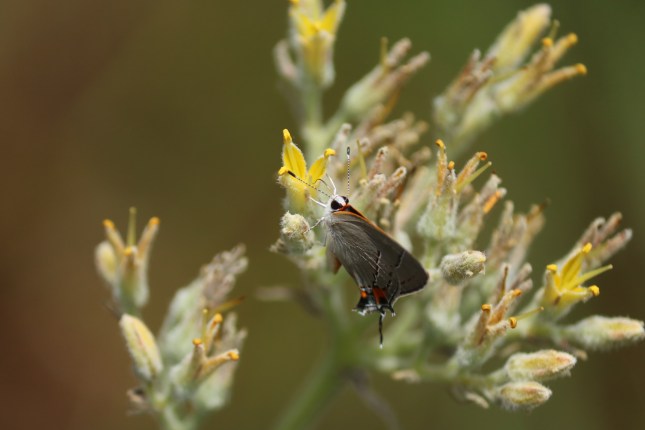
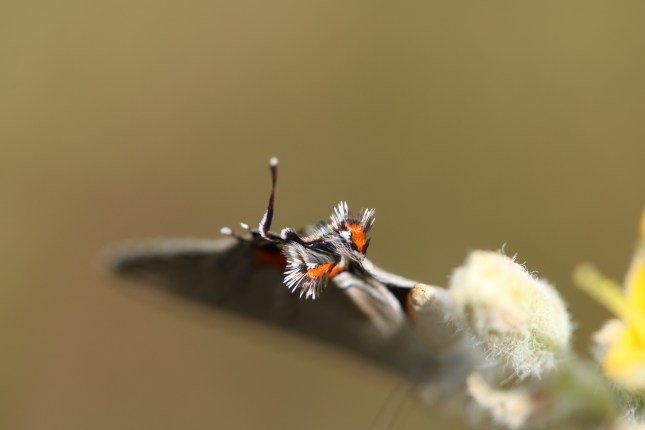
Partial to redroot is the gray hairstreak butterfly. Today one was alternating between two plants, ignoring all others.  Most of its flower action is head down, for a reason.   The head is inconspicuous, while the fanny looks like a showy head, complete with orange coloration, false eyes, and best of all, fake antennae.

butterfly both ends S GOOD USE

Head down on redroot. Fake antennae “up.”

An attacker is likely to go for the wrong end of the butterfly.  You might think a bird would gobble it up altogether, so what good is that fake head?  Entomologist Andrei Sourakov from the University of Florida found out.   The predators fooled are not big birds, but rather spiders.  They inject their venom into the wrong end of the butterfly.  Score one for the graystreak.

butterfly feeding front end g

Sipping nectar

butterfly rump end 1

The rear end with false eyelashes.

BRIEF VIDEO  Watch the fake antennae wiggle: CLICK

THE END


2 Comments

Posted by on September 5, 2019 in Uncategorized


Giant Whitetop, Broadleaf Painted-Sedge

Rhynchospora latifolia

(The name means wide-leaved beak-seed.)

Cyperaceae, the Sedge Family

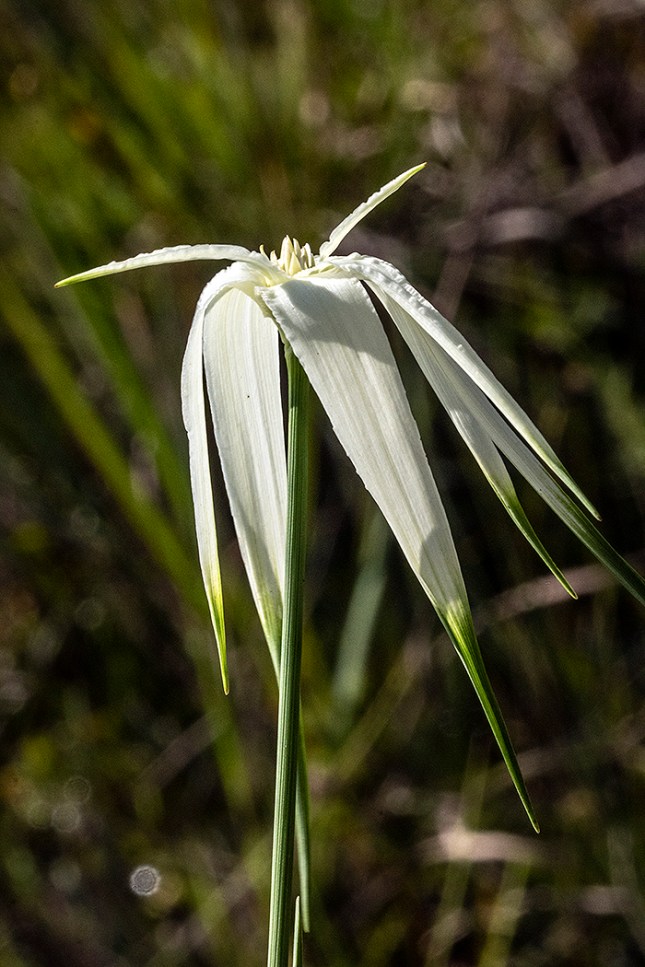
Today’s wildflower is the chosen topic because it is so pretty and so eye-catching now in mid summer.   Rhynchspora latifolia decorates wet meadows and similar habitats standing 3 feet tall, waving its white and green flower heads above its neighbors.    Its smaller cousin Rhynchospora colorata has fewer white lobes, has the lobes not narrow abruptly at the green parts,  often grows more crowded, and prefers slightly less wet sites. According to reports R. colorata prefers alkaline as opposed to R. latifolia in acid locales, although I suspect that habitat difference is a bit overstated.  I’ve seen the two growing within a few yards of each other. Checking that out with a pH meter would make a great class research project.

rhyn lat flower head

The white “petals” are leaves (bracts).

What’s famously odd about the two rhynchosporas, additional Rhynchospora species not represented locally, and a smattering of other sedges and grasses is that they are fully or partially insect-pollinated species in huge plant families the textbooks generalize as wind-pollinated.  These are plants whose ancestors turned away from insect-pollination to wind, then the painted-sedges reverted to insects..

That’s like going back to golf after you throw away the clubs.  They had to re-evolve all the insect-related pollination apparatus starting from scratch.   Colorful petals were long-gone so the replacements are false petals made of white leaves (bracts) green at the tips.   Nectar is gone too, but there’s bright yellow pollen to attract and feed visitors.   What’s dismaying is that these flowers have re-evolved sweet floral perfume, released it seems only briefly in the morning. Most of the day they are without fragrance, but at perfume time they are surprisingly potent.

Morning seems to be the main time for action.  That is when all or most of the pollen-bearing anthers come forth, although they can persist all day.   That is also when most of the pollen-receptive stigmas come forth, although some may be apparent all day.

Rhyn lat stigmas showing 2

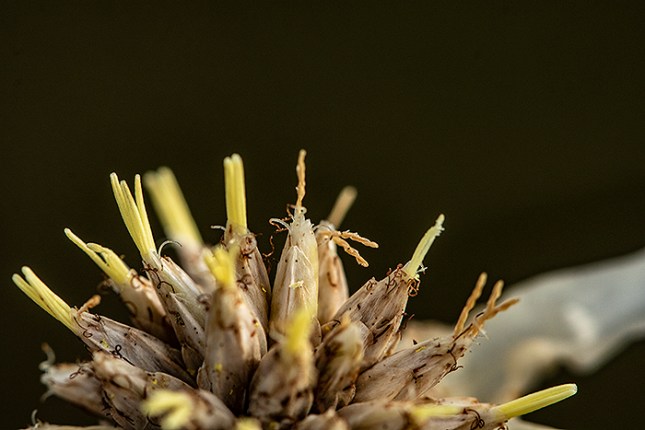
Spikelets (each thick white unit is a flower cluster).  Anthers are yellow. Stigmas are smaller, finer, and white.   Each spikelet is wrapped in bracts and contains several crowded flowers.

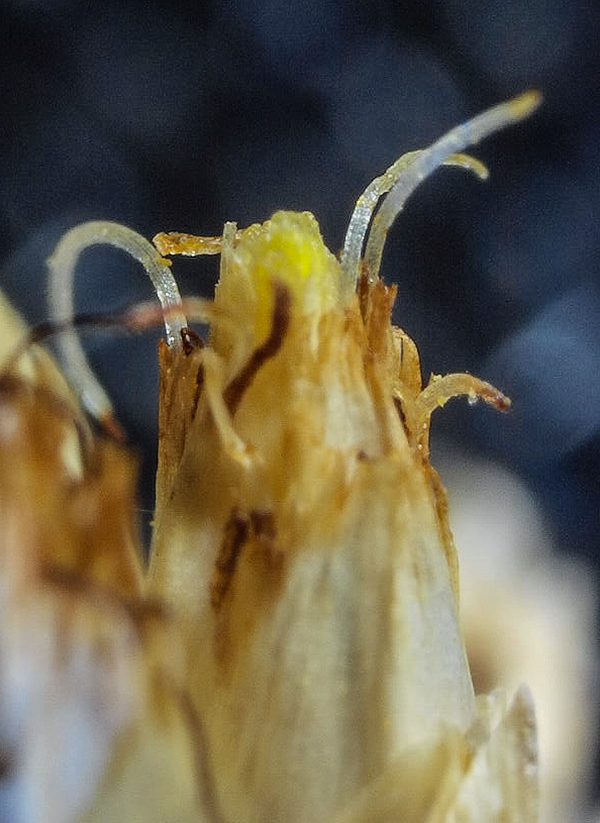
In each tiny flower the pollen-making anthers emerge from the bracts enclosing them and start releasing pollen before the pollen-receiving stigmas mature and emerge.  The anthers are bright yellow and prominent.  The stigmas are white, small, and held close to the flower head. Male-first is called protandry (PRO-tand-ry).  However, the flower head is made of hundreds of flowers, so that even if one flower is “male,” adjacent flowers may be in the female phase, or transitional.    Thus the entire head can be a mass of male and female flowers, although late in the day the balance shifts strongly to persistent stamens as most of the stigmas wither.

Rhynchospora latifolia anther tips and good stigmas 731AM 2

Spikelet in early morning. Anthers just peeking forth. Stigmas (white)  are from different flowers in same spikelet.

The species needs a preponderance of anthers as opposed to stigmas, because the roles the anthers have in attracting and feeding pollinators, and in manufacturing massive quantities of pollen.

If functionally male and female flowers can be mixed close together in the same spikelet, does self-pollination occur?   Evidence that effective self-pollination is unusual or nonexistent is that  many flower heads mature no fruits, or very few, while some others are productive.  Fruit productivity reflects luck in cross pollination.  No visitors from other flower heads carrying pollen from afar, no fruits.

If thwarting self-pollination does not seem a  key reason for  protandry in individual flowers, what is the benefit of a flowering making stamens first?   I don’t know, but have a speculative notion:

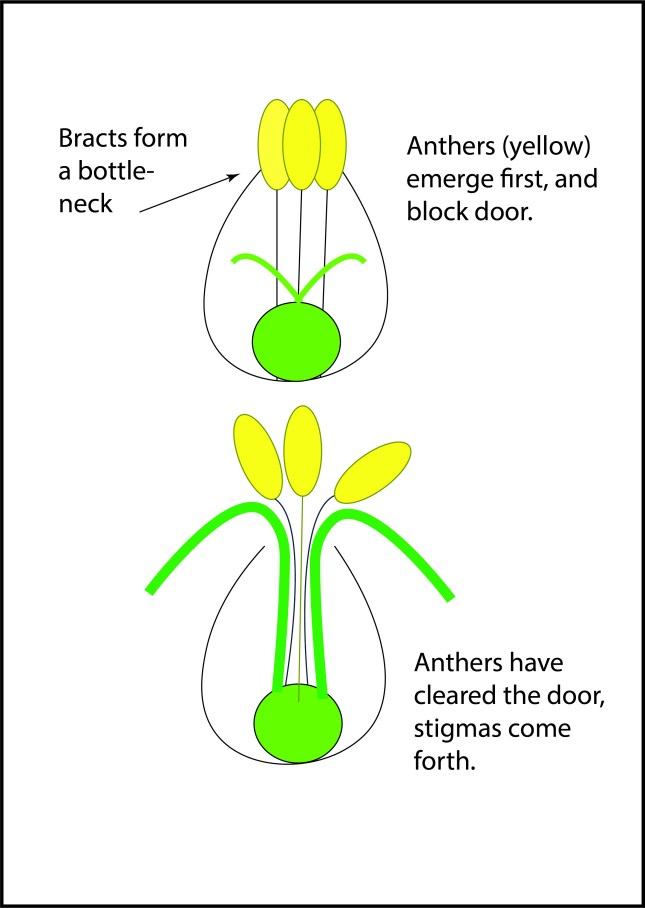
As the stamens and stigmas mature they have to pass through a narrow bottleneck of tiny leafy bracts in order to see the light of day.  If the soft and delicate stigmas matured first they might be crushed in the bottleneck by the large, firm, pollen-filled anther bullies.   Like letting the mice off of Noah’s Ark before the horses.    Once the anthers have “cleared the door,” it is safe for the more delicate stigmas.

rhyn lat spikelet diagram

Reported visitors include bees and hoverflies (syrphids), an interesting combo given that both feed on or gather pollen.


Tags: , , ,