RSS

Tag Archives: self-pollination

Brookweed

Samolus ebracteatus

(Samolus comes from an ancient name for a related species.    Ebracteatus means there are no small leaves mixed with the flowers.)

Samolaceae

There’s a special “breed” of wildflower that I love to see and ponder…species that start their lives in water and then wind up high and dry as the season dried out, often very dry…from one extreme to the other.  Such wet-to-dry types always have interesting tricks up their sleeves.  “Brookweed” is a semi-misnomer for today’s species.   Yes, you can find it in brooks, but you can also find it in dry deserts where water had accumulated previously, in salt marshes, and, in Palm Beach County, on dry sand baking in the sun.   It favors alkaline conditions.   Today you’d never know it has anything to do with “brooks.”
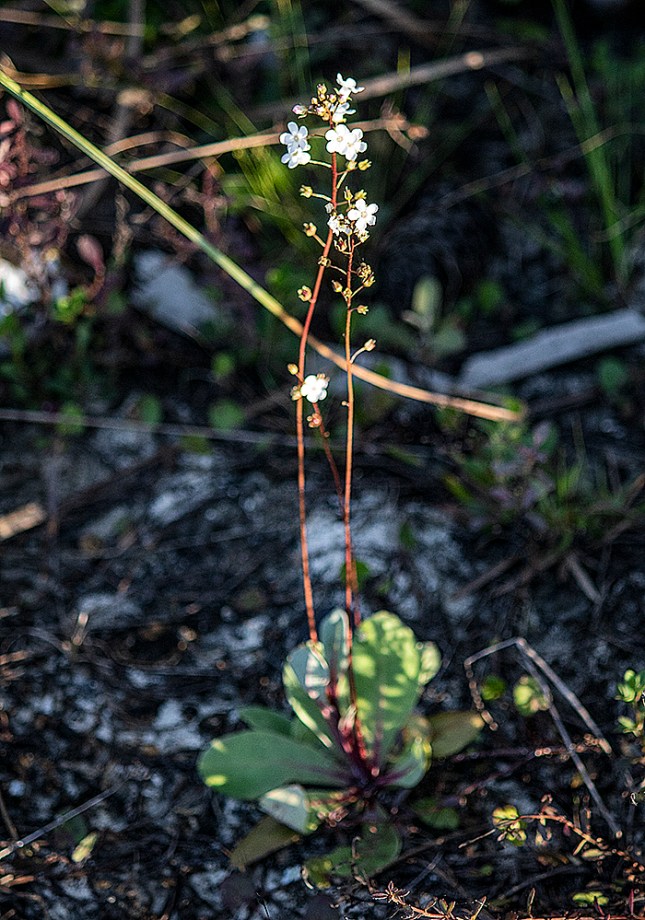
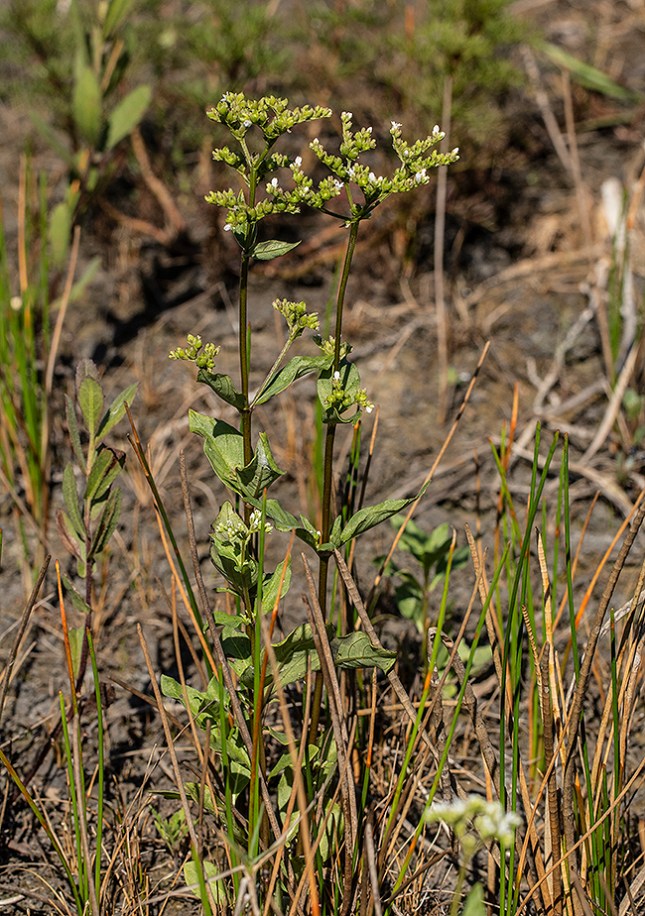
Samolus ebracteatus in dappled sun

The leafy rosette at the base looks like something straight out of Arizona, with thick, succulent, waxy-looking  leaves  in a twisty rosette with some red sunscreen.  The rosettes of most plants have leaves that lie flat against the ground—think of a thistle or a dandelion.  But the brookweed rosette has the leaves contorted so that they tend to face the sun edge-on rather than the more normal face-on, the contorted  configuration cutting down on direct solar radiation at mid day, and at the same time maximizing wind exposure, allowing cooling.
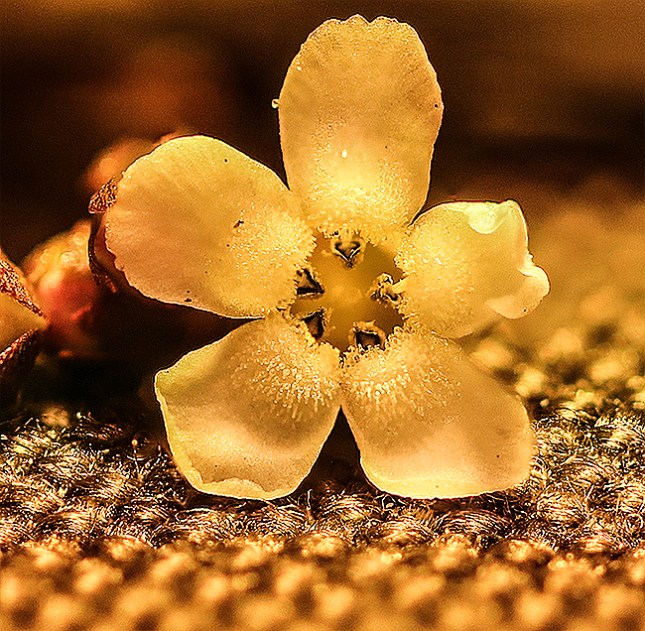
samolus ebracteatus on cam ranger

The white flowers are about ¼ inch in diameter on short stalks arrayed along a long wand.  They mature from the base upward as the wand grows, so as the season progresses the plant keeps making new flowers over a long time period while lower down fruits mature from the older flowers and release seeds. The entire reproductive cycle occurs all at once.

Seen from the side,  the flower looks like a tiny vase.  The upper rim of the vase is lined on the inside with five pollen-producing anthers mixed with fuzz.   The pollen-receptive style rises straight up from the vase floor. As the style rises it passes through the ring of fuzz and anthers which cover the tip of the style (the stigma) with pollen. That pollen germinates and completes the sexual cycle, all contained within the same flower.  No need for the birds and the bees.
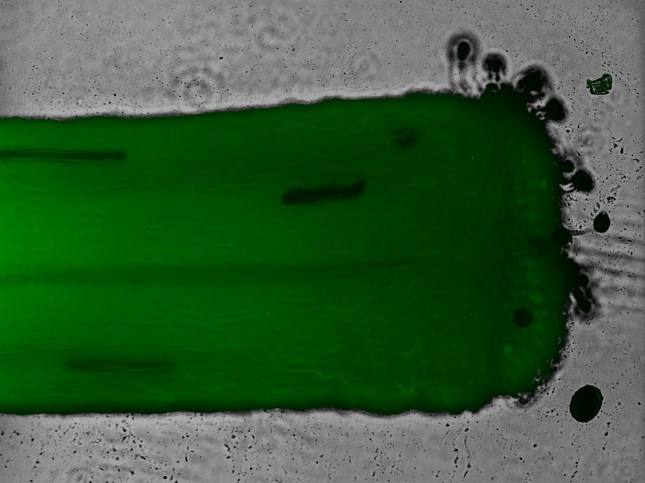
samolus above green1

Style and stigma with self-pollen germinating.

That last statement is maybe a little over-stated.  Despite the self-pollination, bees and butterflies do visit the flowers.  Perhaps they bring a little outside pollen just to shuffle the genetic deck a bit.

There’s one more weird thing.   On the outside of the flower at the base, there is a donut of glistening wet material around the “bottom of the vase” surrounding the point where the flower stalk is attached.   A mystery.  Can’t imagine the shimmering gel attracts or feeds pollinators who could not get at it down and outside.    I suspect it is “flypaper” to prevent little crawling insects from bothering the blossom.
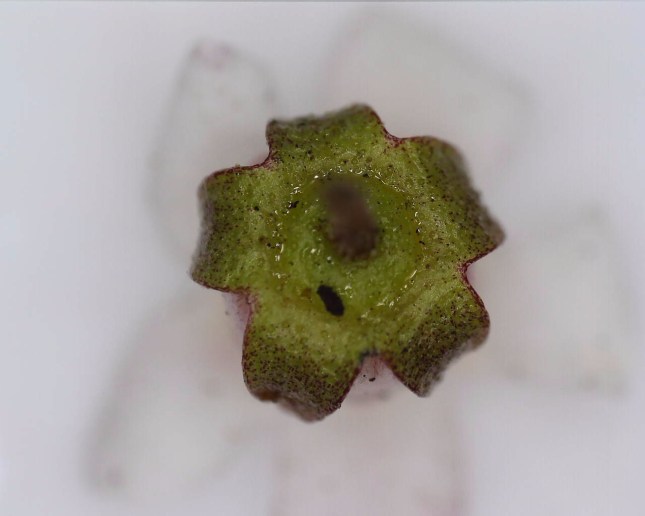
200403172614863

Sticky ring around the base of the flower
 
3 Comments

Posted by on April 3, 2020 in Samolus, Uncategorized


Tags: ,

Lax Hornpod Needs Neither Bird nor Bee!

Mitreola petiolata

(Mitreola means little mitre, because the fruit looks like a Bishop’s mitre.  Petiolata indicates the leaves have stalks.)

Loganiaceae

Mitreola petiolata is a worldwide warm-climate weedy species whose point of origin and history of dispersal is unknown.  Its intercontinental range include all of Florida.  Let’s call it a native species.

mitreola petiolata plant - Copy - Copy - Copy

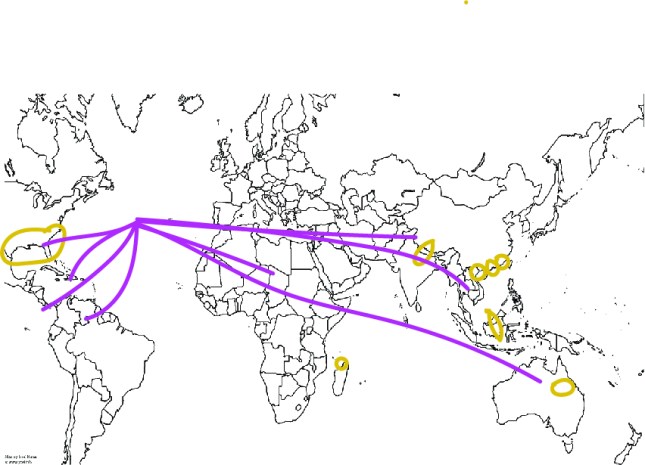
That huge pantropical distribution stands out in the small genus Mitreola where most of the other species have narrow ranges scattered in Africa. Asia, Australia, Borneo,  and Madagascar.   Mitreola sessilifolia, similar to today’s species ranges across Florida and much of the southern U.S., extending into Mexico.

mitreola map

Each yellow circle represents one Mitreola species.  Mitreola petiolata is “everywhere,” the purple lines showing its global reach.

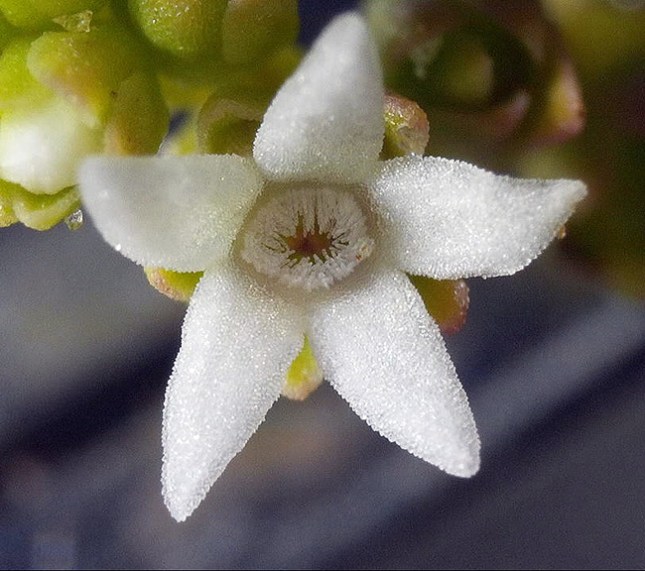
Mitreola petiolata has pretty little white flowers with a curious donut of hairs partly blocking the flower’s throat.

Mitreola fresh flower

Highly magnified. The flower is about 1.5 mm in diameter.

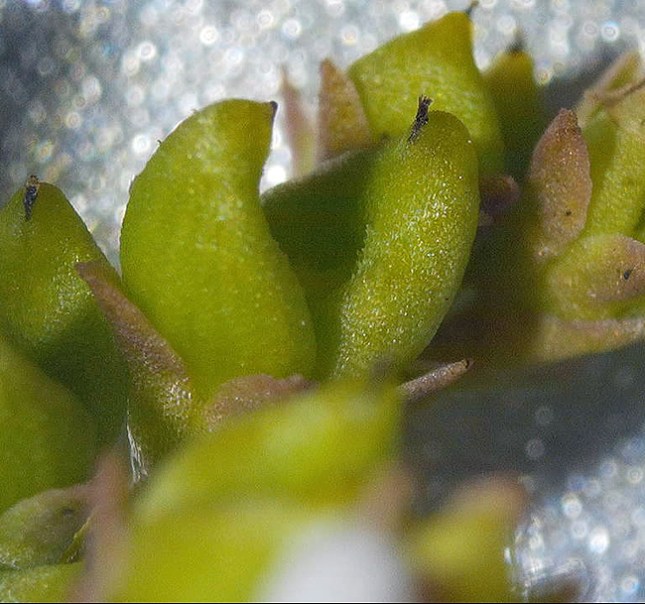
And speaking of curiosities, the pod is a two-horned “Bishop’s mitre.”

mitre

mitreola fruit - Copy

Pod

Weedy species such as this distributed far and wide often reproduce free of the need for a male plant and a separate female mate to establish together for cross pollination at each step during world conquest.  Botanical imperialism is more efficient if you spawn alone.  There are different ways to accomplish that.   Mitreola petiolata uses extreme self-pollination within individual flowers.

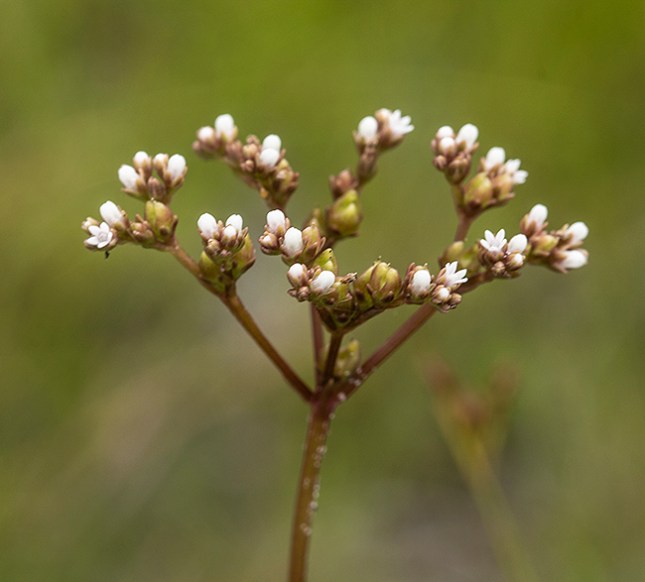
mitreola inflorescence

Back in 1841 botanists John Torrey and Asa Gray noted, “the pollen tubes are often so copious, even in dried specimens,  as to fasten the anthers to the stigma.”  This observation is 178 years old, and I’ve never seen anyone record checking it out since.   It is about time! This is going to be better than Geraldo Rivera opening Al Capone’s vault!  Get ready!

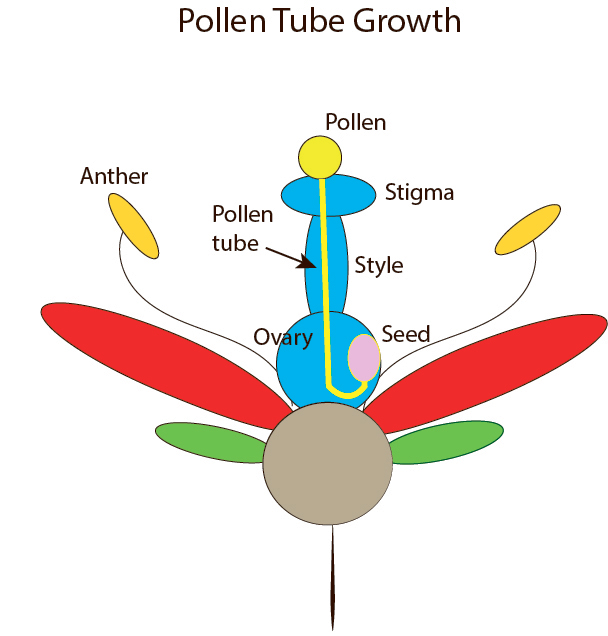
Be patient one moment though, after almost two centuries the mystery will hold 30 more seconds while a little background refresher may help explain what those two were talking about.   In a “normal” textbook species, a bird or bee transfers some dustlike pollen grains from the pollen-producing anther of one flower to the pollen-receptive stigma of another flower.   Then a tiny thread called the pollen tube grows like a root from the newly landed pollen grain down through the stigma and style to the ovary, carrying sperm to fertilize the baby seeds there.  To repeat, the pollen tube is a tiny sperm-bearing filament extending from the pollen grain to the baby seed within the newly pollinated flower.   Here is a helpful diagram:

pollen tube diagram2

Textbook normal pollination. Pollen grain (yellow) deposited onto stigma (blue) by pollinator.  Then pollen tube (yellow) snakes down to deliver sperm to seed (violet).

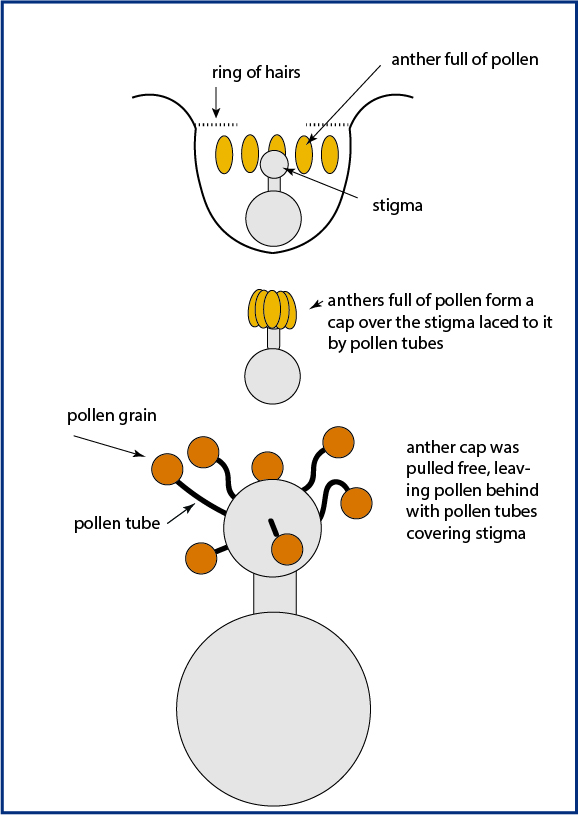
Okay then, we now can carry forward knowingly. Mitreola petiolata has a ring of five pollen-making anthers attached inside the flower. The anthers unite to form a cap covering the  stigma   The pollen grains inside those anthers do something weird, they all sprout pollen tubes while still inside the anthers that made them.  Today’s species skips the messy business of birds, bees, and pollen transfer to a different flower.

mitreola flower diagram - Copy - Copy - Copy

Top image:  diagram of the Mitreola petiolata flower.  Middle image: anthers (yellow) united into cap over stigma.   Bottom:  anther cap has been pulled away from stigma revealing  pollen grains and their pollen tubes penetrating into the stigma.

The countless premature pollen tubes form a network lacing the anthers to each other and to the stigma in a wild orgy of self-pollination.   When this has occurred, as Torrey and Gray noticed back the year President William Henry Harrison died in office, the mob of pollen tubes have stitched the anther cap firmly to the stigma.

MitreolapetiolataApril25AnthersStuckToStigma - Copy

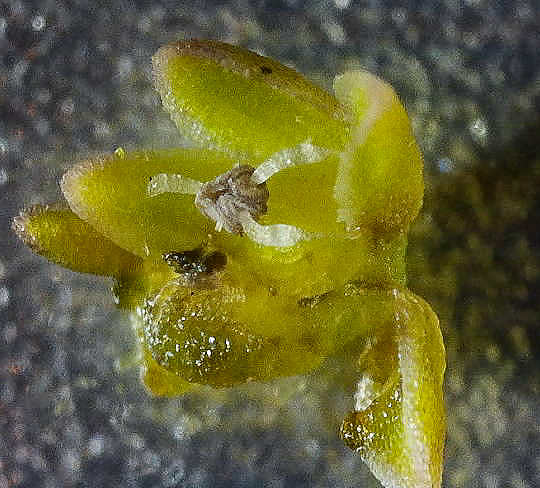
This is the base of the flower with the petals removed.  The anther cap (gray above the center)  is tied to the stigma hidden beneath it.  The 3 white flaps are anther attachment points left behind when the petals were torn away…remnants of the petals and their connections to the anthers. This photo shows the same info as the middle image in the diagram above.

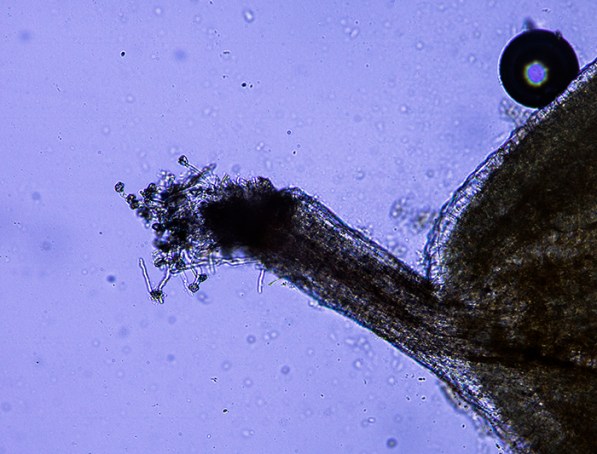
When the anther cap is yanked away from the stigma under a microscope, the stigma remains covered with pollen tubes burrowing in for sperm-delivery.

MitreolapetiolataApril24style - Copy

This is the stigma with the anther cap pulled off.  The tangle on the left is a mass of pollen grains and pollen tubes left behind from the anthers, and penetrating the stigma.  Extreme self-pollination! The style is the shaft in the middle, and the large body on the right is the ovary.  This photo matches the bottom image in the diagram above.

I’ll bet every flower on every Lax Hornpod in every wet meadow around the Globe matures a fruit filled with self-fertilized seeds.  It’s an inside job!

 
6 Comments

Posted by on April 26, 2019 in Mitreola petiolata, Uncategorized


Tags: , , , , , , ,