A Tisket a Tasket, a Muhly Sweetgrass Basket
Muhlenbergia capillaris var. filipes
There’s “just something” about ornamental grasses. Grass plants are intrinsically beautiful, and they keep on keepin’ on. About 50 or more native species are available commercially in Florida, used mostly in land restoration and often in wetlands. A few are backyard garden friends: Fakahatchee Grass, Dwarf Fakahatchee Grass, Chasmanthium (mostly north of here), and sometimes others. In the autumn around our area and beyond appear misty clouds of “Pink Muhly Grass,” aka Muhlenbergia capillaris. (Yes, it also comes in white.) Going beyond pretty in pink, let’s take a better look at Muhly. After all, it was the 2012 Garden Club of America Plant of the Year. Wooohooo!! It caught on big-time around the world, planted extensively in Europe and Asia.
https://www.koreaherald.com/article/2117357
Its natural range runs from New England to Central America on rocky sites or sandy flatwoods, prairies, and similar situations, mostly moist but not necessarily. As might be predicted in a prairie-loving species, being burned improves its next flowering flush. Some time ago in this blog I wondered why it is so colorful, after all, being wind-pollinated it needs no floral visitors. The key to that is probably unpalatability to pests and to grazers. The pink is possibly warning coloration—if you eat me, you’ll remember the tummy ache next time you see pink. The explanation may be, speculatively, high content of silica, and the species definitely is highly fibrous.
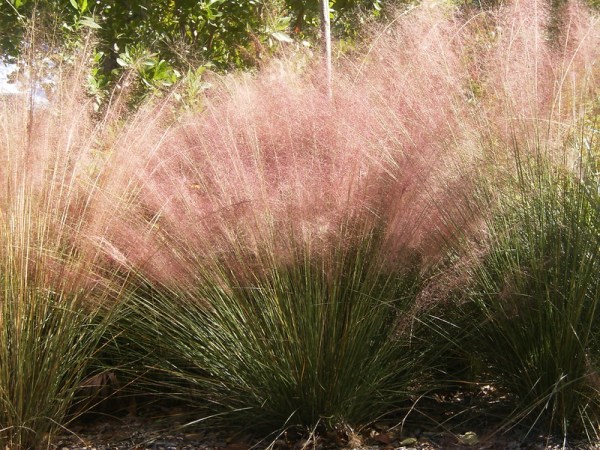
Photo by Jenny Evans
Highly fibrous you say? That ties to something else. Sturdy baskets. There are two, very similar, varieties of Muhly in South Florida: let’s call one the “normal” variety. The other is Muhlenbergia capillaris var. filipes, which differs mostly by having long awns (stiff threads) on the spikelets. Does “filipes” occur in our area? Yes, although with a popular ornamental species you always have to wonder about horticultural influences. In any case, filipes extends from Miami-Dade County northward to its favorite habitats: the coastal mid-South, in particular barrier islands from Florida to North Carolina. That is also the homeland to the Gullah People living there for countless generations dating back to the early slave trade era.
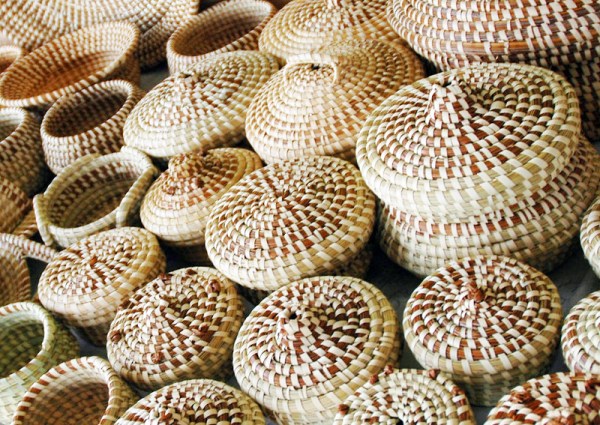
Courtesy Woody Hibbard
A tradition of the Gullah People, to this day and dating all the way back anciently to West Africa, is making beautiful and elegant sweetgrass baskets. You can buy them today, say, in Charleston, Mt. Pleasant, SC, or Hilton Head, and the nice ones can be as expensive as the time and artistry required to create them. They are made of coiled bundles of Sweetgrass (var. filipes) stitched together, usually, with fibrous strands from Saw Palmetto leaf stems.
https://gullahsweetgrassbaskets.com
 John Bradford
 George Rogers
 George Rogers
 Dee Staley
 Treasure Coast Natives
vickiedenton
September 9, 2026 at 11:59 am
Greetings George, long time since I pestered you with what is this and why is that! Hope you and yours are well and staying cool…tromping through the woods in summer here is tough. We have been in and out due to new oncologist and more frequent visits, but Don is hanging in there. I finally germinated spores of Ctenitis submarginata this spring. Couldn’t believe they actually emerged! So far behind in reading my emails and just read yours on Muhly grass. I grew up in Mt. Pleasant, SC and as a kid, always saw the Negro women basketmaking along roadsides. Why wasn’t I smart enough to have Dad stop and ask how and why and teach me??? There were country roads…so many weavers…not now. All built up. I certainly asked enough questions growing up…really sorry now I didn’t ask more. The baskets were so pretty and were a bit expensive, but with babysitting money, they were high dollar! Still, the process intrigues me. I just ordered a book on basket weaving, thinking I might be able to use it in one of my Floral Design classes for kids. After reading, it would have to be a camp project. Class is only once a month for an hour. We have made some fun things. January is the first class for ’27 and I want to do a challenge class, covering their eyes and creating an arrangement by feeling the plant material, as a blind child might do, then second half of class, off with the blinders and they can do one with their eyes open and not their finger feelers. I want them to think about that. I have a dear friend who was born blind. We lived in San Diego in an apt complex with alleys for garbage pickup and to the garages. All the gang rode bikes and we put Larry in the middle and he never skipped a beat, right, left, slow, turn…we never thought anything about it. We were in 1st grade, too. He plays bass in the church band, put in a new sound system for the church, plays piano and docked a sailboat by sound. It made the front page of the San Diego paper…what a guy. I had a bright idea of incorporating Clitoria turnatea into the Podocarpus hedge (NOT my choice for our HOA). Love the color of the flowers but that thing ate the hedge. It is like Ipomoea hederifolia, great attractor but bloody overpowering. More than 2 years later, I am still pulling the seedlings of Scarlet Creeper, an apt name, for sure. I imagine it will be the same with the Clitoria. What a color! Thanks again for your blogs. Even though I never met John Bradford, I miss him. Vickie