Cyperaceae
Funny how half of what humans eat are grasses, more than that if you count livestock food. So what’s up with Sedges? There are many thousand of them too, and they look like grasses and make “grains.” Don’t we eat Sedges? Scarcely. Why not, and which do or did we eat?
Sedge grains (achenes) are very rarely eaten. Some peoples in extreme northern climates where the sedge genus Carex is common while other foods can be scarce, eat grains from a few species. More prominently and about as direct evidence as you can get for a “Paleo Diet,” there are Sedge grains from bulrushes in human coprolites at multiple U.S. caves going back almost 4000 years. Evidence shows them to have been prominent staples spanning a couple thousand years. Charred bulrush remains date back in Nevada some 12,000 years. (Bulrush rhizome starch was eaten as well as the grains.)
Why don’t you see Sedge grains much in human food? Well, they are smaller than the grass grains we eat, but those have experienced millennia of artificial selection to get big and starchy. Why did that never happen with Sedges? Speculatively, a couple reasons: 1. There were oodles of grasses alongside human evolution, and cultivated. Wheat has been in cultivation forever. Sedges are more marshy: not so front & center and vastly more difficult to cultivate, you know, in wetlands. 2. Grasses are relatively easy to hybridize, but sedges have very weird chromosomes that don’t pair up readily for artificial breeding. 3. Sedges are more likely to invest their starch into rhizomes than grasses are, not so prone to bulk up their seeds.
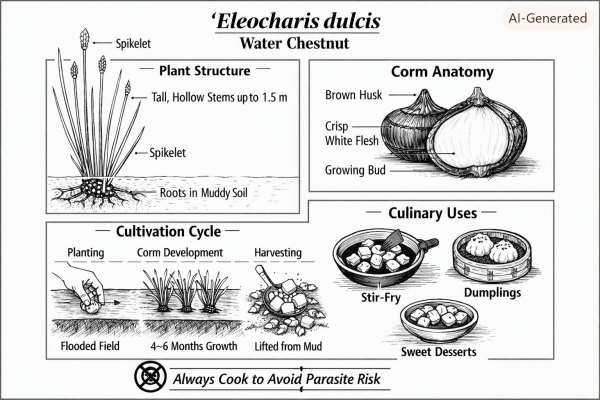
Thanks AI. (And do mind those parasites—flukes, unpleasant hitchhikers.)
More starch to the rhizome in Sedges? Well yes, that’s what gives them their (limited) path to the kitchen. Do you like horchata? Horchata in Spain is mostly made of a species we think of as an introduced weed locally, Yellow Nutsedge (Cyperus esculentus). Esculentus means “good to eat.” You see it around PB County, mostly in disturbed moist places. It likes where water collects in construction sites. The species is also called “chufa” or “tiger nut” when grown for its tasty tubers. After Spain, much chufa cultivation happens in West Africa, where they are soaked before eating, then used in varied ways from “soup to nuts.” A little bit is grown deliberately in the U.S. as wildlife fodder.
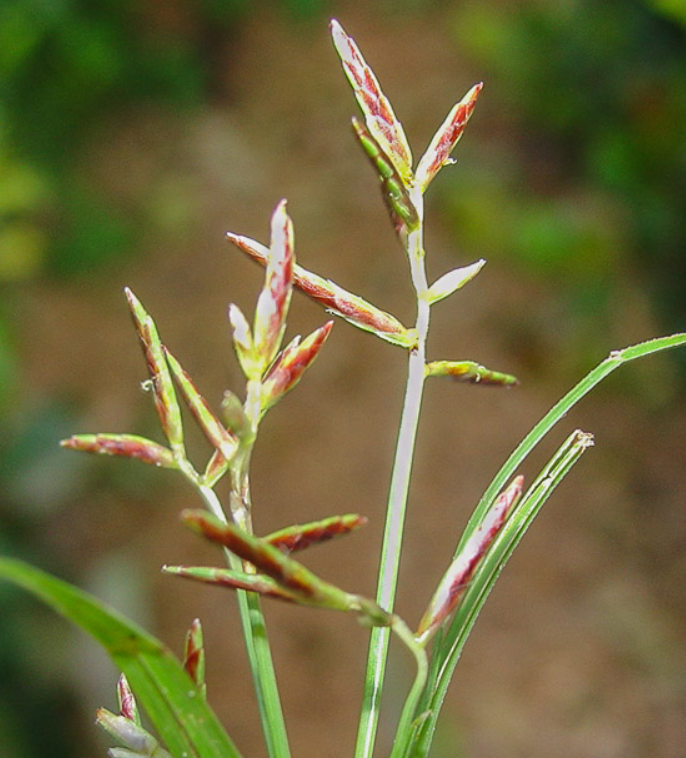
Cyperus rotundus, by John Bradford
Another weedy tuberous Sedge species around here is Nut “Grass,” Cyperus rotundus. Its tubers are less useful, being more loaded with aromatic stinkiness. King Tut liked Cyperus tubers, C. rotundus (in fragrances) or C. esculentus (as candy). They’ve been found in Egyptian tombs going back 6000 years. They were ground and mixed with honey. Sedge candy! Makes me want to try it, the “secret delights of Cleopatra bathing on the Nile” reawakened in Jupiter slogging in waders along the Loxahatchee.
Not being in Spain, or a Pharaoh, what sedge might I eat? Just the day before yesterday, I enjoyed an ice-cold can of Water-Chestnut Beverage, with W-C chunks similar to chunky bubbles in bubble tea. Water-Chestnut remains crunchy in stir-fry. It’s the corm (thick ground-level bulblike stem) of the Asian sedge Eleocharis dulcis. (Dulcis means sweet.) Sedges, as we know, are a pain to cultivate because of that proclivity for wetlands. Oh, that’s not a problem where you already grow rice in wetlands. You can rotate them, or intercrop them.
Eating “Water-Chestnut” is about as ancient as eating itself. In the Jordan Valley, archaeological remains (identifiable starch grains still clinging to stone-age grinding tools) date back some 780,000 years. That’s not a typo. That’s the Flintstones. But the “Water-Chestnut” in question is probably a different and non-sedge species, Trapa natans.
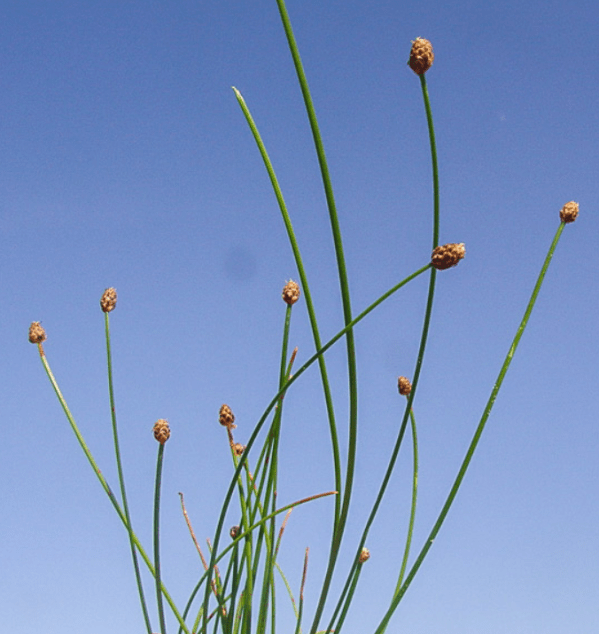
Eleocharis flavescens by JB
We have a few species of Eleocharis around South Florida, so do we eat them? No, but maybe “they” used to. The native Yellow Spikerush is related to Water-Chestnut, as Eleocharis flavescens. It has a smallish corm, like a mini W-C, hidden behind a broom of muddy roots. Remains of the genus turn up in North American archaeology, including over 12,000 years ago as charred remains at a hearth. There’s no telling if it was there as a “seed food,” or “tuber food,” or scraps from basketry or a similar purpose.
So then, if your idea of the way to enjoy wild plants is to eat them, Sedges aren’t the Florida family for you — unless you take a time machine back 3800 years to a Texas cave. But then don’t step in a coprolite!
 John Bradford
 George Rogers
 George Rogers
 Dee Staley
 Treasure Coast Natives