Morus rubra
Moraceae (Fig Family)

When I’m lookin’ stuff up I like to check on John Kunkel Small (early 20th Century FL botanist), not merely because he did good work, but also a hundred years ago the natural flora was a little bit more intact. Also, he cared about human-plant interactions before Europeans. Many pre-European millennia left traces we for overlook. In that connection, Small remarked this about Red Mulberry: “In Florida the mulberry is largely confined to the sites of aboriginal activity. The fibrous inner bark was used for clothing and for making other objects.” He featured that particular use, not to mention that the wood makes springy archery bows to this day, the sap was an historical cure-all, and oh, yea, the fruits are tasty good before the birds recycle them onto your car. The edibility of the fruits helped mulberries ghost human settlements as botanical “camp followers,” if you catch my drift.

Look closely. The fleshy parts are swollen leaves. Image courtesy TL Tandon via Flickr
Misnomer alert! A mulberry isn’t a berry, actually not exactly a fruit. The true fruits look like tiny dry seeds. The “berry” is a cluster of those wrapped in juicy, swollen, darkened leaflets. A phony berry! Tastes good though.

Reproduction in red mulberries is messy business. The plant manuals tell you the trees are “dioecious,” that is, separate male and female, and pollinated by wind. That’s no doubt basically true but not the whole truth. You find the trees often fairly isolated in the understory. How can airborne pollen be sufficiently abundant to get the job done on well separated trees? Part of the answer is that the pollen is launched forcefully onto the breezes from the male flowers. Additionally, like many separate-sex plants, they cheat. Female trees often have secret male flowers as “back-up” assured pollination. The proportions of these back-pocket male flowers can adjust with environmental conditions, which would be an intriguing story in itself.
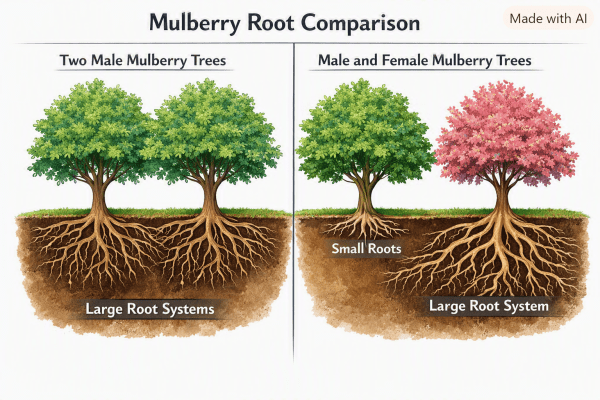
What’s more intriguing, however, is that mulberries are to my knowledge, the only separate-sex plants known where one influences the other. (The research used easily cultivated white mulberries, not red.) Females need more water and nutrients than males in order to plump up those sugary peseudoberries, whereas males casually spew cheap powdery pollen…light duty. So it is in the interest of both sexes to tilt provisions in favor of females. Researchers found that when you grow two males together they equally make a large root system. But when a male and female grow together the male reduces its roots and the female grows a large system, a winning combination for berry-making.
 John Bradford
 George Rogers
 George Rogers
 Dee Staley
 Treasure Coast Natives