Bombus pensylvanicus
A photo of a bumblebee on a flower. Camera fun, no big deal, but this particular species is of special interest.
You can distinguish the “American Bumblebee” from other Florida-occurring Bumblebee species because the American Bumble has 12 segments in the antenna (good luck with that!), pollen sacs on its hind legs (vs. no sacs anywhere), and its “back” from the wing attachments to the abdomen is black, as opposed to yellow or mixed colors.
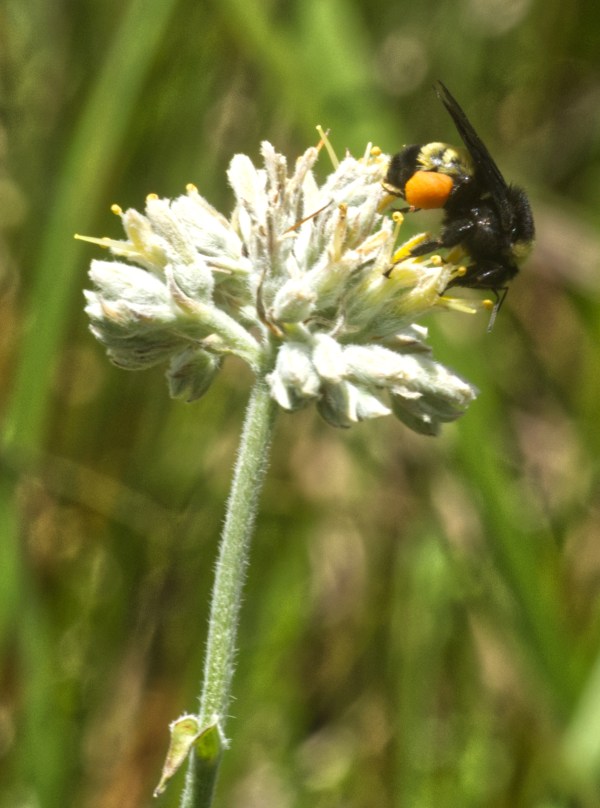
Why would a Bumblebee not have pollen-collecting sacs? Those sac-free species are cheaters. So-called Cuckoo Bumblebees, they’d rather hijack other Bumblebees’ nests rather than gather their own pollen. Such not-so-busy bees are unusual in Florida, one historical cheater here, Bombus variabilis, may be extinct or nearly so in the U.S., surviving still in Tropical America. A parasite needs a pollen-collecting host, and the host species have problems which brings us back to the American Bumblebee.
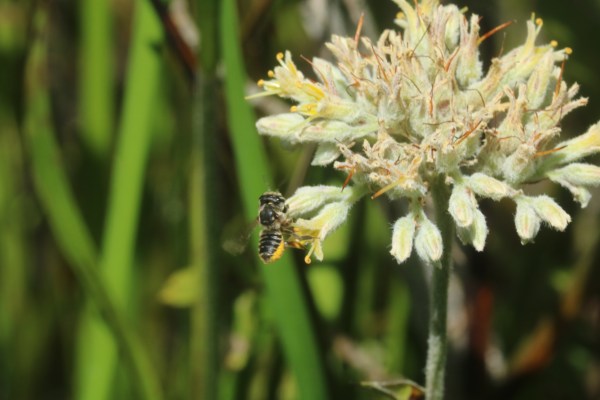
The American Bumblebee has been in decline for decades. How old and how severe is the problem? Hard to say, because the data are skimpy. After all, not many biologists study Bumblebee distributions, and it is tough to gather info over millions of square miles. Despite holes in the knowledge, it seems the American Bumblebee and some others, but not all bumblebees, are dwindling.
What’s particularly odd about the American Bumblebee is that most of the decline has been in the northeastern portion of its historical range from Canada to Florida, Mexico, to (a little) in California. It is doing comparatively well in the southern and central states, while disappearing from the northeastern corner of its range. Recent publications suggest about 20% range loss so far, mostly in and near New England.
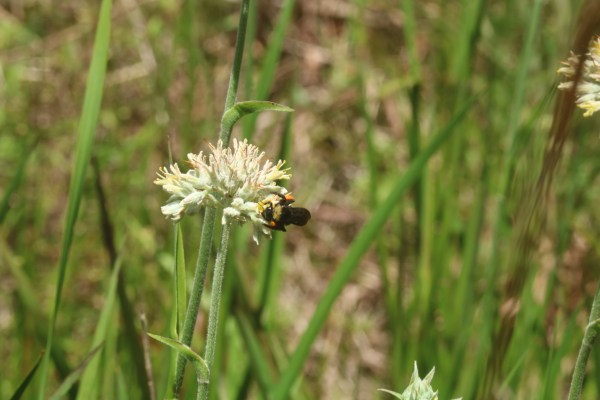
There is no consensus on the reasons, especially because any explanation for the decline must take into account its geographic bias. Searching Goggle turns up with differing degrees of emphasis “the usual suspects” with respect to decline in other living things. In alphabetical order:
Climate change:
When a wife is murdered, detectives look first at the husband. When an insect range changes, detectives look first at Global Warming. But, although an indirect effect is obviously conceivable, it not easy to explain how a warming climate would wipe out a species in the coldest part of its range. So far, no evidence.
Neonicotinoid insecticides:
That the decline seems to have accelerated with the onset of heavy use of neonicotinoid insecticides is suspicious. And neonicotinoids are prime suspects in related crimes such as honeybee Colony Collapse Disorder, migratory bird disorientation, and more. But are neonicotinoids a special problem in the Northeast? As the District Attorney may say to the detectives, “suspicious, go get me more evidence.”
Parasites:
Bumblebees suffer from mites and microbial infections, most famously a fungus Nosema bombi. It has been speculated strongly that a deadly strain Nosema invaded native Bumblebee populations from European Bumblebees imported for greenhouse pollination. Notably, researchers have shown a high instance of the fungus in declining Bumblebee populations. But association does not prove cause. It could be that declining Bumblebees are weakened from some other root cause, making them more susceptible to infection. Molecular studies have failed so far to find a special deadly Nosema associated with commercial bees. But then again, microbes are many and we don’t know what we don’t know.
Shrinking Habitat:
American Bumblebees are largely meadow species, breeding in low grassy plants. Shrink the meadows, shrink the BB populations. Meadows may be a declining “thing.” Just ask the butterflies! Meadows don’t have much protection, as opposed to scrub, or wetlands, or old growth forest. Protected meadows mature into woodlands. Lots of meadows were roadsides and railroads, or hayfields, or fallow fields, or pastures, or margins around farmlands. Changing agricultural practices and changing land-use patterns aren’t helping expand meadowy bumblebee habitat. A changing agricultural practice is massive application of effective herbicides, such as Round-Up. Many meadow species are “weeds,” and we’ve gotten effective at weed control. Could it be that open, weedy, semi-neglected meadows have diminished especially in the Northeast? Maybe so, given that a great deal of former farmland and lumbered land in and around New England has reverted to forest. Fires that used to return forests to meadows are now better controlled. Where do you build new subdivisions and big box stores? Largely in existing open unprotected vacant space. One day meadow “weeds,” next day sprayed turf and parking lot.
So whodunit? Nobody knows, or if they do, they have not brought other observers into agreement. In Agatha Christie’s “Murder on the Orient Express” every suspect had a hand in it. Or then again maybe Global Warming, germs, insecticides, weed control, and dwindling vacant lots are a bunch of red herrings. Personally, my favorite culprit is habitat loss, but that’s no more than a guess.
 John Bradford
 George Rogers
 George Rogers
 Dee Staley
 Treasure Coast Natives
habitatsp@aol.com
July 16, 2022 at 10:45 pm
Nice perspective on bumblebees.
Thanks for describing the different types. I must admit, I rarely see thm here, but used to see them often when my son lived in Pensacola.
Hope you are staying cool this summer!
Chris
George Rogers
July 17, 2022 at 9:07 am
Morning Chris…yea, surprising how few you see. There’s a large patch of Lachnanthes near my house. It and a big patch of Hydrolea also nearby are my two pollinator-watching headquarters.