This morning John and George pondered the ways of lichens in Halpatioke Park in Stuart, Florida. There’s always much to learn and say about these biological curiosities. First we’ll knock off the “Botany 101” basic lichen facts you could find all over the internet, then attempt something more off the beaten path.
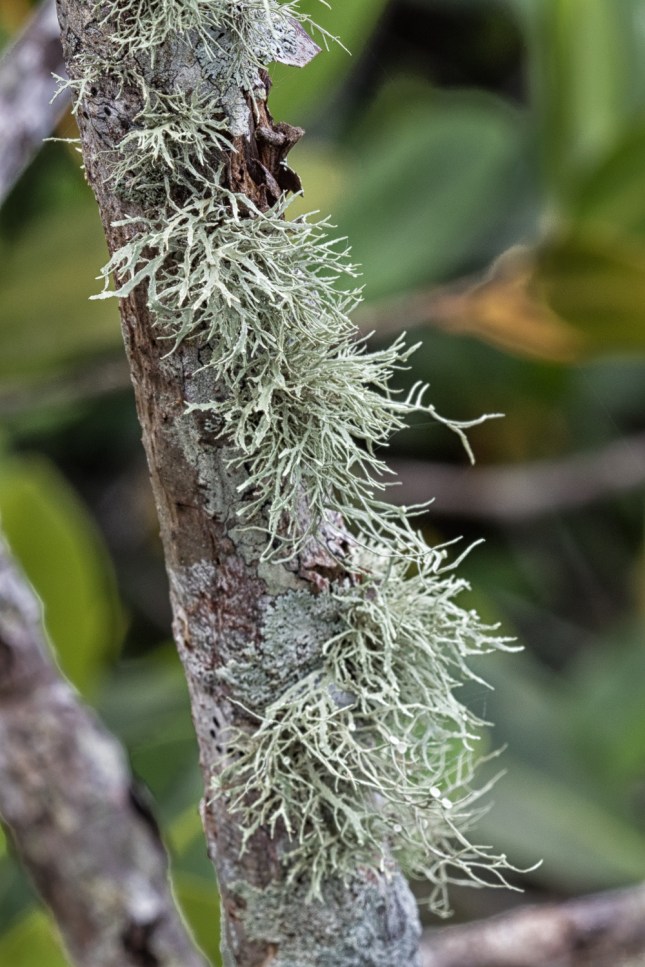
A branched “fruticose” lichen, by John Bradford.
LICHENS 101
- A lichen is a symbiotic union between a fungus and one or more algae species, or sometimes cyanobacteria, living together as one.
- Lichens are not all related to each other. They evolved many times.
- Lichens favor extreme habitats such as rocks, concrete, sand, and especially tree bark.
- Lichens, when dry, go into suspended animation, and come to life when moist.
- Lichens exhibit three different body forms: one form resembles paint, one form resembles a crinkled leaf or fried bacon, and the third form is branched and shrubby. They sell the last-mentioned as shrubs for model railroads and dollhouses.
- Because lichens are two-species species, their reproduction is a coordination problem. Most lichen reproduction is thought to be tiny clonal fragments where the fungus and alga elope together, although the fungi sometimes form spore-making organs.
- Lichens come in beautiful colors stolen and applied as lichen fabric dyes.
- Some lichens suppress surrounding competing vegetation.
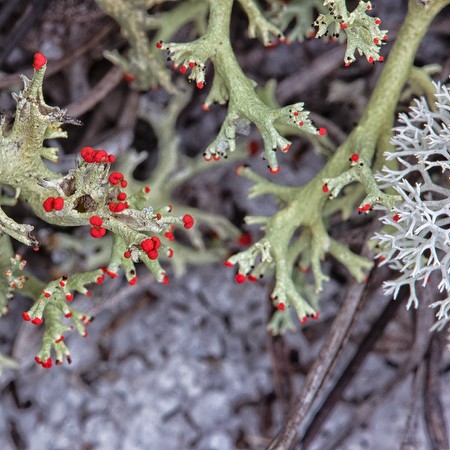
By JB
Okay then we’ve got the lichen picture. Now for the weirder parts:
Weird thing 1. Most lichens grow as irregular shapes, or shields, or roundish patches. They grow in ways consistent with starting from a point and growing outward like ripples on a pond although far more irregular. But today John and I noticed something very different: a tendency for multiple different types of lichens to appear as horizontal bands, partial belts, across the oak tree trunks, especially laurel oaks.
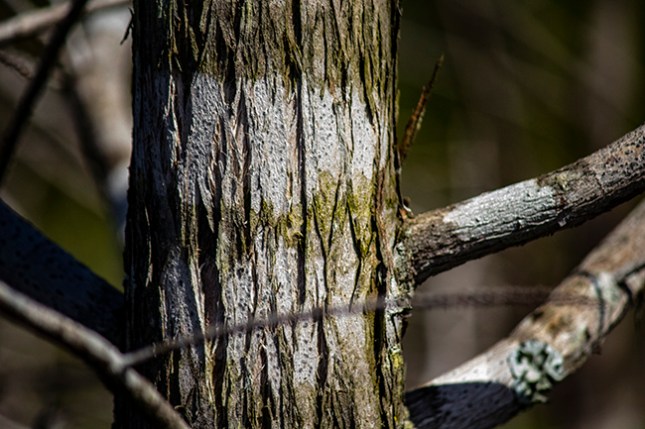
Lichens often appear as horizontal band aids.
The way that comes about may be sort of obvious but then again, not. The obvious part is knowing that the tree trunk expands in girth like my waistline after too many donuts. It stretches horizontally but not vertically. If you put a roundish paint spot on a tree and let it grow 10 years the dot will be stretched laterally into a horizontal bandaid. Strtching ought to make it fragmented and thein. If two kids take a ball of taffee and pull, it will of course get longer and thinner, or may break. So here is the surprise…when a thickening tree taffee-stretches a lichen laterally, it usually does not thin or fragment, even if stretched many times its original diameter. The stretched part seems to self-heal and re-thicken, even filling in the cracks if fragmentation is apparent. It compensates for the stretching, you might say adapted to its preordained strain. If you’re going to dwell on a tree trunk, get ready to be stretched. You don’t see such banded lichens on concrete, or on palm trunks, which have minimal expansion in girth.
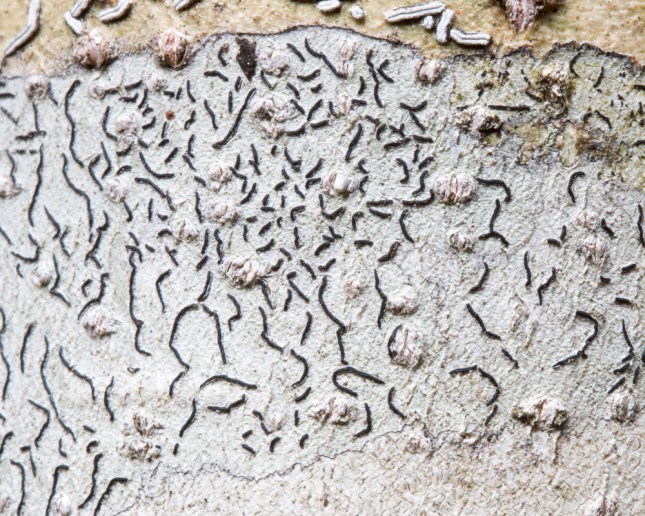
BY JB
Weird thing 2 is the extreme sensitivity of lichens to air pollution. There they sit on a tree with no roots and no protection, exposed to every breeze and absorbing every drop of mist and rain, as well as everything carried in that wind, mist, and rain, including nutrients, radioactivity, and toxic pollutants. That tendency favors some lichens, for example, if the air pollution is rich in nitrogen compounds, certain lichens may say, “thank you for the free fertilizer.” Most often though, it seems to me, air pollution diminishes lichen coverage and diversity. The most obvious sources of air pollution around here are highways, and the pollution-effect was apparent today along ever-busy four-lane Indiantown Rd. in Jupiter. Adjacent to the road is a bald cypress swamp extending from the edge of the pavement back maybe half a mile or so. The lichen diversity and coverage is conspicuously diminished with proximity to the traffic.
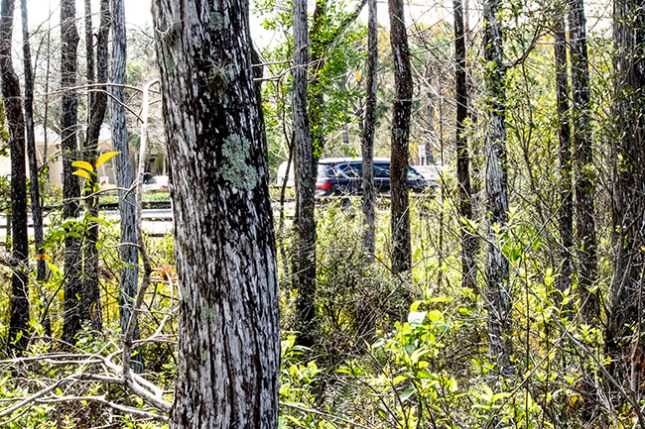
The case of the disappearing lichen. The tree(s) in the foreground far from the busy road are rich in light-colored lichens. Follow your eye out to the road…the darker trees near the road (such as those in front of the black car, or on the far left) have few or none. All the trees are bald or pond cypress.
 John Bradford
 George Rogers
 George Rogers
 Dee Staley
 Treasure Coast Natives
theshrubqueen
February 22, 2019 at 9:28 pm
Hmm,likin’ the photos.
Freda Betts
February 22, 2019 at 10:34 pm
I’ve often wondered if lichen growing on tree trunks means that the tree is aging and beginning to decline. I notice several different kinds on the older small trees in my yard, such as Florida privet and Storax. Would like to know your thoughts. Thanks.
George Rogers
February 25, 2019 at 12:01 pm
Right—I sometimes see the same. I don’t think the presence of lichens is a direct sign of decline exactly, and they are not reputed to hurt the tree. My feeling is that you tend to see them often on such trees, although not exclusively, is that the trees in decline don’t have much canopy, and light will favor many species of lichens. Also maybe (totally speculatively) that the declining bark may provide a nice substrate, and that most lichens grow slowly, so that within a certain framework, older trees may accumulate more lichen growth. All that said, I suspect less canopy/more light is the main factor in the equation.
Chris Lockhart
February 23, 2019 at 12:00 am
I’m likin’ the observation about the lack of lichens near the road (sorry – I couldn’t help but go for a little alliteration. 😉
Ginny Stibolt
February 23, 2019 at 6:59 am
Actually, it’s been shown and verified that a yeast-like bacteria is the third symbiont in lichen. Scientist think the bacteria may fix nitrogen.
https://www.theatlantic.com/science/archive/2016/07/how-a-guy-from-a-montana-trailer-park-upturned-150-years-of-biology/491702/
https://www.ncbi.nlm.nih.gov/pmc/articles/PMC3067232/
George Rogers
February 25, 2019 at 12:55 pm
That bacteria turn up in lichens is of course fascinating. I have not reread that article recently, but I recall back when it came out a couple years ago with such a blockbuster title, I felt mildly disappointed. At the time I thought it might make a great blog, but I backed off upon reading. While not questioning the detection of bacteria in lichens, or that bacteria may have symbiotic roles in lichens, I felt that the find might be a little over-hyped, referring to turning the concept of lichens on its ear, or calling bacteria “the” third symbiont. That is a large claim, given the small sample size in the face of an unknown yet huge number of lichens, between 10 and 20 thousand. More importantly, lichens involve a vast array of fungal and algal symbionts, lichens having evolved many times separately. “Lichen” is more of a lifestyle concept than a biological category. Therefore it is a bit of a leap to go from bacterial DNA spotted in a couple lichens to such big claims. Bacteria, as well as 3rd fungi, in lichens are definitely something to watch, especially with the contemporary technology to detect them, but I’m not certain lichenology has been turned on its ear yet or that all lichens are a well defined 3-way symbiosis. I’d be very interested in the opinion of Dr. Chinnery, a fungal expert who occasionally reads this blog if he happens to spot all this.
Linda Grashoff
February 23, 2019 at 10:38 am
Interesting observations and cool information! The first lichens I remember noticing were in northern Michigan, and I’ve wondered what must be similar between that area and Florida. So it’s the “extreme habitat”? Could “extreme” in northern Michigan be the cold temperature? The soil is pretty sandy up there, so maybe it’s the sand. BTW, I lived in southeast Michigan for many years. In that area of the country “up north” means at least north of Bay City, and often means the UP (Upper Peninsula). When I first started coming to Sarasota and heard people talk about “up north,” it took a while to understand what they meant.
George Rogers
February 25, 2019 at 10:14 am
Linda, That is all totally interesting. Lots of Michigan folks around the W coast of Florida-right? I was out botanizing near Tampa yesterday and was unthinkingly wearing a Michigan t shirt, and two, or was it three, strangers mentioned their Michigan connections in passing. Although I’ve moved around more than I care to admit, I regard my predominant roots as Detroit- and Ann Arbor-ish. My brother lives now near Adrian and a son in Ann Arbor. I’ve always been amazed at the bio-similarities between places in Florida and places “up north” as you say during the hot months—the pines, the smell, the lichens, brackens, the sand. I have often had the feeling walking in Florida scrub, hey this is evocative of memories far way. I’d agree with your outlook of sandy extreme habitat, to include nutrient-poor, over-drained pine-dominated sand. The photo above of the British-soldier-type lichen labeled “By JB” looks very “Michigan” to me.
leonorealaniz
February 24, 2019 at 6:54 pm
Thanks for text and images, George. The red blooms are outrageously beautiful. I dyed with N California lichens wool in sulphur yellow colors. The wool never stopped smelling fresh. you want to inhale it. I LOVE Lichens and have encountered them in many places, but will check now whether proximity to pollution affects their presence.
George Rogers
February 25, 2019 at 10:18 am
Morning Leonore, As I recall, plenty of striking lichens out in your neck of the woods, hopefully unpolluted. And you know what, I really enjoyed seeing your testament to lichen dyes. I mention them from time to time, and needed the reinforcement of you saying, yes, I’ve done that.