Glade Lobelia
Lobelia glandulosa
Campanulaceae (Lobeliaceae)
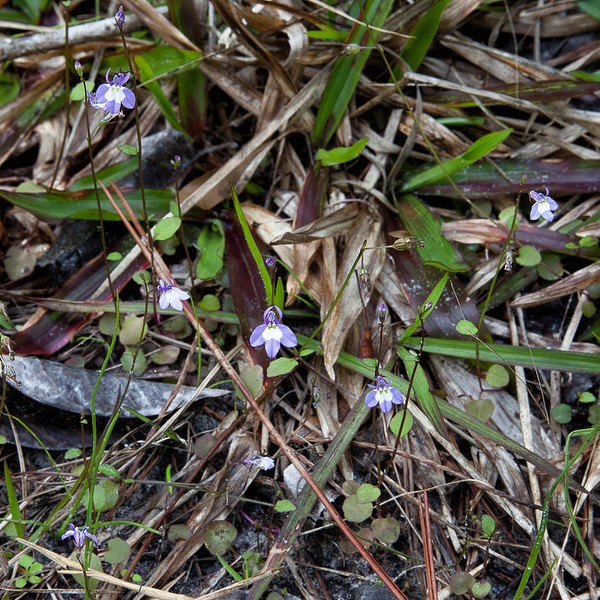
Lobelia feayana (by John Bradford)
Yesterday John and George trekked under the hot sun down a dirt road in the large wetland area west of Jupiter, a zone of marshes, depression ponds, and wet pine woods. There’s a special treat there—a flowing gurgling glimmering brook with clear water and tiny fish, lined with all your basic wetland plant species. A natural garden of delight. (The horseflies too were delighted to have some fresh meat. Come along.)
And no garden is completely delightful without a Lobelia, as lobelias are among the most widespread, diverse, colorful wildflowers and cultivated horticultural selections around the garden globe, over 350 species. Today’s Glade Lobelia is a pretty blue wildflower reminiscent at a glance of last week’s Scutellaria. And just as Scutellaria had a gimmick, the scute, lobelias have their own odd flower feature.
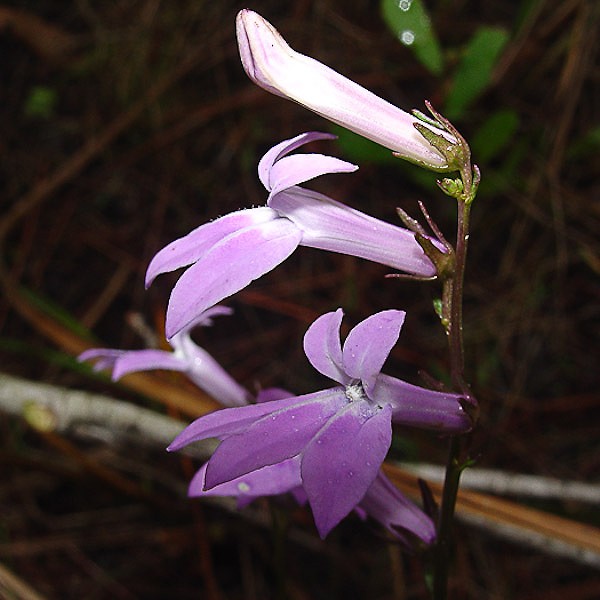
Lobelia glandulosa (by JB)
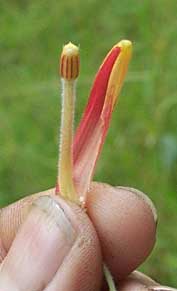
In lobelias, there are two linked oddities: the flower tube is slit for most of its length, and the five stamens are fused into a tube encasing the style and stigma. As the flower opens the stigmas are hidden within the anther tube, making the flower effectively male (pollen producing) at first, then later the stigmas emerge past the end of the tube to render the flower female. (These features are notably similar to similar structure in the Aster Family.)
This link shows the anther tube removed from a flower. The style and stigmas are inside the tube CLICK
Lobelias have hummingbirds, butterflies, and who knows what else, as pollinators, mostly bees no doubt. In most other flowers the pollinator has to fit within the petal tube, like a car entering the garage. But in Lobelia, the visitor pulls open the split petal tube to gain access to inner flower, contacting the anthers or stigmas through the slit. This link shows a hummingbird probing the slit flower while having its head tapped by the anther-stigma unit. CLICK
As a student, I remember being wowed at a more northern species, Lobelia inflata, sometimes called Indian Tobacco. (A dumb name since true tobacco itself was a Native American bad habit.) The professor said, accurately, that people smoked this species and used it in medicines for the several alkaloid drugs it contains, most interestingly for smoking-cessation and for curbing other addictions. That was in the 70s, and research has marched on. It turns out the dominant alkaloid, lobeline, interacts with more or less the same brain receptors as nicotine, although they are not similar chemically. There’s perhaps something potentially useful going on there, and lobeline interferes with the neurotransmitter dopamine.

One of these days I’ve got to quit smoking!
 John Bradford
 George Rogers
 George Rogers
 Dee Staley
 Treasure Coast Natives