RSS

But can you say Aeschynomene?

Aeschynomene americana and A. indica

Jointvetches

Fabaceae, Leguminosae
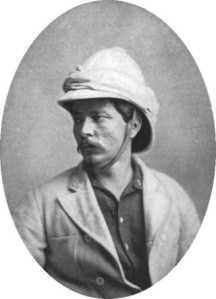
Dr. Livingstone I presume?

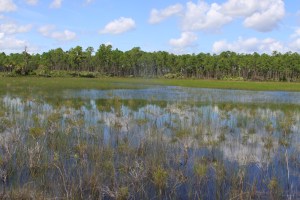
Today John and George scoped out the Kiplinger Natural Area off of Kanner Highway in Stuart.  Among the many attractions, the area is home to gorgeous Loblolly Bays (Gordonia lasianthus), but that’s for another day.

Enjoy this Gigapan of a pond in Kiplinger taken by John.  You can zoom in and out and pan around.  Click

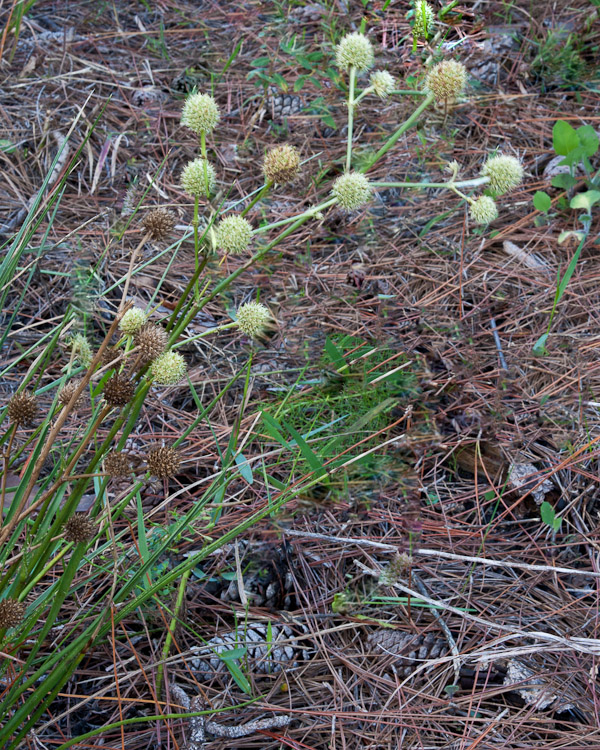
Even more amazing than Loblolly Bay (yeah, right)  are two skanky Legume weeds, species of Aeschynomene.  The amazing thing is their togetherness.  Although not rare, you don’t see Aeschonomene every day, yet in Kiplinger two species occur essentially mixed in the same clump.  If you agree with our speculations, you obviously possess superior intellect, and feel that birds of a feather flock together.  Here we have two different species of the same genus holding hands, even though one is native and one comes from afar.
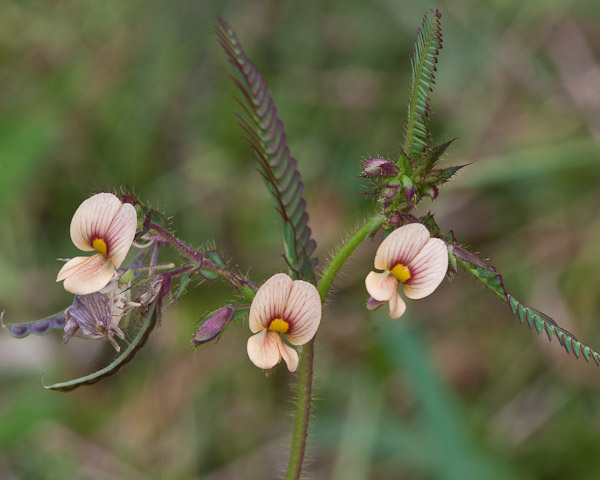
Aeschynomene americana by JB

Because both species are seeded deliberately around the warm world for livestock fodder,  their precise nativities are obscure.  But let’s pretend we know.  Aeschynomene americana, Shyleaf, is native and widespread in Florida.  Aeschynomene indica  is likewise widespread here but not native, and probably originated in South America.  Seeds are sold commercially, and species of Aeschynomene can be noxious weeds.
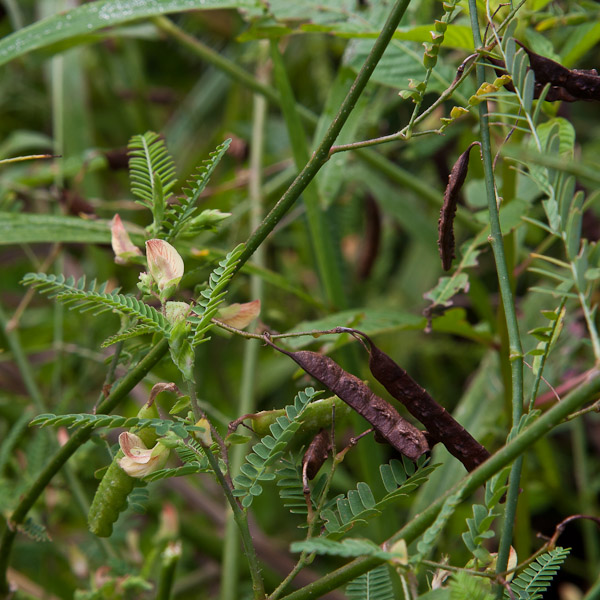
Aeschynomene indica by JB

The two growing almost touching each other seems to be a reflection of shared genes and therefore shared ecological tolerances and preferences, which is something to ponder.  Tendencies for different species of the same genus to reunite happens.  A cherry-picker might pluck debatable examples from Echinochloa, Emilia, Richardia, Sesbania, and Sida.

Overall in Florida there are about six Aeschynomene species, some native, some not.  A quick word on distinguishing the two species featured today and most likely to be encountered in the range of “Treasure Coast Natives.”   Aeschynomene americana has leaflets with 2 or more longitudinal veins, flowers with a predominantly pinkish cast, and fruits with one edge deeply lobed into pretty curves.  Aeschynomene indica, by contrast, has flowers with yellow and pink tones, a single vein in each leaflet, and fruit with almost straight (very slightly curvy) margins.  Interesting agricultural fact:  Aeschynomene americana adds 112 kg nitrogen per hectare in Florida.

Now here is the cool part.  Pith from Aeschynomene species is the usual pith of pith helmets, long favored by British explorers, tropical troops, oppressors of indigenous peoples, and khaki-wearing headwear fashionistas.  It took a lot of work to cut strips of pith and layer them onto a helmet mold, like paper mache.  Pith is porous, and a real pith helmet provides air conditioning when you dunk it in water.  The water evaporates cooling your malarial brain.  Amazingly,  they still manufacture the helmets (at least in Viet Nam) and you can still make yourself look like a 19th Century colonist if you wish.

Jungle explorers prefer pith helmets for sun protection.
 
3 Comments

Posted by on October 16, 2011 in Jointvetches


Tags: , ,

Catesby’s Lily—Eye Candy and Brain Teaser

Catesby’s Lily

Lilium catesbaei

Liliaceae

First things first, who was Mark Catesby?  And why does that matter?  (It does, be patient.)  Born and educated in England, Mark (1682-1749) earned his mark exploring, documenting, and illustrating the natural history of the Southeast and the West Indies before the days of the mighty Linnaeus, whose work is the official beginning of plant nomenclature.  Mark Catesby’s “Natural History of Florida, Carolina, and the Bahama Islands” displayed the natural history of our area in engaging vivid color, in the early 18th Century.

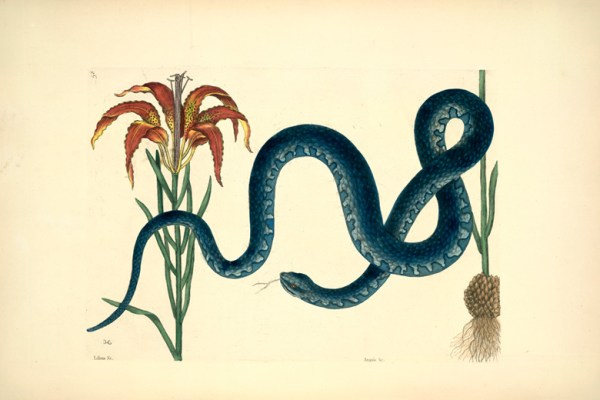
Catesby’s Lily and “Wampum Snake” by Mark Catesby

The example above shows Catesby’s Lily etched by Mark himself along with a “Wampum Snake.”  The critter has gone through the nomenclatural mill since Catesby’s times, and appears to be what we’d now call a Banded Watersnake (Nerodia fasciata).  (Commentary on this identification is welcome.)  So here is the big deal:  MC brought together one of the showiest wildflowers of the Southeast with one of the most colorful books of the early 1700s.  Who needs a Canon with all those megapixels!?

Well, we do.  Compare Catesby ca.1743 with Bradford October 2011.  Enjoy the Gigapan taken yesterday at the Jupiter Wetland Trail by John, and play Find Waldo.  In a Gigapan you can move in and out and pan around with a little practice.  Catesby’s Lily is there for visual enjoyment.

CLICK

What pollinates such a showpiece?  The main pollinator, at least in our place and time, seems to be the Palamedes (or Laurel Swallowtail) Swallowtail Butterfly (Papilio palamedes). (CLICK)  There are other cases of butterflies being prominent pollinators on our native lilies.  And there is mystery here.

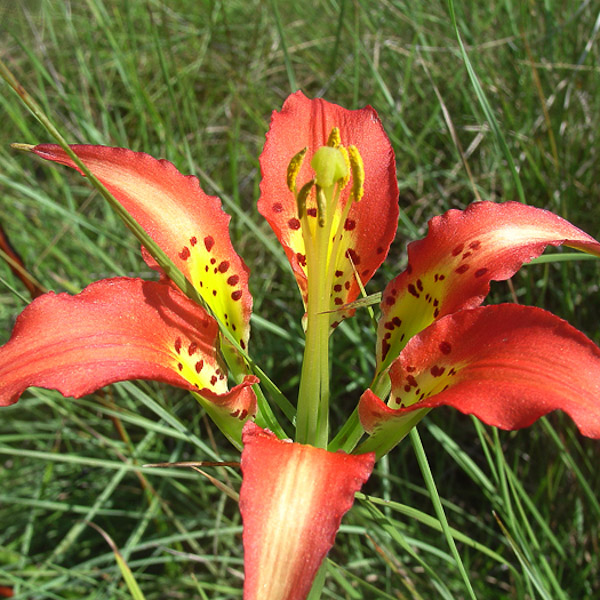
In a botany class we teach that a big showy flower is a large investment for a plant, and that flowers tend to fit the body sizes of their pollinators.  A textbook butterfly-pollinated flower might look like a tiny inverted witch’s hat half an inch tall.  Such flowers are usually clustered.  Think of Pentas or Butterfly-Bush.  We teach also that jumbo reddish or orangish flowers tend to serve hummingbirds.  So how is it that humble butterflies dominate these expensive, orange-red “bird” flowers bigger than a butterfly? And to throw in another curve, the petal (tepal) bases are narrowed sharply, leaving big gaps between them.  Such “clawed” petals occur occasionally in the floral world but are odd by Lily standards.  So what’s up with all that?  Now it is time to speculate.

Could it be that big reddish lilies adapted originally for bird visitation spawned descendants re-treaded secondarily to butterflies for reproductive services?  Could the history of Catesby’s Lily be something like that of a child who grew up to be a particle physicist, and drifted later in life to  selling  live bait?

Evolutionary biologists seek hints of earlier characteristics of any species by looking at the broader context of its relatives.  If you suspect the guy selling bait started out as a physicist, you might find it relevant that his mother, father, brother, and third cousin were Nobel Laureates.  Lilium has scores of species around the Northern Hemisphere.  Is bird-pollination commonplace among them?  Yes.

So could it be that habitats occupied by Catesby’s Lily became hummingbird-deficient during ancient times, steering originally bird-pollinated lineage down the butterfly path?  Palamedes Butterflies are common inhabitants of open wet places, so did they fill an ancient void?  Did the Lily and butterfly find each other as a “second marriage”?  (Lily-Swallowtail hookups are known to involve additional species.)

Catesby's Lily by JB

What about those unusual clawed petals?  Hummingbirds hover and poke big strong beaks into tubular petal arrangements.  But if a “bird” flowers gets a re-tread to become a “butterfly” flower it might have to adjust to the ways of a butterfly:  a butterfly lands and hangs on; it probes for nectar with a thin and delicate proboscis; its wings would not fit into a tubular shape but seem compatible with well separated petals.   Those grooves at the petal bases might help guide the proboscis.  A wild speculator might interpret the non-conventional petals to be a secondary adaption to the needs of the visiting butterfly.

Catesby’s Lily ranges across the southeastern Coastal Plain from the mid-Atlantic states to Louisiana.  The butterfly wanders similarly but more broadly, and its floral visits are not strictly the Lily.

To change the subject, the main larval host for our “Laurel” Swallowtails are Red Bay and relatives in the genus Persea, a genus persecuted by Laurel Wilt disease.  Oh oh:  the disease kills the Red Bays, which might impact the butterflies, which might impact Catesby’s Lily.  Hope not.

Lilium catesbaei occupies mostly wet pine woods, wet prairies, and similar open moist habitats.  It is generally reputed to decline if fire is suppressed and  to increase after burning, ducking hot times by means of bulbs safely below ground.  The beauty lures eager native plant gardeners like Papilio palamedes, and cultivation is possible, but the lily is particular and reputedly hard to grow.  Not often spotted in the garden world.  That’s ok—kinda nice just where it is.

 
2 Comments

Posted by on October 8, 2011 in Catesby's Lily


Tags:

Baldwin’s Kissing Comfit

Baldwin’s Eryngo

Eryngium baldwinii

Apiaceae

Today John, John’s wife Dee Staley,  and George enjoyed a field trip on a perfect October day to the Kissimmee Prairie State Park with the Palm Beach Chapter of the Florida Native Plant Society.  On the way, Dee pointed out  Crested Caracaras to add delight to the day.  Sorry, no pictures!

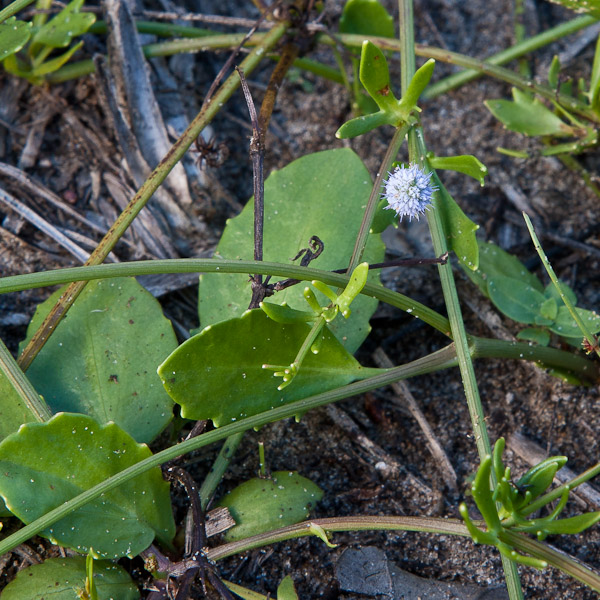
Although the main theme of the expedition was hot and heavy grass-watching, one of the first distractions was Baldwin’s Eryngo sprawling  in a sandy meadow displaying its fuzzy little blue flower globes.  This species creeps around most of Florida and a little in neighboring states, often on seasonally moist sands.

Baldwin's Eryngo in Kissimmee Prairie State Park. Photo by JB.

Now for a momentary edifying sidetrack.  Ever wonder why so many plants of the Southeastern U.S. have Baldwin in their names, usually as  baldwinii?— Eryngium bladwiniiEleocharis baldwiniiScleria baldwiniiRhynchospora baldwinii.   William Baldwin (1779-1819) was a Philadelphia physician and botanist prone to explore the Southeastern U.S. (and much beyond);  he had a jones for sedges.  His friends, enemies, and correspondents were a who’s who of American botany of the period, their names echoing through the botanical literature as specific epithets:  Amphicarpum muhlenbergii,   Eragrostis elliottii, Fraxinus darlingtonii.  Dr. Baldwin was probably mostly a swell guy, yet he dissed the work of his controversial contemporary Constantine Rafinesque acidly as “the wild effusions of a literary madman.”  The madman outlived the doctor by over 20 years.  Baldwin died of Tuberculosis on a plant-hunting excursion.

Back to Baldwin’s Eryngo.  Crush it…smell the carrots?  Eryngos are in the Carrot Family, the Apiaceae, also known as the Umbelliferae for their  trademark umbel inflorescence.  In Eryngo the umbel is squshed down to a tight flower head reminiscent of Asteraceae.

This would be a fun genus to study, or maybe a nightmare, due to the mind-boggling diversification of its species.  If Darwin had not studied finches, Eryngium could have helped illuminate the origin of species.  Around here we see Eryngium yuccifolium, Rattlesnake Master, which looks like a desert yucca, and we see and smell  the utterly different Eryngium aromaticum, which has bristly leaves not too different from some lawn weed.

Statewide there are nine species in Florida from the tip of the Panhandle to the docks of Miami, in habitats ranging from swampish to scrub,  one species endemic and endangered (Scrub Eryngium), a couple others escaped  exotics.  The garden selections are mighty pretty and are probably taken to be thistles by casual passers-by.

The crazy quilt of Eryngium diversity has not escaped the interest of contemporary taxonomists who are attacking  the genus—known for long distance dispersals, hybridizations, and rapid diversification—using DNA techniques to sort it all out.   There are over 200 species worldwide.  As varied as the species may be in overall appearances, in habitat preferences, and in behavior, they all have flowers in globose heads, and these are often blue.

Being fragrant, Eryngos collectively have big histories in human affairs.  As explained in Dan Austin’s “Florida Ethnobotany,” candied Eryngium bits were called “kissing comfits.”  They  were the breath mints of their day, except better, having aphrodisiac power.  Along these lines, and  to recycle Dr. Austin’s gleanings from Shakespeare, Falstaff said:

“Let the sky rain potatoes; let it thunder to the tune of Greensleeves; hail kissing comfits and snow eryngoes; let there come a tempest of provocation.”

Who said botany is stodgy?   In what other blog does a smelly little weed  lead to aphrodesia and tempests of provocation!

 
2 Comments

Posted by on October 3, 2011 in Baldwin's Eryngo


Tags:

Mushroom Identification 101

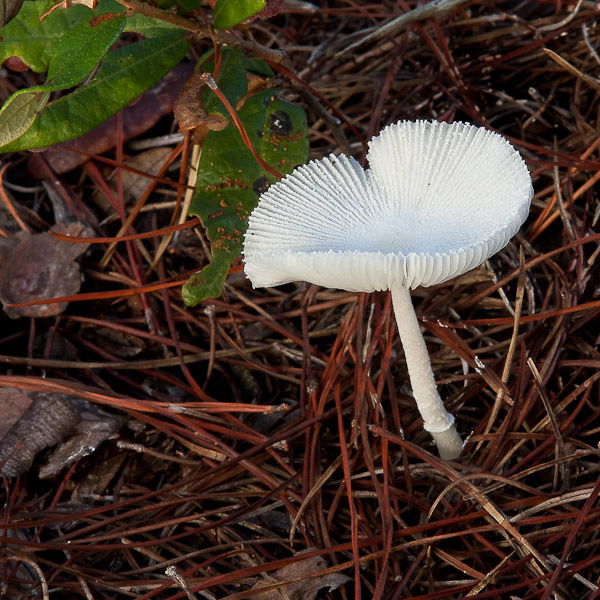
While walking through Hawk’s Bluff, which is part of the Savannas State Preserve, I noticed a white mushroom. Normally, I’m looking for plants to photograph or grasses to identify, but the white mushroom set against the pine needles presented a nice photo op.

When I got home and downloaded the picture, I started wondering about the name of the mushroom. Now I knew that mushrooms, like all other flora and fauna would be divided into Families, then Genera, then Species. But since I’ve never really spent any time trying to ID a mushroom, I didn’t even know where to start. I began by searching Google for images of white mushrooms of Florida. After spending some time and not finding a match, I came on a site entitled “WELCOME TO FLORIDA FUNGI”. And what was better, it had a section entitled “Ask Bill!” Bill said, “Send in your photos and I will help you ID them.”

Never one to turn down a offer of free help, I wasted no time in attaching my photo to a email and sending it off, hoping to get some info in a few days. Imagine my surprise when a few hours later I got an email from Bill giving me the Genus of the mushroom. Bill was positive that it was a Leucocoprinus but it had the possibility of being one of a couple of species. As I later learned, Leucocoprinus is a genus of fungi in the family Agaricaceae whose best known member is the yellow pot-plant mushroom (Leucocoprinus birnbaumii). The genus has a widespread distribution and contains about 40 species.

The ID of Leucocoprinus was just fine for a title for my picture and I was happy. But, apparently Bill wasn’t and he sent the picture off to his contacts for their opinion. As Bill forwarded me their comments and opinions, I began to realize that the positive ID of some mushroom species is not something that one learns overnight.

While I think that I’ll stay in my comfort zone of plant and grass ID, it is interesting to learn something about the world of fungi. And it’s also nice to know that there are people like Bill out there that are willing to take the time and lend their expertise to helping someone asking for help. Here is a link to Bill’s site for anyone wanting to know more about the fungi of Florida: http://www.nettally.com/annep/floridafungi/

Thanks Bill.

 
Leave a comment

Posted by on September 29, 2011 in Mushroom


Tags: , , ,

Spotted Beebalm

Spotted Beebalm, Spotted Horsemint

Monarda punctata

Lamiaceae, Mint Family

 No doubt many wildflower and garden-flower enthusiasts with northern roots had their first native Monarda experience with the attention scarlet Oswego-Tea (Monarda didyma) and with the violet-purplish Wild-Bergamot (M.  fistulosa).  The ruling species around here is the Spotted Beebalm (Monarda punctata), which ranges into the northern states, including as a prairie flower.  (For the sake of completeness, another Florida species north of our stomping grounds is Lemon Beebalm, Monarda citriodora.)

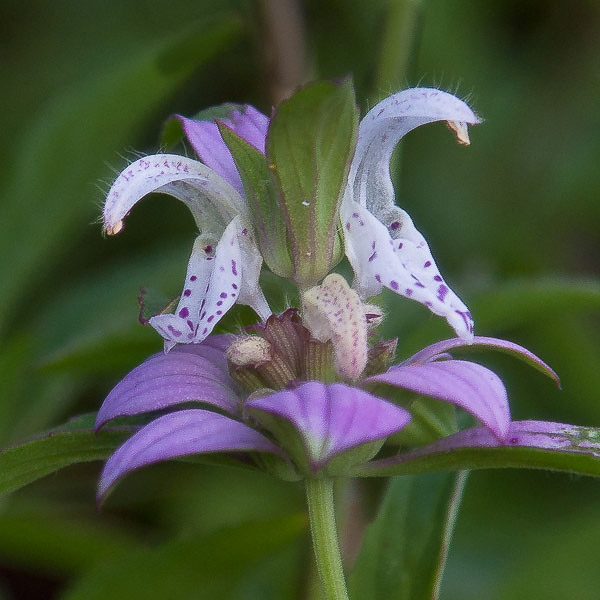
Spotted Beebalm is a one-plant flower show with rich purple bracts, purple-tinged calyx, and purple-spotted two-lipped white to slightly yellow corollas with gaping mouths.   This could be taken as a classroom example of a bee-pollinated flower, with a horizontal landing platform grooved with a debatable nectar guide, and with all those irresistible purple polka dots.  And bees do arrive aplenty.   Many species.  Butterflies show up too.  The more the merrier.  Spotted Beebalm is living testimony to wasps as floral visitors too.

Wasp-pollination is mildly surprising, because wasps are generally carnivores at heart, and are known to visit flowers as hunting grounds for buggish prey.  Maybe that was the original reason for wasp-flower visits.   In any case, some wasps extract pollen and nectar nutritionally, obviously spreading pollen in the process. CLICK  

Look closely at the photo.  As with most two-lipped flowers, the stigma (pollen-receiver) and anthers (pollen-makers) are pressed up to the top of the inside of the floral tube (the roof of the mouth).  That way, bees pushing into the tube brush past the stigma, dropping off pollen, and past the anthers, receiving pollen.  Monardas characteristically have wide-spreading anthers, and are split into two subgroups of species, divided over whether the anthers and stigmas are shorter than the tube, or jut out from it.

Now comes a little speculation:   Broaden the view a moment, say, to Orchids, the most diverse plant family.  Orchids have intricate pollination mechanisms tending to correspond to individual pollinator species.  Many members of the Mint Family likewise have complex systems involving levers and mousetraps apparently to interface with narrow ranges of bee species.   But Monardas seem (repeat: seem!) to have comparatively simple systems by mint standards not particularly specialized for anybody, and thus open to the plenteous biodiversity drawn to the blossoms.  Their specialty seems to be splashy billboard advertising rather than a niche market.  Beebalms are the Yeehaw Junction of the wildflower world.

Clumped in a naturalistic garden, Spotted Beebalm has pros and cons.  It is an occasional component in the sunnier gardens on the Palm Beach State College campus.  When in full glorious bloom, Spotted Beebalm earns ooohs and ahhhs from passers-by.   But glory is fleeting, and when not in flower the plants are far less attractive, and not durable.  Is the plant a perennial or an annual?  Yes. The individual stems decline post-flowering and look crummy.  The plants re-seed, which is good or bad depending on your standpoint.  Flowering time is hurricane-time, late summer, early fall.  (This post is a collaborative effort by John Bradford and George Rogers.  John took the photo.)

 
1 Comment

Posted by on September 24, 2011 in Spotted Beebalm


Tags:

Tell the Dentist “Hold the Novocaine”—You’ve Got Toothache Tree

Wild Lime, Prickly-Ash

Zanthoxylum fagara

Rutaceae

 Wild Lime is no real lime, although it is a native hammock-dwelling Citrus in the fragrant company of Torchwood (Amyris elemifera), Hercules Club (Zanthoxylum clavis-herculis), and many additional native and cultivated Florida Citrus species.  The approximately seven native zanthoxylums in the U.S. plus the 200 others worldwide have a rich history in human affairs.

Listing the umpteen afflictions historically treated with these bioactive trees would be tedious, so we’ll zoom in on a couple.  Zanthoxylum species are sometimes called Toothache Trees, and they do have well substantiated ability to numb the mouth dating back to pre-European applications, as reflected in diverse Native American names.  Pharmacological research has backed this up in a modern scientific context, and there is some interest in the plant’s chemistry relative to leukemia.  At a less sophisticated level, Zanthoxylum juice has turned up in commercial natural toothpastes.

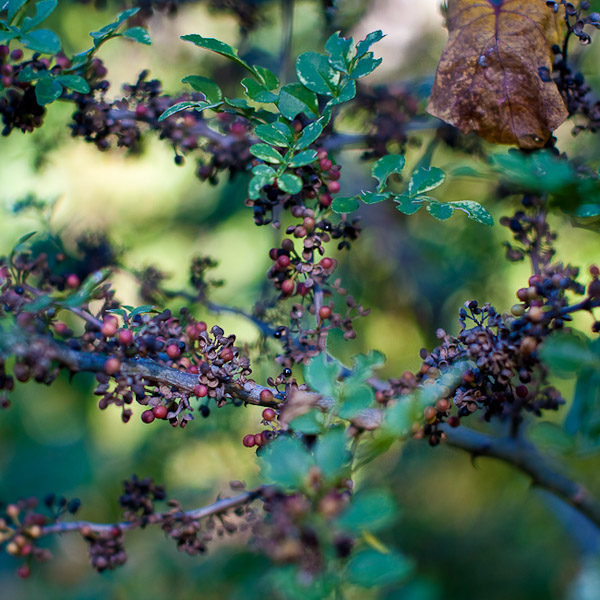
Wild Lime fruits in September. Photo by JB

Crushed Zanthoxylum parts present a citrusy spicy fragrance, and serve most saliently as Sichuan Pepper from various Asian species.  The spice is also call “fagara,” giving today’s species its specific epithet.  Zanthoxylum means yellow wood, a self-explanatory name; the wood, bark, and roots yield a yellowish dye.

For gardeners who can live with bloodthirsty spines, Wild Lime is an attractive and tough smallish landscape tree or shrub tolerant of drought, of alkaline soils, and of life near the sea.  This and other ornamental native and non-native Citrus species are vectors of Citrus Greening and no doubt of additional ailments afflicting the Florida Citrus industry, and thus are unwelcome trucked commercially around the state.

The trees are dioecious, that is, separate male or female.  This is a remarkable reproductive system in a large woody plant where half of the individuals are devoted solely to pollen production.  But then again, the same can be said of mice and men.  The small dehiscent pods contain merely one black glossy seed.

Wild Lime is among the diverse Citrus species valuable as host plants for the Giant Swallowtail Butterfly whose larva looks like a bird dropping on the tree’s stem.  The endangered Schaus Swallowtail depends mostly on the related Torchwood, raising the question of Wild Lime serving potentially as a “plan B” for this swallowtail.

This post is a collaborative effort by John Bradford and George Rogers.

 
5 Comments

Posted by on September 17, 2011 in Wild Lime


Tags:

Sesbania vesicaria will raise a few blisters

Sesbania vesicaria

Bladderpod

Fabaceae, Leguminosae

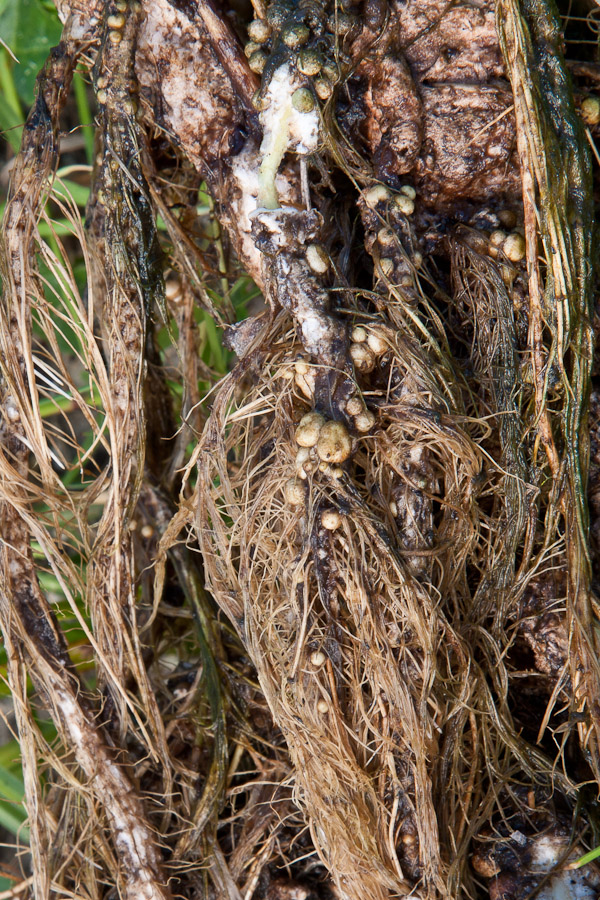
 A trip to Kissimmee Prairie State Park today revealed beautiful Sesbanias to be the plants of the day John and George stopped the car to check on Danglepod, Sesbania herbacea, in a roadside ditch near the park.   This species is probably native, although perhaps a little too weedy and widespread for its exact origins to be clear.  The pod is long and skinny, in contrast with today’s featured species below, and the standout feature is underground, or better put, under water.  The root mass looks like Santa’s beard, a  bleached-white spongy mop studded with nitrogen-fixing nodules on steroids slurping nutrients so aggressively out of the stinky canal water you could almost hear it.  If you ever need a plant to sop nutrients out of eutrophic water, here’s a candidate—or do all those nitrogen-fixing nodules put nitrogen back in?  A water-lover for sure.  Various species of Sesbania have “river hemp” as part of their names.

Sesbania herbacea with awesome roots. Note the root nodules. Taken 10/2/11 by JB.

Being fast-growing, tolerant of hard times, and nitrogen-fixing,  species of the large genus Sesbania have worldwide roles as green manures, fodders,  and similar applications, although the seeds (and other parts?) are toxic.   They are also showy, which no doubt is why Sesbania punicea with  flame-colored flowers and winged pods has escaped cultivation to become a Category II invasive exotic in Florida and beyond.   Why does somebody always have to sell every #$%^ weed with colorful flowers?   And why does every species of Sesbania have its own weird pod?

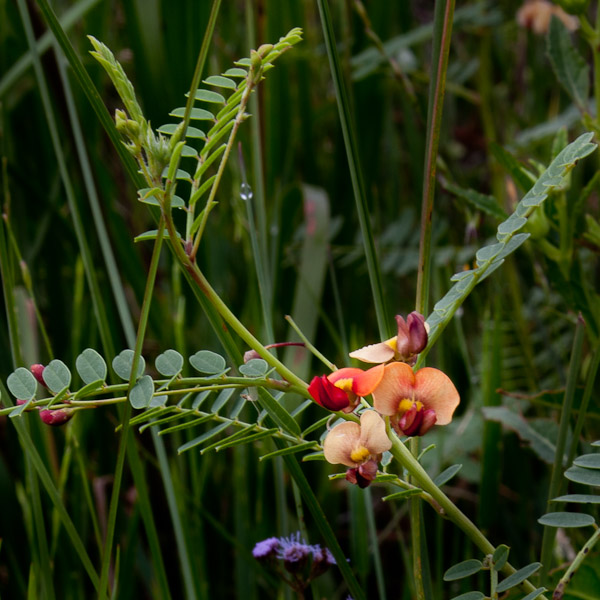
Sesbania vesicaria. Photo by JB.

Colorizing the lonesome prairie is Sesbania vesicaria with three-toned blossoms in  lively salmon red shaded  with deep maroon and  with a  sunny yellow eye.  You can’t miss them.  The name Bladderpod is self-explanatory upon encountering the bladder, and is reflected in the species  name “vesicaria,” which means puffed up.  Vesicants cause blisters.  The mature legume is puffy,  bloated, pointy at the ends, and dangling decoratively.   Confession time:  having seen the bladder dangling on bare twigs in the off-flowering months, the identity was not obvious until  leaves and flowers  illuminated the pretty truth.   The pod could pass for a large insect pupa, except for being  full of seeds.

 
Leave a comment

Posted by on September 10, 2011 in Bladderpod


Tags:

Pineland Chaffheads

Pineland Chaffheads

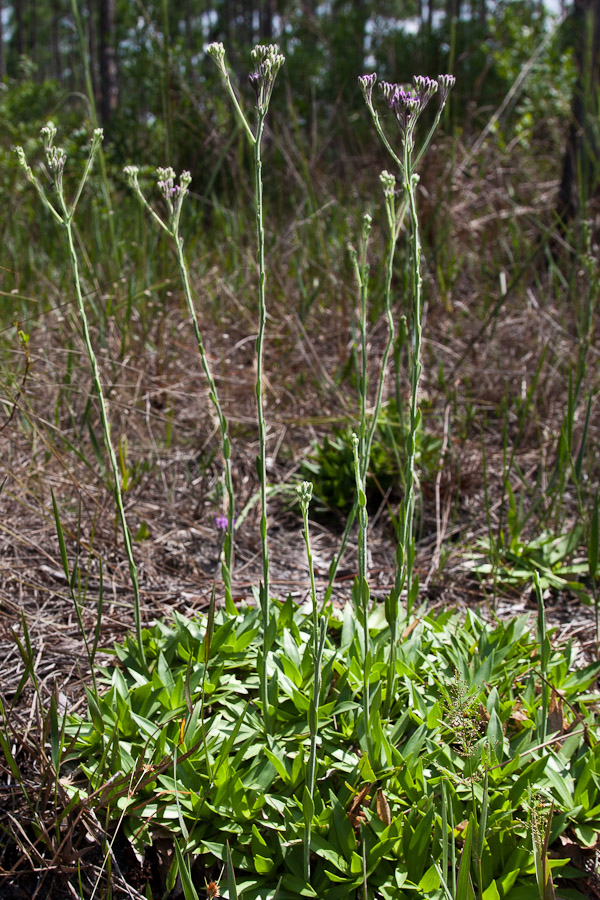
Carphephorus carnosus  CLICK

Asteraceae

 Carphephorus carnosus has a striking appearance, the slightly succulent leaves mostly at the plant base,  in low rosettes, often crowded in sizable patches, stiff and knife-shaped.  The appearance suggests a desert species, or maybe something from a rock garden.

The geographic distribution is interesting too.  Restricted more or less to central Florida,  the species occurs in pinewoods, prairies,  and low open usually moist habitats.  These habitats are hardly the desert/rock garden just mentioned, except in a seasonal sense.   The habitat  are places of periodic fire,  of blazing sun,  and of  poorly drained sandy soils where conditions flip-flop between seasonally  soggy and seasonally xeric.     

Carphephorus carnosus in early September

The plants seem highly adapted to fire.  The dense patches of low rosettes appear to be fire-resistant:   low and tough, out of harm’s way from blowing flames and blowing winds.  The congested leaf islands formed by the crowded rosettes appear to  offer flame-proofing like buffalo in a ring.  The edges may fry, but the inner reachers are protected.  The plants have a hard knotty core to which they can burn back or die back in the dry season, to regenerate fresh leaves in the summer months,  culminating with flowering in the safe rainy autumn.  Turning briefly to a related species,  Carphephorus paniculatus is not just fire-tolerant, but also fire-dependent.  The latter species has been documented to decline by 75% after three decades of fire protection.  This is probably true of C. carnosus as well.  These pioneer species with parachute “seeds” (achenes) can blow readily into recently burned areas.

Species of Carphephorus are glandular, with the fragrance champion being C. odoratissimus, “Vanilla-Leaf,” with vanilla-scented foliage.    The most obvious explanation for the aromatic essences is protection from herbivores.  Although the fragrance suggests vanilla, it differs chemically from the natural orchid extract.  The volatile essences from C. odoratissimus are a mix of sesquiterpenoids (these  are common in Asteraceae), miscellaneous other compounds,  and, primarily,  coumarin, which can smell like vanilla.   Coumarin is scattered among diverse plant families as a feeding deterrent;  among other effects, it suppresses livestock appetites, and converts into a toxic anticoagulant, making it useful in modern human pharmacology.

These plants undoubtedly have ecological secrets relating to their harsh habitats.   Their beauty comes in large part from their stark toughness topped with rich purple flower heads.   This post is the outcome of a trip to Jonathan Dickinson State Park by John Bradford and George Rogers.  John took the photo.

 
Leave a comment

Posted by on September 3, 2011 in Pineland Chaffheads


Tags:

St. Andrew’s Cross

St. Andrew’s Cross St. John’s Wort

Hypericum hypericoides

Clusiaceae

Every time I (G. Rogers) think about St. John’s Wort my mind jumps to a business wonder.  Near my parent’s home in Brevard NC is Gaia Farms CLICK where roadside weeds are spun into gold, or at least ground up and bottled.  Lots of weeds, apparently lots of gold, and yes, Gaia carries one of the mainstays of herbal remedies, St. John’s Wort (Hypericum perforatum, a different species of Hypericum than today’s species).

Species of Hypericum as folk remedies date back into antiquity.  Once upon a time back when spells and curses were pesky, Hypericum served as witch-repellent.   In modern times we are more troubled by depression than hexes, and the herb sells as depression-repellent.  Also there is interest in it as a potential antiviral drug.   We do not have the expertise to pronounce on the efficacy or safety of Hypericum products, but we do have a strongly developed general skepticism of witch-cures.

Like many plants with a medicinal history, there is toxicity. These plants when ingested photosensitize the skin, making it susceptible to sun damage, potentially fatally so.  There’s a nod to this in the Gaia instructions: “Avoid excessive exposure to UV radiation (e.g. sunlight, tanning) when using this product.”   Hypericum species poison livestock, especially cattle.

All this medical schooling is a prelude to John’s and George’s opening-day-for-archery-hunting exploration of the Corbett Wildlife Management Area Hungryland Slough.  We kept our heads down on the swamp boardwalk.  Prominently in bloom was St. Andrew’s Cross, Hypericum hypericoides.

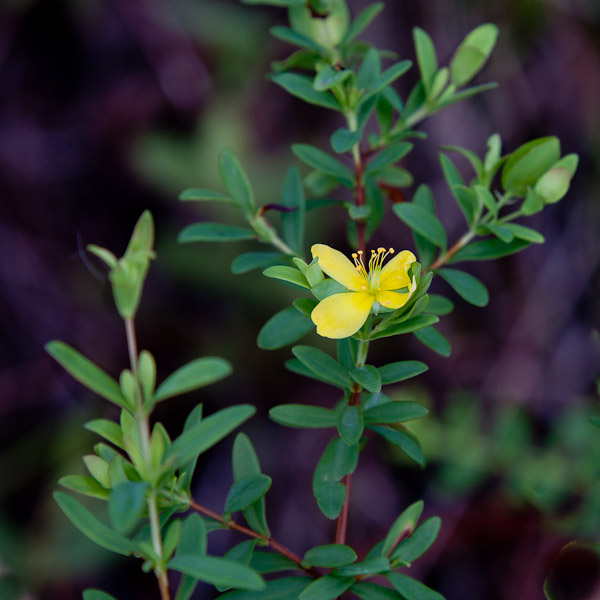
Hypericum hypericoides

Hypericum is a big genus of over 400 species, with a few dozen growing wild in Florida.  Identification hints for St. John’s Worts generically are yellow flowers having 4 or 5 free petals and stamens that you can count.  The opposite leaves are freckled underneath with tiny black or translucent spots as seen with a hand lens.  One the more abundant species, dominating local “Hypericum marshes,” is Peelbark St. John’s Wort (H. fasciculatum), which has shredded reddish bark and five petals.  Our own Hypericum hypericoides distinctively combines four petals with two styles in the flowers on a shrubby frame bearing sessile more or less elliptic leaves.  (Our other locally present four-petal species have three styles.)

How did the common name for Hypericum hypericoides become “St. Andrew’s Cross,” while a separate species Hypericum crux-andreae (St. Peter’s Wort) seems to have a natural claim on the former name?  Even with references to three different saints, you can’t fix the world in one blog.   (This account comes from a collaborative effort by John Bradford and George Rogers.  Saint John took the photo.)

 
Leave a comment

Posted by on August 27, 2011 in St. Andrew's Cross


Tags:

Button Rattlesnake Master

Button Rattlesnake Master

Eryngium yuccifolium

Apiaceae

Today John Bradford and George Rogers  wandered through the Sweetbay Natural Area adjacent to the Palm Beach North County Airport.  The area is named for the Sweetbay Magnolia (Magnolia virginiana), but this post will feature a much odder plant that was in full bloom today.

Sweetbay in August

What plant looks like a yucca straight from the desert, has white flowers packed into congested heads like so many other locally abundant species, and smells like carrots when bruised?   The Button Rattlesnake Master:  Eryngium yuccifolium.  The globe-shaped heads of small white flowers resemble those of Buttonbush (Cephalanthus occidentalis) and Buttonweed (Spermacoce verticillata, not native).  All three were in flower in close proximity.  It would be interesting to know how much overlap they have in flower visitor species.  Probably much.   Many species visit the Eryngium.

Being a member of the Carrot Family (Apiaceae), it comes by the carrot smell honestly.  And, yes, the plant has a taproot.  The long skinny leaves look more like those of a Monocot (such as a true yucca or a grass) than the Dicot this species is.  Around here the plants reach about three feet tall.

Eryngium yuccifolium

Eryngium yuccifolium is odd and beautiful enough to be a garden plant, and it is, being started readily from seeds.  The  species is distributed across the southern and central U.S. from Florida to Minnesota  in diverse wet and dry habitats ranging from limestone glades to pinewoods to tall grass prairie, all demanding the characteristic of requiring durability, especially to withstand fires—burning pine woods in the South and burning prairies in the mid-West.  When the top fries or dies, regeneration comes from the taproot.

Why the name “Rattlesnake Master”?   According to some accounts, Native Americans rubbed the pulverized root onto the hands to gain mastery over rattlesnakes.   (Relevantly somehow, on a prior visit to Sweetbay we encountered a pygmy rattler at the very site where the Eryngium grows.) According to other reports, the name has to do with historical uses to treat snakebites.   Extracts from Eryngium roots reportedly reduce inflammation, so the snakebite treatment is a folk use with potential extension into modern pharmacology.

Maturation of the flowers is protogynous (pro-TOJ-eh-nus), that is, female first.   The stigmas poke out early between the petals, with the flower remaining otherwise closed.  The closed petals hold the stamens in.  Eventually the petals spread, the stamens emerge, and it is male-time.  The male and female phases overlap, and the flowers are self-compatible, resulting in high seed production.  Neat system-eh?   The flower is receptive to outside pollination before it can pollinate itself.  If there is no outside pollination, then the flower self-pollinates as Plan B. (This post is a collaborative effort by John Bradford and George Rogers. JB took the plant picture. GR took the scenic vista.)

 
2 Comments

Posted by on August 19, 2011 in Rattlesnake Master


Tags: