Catesby’s Lily
Lilium catesbaei
Liliaceae
First things first, who was Mark Catesby? And why does that matter? (It does, be patient.) Born and educated in England, Mark (1682-1749) earned his mark exploring, documenting, and illustrating the natural history of the Southeast and the West Indies before the days of the mighty Linnaeus, whose work is the official beginning of plant nomenclature. Mark Catesby’s “Natural History of Florida, Carolina, and the Bahama Islands” displayed the natural history of our area in engaging vivid color, in the early 18th Century.
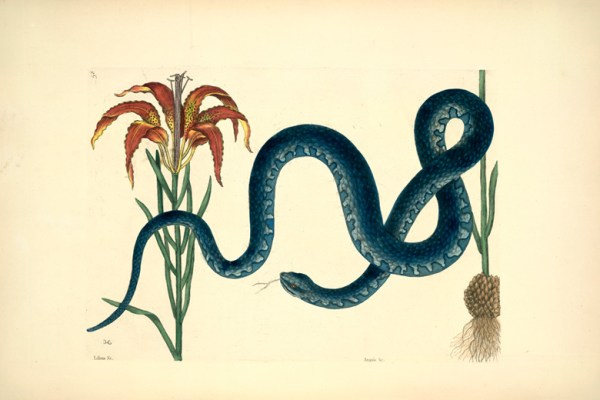
- Catesby’s Lily and “Wampum Snake” by Mark Catesby
The example above shows Catesby’s Lily etched by Mark himself along with a “Wampum Snake.” The critter has gone through the nomenclatural mill since Catesby’s times, and appears to be what we’d now call a Banded Watersnake (Nerodia fasciata). (Commentary on this identification is welcome.) So here is the big deal: MC brought together one of the showiest wildflowers of the Southeast with one of the most colorful books of the early 1700s. Who needs a Canon with all those megapixels!?
Well, we do. Compare Catesby ca.1743 with Bradford October 2011. Enjoy the Gigapan taken yesterday at the Jupiter Wetland Trail by John, and play Find Waldo. In a Gigapan you can move in and out and pan around with a little practice. Catesby’s Lily is there for visual enjoyment.
What pollinates such a showpiece? The main pollinator, at least in our place and time, seems to be the Palamedes (or Laurel Swallowtail) Swallowtail Butterfly (Papilio palamedes). (CLICK) There are other cases of butterflies being prominent pollinators on our native lilies. And there is mystery here.
In a botany class we teach that a big showy flower is a large investment for a plant, and that flowers tend to fit the body sizes of their pollinators. A textbook butterfly-pollinated flower might look like a tiny inverted witch’s hat half an inch tall. Such flowers are usually clustered. Think of Pentas or Butterfly-Bush. We teach also that jumbo reddish or orangish flowers tend to serve hummingbirds. So how is it that humble butterflies dominate these expensive, orange-red “bird” flowers bigger than a butterfly? And to throw in another curve, the petal (tepal) bases are narrowed sharply, leaving big gaps between them. Such “clawed” petals occur occasionally in the floral world but are odd by Lily standards. So what’s up with all that? Now it is time to speculate.
Could it be that big reddish lilies adapted originally for bird visitation spawned descendants re-treaded secondarily to butterflies for reproductive services? Could the history of Catesby’s Lily be something like that of a child who grew up to be a particle physicist, and drifted later in life to selling live bait?
Evolutionary biologists seek hints of earlier characteristics of any species by looking at the broader context of its relatives. If you suspect the guy selling bait started out as a physicist, you might find it relevant that his mother, father, brother, and third cousin were Nobel Laureates. Lilium has scores of species around the Northern Hemisphere. Is bird-pollination commonplace among them? Yes.
So could it be that habitats occupied by Catesby’s Lily became hummingbird-deficient during ancient times, steering originally bird-pollinated lineage down the butterfly path? Palamedes Butterflies are common inhabitants of open wet places, so did they fill an ancient void? Did the Lily and butterfly find each other as a “second marriage”? (Lily-Swallowtail hookups are known to involve additional species.)
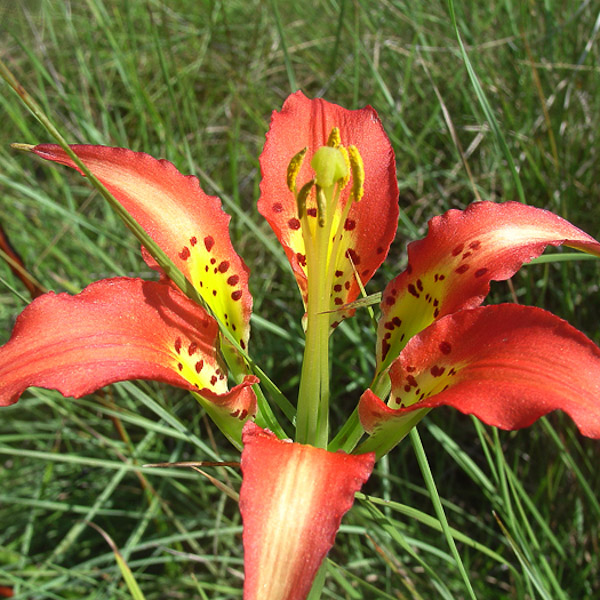
Catesby's Lily by JB
 John Bradford
 George Rogers
 George Rogers
 Dee Staley
 Treasure Coast Natives
George Rogers
September 1, 2013 at 7:58 pm
Ooops–it was 2 years ago