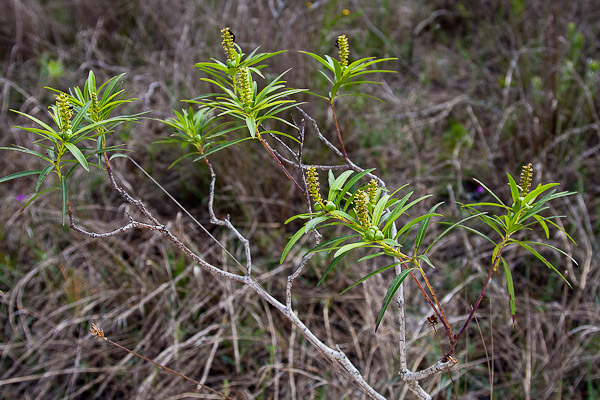
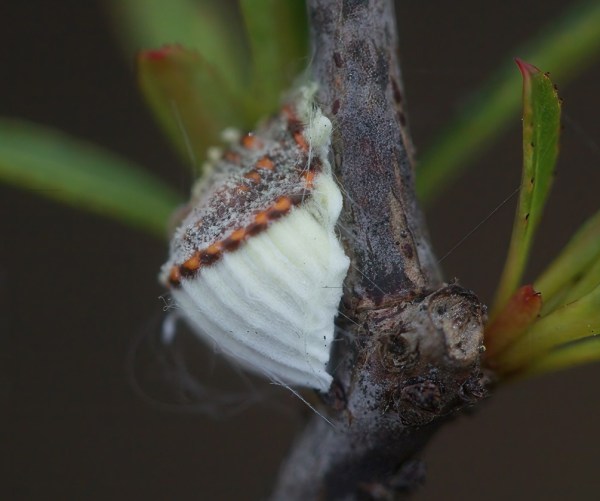
Generally it would be nice to think that native species in their natural habitats are mostly free from invasive pests, but it happens. One such happening seems widespread, sometimes severe, and unreported. I try to avoid plant ailments in the blog, but the present case seems noteworthy. In recent years I’ve spent a lot of time working in depression marshes, and have developed a special fondness for the two main woody species there: Peelbark St. Johnswort (Hypericum fasciculatum) and Corkwood (Stillingia aquatica). That’s very nice, but there’s a fly in the ointment. Corkwood often is infested with Cottony Cushion Scale. Cottony Cushion Scale is most easily recognized by its female with striking white fluted egg masses. It has been an exotic pest in Florida for at least a century, most famous as a Citrus scourge, also happy to parasitize many additional species.
Stillingia by John Bradford
The number of insects on a Stillingia can range from one to many. That they can kill the plant is obvious from many observations of dead and dying Stillingias peppered with the pests and their decaying remains. A skeptic might mumble, “maybe the Stillingias were otherwise ill, and the insects are taking advantage of their weakness.” Possible, but my gut doesn’t agree, and even if my gut is wrong, the poofy pests are not helping.
Cottony Cushion Scale on Stillingia
Although Cotton Cushion Scale has broad range of hosts, it seems to have a special taste for Corkwood. How widespread is the problem? I don’t know. On inaturalist you can sometimes spot the Cottony Cushion Scale on photos of Stillingia far beyond Martin and Palm Beach counties, such as near Punta Gorda and near Naples.
Been working on projects lately that have me dipping deeply into on-line resources. That got me thinking it might be fun and useful to gather the wealth of local plant information and imagery created by John Bradford, who is working with me now on a tree and shrub photo guidebook. There’s something for every native plant enthusiast below: photos, online class, grasses and sedges, on-demand wildflower guidebook, and huge set of photo guides to local natural areas, by far the best listing anywhere (IMHO).
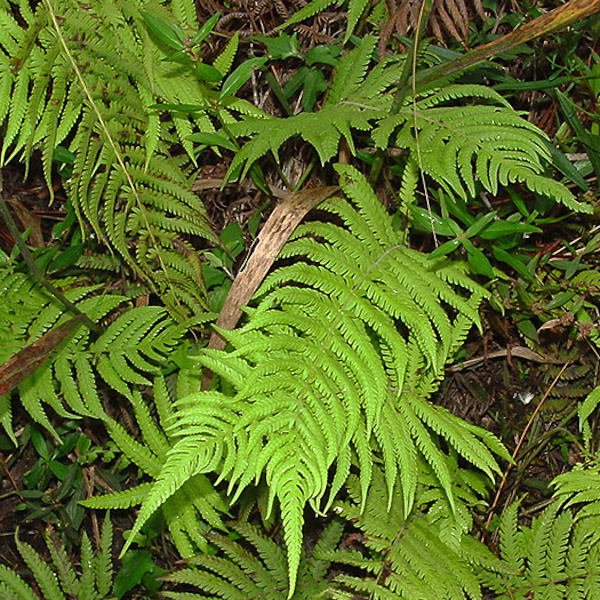
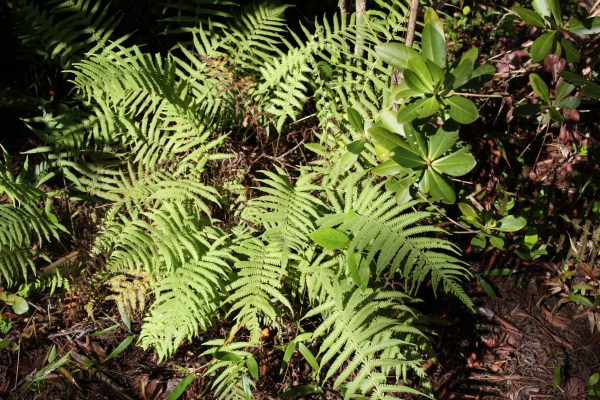
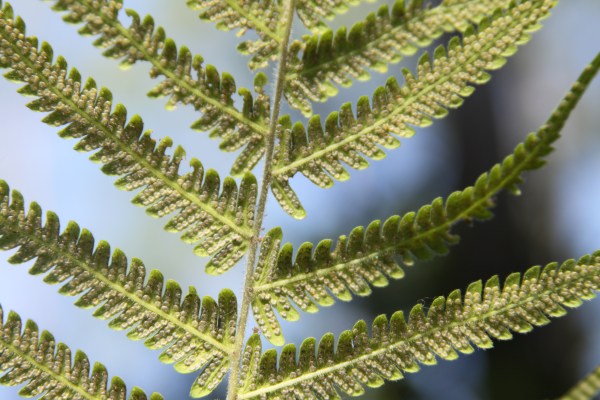
Something that bugged the Native Plants class I taught for 20 years is the observation that in our immediate area Kunth’s Marsh Fern, one of the most common and prettiest ferns hereabouts, thrives best on 45-degree slopes, in other words on the banks of streams, ditches, and ponds.
Photo by John Bradford
What’s bothersome is that ferns generally get around by wind-blown spores, but this particular fern is mostly on wet banks. Okay, sure, the spores blow all over the land, and a certain percentage land in a suitable habitat, stream bank or wherever, with the vast majority going to waste landing elsewhere. Duh. As true as that has to be, and obviously is for many plants (such as bromeliads on tree branches), there remains a gut feeling of , “smart ferns on streambanks should use water dispersal.” I’ve long wondered if the spores have some specialization for water-dispersal. Perhaps, but if so, never documented to my knowledge. Then today, Eureka!, stumbled upon a 2013 article by Dutch botanist J. Sarneel featuring wetland species dispersal in the Netherlands. The info there just plain “feels” right for the problem at hand.
Thelypteris kunthii, so far as I know, does not grow in Europe but the very (very!) similar related Thelypteris palustris does, and guess how it gets around?
Dr. Sarneel and associates set up giant sieves to capture water-borne seeds and other dispersal-organs in a stream flowing out of a swampy area. (Palustris means “lives in swamps.”) They captured the diverse floating dispersal-units of many aquatic species, and gathered data on their suitability for water dispersal. Out of 252 units from 10 species recovered were 20 rhizome growth tips from Thelypteris palustris, which apparently sheds the tips as the banks erode or as the rhizomes extend into an exposed position. The rhizome tips took several days to sink fully, and over 57% of them resprouted when tested.
That’s gotta be how our Kunth’s Marsh Fern manages to own so many stream and ditch banks. Maybe.
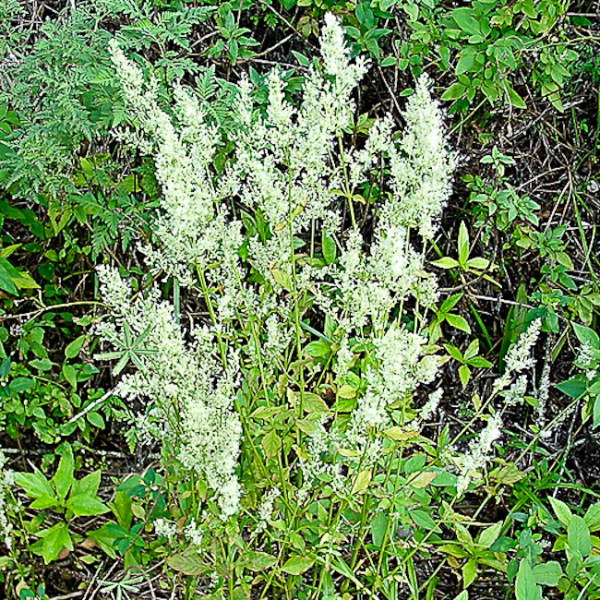
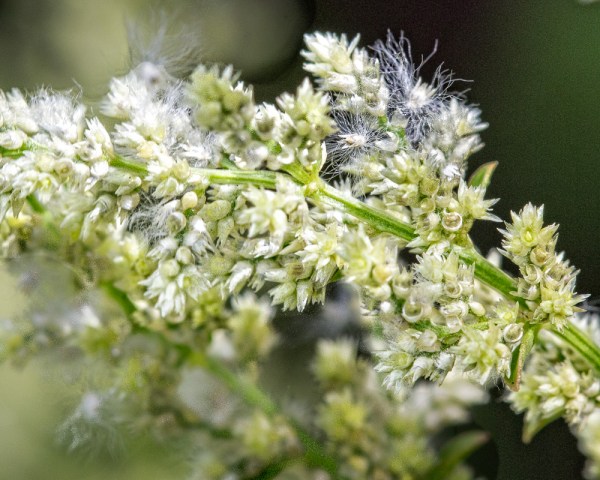
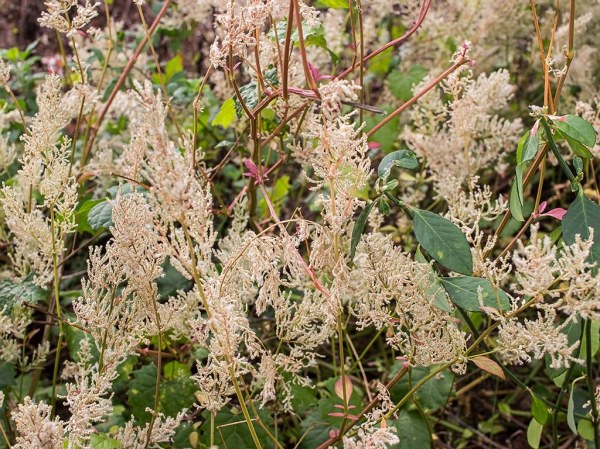
Looking pretty right now, as it does much of the year, is the pufffy white plant known locally as Juba’s Bush. You see it here and there, fairly showy. Look closely, some individuals are more feathery-puffy than others. The feathery ones are females having seeds covered in white hairs. The males have tiny white hairless flowers.
All photos today by John Bradford.
The species is regarded as a minor sources of allergenic pollen, although I’m not sure about wind pollination, given that the flowers are fragrant. Would be interesting to know what happens pollination-wise.
Female flowers with hairs
OK now, who was Juba, other than a city in Sudan? Juba I and II were father and son Kings of the ancient North African kingdom of Numidia. One of the King Jubas named a miraculous medicinal plant “Euphorbia” for his physician Euphorbus. In somebody’s imagination Iresine called to mind Juba’s legendary Euphorbia plant, thus Juba’s Bush.
Male inflorescences
Iresine diffusa itself has quite a medicinal history of its own. Shift the camera from Numidia to Jamaica. The discovery of the genus Iresine in a formal botanical sense was in Jamaica in 1756. Perhaps dating back to indigenous inhabitants, Jamaica has a long tradition of “root tonics” blended from the roots of several local species. Some of the tonics are bottled commercially, others more informal. Dr. Sylvia Mitchell at the University of the West Indies studied 38 different tonics. It turned out that Iresine diffusa, known locally as “Nerve Wist,” is in most of the tonics, reputed to enhance “male vigor.” I’d include the label of the main commercial tonic incorporating Nerve Wist, but the brand name and associated imagery are a bit salacious for our nice family blog.
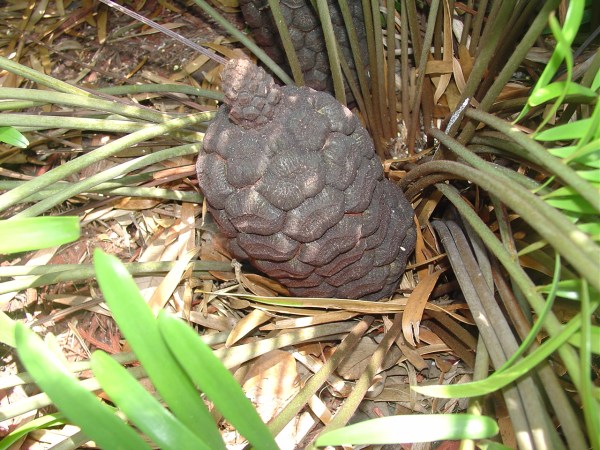
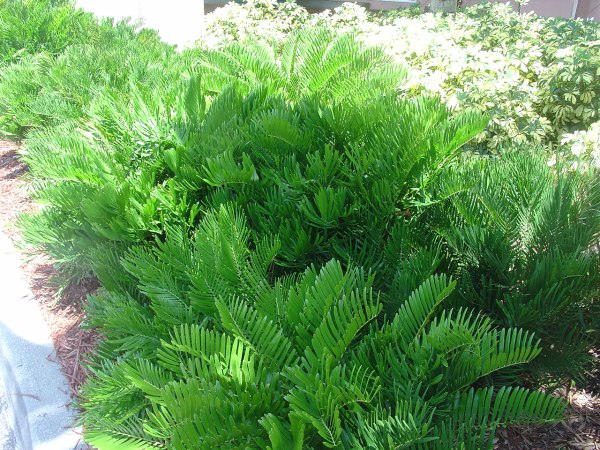
Thank you to Pat Bowman for suggesting today’s topic and for providing resources to boot. One of South Florida’s most curious plants is the Cycad known as Coontie. The curiosity begins with being a Cycad, the only one in the U.S. Cycads are living fossils dating to the time of dinosaurs associated mostly with the Southern Hemisphere. Most look like big ferns or small palms, although they are unrelated to both. Cycads have no flowers, but rather seeds in cones, on separate male and female individuals.
Coontie female cone
The Coontie cones are pollinated by beetles who live their entire lives in the male cones, except when they visit the female cones. And speaking of insects, Coonties are essentially the exclusive hosts to the beautiful Atala Butterfly and its hungry orange caterpillars. Dependent on Coonties, the butterflies became rare as Coonties became scarce in the wild, so scarce that in the 1950s Atalas were presumed extinct. Happily, however, the butterflies survived on one island off of Miami, and widespread Coontie cultivation has allowed the Atalas to rebound since the 1970s. It is possible that all the Atalas now descend from that single island population, unless there were other undetected hideaways. Why did Coonties become scarce? In addition to standard habitat destruction, they once were a commercial source of starch. They got dug up, ground up, and ate up.
Coontie lives naturally in Florida and Georgia into the Caribbean, with its classification and original range both are a little bit murky, probably by being moved around by pre-European peoples who harvested starch from the big chunky subterranean stems (“roots”) long before Europeans arrived. Isolating the starch is not easy due to dangerous toxins.
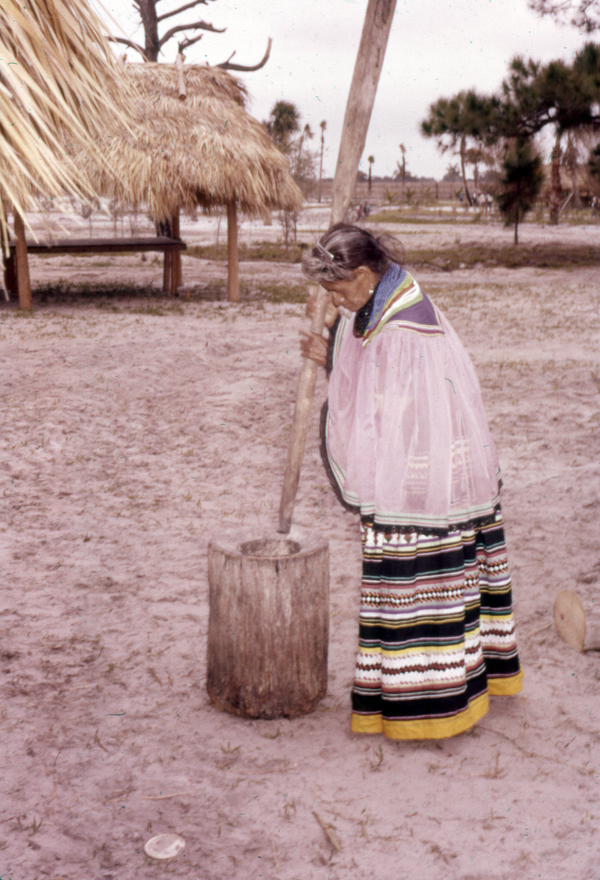
Grinding Coontie
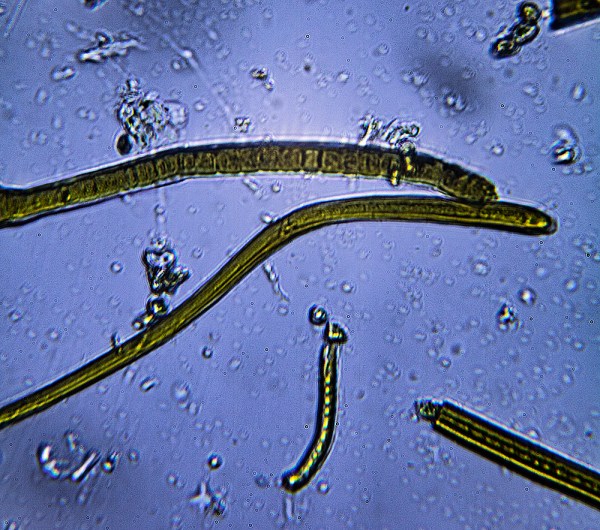
The plant produces some of the poisons directly, and other toxins perhaps come from symbiotic nitrogen-fixing Cyanobacteria (Blue Green Algae) associated with the roots. Detox required cutting and pulverizing the root followed by extensive washing, at least sometimes in a running stream, sometimes involving boiling, followed by straining to separate the starch from the pulpy residue. The starch flour was shaped into cakes and sun-dried. The pulp became fertilizer.
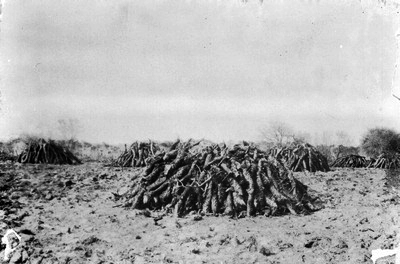
All dug up
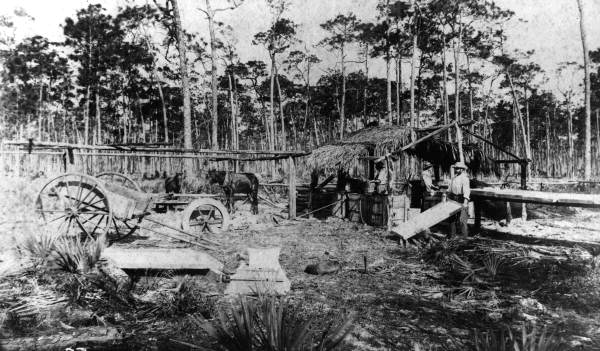
European settlers got in on Coontie starch, ultimately on a commercial scale with Coontie mills around the Miami area from the 1830s to somewhat beyond 1900. The starch was shipped far and wide as “Florida Arrowroot” for cookies, biscuits, pasta, army food, and laundry. The problem is, Coontie was not farmed but rather dug in massive quantities from the wild, not a sustainable practice. It became scarce, and also illegal in the 1920s due to fears of accidental poisoning. The last Florida Arrowroot factory succumbed to the “Great Miami Hurricane of 1926.”
Coontie mill near Miami
Happily, the plant is attractive and grows well in plant nurseries, and has become a popular landscaping choice: slow-growing, ferny-looking, tough, and not very demanding. Around Palm Beach County, except where introduced, you don’t often see it growing wild, but there is plenty in front of stores, in median strips, and around homes, including mine. Some landscape plants are merely pretty, but Coontie is fun to think about on each encounter: older geologically than the flowering plants, having the weirdest pollination system in town, and having a foodie history. When it looks all bug-eaten in the landscape, that’s a good thing…Atala support.
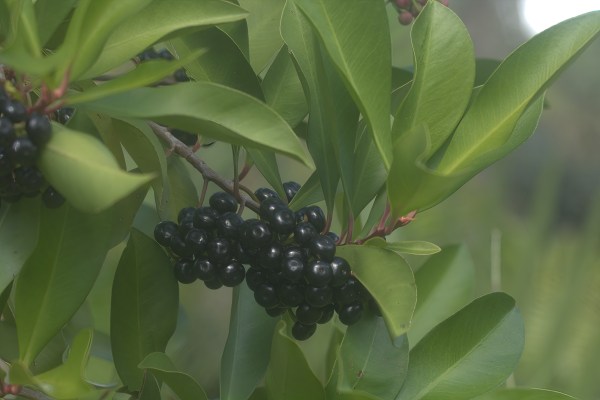
In natural areas at this moment are massive glistening clusters of shoebutton ardisia fruits. Wow is it prolific! The plant is a worldwide invasive exotic once grown in gardens, now a shrubby nuisance in natural areas. Don’t know if it is just “sampling error,” but I feel like I see more of it in Martin County and northward, than in PB County. In any case, there is plenty for everybody.
Shoebutton by John Bradford
Something I often wonder in the cases of invasive species with supernatural growth, as many seem to have, is, “isn’t there a way to harness that exuberance”? Biofuels, or food, fodder, fibers, or lumber, oils…some silver lining to each different invasive cloud.
The flowers by JB (not flowering now)
In the case of shoebutton ardisia, maybe medicines of the future, which is an over-worked theme perhaps in plant science, but this case seems so promising. Do not get me wrong, I am not suggesting using extracts from the plant for any purpose. No no no! Very likely toxic and dangerous. But maybe with continued research it could earn its keep. A diverse handful of unrelated plants produce a compound called bergenin. One is Caesalpinia digyna, a legume used traditionally to treat anxiety among other purposes. That is interesting because bergenin has emerged as a potential candidate as a natural antianxiety medication reportedly (one study) rivaling Valium (Diazepam) in effectiveness. Ardisias too produce bergenin, including A. elliptica.
Lots of berries
To get to the point then, shoebutton ardisia grows unwelcomely in Florida and around the tropical globe in crop-sized quantities on poor soils with no fertilizer, and makes billions of fruits. Wouldn’t it just be a fine thing IF bergenin turned out to be an effective and safe antianxiety med, and IF it could be sourced to redeem today’s rampant invader?
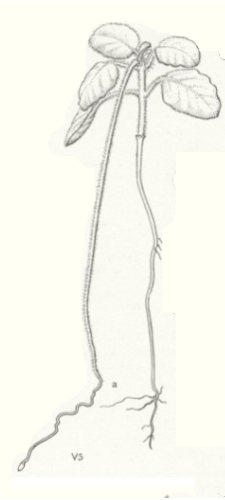
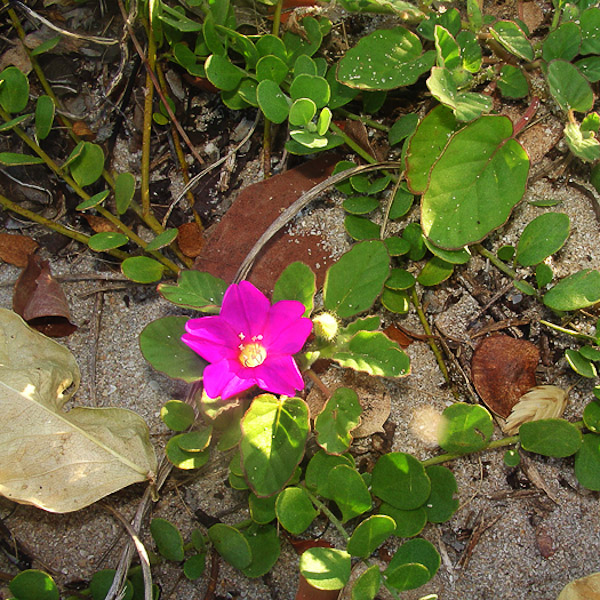
While beachcombing a few days ago for flowering nickerbean (found a couple), a stunning blossom surprised me directly on the beach sand glowing purple and yellow between my flip-flops: Beach-Peanut. Misnomer alert: not a peanut. What this species has in common with a peanut is it buries its fruit, pretty dang deep, generally between 4 inches and a foot. Then it somehow manages the miracle of sprouting way down there and penetrating to the surface, or the buried seed may wash away during beach erosion to find itself under shifting sands on a different beach. Perhaps Nicole relocated a few. As the “peanut” is pushed down through the abrasive sand, it forms a thick protective “helmet” on its downward end.
Look at this crazy plant burying its fruit!
The buried “nut” is in the lower left.
The species is rare in Florida, on a short stretch of the coastal East Coast, and extends southward onto tropical beaches beyond the Sunshine State. You don’t see it often, and never would if not for that eye-popping magenta flower. Oddly those purple petals are not petals, but rather fancy sepals.
By John Bradford
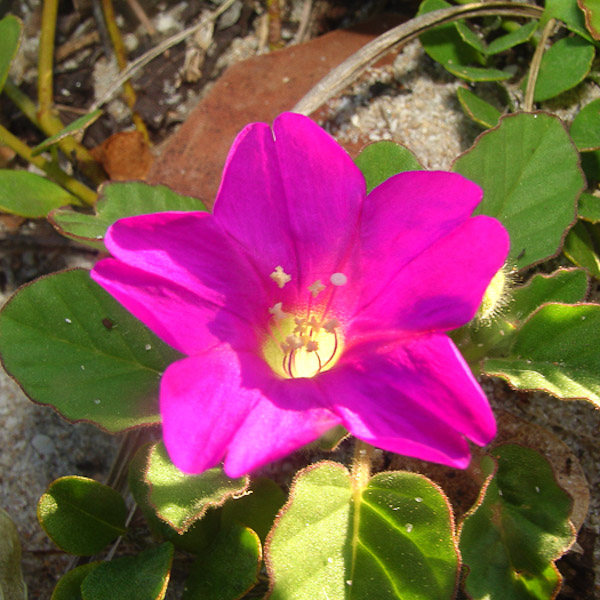
I wonder what pollinator visits it. Maybe nobody, because the tiny bit of study devoted to the biology of this species, in the 1970s, found two types of flowers: 1. The showy ones seem to be strictly functionally male, oddly having no recipient for their pollen because there seem to be no pollen-receptive female (or mixed sex) flowers. (They may have a stigma but it does not work.) 2. The second type of flower never fully opens. Instead, it self-pollinates while remaining shuttered and buries the baby.
This flower is functionally male-only. By JB.
So why make those big showy pointless male blossoms? I don’t know. Somewhere along the line something must have changed. Perhaps pollen-receptive flowers do (or once did) exist in the less-explored parts of the range on some remote Gilligan’s Island beyond Florida. If so, the seeds most likely to go forth and successfully colonize a new beach would be those that mature into self-pollinated individuals with assured solo reproduction. No partner from a second seed required. So then maybe Florida is home to a line of mutated self-pollinated diaspora escaped from a proper but undiscovered male-female population. As the last botanist who studied Beach-Peanut said, “this interesting genus requires further study.” Ya think?
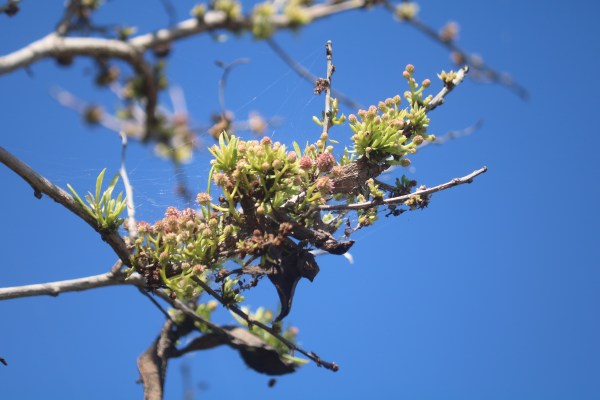
A few years ago John and I botanizing on Hutchinson Island along the shore noticed a lot of Buttonwoods to have weird stunted growth characterized by vast numbers of stunted branches in tight clusters. This is more or less a “witch’s broom,” a broad term for deformations in various plant species caused by various “things” interfere with growing branchlets. If the growing tips are killed repeatedly, new growth comes forth, only to die, followed by more new growth, etc. etc. until you have a “broom.” Tip killers include smog, mites, microbes, herbicides, and who knows what else. I guess at the time, puzzled, we were superficially inclined to attribute the witch’s brooms to cold salty January ocean winds. The damage seemed worst on exposed trees. Maybe from nasty winds. Probably not.
Then over the last few days there it was again on Jupiter Island in the same type of seashore habitat several miles south of Hutchinson. Again the damage is widespread, conspicuous, and unevenly distributed. This renewed my curiosity.
Witch’s broom on Jupiter Island a few days ago
What do you do when you’re curious? Google! Doing that turned up deformed Conocarpus cultivated in Iran with the trouble attributed to a a pathological microbe. Could be something similar here but the Iran damage looks different from the Florida trouble. Unlike the case in Iran, I’ve encountered damage only on seashore individuals, as if maritime conditions are a factor either directly or as a stress, or merely chance, given that Conocarpus is a seashore species, so except for cultivation, seashore habitats are its home.
More Googling led to the UF/IFAS blog of a year ago 12 Nov 2021 by Michelle Leonard-Mularz showing damage identical to that Hutchinson Island and on Jupiter Island but much farther south, in the Keys, no doubt again near the sea, although less prone to cold January winds than Hutchinson Island and Jupiter Island. That blog attributed the witch’s brooms to the ALS inhibitor herbicides, for example Image, taken up by the roots.
Witch’s broom in the Keys from IFAS blog
That’s probably correct, although perhaps short of proven beyond the shadow of a doubt. The damage being near the sea casts a small shadow of a doubt, and I see the damage among mangroves where I don’t think there ought to be root-uptake herbicides, but you never know. In all cases there are roads nearby, with roadsides weeds conceivably suppressed the chemical way. This IFAS publication shows (Figure 4) stunting on a Conocarpus in a nursery pot, attributed to herbicide
In any case, time will tell more along the seashores where a lot of naturally occurring Buttonwoods are in obvious distress from Martin County to the Keys. When you get around that habitat, take a glance at the Buttonwoods, and be careful with the herbicides. The modern types kick ass.
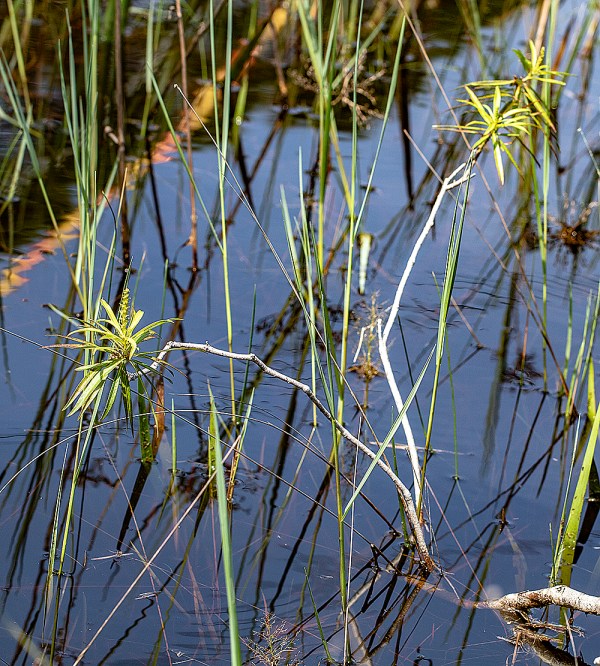
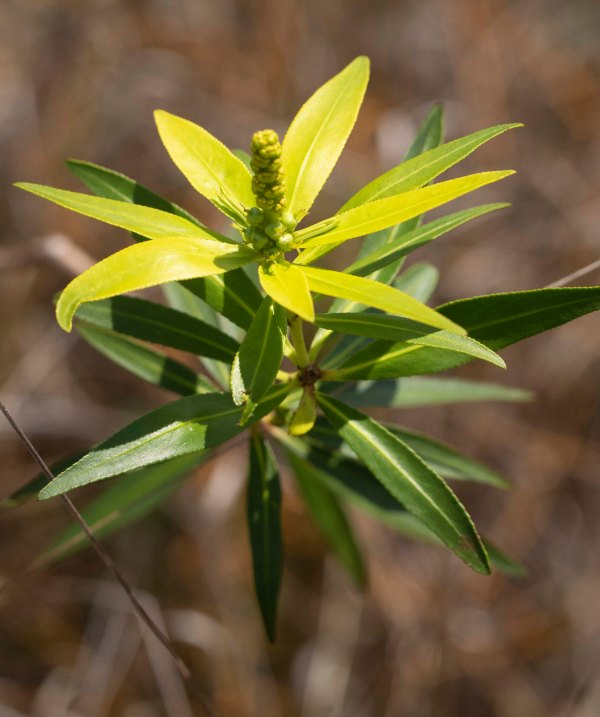
Around Palm Beach and Martin counties are thousands of shallow depressions ranging from a few yards to hundreds of yards in diameter. A few hold water year-round. A few seldom-to-never hold standing water. Most are flooded during the rainy months, and droughty and crusty during the dry season. Most of the seasonally flooded depressions are dominated by two shrubs coexisting hand-in hand: Corkwood (Stillingia aquatica) and Peelbark St. Johnswort (Hypericum fasciculatum). These marshes don’t have a formal name, so I call them Hypericum-Stillingia marshes. They are an intriguing yet virtually unstudied ecosystem.
H-S marsh. Look how shrubs cluster around the tree bases.
What a harsh environment! Under water half the year, and a sun-baked desert the other half. Which season is worse… suffocating submerged roots in the summer-autumn, or dry-roasting the rest of the year? Every species must cope with both extremes, and each has its own mechanisms for dealing with the seasonal double whammy. Every species there has its own story. Let’s look at the key players: Hypericum and Stillingia.
Above, Hypericum. Below, Stillingia.
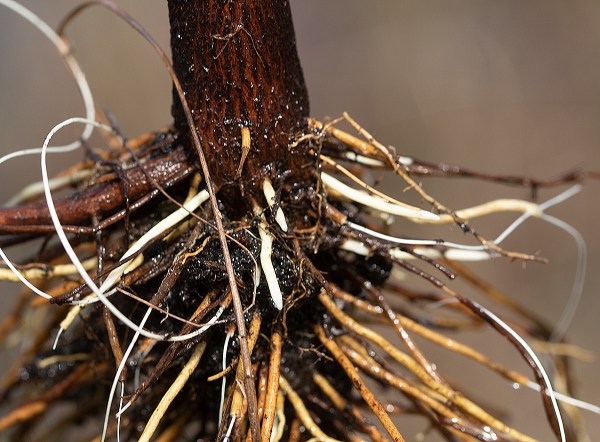
How does Hypericum survive the flooding? It has an extremely shallow roots system snaking around just under the surface, and little “snorkels” rising up into the standing water where there is dissolved oxygen.
Hypericum roots with snorkels
There are also stilt roots around the base of the trunk, able to capture oxygen even when there’s flooding below. They also capture algae and nitrogen-fixing cyanobacteria, which probably helps with mineral nutrition.
The same species in the hot dry season benefits skinny leaves resembling conifer needles, and from protective bark far thicker than that known on any other local shrub.
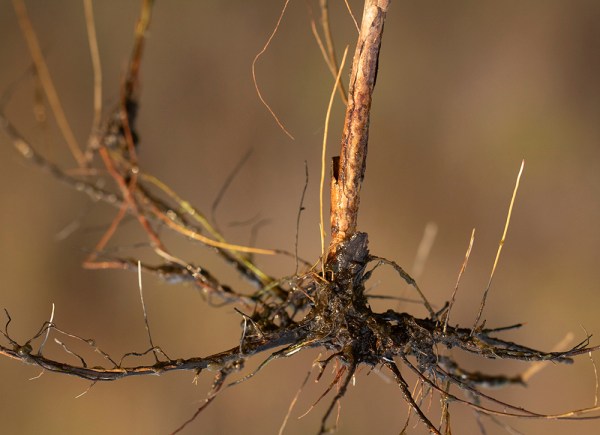
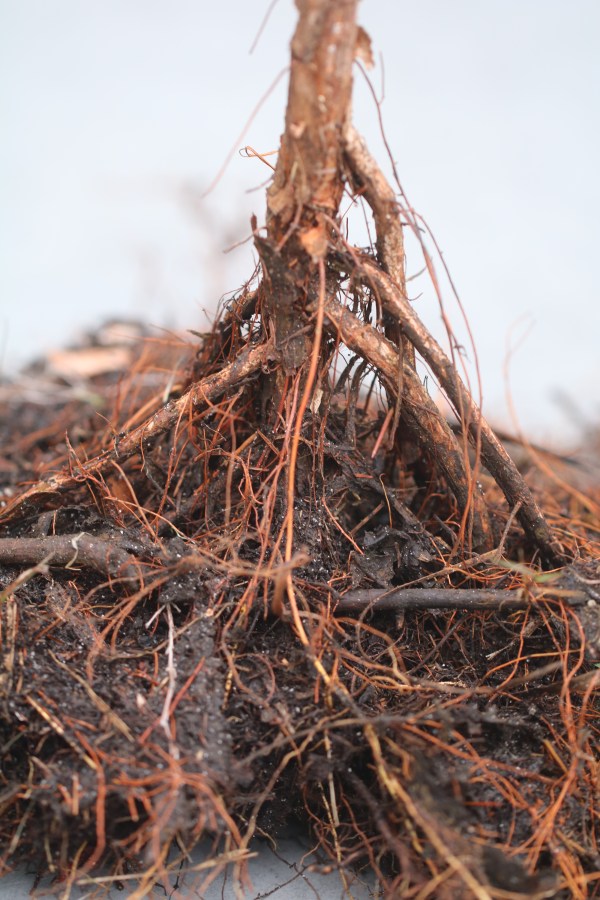
Stillingia aquatica differs by having, instead of wandering shallow roots, comparatively deep roots in a crowded mass, and with built-in air canals near the water surface.
Stillingia roots
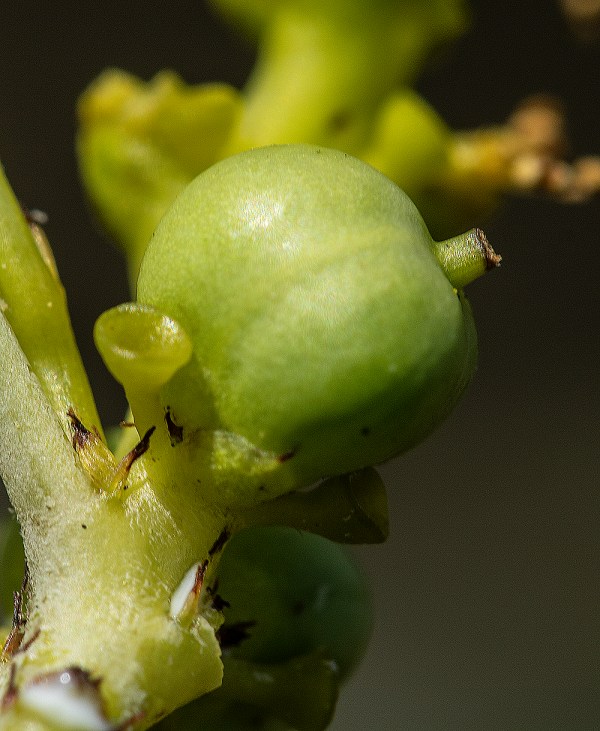
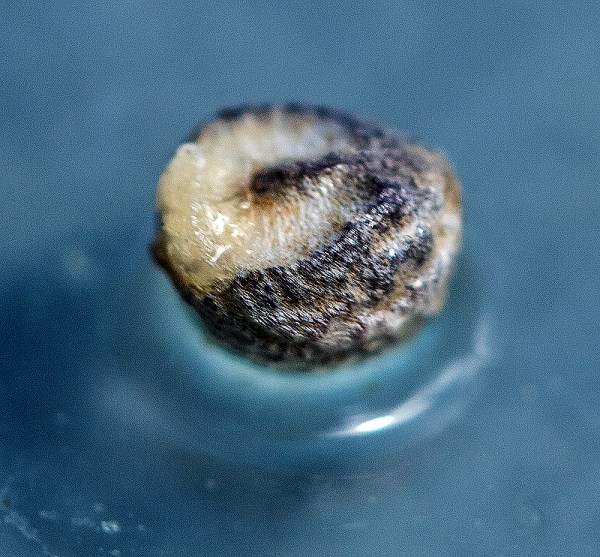
The base of the root mass is deep enough to stay where the soil remains moist year-round, and the air canals up high handle ventilation. The leaves are narrow, and, like some desert plants (you know, cacti), the trunk has thick green tissue able to photosynthesize with minimal water loss. The flowers are far out in a marsh where pollinating insects are scarce. The strongest cross-marsh fliers are wasps, drawn from afar to the tuft of yellow bracts under the flowers, and fueled by little nectar goblets on the stem near the flowers. As is also true of Hypericum, in Stillingia if insects fail to bring pollen the plant pollinates itself as a reproductive safety net. Stillingia seeds are built for both seasons: they can float when flooded, and each has built-in ant food for ant assistance during dry times.
Yellow bracts
Nectar goblet
Stillingia seed with ant bait
A completely different set of woody species lives on the raised hummocks above the highwater line. The hummocks are masses of tree roots, mostly from Slash Pines, with accumulated organic debris and oodles of ants. Eight species “own” the hummocks: Cocoplum, Dahoon Holly, Muscadine Grape, Myrsine, Saw Palmetto, Smilax, Swamp Bay, and Wax Myrtle. What almost all have in common is small bird-dispersed fruits rained down by birds sitting in the Slash Pines. Most of the hummocks host masses of Wax Myrtle, which, as a nitrogen-fixing species, will be found by future ecologists to fertilize the other hummocks species.
Cyanobacteria = Blue Green Algae
Bird droppings from the pines are great sources of phosphorus. The plants are conspicuously extra-large near major bird nesting sites. What’s tricky to explain is that most of the hummock-dwelling shrubs (but none of the bottom-dwellers) are dioecious, that is, have separate male and female individuals. Reasons for this are unknown, although dioecy correlates with harsh seedling conditions, including shade. Makes sense, given that a completely female dioecious plant can specialize on making particularly tough shade-tolerant seedlings instead of using half its resources for male functions, making and dispersing pollen.
In short, the Hypericum-Stillingia marsh is a living laboratory of unusual nutritional relationships, odd root structures, unique pollination challenges, complex breeding systems, and adaptations to tolerate two environmental extremes in the same plants. On one hand, it is surprisingly how minimally these systems are known. On the other hand, I like the unexplored mysteries right under our noses. That’s what makes it all so much fun. Anybody can go to an Hypericum-Stillingia marsh and delve into the unknown for an hour.
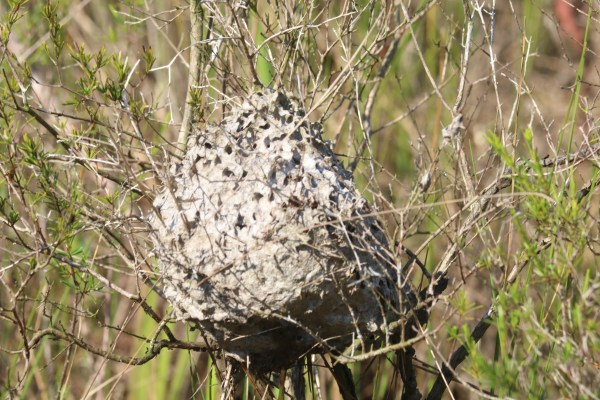
Ant carton nest “treehouse” high and dry above the flood.
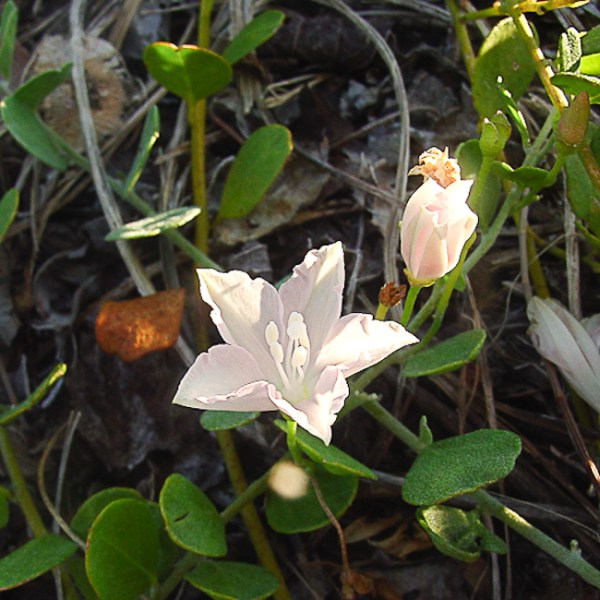
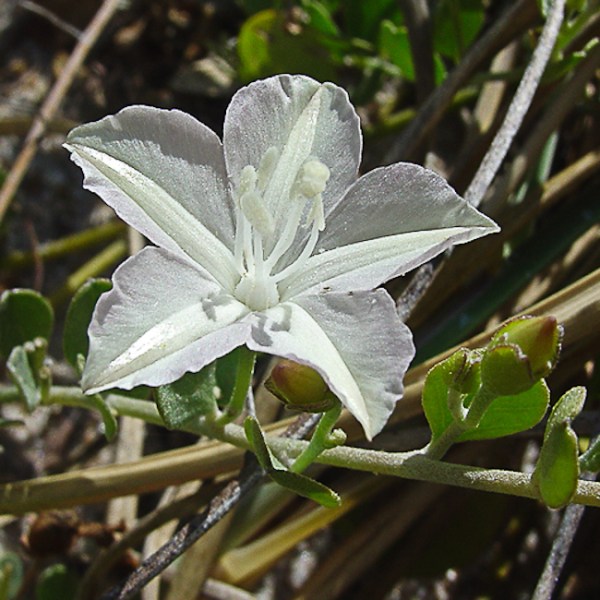
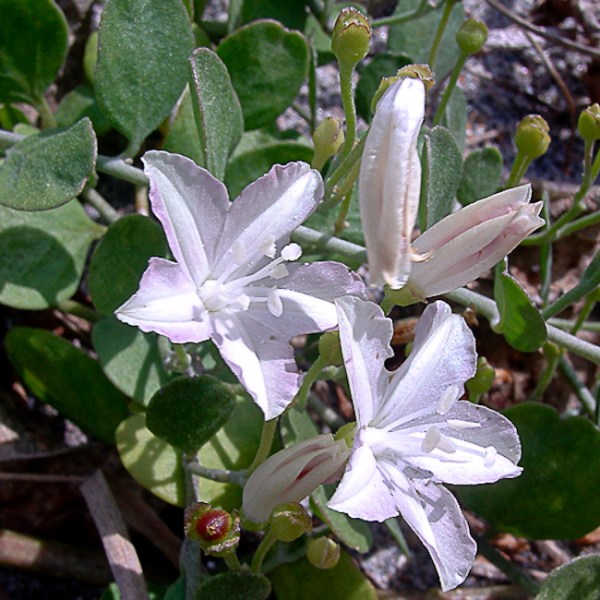
So often you go looking for one thing, strike out and find something else. While walking the local sandy coastline for other plants, I stumbled upon a beach dunes treat: Jacquemontia reclinata, a federally listed endangered species with no known footsteps outside of a few SE Florida counties, including Palm Beach County. Land management authorities don’t like reveals of where you can see endangered species, so suffice it to say Beach Clustervine has been previously reported where encountered in flower today, although “believed to be extirpated.”
Jacquemontia reclinata. All photos today by by John Bradford.
The disappearance doesn’t surprise me, because the species inhabits disturbed seaside sand where everything disappears. All kinds of things come and go where the waves crash, the sand drifts, and the briny breezes bluster. So I suspect that if all truth were known, Beach Clustervine may often be a “pop up species,” here today, gone tomorrow, back next year, or decade, or century. A quick look at occurrences on iNaturalist around SE Florida buttresses the notion. Incidentally, there have been reintroduction efforts, but I don’t know where.
That all leads to the main point. A creeping vine on seashore sand must have fantastic powers. First off, pollination could be a problem for a spotty species widely scattered in small patches in strong winds. But no worries, a wide array of insects visit. And as you might expect in a beach pioneer, the vine does not require pollinators, self-pollination providing reproductive assurance.
What I find intriguing is the poorly known unknown, the seeds. They obviously must float in the drink before washing up on a new beach and taking hold. Those must be some tough little seeds, and why Floirda but not the Bahamas? (Or is it lurking on one of many many beaches there awaiting discovery?) After washing up to be buried under shifting sand, the seeds must “lie low” until some moment of disturbance exposes them to their germination cues, perhaps some combination of air, light, and freshwater. Biologist John Pascarella and collaborators investigated the seed biology over the years 2001-2007. Soil cores revealed buried seeds waiting patiently in the seashore sand. Chemical testing showed a whopping 100% of year-old buried seeds to be alive. An interesting kink in that study was that even when buried seeds are all viable, not all germinate when presented with a set of seemingly favorable circumstances. Seems that different seeds have different triggers, some always in reserve for the many moods of the sea.
 Treasure Coast Natives