Sensitive Brier
Mimosa quadrivalvis
Mimosaceae
First, today’s story is based at Halpatioke Park in Stuart. Enjoy John’s Gigapan in the park. You can pan around and zoom in and out. Click Here
Second, let’s get our Mimosas straight.
Different Mimosa #1: Most gardeners and botanical garden visitors have touched and crumpled poor neurotic Sensitive Plant. That fun species is Mimosa pudica (pudica = shy) and, although not native to Florida, crops up occasionally in the sunshine state. It differs from all other Florida Mimosas by having just two pairs of pinnae (major leaflets).
Different Mimosa #2: Mimosa strigillosa, sometimes called Powderpuff or Sunshine Mimosa, is a Florida native and a commercial groundcover. It was a 2008 Florida Nursery Growers and Landscape Association 2008 “Plant of the Year.” This species has a somewhat elongate (vs. globose) flower head and is the only thornless species in Florida. (The 4th Florida species, Mimosa pigra, is a vining species with thorns and with flat fruits.)
Different Mimosas #3: Tropical American Mimosa tenuiflora and some other species have psychedelic root drugs used in mind-bending preparations. As far as we know, the only “trip” you experience from any of the Florida species is stumbling over a vining stem.
Different “Mimosa” #4: The “Mimosa” tree is not a Mimosa and is irrelevant.
Different Mimosa #5: Is a disgusting cocktail made with champagne and orange juice. Avoid it.
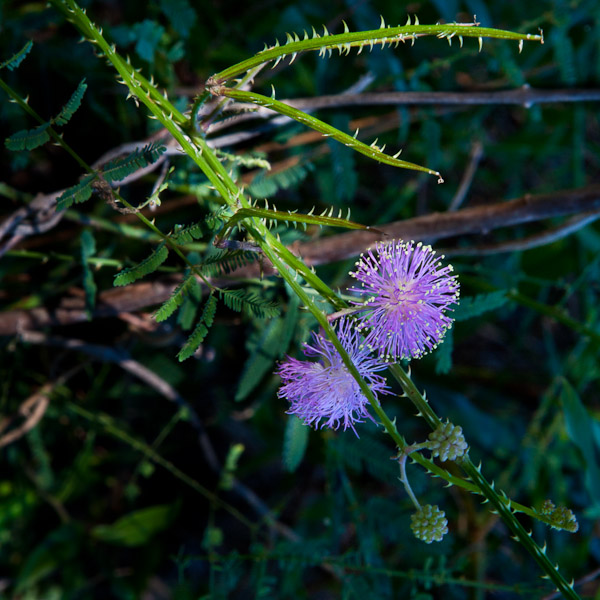
Mimosa quadrivalvis flower heads (by JB)
Now that the pesky imposters are marginalized, let’s talk. Yesterday John and George enjoyed a 70-degree, blue-sky visit to Halpatioke Park and selected Sensitive Brier to feature here. Mimosa quadrivalvis, the only Florida species with a four-angled (vs. flat) pod, was in beautiful bloom with its highly pink poofy flower heads. Less attractive but more interesting were its ugly bristly pods. To older folks, this species may be more familiar as Schrankia, a persistent form of nomenclatural brain pollution. Does Sensitive Brier recoil from probing like a good “sensitive” brier should? Yes, but less dramatically than Different Mimosa #1.
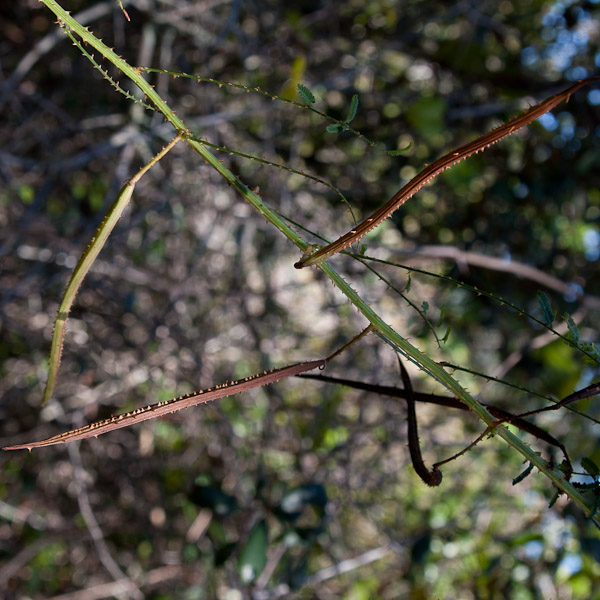
Thorny ripe pods (by JB)
Let’s linger a moment on the sensitivity. Many Legumes tend to droop their foliage at night. They are not wilted. Rather, they “close up shop” by means of little muscles called pulvini (singular: pulvinus) at the bases of the leaves and sometimes at the leaflet bases too. The pulvinus controls the angle of the dangle in response to environmental cues. We won’t go far down that technical road, but briefly, the plant responds to the different reddish light tones during the day compared with those at dusk. Far-red light characteristic of dusk sends a “time to droop” signal to the pulvinus. The mechanism is related closely to the way long-day and short-day plants determine the season, and to red/far-red cues governing seed germination. Take the drooping reaction, change the cues from light color to touch, and you have leaves that recoil when a cow comes sniffing around. You can watch here as a Mimosa goes to sleep thanks to its pulvini. Click
What really grabbed us, literally, was not the beguiling flower head, and not the sensitive leaves, but the pods. They are scary, resembling slim barbed torpedoes. A reasonable observer might interpret the thorns on the pods as protection from herbivores, which of course is probable, especially since the entire plant is armed similarly. Beyond that, fruits from many plant species apply spines and varied protuberances to cling to passing creatures to aid dispersal. That’s conceivable with today’s plant.
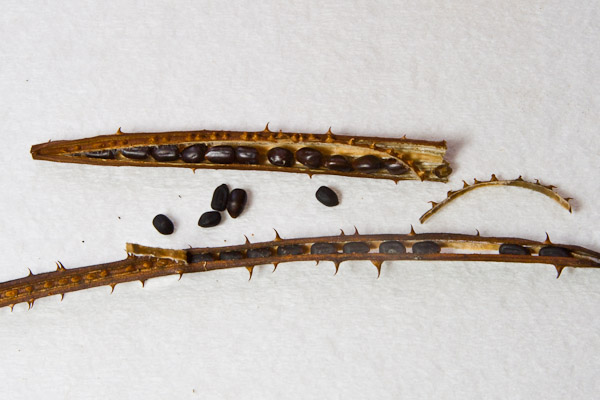
Mess with the pods, and they unzip (by JB)
 John Bradford
 George Rogers
 George Rogers
 Dee Staley
 Treasure Coast Natives