Xyris caroliniana
Xyridaceae (The Xyris Family, not real grasses.)
Xyrises are a big group, about 300 species, approximately 25 in Florida. The local species live mostly in sunny open wetlands. But an outlier, Carolina Yelloweyed-Grass, thrives relatively “high and dry” in open slash pine savannas and similar places.
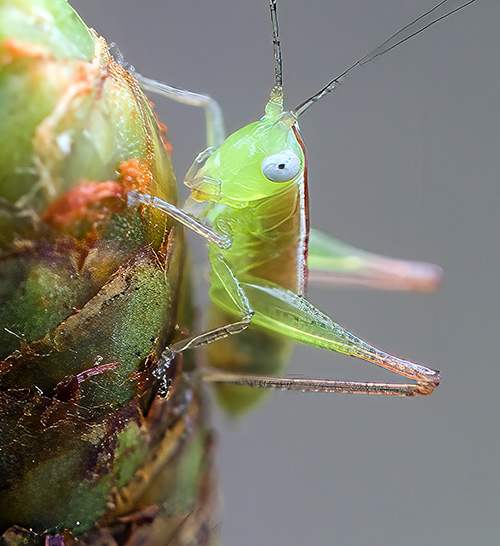
Tagalong on the Xyris
The eccentric habitat is merely one unusual feature of a species with n oddball history, starting on or near an 18th Century rice plantation way down upon the the Santee River in South Carolina. To this day, it is unclear exactly what species actually was “the first” Xyris caroliniana, as no original material exists. That original “X. caroliniana” was probably not actually the species now officially designated to carry the name. Xyris caroliniana may be the “President George Bush” of the plant world. Serial use of one name is ok with presidents, but a bummer in botany.
Hard to generalize about 300 species, but most Xyris species have broad flat thickened leaves fanlike meeting edge-to-edge. Think of an Iris. Their main ecological challenge for those aquatic xyrises may be excessive sun while aerating oxygen-starved submerged roots.
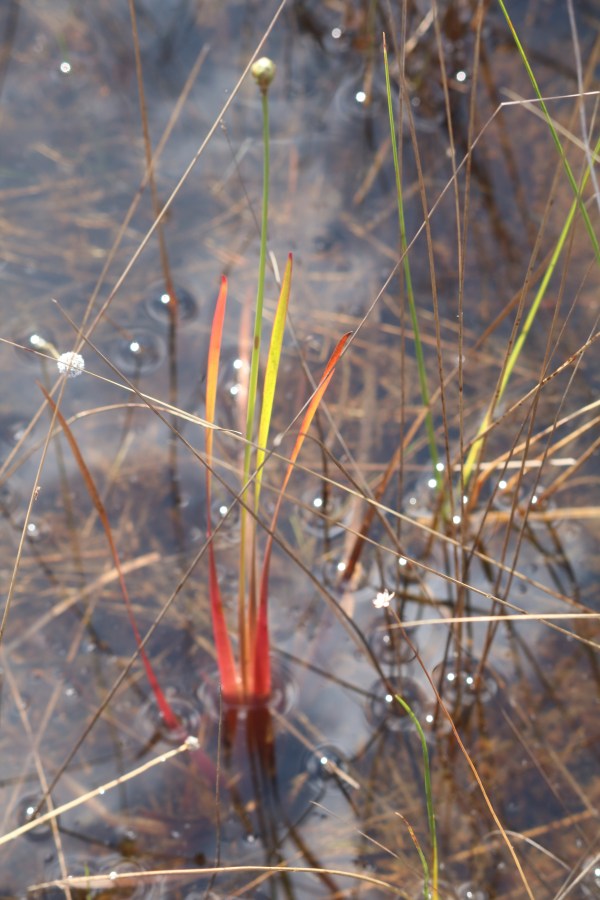
Xyris smalliana in flooded marsh
It is different up in the pine savanna where Xyris caroliniana grows. Its problems include surviving fires. Xyris caroliniana consequently has a safe underground bulb from which skinny grasslike leaves rise in a three-row spiral. That the leaves and flower stalk are twisted probably reflects their spiral origins, and the twists may help the foliage compete with thick crowded grass.
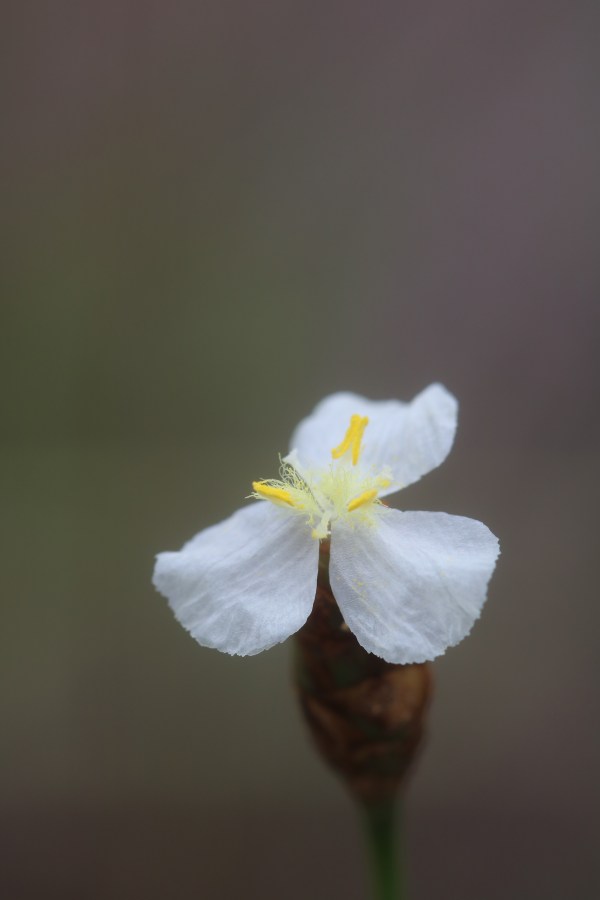
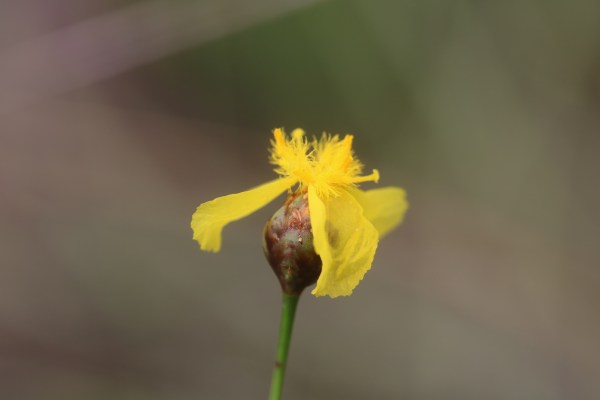
Closeup flower photos today by John Bradford.
Speaking of unusual attributes: the flower color. With exceptions, xyrises generally blossom yellow. Xyris caroliniana differs by having white flowers and yellow ones on separate individuals. In the northern part of its range, yellow dominates, whereas in South Florida white rules, but yellow occurs too, even occasionally alongside white.
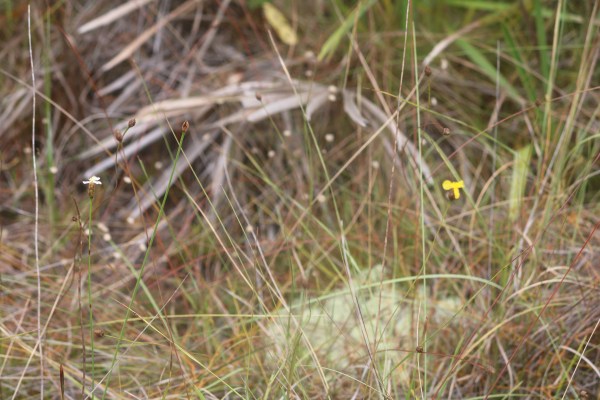
White (left) and yellow together
Despite the presence of both, it seems (with inadequate data) that on large regional scale and in a small meadow, either way, the two colors cluster, not at all evenly intermixed. This uneven clustering probably does not have much to do with pollinator distributions. Fact is, limited study shows much-to-most reproduction to be by clonal seeds produced by the plants sans pollination. The seeds are genetic replicas of the parent. That could explain the patterning, a white-flowered pioneer peppers its neighborhood with clonal white-flower seeds, these growing up to add more and more white-flower plants, and there’ya have it, a white-flowered cluster. Ditto for yellow in its own corner You’d wind up with “white zone” and “yellow zones,” plus here and there limited mixing.
 John Bradford
 George Rogers
 George Rogers
 Dee Staley
 Treasure Coast Natives
Suzanne Koptur
July 12, 2024 at 10:46 am
I wanted to name our firstborn Xyris but husband put the kabosh on that. Did not know they had apomixis!
George Rogers
July 12, 2024 at 2:14 pm
Xyris would be a great name. Although would get confused with Cyrus probably. The apomixis thing is a little thin. Robert Kral, master of Xyris, surmised it some time ago but never tested it. Subsequently there have been some bagging studies. The older I get, the more I see clonality! (If for any of your activities you need actual reference to bagging, I can root it out of the dusty catacombs.) Thought of trying some Xyris bagging myself, but then again, to what end!?
Suzanne Koptur
July 12, 2024 at 6:20 pm
For fame and probably not fortune, would be a worthwhile study. I enjoy your columns and recently got a copy of your Landscape Plants book.
George Rogers
July 12, 2024 at 6:37 pm
Thanks!