Hyla cinerea
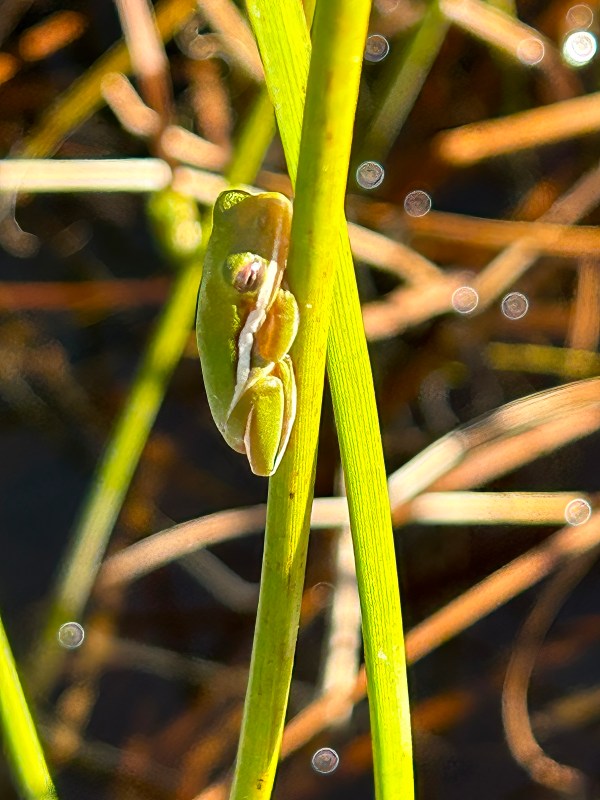
My google book report. Spending much time these days in marshes, I’ve become friendly with marshy critters from hogs to frogs. Although not a plant, the Green Treefrog, being green and living in trees, is sufficiently planty for this botanical blog. They conduct froggy business nocturnally, and pass the day crouched torpidly on vertical emergent marsh plants. Their coloration adjusts within limits to the lightness or darkness of the background, raising the question: do the frogs prefer different species as perch sites? Right place right time you can find a whole bunch of them. Emergent vegetation over open water is a nice place to snooze: camouflaged from angry birds and defended from ground attack by a moat. Black racers enjoy a tasty frog, and preliminary indication suggests the GTF to have some resistance to pygmy rattlesnake venom. No doubt that open water below the perch helps with temperature and humidity.
Being eaten as adults may not be the worst problems green treefrogs experience. They breed in ponds and pools: you know, eggs deposited in water, then tadpoles. The tadpole stages is where it gets interesting, especially to biologists who have looked into tadpole predation and found surprises. (Prominent mention to Margaret Gunzberger comparatively recently, and earlier Michael Blouin among many.) Here’s the surprise, at least to me: The frogs are abundant around shallow seasonally temporary depression marshes locally, but they breed preferentially in permanent year-round ponds, potentially distant from their usually haunts.
Plenty of room for research here, but part of the puzzle, if there is a puzzle, seems to be differential predation. There are a lot of small fish even in temporary pools and ditches where little fish become increasingly crowded as the pools dry, shrink, and even disappear. That’s not good for tadpoles trapped with the crowded hungry fish. And fish are not the only predators, dragonfly larvae too are tadpole eaters, and they tend to share the frog’s need for emergent vegetation, adding to the risk of the frogs breeding at shallow hangouts. That’s all somewhat speculative, if also obvious. What prior researchers have actually demonstrated is that the main tadpole predators in permanent ponds, bluegill have a distaste for Green Treefrogs, making the tadpols perhaps “safer” in a pond than in a temporary pool. (Interestingly, there’s a closely related treefrog with the opposite preferences, but that’s a separate story.)
As anybody who goes outdoors knows, South Florida freshwaters suffer from nutrient pollution, chemical contamination, and Bluegreen “Algae” (Cyanobacteria). You might ask, how does that big fact impact today’s little frog? I don’t know,except for one odd little slice of that pie: as recently as 2014 a new species of Bluegreen Alga (Aetokthonos hydrillicola) was discovered associated with invasive hydrilla, and it does not play nice, making trouble mostly a little north of Florida but also in Central Florida. The alga got famous as a suspect in Eagle deaths. It kills frogs too. The GTF appears so far to be immune or resistant, good news for it, if not for the overall balance of nature. Maybe its immunity comes from a long history living in little ponds with high Bluegreen Algae exposures. The frog is expanding its range northward, with the obvious supposition being climate change, although there are alternate possibilities such as uneven parasite or toxin distributions, and aquarium releases.
 John Bradford
 George Rogers
 George Rogers
 Dee Staley
 Treasure Coast Natives
theshrubqueen
November 11, 2023 at 3:26 pm
Survival of the fittest strikes again?
George Rogers
November 11, 2023 at 8:15 pm
It does look smugly fit doesn’t it