Crematogaster atkinsoni
Crematogaster is a name of controversial origin. As spelled, it means burning stomach. But they don’t need Nexium… the name probably originated from cremasto-. Cremasto– means “suspended,” as in “cremaster,” the stalk suspending a butterfly chrysalis. The ant in its defensive mood arches its “stomach” (abdomen) suspended up over its head with its stinger facing forward, thus the name Acrobat Ants. The stinger does not sting, but instead is a spatula for dabbing toxins onto foe. They can bite too. Professor George Atkinson (1854-1918) was a prominent U.S. entomologist.
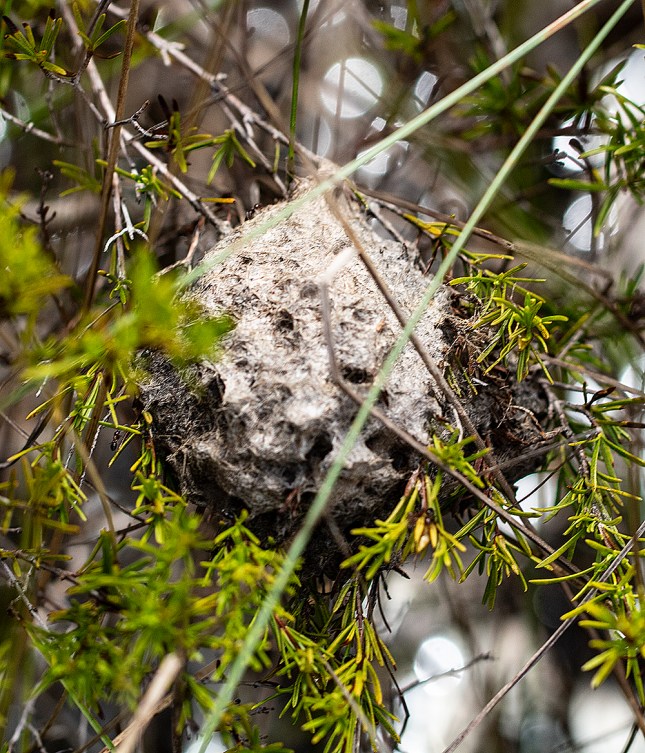
Carton nest in Hypericum
Around South Florida and beyond, a curious sort of ant nest decorates marshes, in John’s and my experience mostly the depression ponds dominated by Peelbark St. Johnswort (Hypericum fasciculatum) and Corkwood (Stillingia aquatica). These “carton” nests are gray and papery resembling hornet nests in color and texture. The cartons range in size from a tennis ball to a cucumber, up on a host plant, usually Hypericum around here, safe and dry above the high-water level.
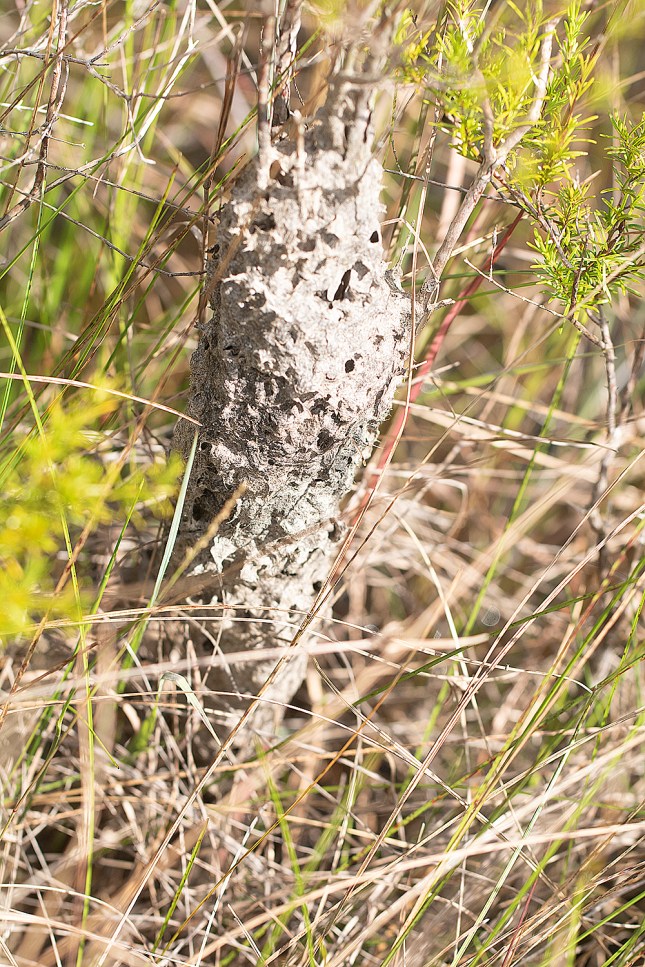
Don’t touch, we are nice but will bite if abused..
It was Professor George Atkinson who first described the nests in 1887, attributing them incorrectly to ant species not otherwise known to such constructive feats. Something wrong there!
Ant nests don’t get much attention, and the next leap forward waited until 1919 when Harvard Professor William Morton Wheeler discovered the nest dwellers to be a previously undescribed species he named C. atkinsoni. The species is especially fond of periodically inundated open marshy habitats usually near the sea. Recently some entomologists reclassified C. atkinsoni as a variant of another species, C. laeviuscula, although an objection to the demeaning merger is the unique nest-building by C. atkinsoni. Around the world, varied ants, including other species of Crematogaster, make carton nests broadly defined, but in the Southeastern U.S., C. atkinsoni has a monopoly.
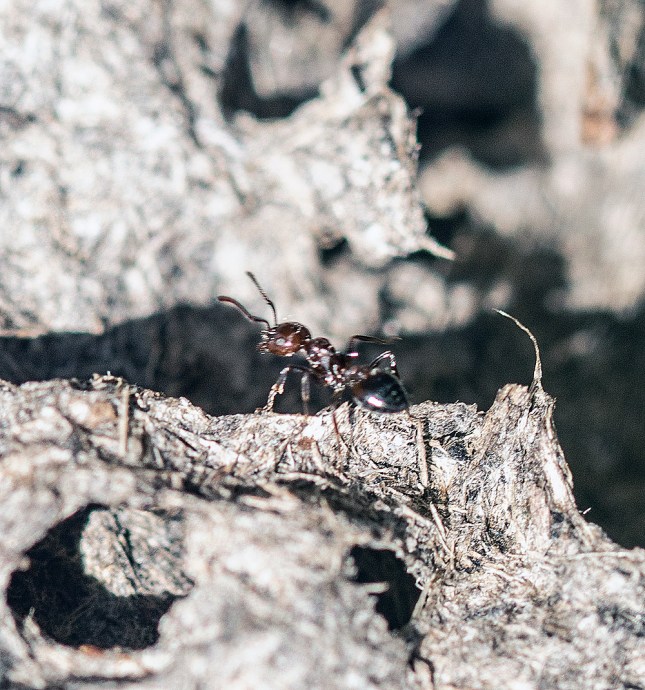
I live here.
To this day, the ant and its nests seems under-studied, at least as far as I can tell on Google. What does an ant colony in a paper box perched isolated above the flooded marsh eat? What are its seasonal cycles? Given the abilities of tropical carton-nest ants, there are multiple possible answers on how to “get provisions” during high-water lockdown. Your guess is as good as mine, although look twice at numbers 4 and 5:
- Capture food before the flooded season and store it in the nest?
- Capture insects or seeds visiting the host plant, or visiting neighbor plants accessible by leaf and stem bridges? (Even in high water the crowded plants touch each other so it is possible to get around a good bit. C. atkinsoni has been reported to eat other insects.)
- Cultivate seeds in the nest? (Ants are known to nibble growing roots from seedlings in their nests. Some epiphytes establish in tropical “ant gardens.”)
- Cultivate fungi? (This is likely the (or a partial) answer…some non-U.S. species of Crematogaster cultivate fungi, including yeasts, on the carton material itself. Looking into this would be an interesting research project, by taking “biopsies” from the nest for laboratory culturing without destroying the colonies.)
- Farm sucking insects for their honeydew? (Other species of Crematogaster in other tropical habitats farm scale insects in their nests, and UF entomologist W. Whitcomb reported varied Florida crematogasters associating with aphids.)
- Wait it out, perhaps with some adult die-off?
Might be possible to find this out, and to a point is a tempting research project, but not if you’d have to poison the ants and destroy the nests. The nests are rare, complex, and beautiful, not to mention in protected natural areas. Better to leave something to the imagination.
 John Bradford
 George Rogers
 George Rogers
 Dee Staley
 Treasure Coast Natives
theshrubqueen
August 8, 2020 at 9:39 pm
Cool, surprised I have not seen any…distracted by snake fear probably.
George Rogers
August 9, 2020 at 7:47 am
perhaps for good reason….my projects take me out wading almost daily and I worry about critter encounters, and know somebody who had a “bad encounter”…fact is, the nests are not that common
Annie Hite
August 8, 2020 at 10:30 pm
As always, fascinating food for thought. There’s a lot of the St. Johnswort you describe (if I’m identifying it correctly) in Jonathan Dickinson but I haven’t noticed these nests. I’ll be looking purposefully now unless you think it’s too far from the sea.
George Rogers
August 9, 2020 at 7:49 am
I took the pictures in the Hungryland Wildlife Area pretty far inland. They are not adequately studied for any rel sense of distribution. You don’t see them very often.