Forestiera segregata
(LeForestier is a personal name. Segregata refers to the separate male and female plants.)
Oleaceae (The Olive Family)
Years ago I had a horticulturist friend whose son had a backyard clubhouse. The boy posted a sign over the door saying Privet Club. I complimented my friend on imbuing his son with such horticultural enthusiasm. He replied, “naw, he just can’t spell private.”
Forestiera segregata is a shrub distributed in the Caribbean and in and near Florida, it is abundant in our area, willing to grow happily and quickly in diverse habitats, shaded and sunny, best moist but ok with dry, iand alkaline places are fine. Broad tolerances are part of the key to its place in native landscaping. In Florida the natural distribution is mostly near the coasts, not much inland.
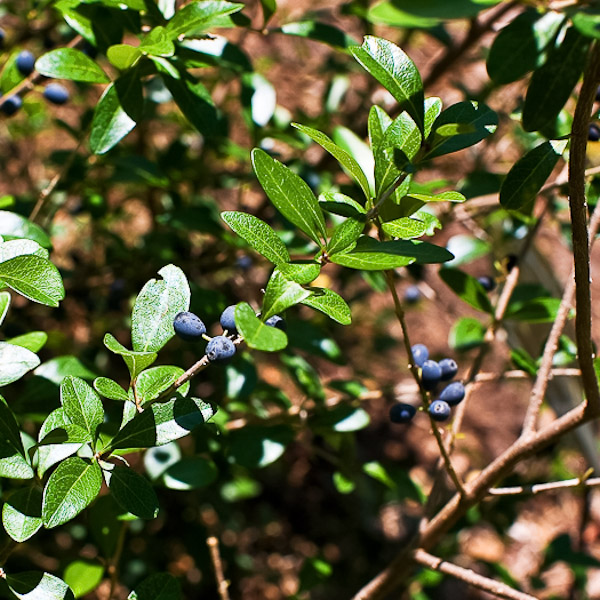
Blue olived by John Bradford.
Swamp-Privet has separate male and female individuals, that is, it is dioecious (dye-EE-shus). Only a small minority of plants are, and far more unusual is the combination of dioecy and predominant insect pollination as opposed to wind. You’d have to work awhile to make a short list of Florida species with that combination. Wind-pollinated plants make a lot of pollen, so separating the male pollen-making and female pollen-receiving plants avoids plants being overwhelmed with their own pollen. Implicit in that, separating male and female plants forces cross-pollination. Why can social sexual distancing be a disadvantage in most insect-pollinated species? Wind carries pollen long distances, but insects not necessarily. Separate male and female plants may be farther apart than the usual insect delivery-trip. All couched in usually, maybe, and often of course.
The fruits look like tiny blue olives, which may be the result of their membership in the Olive Family. The fake olives taste like rat poison, at least to a human. Maybe so to bird distributors too, as it seems the fruits persist on the shrubs uneaten like my granddaughter’s broccoli, much longer than apparently more palatable fruits, oh say, blueberries or mulberries. Observers have suggested that birds shun yucky fruits until more sugary options are depleted, then the birds turn grudgingly to the nasty fruits in which the plant invests minimal precious sugar. Cheap fruits for desperate birds? Beggars can’t be choosers.
The beauty of the fruits exceeds the flavor, and in other Forestiera species ancient cultures smooshed the fruits with white clay to make cool blue body paint. The medical practitioners in such cultures harnessed the repulsive little olives as an emetic (something that induces vomiting). And speaking of useful Forestiera, the lightweight straight branches are good arrow shafts. In dry habitats forestieras are valued signs of “dig here for water.”
 John Bradford
 George Rogers
 George Rogers
 Dee Staley
 Treasure Coast Natives
Diane Goldberg
May 1, 2020 at 5:47 pm
I have a number of dioecious plants. One of them, the waxy myrtle of which I have six are all males, but my Florida Privet, is my favorite and is a female, which fruits when I get lots of migrating birds. They seem to love the fruit because they are all gone quickly and I’ve seen my birds eating the fruit, but even when it’s not fruiting it’s my favorite because so many different types of birds like to spend time in it. It is open enough to see the birds, but with enough branches to make them feel safe from predators, which I get too. I have a birdbath near by that the birds love to use and then they will rest or dry off in the privet. I have many seedling that I am glad to share.
George Rogers
May 1, 2020 at 6:25 pm
Thanks for adding in Diane.
theshrubqueen
May 1, 2020 at 5:51 pm
You have reminded me I need to review some of my native plants…I thought I knew this one. Birds are kind of picky I guess – tons of Pitcaya in my yard falling on the ground. Maybe they feel the same way I do about the taste.
George Rogers
May 1, 2020 at 6:27 pm
well yea…and the pitcaya is adapted to other birds in other places….might be some resistance by birds not native to it.
theshrubqueen
May 1, 2020 at 6:55 pm
Makes sense, though oddly I have fewer birds and butterflies since getting rid of most of the evil pepper. That has been disappointing.
Diane Goldberg
May 2, 2020 at 9:07 pm
I have Florida Privet, and Wild Coffee seedlings I can share. My birds love them. A bird bath also brings a nice diversity of birds to your yard, but you do have to clean it and add fresh water at least weekly.
theshrubqueen
May 2, 2020 at 9:08 pm
Have Wild Coffee.. thanks and a pollinator garden..
Diane Goldberg
May 3, 2020 at 8:06 am
Did you know that Fogfruit, Phyla nodiflora is a host plant for 5 butterflies: white peacock, phaon crescent, common buckeye, checkered skipper and gray hairstreak. Sunshine Mimosa, Mimosa strigillosa hosts 17 caterpillars including the little sulfur, gray ministreak and mimosa yellow. Though most of the caterpillars for the mimosa are moths, they are an important food source for birds. Both plants make good groundcovers.
theshrubqueen
May 3, 2020 at 8:29 am
Yes. I have a lot of sunshine Mimosa too dry for fogfruit here though.
Diane Goldberg
May 1, 2020 at 6:02 pm
It’s easier for most birds to eat small fruit. I also have the native Red Mulberry and the very thorny native blackberry. The birds like these too. But the birds like the Corkystem Passionfruit even more. They have spread the vine all over my yard. I don’t mind because it brings the zebra longwing and gulf fritillary butterflies to my yard.
Robert Rajkovich
May 1, 2020 at 6:09 pm
Excellent article. Well written and easy to understand. Foresteria is a street name in Lake Park and this is why I read it.
David Hollombe
June 14, 2020 at 9:44 am
For whom did Poiret name his genus Forestiera?
What did Poiret tell us about Dr. Forestier?
1. He was a physician. (Poiret Encyclopédie méthodique, 1810: ibid., 1812 & Poiret, Voyage en Barbarie, p. xxii, 1789)
2. He lived in Saint Quentin. (Poiret, Encyclopédie méthodique, 1810 & Poiret in F. Cuvier, Dictionnaire des sciences naturelle, 1820 & Poiret, Voyage en Barbarie, p. xxii, 1789)
3. He mentored Poiret in natural history. (Poiret in F. Cuvier, Dictionnaire des sciences naturelle, 1820 & Poiret, Voyage en Barbarie, p. xxii, 1789)
4. Poiret sent letters to him from northern Africa in 1785-1786. (Poiret, Voyage en Barbarie, p. xxii, 1789)
5. He died no later than 1820. (Poiret in F. Cuvier, Dictionnaire des sciences naturelle, 1820)
6. But Poiret did not tell us Dr. Forestier’s full name!
Who matches Poiret’s dedications?
a. (Louis) Charles (René) Leforestier, 1778-1850, co-author of Album floral des plantes indigenes de France
Claimed by Georg Christoph Wittstein in 1852. repeated by Antoine Duss in 1896 and by Nathaniel Lord Britton in 1908 ff. and eventually by many others
Occupation: Soldier and gentleman, author of popular botanical works
Lived in Metz and Paris
23 years younger than Poiret
Age 7 years in 1785
Died 30 years after Poiret referred to his friend’s “almost recent” death
b. Vicomte Aimé René Victor de Forestier, 1804-1853, botanical collector and author of botanical taxa validated by others
A botanical author folded into the confusion on es.wikipedia.org.
Occupation: Soldier and gentleman
Lived in Paris and Avon. Travelled in Corsica and adjacent islands, and in the Pyrenees and Spain
49 years younger than Poiret
Born after 1785
Died 33 years after Poiret referred to his friend’s “almost recent” death
c. Pierre Gaspard Forestier, 1761-1847, physician
Claimed by Merriam Webster Dictionary online
Occupation: physician
Lived and practiced in Paris from birth to death.
About 6 years younger than Poiret
Age 24 years in 1785
Died 27 years after Poiret referred to his friend’s “almost recent” death
d. (Claude) André Robert Forestier, 1741/2-1812, physician
Best fit from the evidence
Occupation: physician
Born in Paris. Lived and practiced in Saint Quentin from 1766 until his death in 1812
14 years older than Poiret
Age 44 years in 1785.
Died 8 years before Poiret referred to his friend’s “almost recent” death