Forestiera segregata
(LeForestier is a personal name. Segregata refers to the separate male and female plants.)
Oleaceae (The Olive Family)
Years ago I had a horticulturist friend whose son had a backyard clubhouse. The boy posted a sign over the door saying Privet Club. I complimented my friend on imbuing his son with such horticultural enthusiasm. He replied, “naw, he just can’t spell private.”
Forestiera segregata is a shrub distributed in the Caribbean and in and near Florida, it is abundant in our area, willing to grow happily and quickly in diverse habitats, shaded and sunny, best moist but ok with dry, iand alkaline places are fine. Broad tolerances are part of the key to its place in native landscaping. In Florida the natural distribution is mostly near the coasts, not much inland.
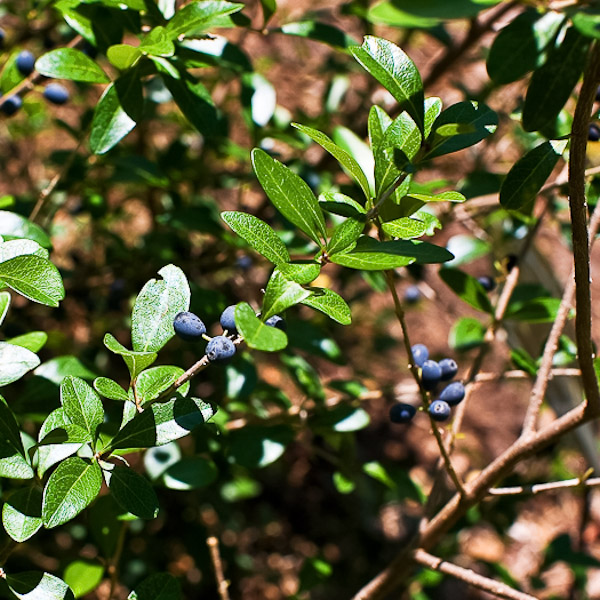
Blue olived by John Bradford.
Swamp-Privet has separate male and female individuals, that is, it is dioecious (dye-EE-shus). Only a small minority of plants are, and far more unusual is the combination of dioecy and predominant insect pollination as opposed to wind. You’d have to work awhile to make a short list of Florida species with that combination. Wind-pollinated plants make a lot of pollen, so separating the male pollen-making and female pollen-receiving plants avoids plants being overwhelmed with their own pollen. Implicit in that, separating male and female plants forces cross-pollination. Why can social sexual distancing be a disadvantage in most insect-pollinated species? Wind carries pollen long distances, but insects not necessarily. Separate male and female plants may be farther apart than the usual insect delivery-trip. All couched in usually, maybe, and often of course.
The fruits look like tiny blue olives, which may be the result of their membership in the Olive Family. The fake olives taste like rat poison, at least to a human. Maybe so to bird distributors too, as it seems the fruits persist on the shrubs uneaten like my granddaughter’s broccoli, much longer than apparently more palatable fruits, oh say, blueberries or mulberries. Observers have suggested that birds shun yucky fruits until more sugary options are depleted, then the birds turn grudgingly to the nasty fruits in which the plant invests minimal precious sugar. Cheap fruits for desperate birds? Beggars can’t be choosers.
The beauty of the fruits exceeds the flavor, and in other Forestiera species ancient cultures smooshed the fruits with white clay to make cool blue body paint. The medical practitioners in such cultures harnessed the repulsive little olives as an emetic (something that induces vomiting). And speaking of useful Forestiera, the lightweight straight branches are good arrow shafts. In dry habitats forestieras are valued signs of “dig here for water.”
 John Bradford
 George Rogers
 George Rogers
 Dee Staley
 Treasure Coast Natives