Utricularia cornuta
(A utricle is a bladder. Cornuta means horned, referring to the spur on the flower.)
Lentibulariaceae
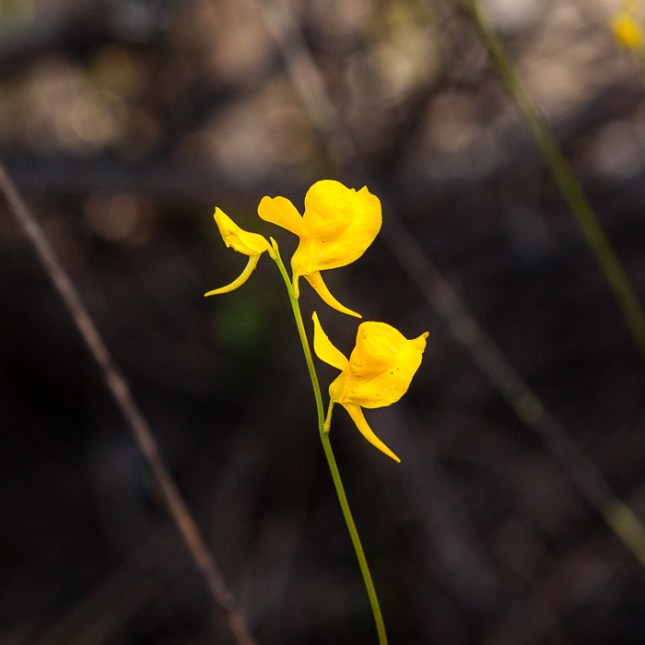
Horned Bladderwort by John Bradford.
Many wildflower enthusiasts are familiar with Bladderworts, species of Utricularia. Utricularias are generally thought of as aquatic carnivorous plants dangling microscopic suction traps in the water. The traps have trigger hairs and a trap door. When a minute swimming arthropod bumps the trigger, the trap sucks the victim in for lunch. That is documented richly on the Internet so no need for more here.
What has been interesting me this week is Utricularia growing in moist sand, often by the thousands in drifts of yellow. Any questions? Question 1: What pollinates a hundred thousand bright yellow blossoms all glorious at once in a couple acres? That’s a blog for another day.
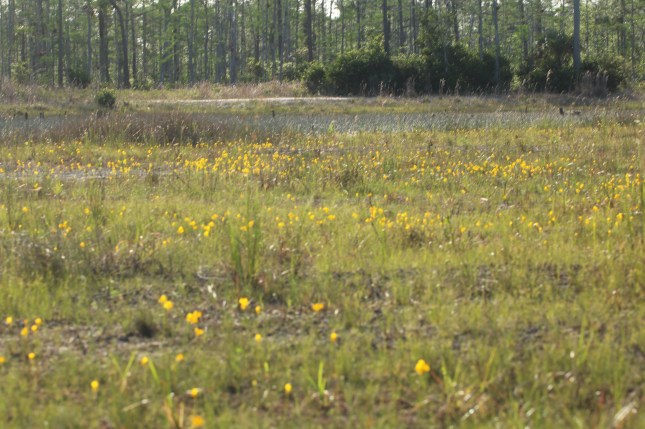
Question two is the topic for today: How can an aquatic water-filled bladder catch water-borne prey while stuck in sand? There has to be more to the story. There is, some of it well known, some mysterious. As the pundits say, “let’s unpack it.”
First of all, don’t the plants root in the sand? No—Utricularia has no roots, although we will soon see leaf-ish structures functioning much like roots.
But let’s stay above ground a moment. Plants typically need to photosynthesize, and that is a job for leaves. But where are the photosynthetic leaves? The plants look like a bare stalk with a flower out of focus on top.
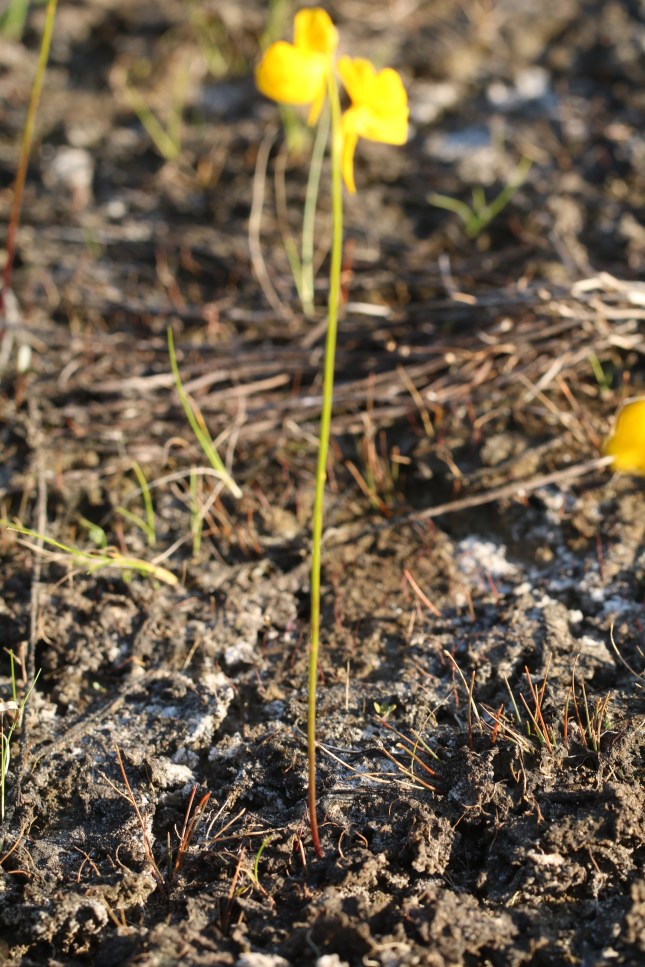
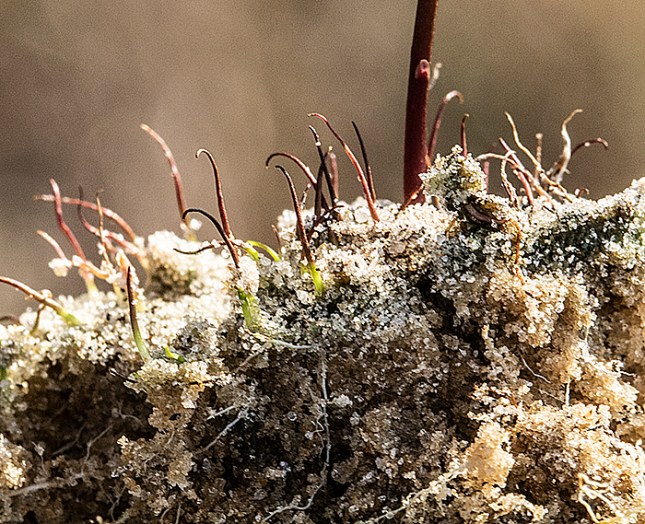
Vertical pins rise from the leafy mesh below the surface.
Just below the soil surface stringy leafy segments form a horizontal mesh, think of a smashed plate of spaghetti. From that mesh millions of pin-sized segments rise vertically from the soil into the light of day. The collective surface area of countless pins is substantial, like the microvilli in an intestine. They are green or partly red (sunscreen? damage?) and probably allow for photosynthesis, and conceivably help aerate the leafy portions below the surface, especially during flooding. Room for research here!
A growing literature is revealing the idea of the trap feeding the plant by catching and digesting prey as simplistic. The traps seem to be micro-ecosystems unto themselves. CLICK
Trap-dwellers include microscopic protists, such as ciliates, bacteria, fungi, algae, and so-called bluegreen “algae.” Bluegreen “algae” are photosynthetic cyanobacteria often able to “fix nitrogen,” that is, convert atmospheric nitrogen to fertilizer.
The microbes manufacture nitrogen fertilizer inside the trap, you say? Isn’t the main point of the carnivorous plant to obtain nitrogen from breaking down the insect victims? And photosynthetic bacteria inside the trap provide the same benefit without bloodshed? Yes, if not studied adequately yet.
OK then, nitrogen-fixing cyanobacteria live inside the trap, possibly contributing to the plant’s nitrogen nutrition, what about outside the trap? Not a new idea. Botanists have recorded cyanobacteria clinging to the outsides of traps in the water.
So now think about that comparatively dry meadow of sand-dwelling utricularias. Could cyanobacteria in the sand be enriching the soil, maybe replacing the need for aquatic bug-catchery?
A close look at a population of Utricularia on “dry” land shows them mostly to rise from a thin surface carpet of periphyton, although not always, and there’s more to the picture. Under the Utricularia is a blue-green living layer a fraction of an inch under the ground surface. It looks like a miniature seam of coal.
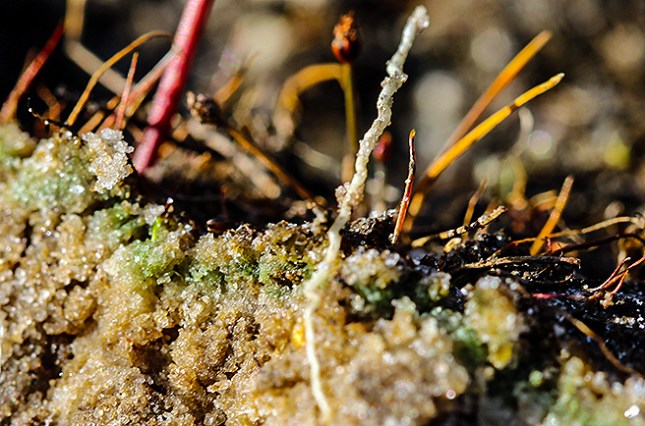
A living blue-green seam in the soil
With room for more data (!), I suspect the land-living Utricularia is deriving nitrogen and possibly additional nutrition from the subsurface blue-green layer. A look at that layer with a microscope shows it to consist in large part of, you guessed it, cyanobacteria.
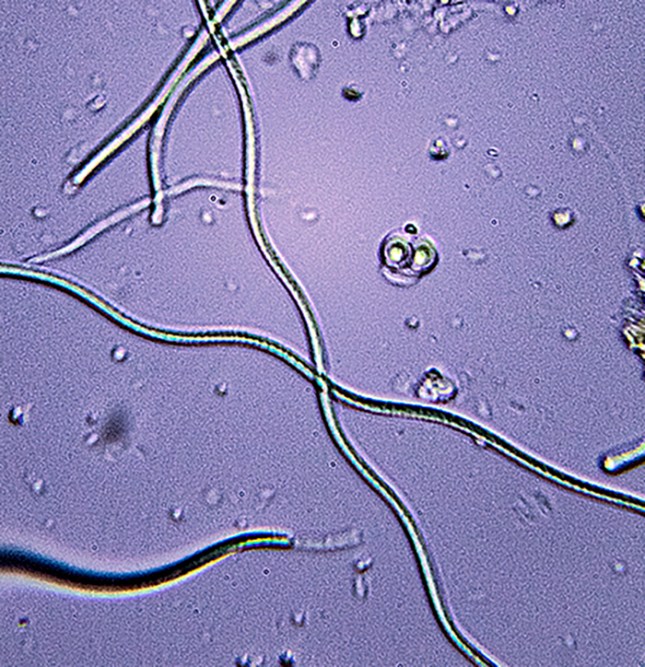
Cyanobacteria from the blue-green layer at the base of a Utricularia.
The plants form a thick brushlike mass of rootlike leaves usually just below the green layer, or sometimes branching directly into it too. The false roots can have traps, which exist to absorb nitrogen. But who said it has to come from within? Traps bathed in nitrogen fixed by a living soil layer of Cyanobacteria might as well absorb it from the outside as well.
 John Bradford
 George Rogers
 George Rogers
 Dee Staley
 Treasure Coast Natives
swampfox384@bellsouth.net
March 28, 2020 at 12:15 am
Very interesting, thanks.
Lindy
April 3, 2020 at 12:05 pm
Thanks for that look and insight into a mini world within our world!