Stuck home waiting for a repair visit. John is homebound as well. Might as well put the trapped time to good use with backyard nature, the feature attraction being zebra longwing butterflies dancing on the firebush.
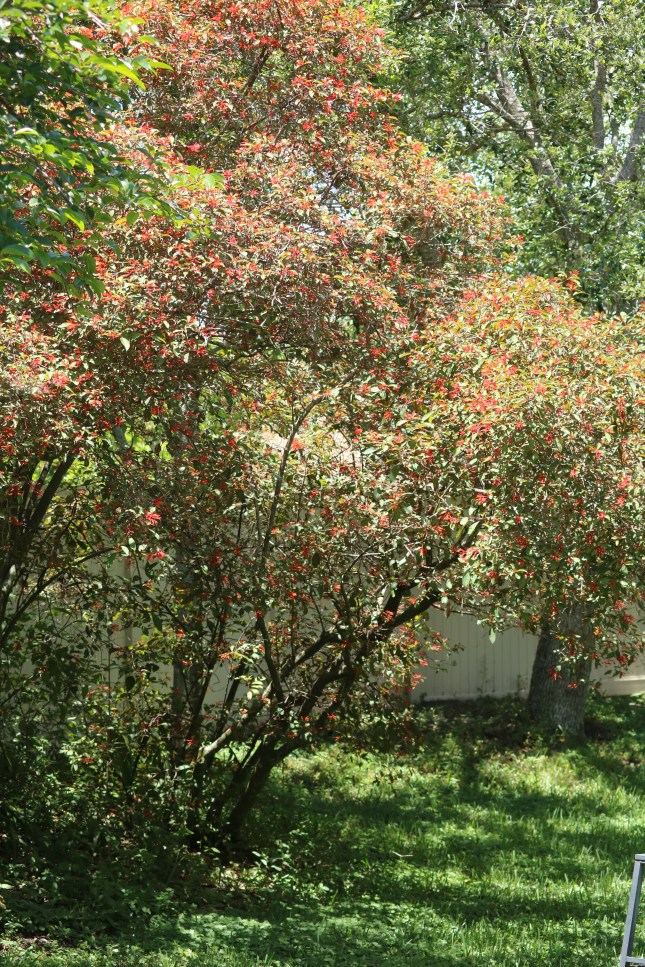
Firebush. Zebra longwings lovin’ it!
Being our lovely state butterfly, this species is about as abundant on the internet as it is in my weedy so-called yard this morning, so we’ll attempt to cruise past the ubiquitous info on better web sites than this, and delve into some eclectic funny business.
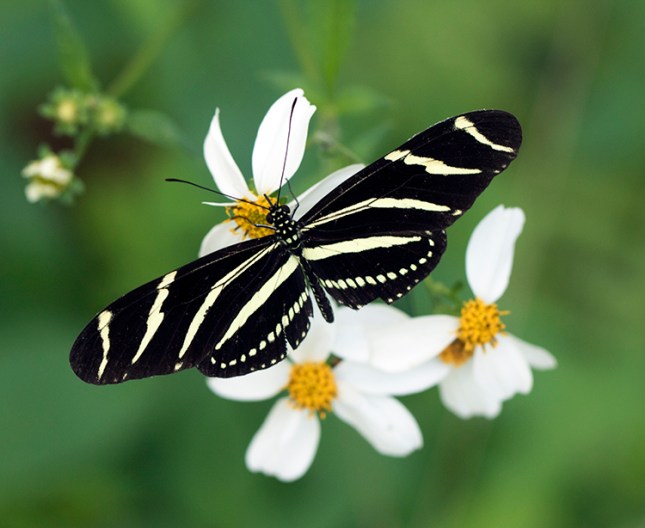
Just a guess, but Bidens exposes pollen aplenty. Perhaps this stop is for pollen.
Zebra longwings are part of the large warm-climate butterfly genus, Heliconius where most species have coloration different from ours, although the related Heliconius peruvianus in Peru and Ecuador is almost identical. The Zebra longwing ranges from rubbing shoulders with H. peruvianus up through Texas and Florida, migrating sporadically into the central U.S., knocked back southward by Jack Frost.
The striking color pattern is probably best interpretable as “danger don’t eat me” warning coloration. Beautiful, yet treacherous with cyanide-related poisons. I’m not sure what percent of the toxicity comes from the host plant as opposed to what the adult manufactures, probably substantially the latter. There is second way to interpret the color pattern, but hold that thought a moment. Two functions for one pattern are possible.
The black and white bristly caterpillars can denude their host passionvines, defeating the plant’s protective hairs. The larvae bite off the hair tips, and weave a protective silk mat over the defenses.
The adult food plants are diverse, and the longwings love firebush. Zebra longwings and close relatives are the only butterflies known to consume pollen in addition to nectar, diversifying their salad bar. For pollen, they like members of the squash family, although I do not know if that preference shows up in Florida. The pollen protein extends their lifespan beyond most other butterflies, and boosts their reproductive capacity. Further, it probably provides raw materials for manufacturing those cyanide-based poisons.
Zebra longwings are among the pollinators known as trap-liners, able to remember a recurring feeding route. They circle home to the same roosting sites at night to cluster for protection from predators. What protection comes from a butterfly gang? Not very scary after all. Hmmm. Here is a thought: Zebras, the hooved mammals, obviously have similar striping, but not as a poison warning. They probably taste dandy to a lion. The zebra stripe protection comes from confusing big kitties by obscuring the outlines of single individuals in the herd. When zebra longwings roost in crowds like a herd of zebras, do their “zebra” markings render angry birds unable to single out individual victims?
CLICK for zebra op art
Same going on here? CLICK
After squabbles for dibs, males mate with the females while the females are still in their pupa or as they emerge. The boys are drawn to the larval mating area partly by chemicals released by caterpillar damage to the host plants. The male gifts the female with a cyanide-laced bomb (in the spermatophore) to defend the female and the brood, and leaves an “antiaphrodesiac” chemical to signal other males to flutter off. The lepidopteran equivalent of a wedding ring.
Ever sense you don’t see as many or as diverse butterflies like you once did? Maybe your memory has gilded your childhood, or then again it might have something to do with pesticides, or extreme herbicidal weed control. Aerial spraying of insecticides, chiefly the insecticide Naled to counter mosquito-borne viral diseases, is harsh on butterflies, controversially in Miami-Dade. Naled is a chlorinated organophosphate related to the now-banned insecticides Dursban and Diazinon, and also to the genocidal gas Sarin. (Gratuitous inclusion of scary tie-in.) How much do we fear Zika and West Nile? How dangerous is Naled to butterflies and to children? How much protection does Naled spewed from airplanes provide? What alternatives exist? All that is beyond the scope of our happy little blog. Yet food for thought, butterfly-lovers.
CLICK to feel sick.
What bugs me abut butterflies is how they manage to fly. Looking out the window right now, it looks like the wing is a firm paddle flapping up and down. But that couldn’t work— they’d just bang against the ground. Must be more to it. Biologists and photographers have studied butterfly aerodynamics, and the Google take-home is that the wing motion is intricate, although too quick to see…another example of the bewildering complexity of simple life forms. The wings twist, turn, distort, curve, curl, and glide like the adjustments of a helicopter blade, or of a swimmer’s hands, although fancier and more dynamic. I set my camera to “video,” filmed the flight, and slowed it down to try to catch some action. The result is below, please click on the link. Among myriad variations, prominent wing movements appear to be reaching forward, then cupping downward and pulling back, subtly resembling a swimmer doing the butterfly stroke. How does a noggin smaller than a pinhead compute all that coordination?
CLICK HERE and see if you can interpret the butterfly flap
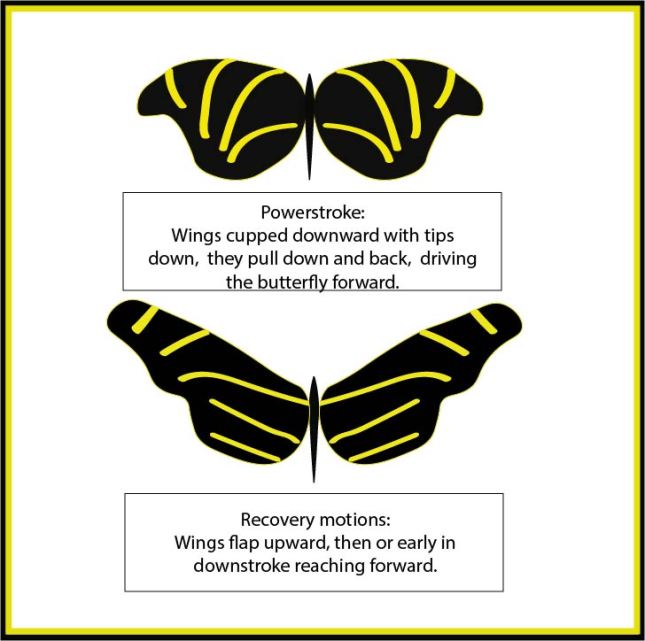
Here is what I think….judge for yourself.
———————————————————————
Music in video: Ryan Andersen Happy Life
 John Bradford
 George Rogers
 George Rogers
 Dee Staley
 Treasure Coast Natives
Suellen
June 8, 2018 at 11:19 am
Great video and lots of interesting information about zebra longwings.
George Rogers
June 8, 2018 at 12:15 pm
Hi Suellen…nice to hear from you! Been awhile. Hope all’s great with you.
theshrubqueen
June 8, 2018 at 4:48 pm
Love it, George.Zebra Longwings are my favorite and the pesticide damage is sickening. I started planting for native pollinators last year,counted 8 types of butterflies in my garden last week including some Atalas. Love the Firebush.
George Rogers
June 8, 2018 at 5:18 pm
I wonder what the total butterfly species count for our area is, and if there are “invasive exotic” butterflies.
theshrubqueen
June 8, 2018 at 5:22 pm
I don’t know George I am astonished at what is showing up here. I planted Coonties last year. There is a lady in JB who grows butterflies.
Linda Cooper
June 8, 2018 at 10:12 pm
I always learn something in your posts George. About ‘invasive’ butterflies – I know Florida is watching for Lime Swallowtail to show up. It will possibly be an agricultural pest. The North American Butterfly Association’s annual 4th of July Butterfly Counts are currently underway all over North America. Go to http://www.naba.org and search for the counts under Monitoring to see if there is a count in your area and who the compiler is. I compile 7 counts in Polk, Osceola, High,ands and Lake Counties. There are a number of counts in south Florida.
George Rogers
June 8, 2018 at 10:48 pm
Wow…thanks Linda..I did not know any of that…fun to explore, and time to become acquainted with the Lime Swallowtail…much appreciated!
http://entnemdept.ufl.edu/creatures/bfly/lime_swallowtail.htm
Annie Hite
June 10, 2018 at 9:44 pm
Although I see them frequently on walks, I spotted my first zebra longwing just today in my yard. It’s a very small yard but has blooming firebush and spanish needles at the moment…so how very timely your blog was. Thank you!
George Rogers
June 10, 2018 at 10:31 pm
As far as I can see, firebush and spanish needles are zebra magnets.
Linda Cooper
June 11, 2018 at 7:51 am
The Zebra population was hard hit in central FL with the freezes in 2010. Since then I rarely have then in my yard in east Polk County though I have plenty of host and nectar plants for them. An astonishing fact is that the Tallahassee butterfly count last summer had the highest count in North America with 365! Think about that.
George Rogers
June 11, 2018 at 4:16 pm
Very interesting for sure. Working on the blog last week, I read about how the northern limits for ZLW’s bounce around extensively…apparently migration tendencies vs. cold. Wouldn’t it be eye-opening to see a graph of numbers in north FL and beyond at any given (warm) time. So much we don’t know.