Lantana involucrata
(Lantana is an ancient name for Viburnum, a similar genus. An involucre, IN-vuh-luke-er, is a nest of leaves around a flower cluster.)
Verbenaceae
We’re working on a photoguide featuring John’s photos to the local natural areas, Peck’s Lake near Hobe Sound, Florida, today. In the scrubby seaside hammock restoration there John and I encountered many crabs and also the Verbena family presenting flowers and fruits in familial synchrony: Beautyberry, Fiddlewood, Rough Verbena, and Buttonsage all hanging around and showing off together.
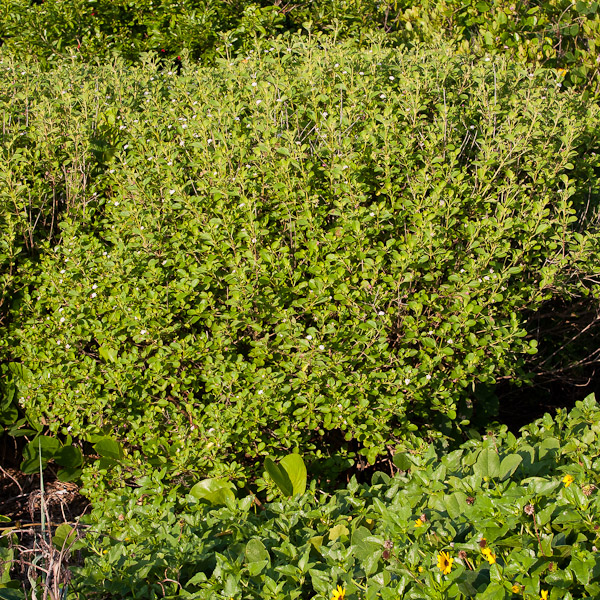
Lantana involucrata, by John Bradford.
The last-mentioned is always a treat, with fragrant-foliage, pastel flowers having yellow eyes, and glossy purple fruits.
Those purple fruits are birdfood, and the prime customer is the Kirtland’s Warbler. Any nature enthusiast growing up in Michigan is familiar with this storied traveler nesting in the northern pine woods and then flying far. The endangered and recovering bird winters, likewise in pine woods, in and near the Bahamas, where reportedly one of its staples is Buttonsage fruits, although insects are on the menu as well. Interestingly, a fruit it likes in Michigan is the blueberry, similar to those of Buttonsage.
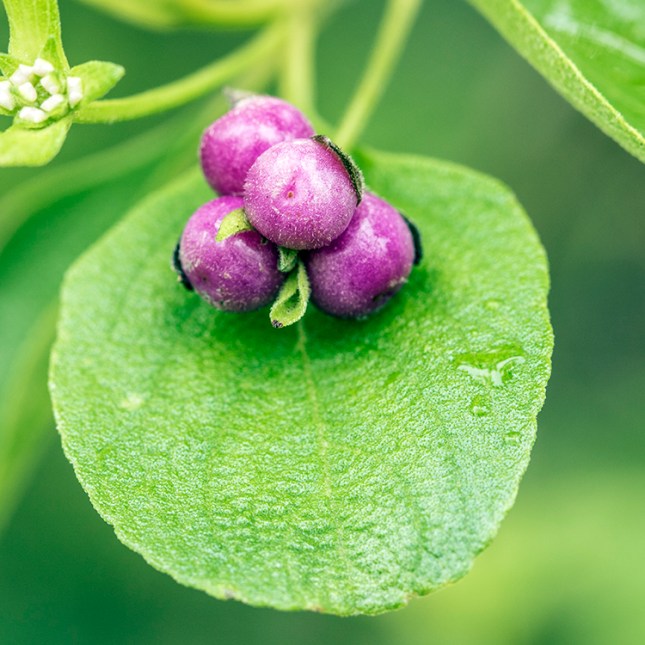
Buttonsage fruits today.
Today’s shrub provides a textbook example of butterfly-pollinated flowers, which often look like tightly clustered inverted little witch hats in pastel colors, each having a bright-colored eye. Bingo…exactly Buttonsage, which feeds more species of butterflies than a witch can shake a broom at.
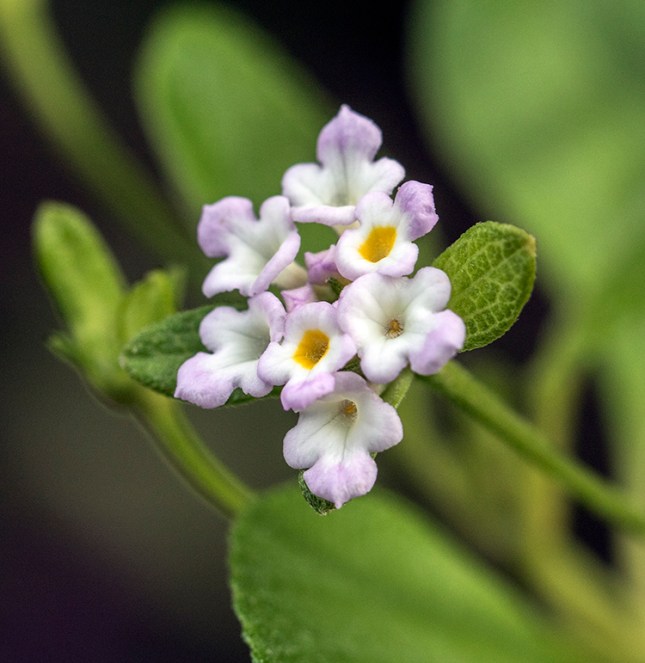
Today
Beyond butterflies, Buttonsage serves pollen to ground-dwelling bees. And there’s a hint it may do the same for some butterflies, in particular Heliconius butterflies, such as the gorgeous Zebra Longwing known to visit the flowers. So now let’s climb out on a creaking limb. Although butterflies are not generally regarded as pollen-eaters, they carry it from flower to flower as they seek nectar. However, if you are going to lug around pollen, why not swipe nutrition from it? Recent research, featuring Lantana, has shown Heliconius buterflies, after collecting pollen on their sticky proboscis, to extract nitrogen nutrients from the grains for “egg production, increased longevity, and nuptial gifts,” in the words of biologists C. Penz and H. Krenn, citing previous researchers.
 John Bradford
 George Rogers
 George Rogers
 Dee Staley
 Treasure Coast Natives

theshrubqueen
October 7, 2017 at 9:17 am
I have noticed some elaborate weddings on the Firebush.