Mikania scandens and Saccharum giganteum (and Pandion haliaetus)
Asteraceae
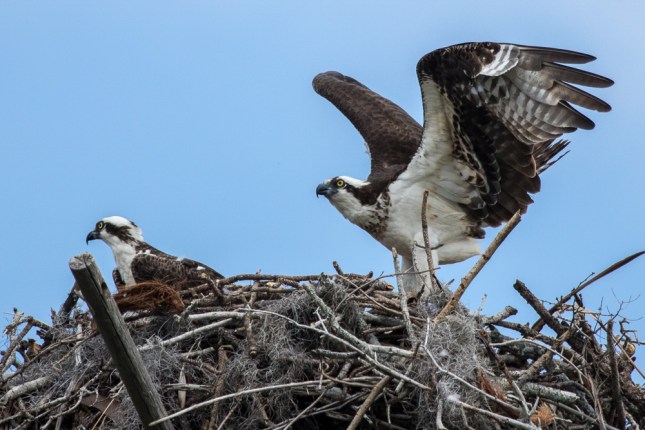
Guano makers, by John Bradford
Today John and I walked under an old osprey nesting pole in Halpatioke Park, Stuart, Florida, prompting old curiosity about the effect of big raptor nests on the flora below in the guano zone. The nest in Halpatioke was too long-abandoned for a great look, so inspired I visited a recently occupied Osprey nest near my home. That lovenest, vacant now, raised a family just a few months ago, and certainly before. Today it was empty and storm-whipped, so I felt ok about approaching and photographing, although an unafraid hawk lighted to eye me with its hawkeye for a moment.
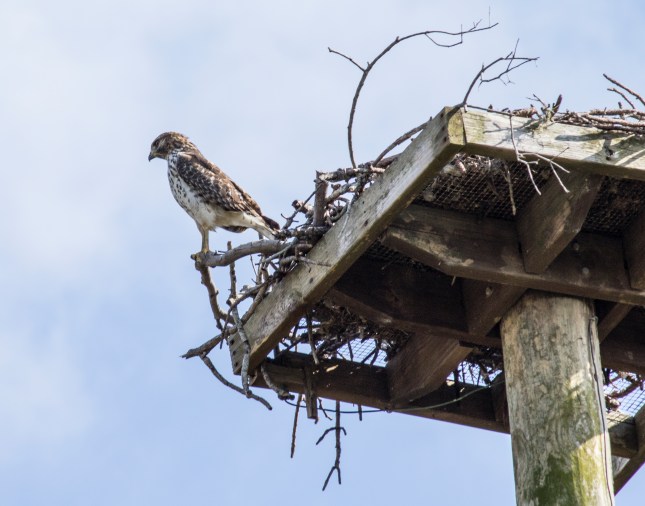
A family of big birds generates a lot of fertilizer, and also brings vegetative pieces, some green and able to root, not to mention any seeds clinging to talons, feathers, and prey.
The nest pole constructed near my home is in a wet “prairie.” Away from the nest the dominant vegetation consists heavily of species of Wiregrass, Aristida.
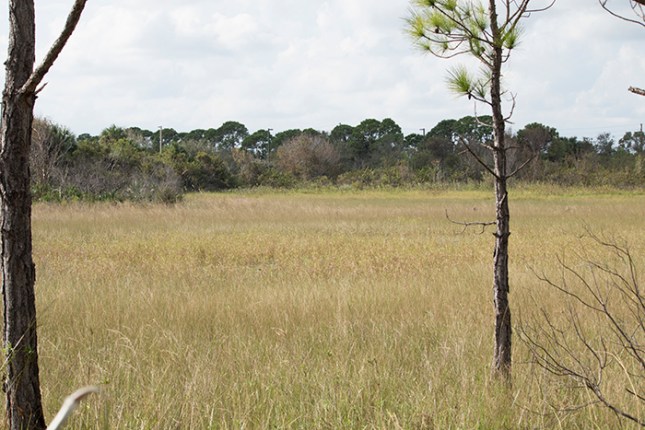
Wiregrass “prairie” looking away from the nest pole.
Around the base of the nest pole, by contrast, there’s no Wiregrass. Instead, there are a couple shrubs (Carolina Willow, Wax Myrtle), and a mix of herbaceous species dominated overwhelmingly by two species of particular note. Seen from above, the guano zone species look like feeder bands around the eye of a hurricane, the base of the nest pole being the eye. Outside of the guano zone it is all Wiregrass.
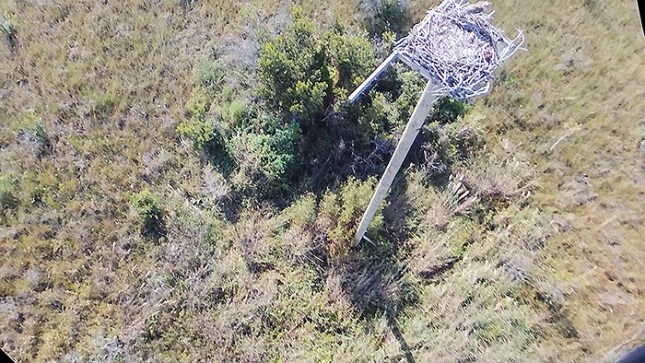
The vegetation around the pole base is different from the surrounding Wiregrass prairie. See also video mini-tour below.
Noteworthy Osprey-nest-loving species 1 = Climbing Hempvine, Mikania scandens
Hempvine forms an uneven circular groundcover patch maybe 15 feet in diameter around the base of the nest pole so abundant and dense it is a challenge to walk across. There is an easy interpretive explanation for its localized exuberance:
Bird guano is a great source of phosphorus, even a commercial source of the nutrient. In 1999 ecologists P. Vaithiyanathan and C. J. Richardson pinpointed Mikania scandens as an indicator of increasing phosphorus levels in the Everglades, where it and another phosphorus-lover, Cattails, can happily coexist in phosphoric bliss.
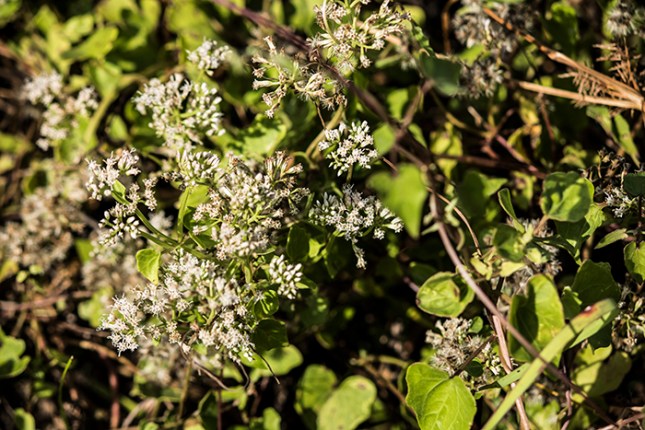
Hempvine by the pole
As an irresistible aside, bird-derived phosphorus fueling harmful algal blooms, and harmful algal blooms as suspected dinosaur killers. Now back to 2017:
Noteworthy Osprey-nest-loving species 2 = Sugarcane Plumegrass, Saccharum giganteum
This big beautiful grass related to cultivated Sugarcane is almost absent from the rest of the prairie, yet is co-dominant in the Osprey nest guano circle rising above the Hempvine carpet, mostly in a broad ring around the outer edge of the Hempvine patch. The association of the big grass with the guano circle is a challenge to explain, so please tolerate my speculations. Hempvine craves phosphorus, but if the Plumegrass does, I can’t find any sign of it. This species tolerates different soil conditions, although it does want wet feet and usually open conditions.
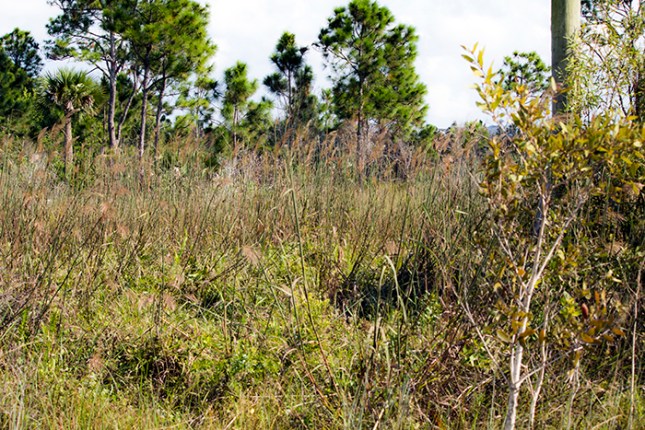
Sugarcane Plumegrass, the pole base to the right.
My hunch is that the Plumegrass would happily occupy much of the wet prairie if something did not suppress it there. I think its confinement to the nest island is not because it needs guano, but because that unique circular zone is a safe refuge. As mentioned earlier, the rest of the prairie is a carpet of Wiregrasses, with multiple species documented to suppress competitors primarily by poisoning soil microbes involved in nitrogen metabolism. That reduces the soil nitrogen levels below the tolerances of competing species…such as perhaps Sugarcane Plumegrass. Remove the Wire Grass and maybe the Plumegrass is liberated…which suggests some experiments. Whatever the explanation, a big long-standing Osprey nest dramatically alters the flora beneath.
CLICK here to see it as the Osprey does.
==============================================================
Extra stuff
Relevant earlier blogs:
Hempvines: CLICK
Bird Manure Part I: CLICK
To dig deeper: Macrophyte species changes in the everglades: Examination along a eutrophication gradient. P. Vaithiyanathan, C. J. Richardson Journal of Environmental Quality 28: 1347. 1999. [Evaluates the effects of nutrient enrichment on changes in the macrophyte community in the Everglades ecosystem. Mikania scandens and Sarcostemma clausum serve as indicators of increasing phosphorus levels.]
 John Bradford
 George Rogers
 George Rogers
 Dee Staley
 Treasure Coast Natives