At the suggestion of Virginia nature friend Pat Bowman, how about wild plants and hurricanes. Do the wild plants care?
Some relocate. It seems that during Hurricane Wilma in 2005, a tropical weedy grass. Steinchisma laxum, previously unknown in North America invaded South Florida Florida arrival was overdue, an easy breezy hurricane hop from the Caribbean, assuming the hurricane did it. Blog co-conspirator John Bradford standing in Halpatioke Park was the first soul in North America to say, “hey this does not fit the measurements of any grasses expected around here.” Now you can hardly escape it.
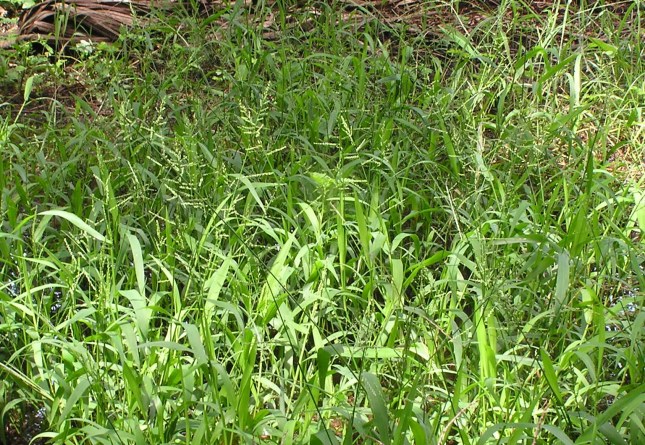
Steinchisma laxum is everywhere, perhaps thanks to Wilma.
My lawn today still has on it millions of small leafy twigs shed from Live Oaks. It is obvious to reckon, “well the gusts blew those free.” True, and branches whipping wildly knocked them off too. But there’s more to it than immediate physical damage. That something more is cladoptosis, defined as “planned” twigdrop. It happens in certain trees, notably in Oaks.
Earlier research indicates the tree somehow “decides” which twigs shall live and which shall shed. Determination occurs early in the life of the twig. Those fated to shed follow an odd development: the “veins” connecting them to their parent branch narrow and choke off supply. It looks like a ring of decay girdles the twig at the snap-off point, and the bark appears to pinch in. When the twig separates, the severed base is not fractured and splintered, but rather more of a rounded knob, like your femur joining your pelvis, essentially “designed” to drop free smoothly.
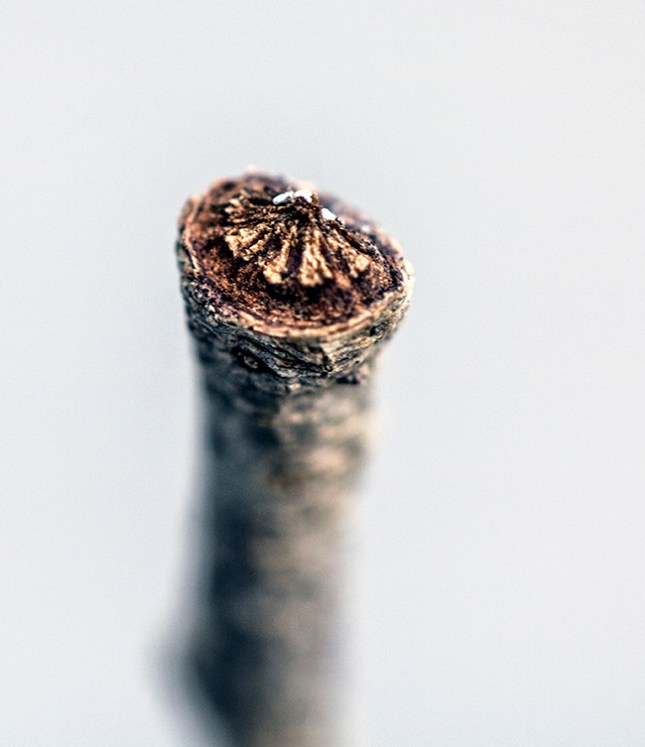
Irma-severed end of Live Oak twig. Unplugged cleanly, not torn, splintered, or fractured.
Why? The limited literature indicates a hormonal seasonal reaction abetted by stress. In short, those scattered twiglets were poised to come loose before Irma roared in. The storm merely shortened the timeframe to hours instead of weeks or months. The tree conceivably needs all its leaves during the moist growing season, but can’t support the full canopy as the warm wet season winds down and dry times approach. The hormone ethylene is implicated. The same hormone serves commercially to defoliate crops for easy harvest. The twigdrop helps storm-proof the tree by reducing wind drag. How many wind storms does a 500-year-old Live Oak experience?
Although Slash Pines may fracture or topple, another common probability is shedding, not little twigs, but rather large dead branches low on the trunk. Ever notice how those trees have nice green canopies up high but not many dead branches down low? There’s a perception that the branch-shedding is protection from ground fires, and that maybe those old branches even have some basal weakness to set them free. “Cladoptosis” of large branches? Maybe…more research needed. The break-off is not clean, uniform, and mechanical as the Oak twigs. Walking in The Haney Creek Natural Area today John and I saw the broken pine branches to be all sizes, alive, and dead, and torn and splintered. Less convincingly “preplanned” than Oak twiggies.
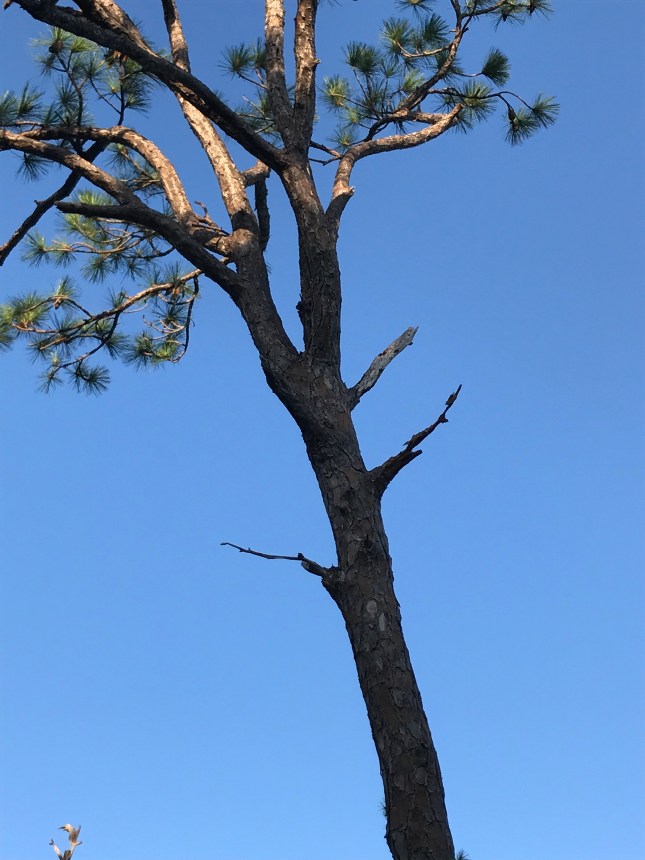
Pine branch shedding uneven, messy, and fractured.
Many woodland trees lie prostrate from past thunderstorms and hurricanes. My favorites are in swamps: Red Maples and Sweetbay Magnolias where the fallen tree resurrects multiplied as branches rise vertically to become new trunks. Ex uno plures! From one comes many, a whole new mini-population.
Busted-off branch bases and torn bark on standing tree trunks invite trouble and may or may not heal. Healing comes mostly from above, which is why branch-stumps tend to fare poorly…”above” is gone. Sugars, hormones, and growth processes cover a wound mostly downward, like pulling down a window shade.
After pruning, grazing, or hurricanes new stems grow from the lateral buds situated where the leaf joins a skinny young twig. Repeat, skinny young twig. But on any tree damaged in a storm a few years ago new branches sprout from the thick old trunk. How can that be, that gnarly old trunk lost its lateral buds decades ago. Well, not entirely, that old bark has an amazing emergency repair mechanism known as latent buds. Latent buds creep outward hidden within the bark as the tree expands, waiting for hurricane day. The equivalent of me sprouting a new leg should one be yanked off.
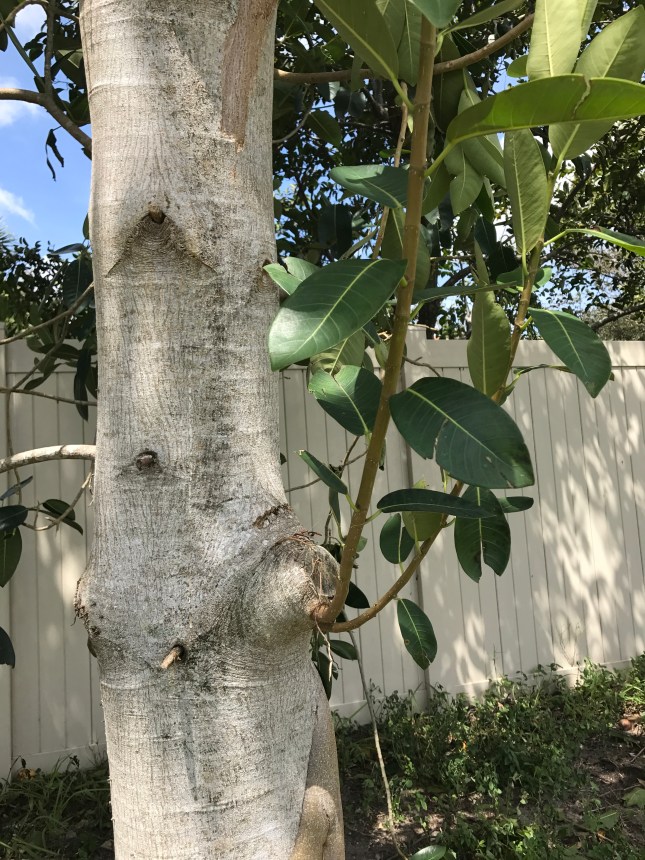
Latent buds in bark competing to replace severed stem on Strangler Fig.
The magical regenerative powers of plants go doubly in an environment where storms and fires are endemic, such as here. Check a wild area after a major storm, and there is likely less damage than expected, in some places no damage is even detectable. That was almost true in Haney Creek today, Liatris all abloom, Hog Plums with plums still attached, and most foliage intact and green. The native flora evolved to stand up to trouble. And where destruction does occur, the ability of life to rise from subterranean structures or from broken plants is quick. Moreover, the soil seed bank is ready to rise. Disturbed dirt never stays bare for long.
If you want to find damage, seek it near the sea. The salty winds “burn” foliage, and sow salt into the soggy earth. The plants mostly recover ok from the saline attack. Guess what species is especially resistant. Live Oak.
Does a big hurricane change the composition of the flora? Sure, within the constant ebb and flow of species in our dynamic world, but, given the fact that our flora has evolved through thousands of hurricanes, one event won’t cause radical mischief, except maybe where human activity has created an unnatural imbalance.
Upon emerging from our bunkers the morning the tempest subsided, one of the most positive sights after, “hey, we still have a fence,” were blue jays and butterflies. Where did those jays ride out the fury, and a butterfly in a hurricane, well, that’s just poetic.
 John Bradford
 George Rogers
 George Rogers
 Dee Staley
 Treasure Coast Natives
Linda Grashoff
September 15, 2017 at 5:28 pm
A lovely post—fascinating! Now I won’t feel bad when I see all those oak twigs on the ground.
George Rogers
September 16, 2017 at 7:28 pm
Thanks Linda! When we go back to work Monday I’ll be able to print a hard copy of the marvelous item you sent!
theshrubqueen
September 15, 2017 at 7:52 pm
Great post. I have a terrifying sized Strangler Fig that was so efficiently thinned by Matthew – Dear Irma didn’t do much damage.
George Rogers
September 16, 2017 at 7:49 pm
Is it even possible to kill a strangler fig?
theshrubqueen
September 17, 2017 at 8:09 am
I think not. What is interesting -the branches that are shed are usually the vertical ones leaving the horizontal structure intact.
Diane Goldberg
September 16, 2017 at 11:45 am
My Slash Pines lost small branches, but my Florida Privet went down, so I see your point. I live out west, just east of I-95 and was surprised to see a Black Crowned Night Heron in the marsh. I guess he blew over too.
George Rogers
September 16, 2017 at 7:50 pm
Hi Diane, Wouldn’t it be interesting to know where all the birds go in a hurricane, where they hide and hunker?
Jane
September 16, 2017 at 1:15 pm
All of the trees that I have that contained heavy crowns either snapped or blew over. But, all of the trees with loose, open crowns or that i had recently (thank goodness) trimmed were just fine. Examples of those that snapped: Crabwood, Lancewood, Mastic and those that did not: Wild Tamarind, Oaks (previously thinned), Stoppers, Holly. Anything that gave resistance with it’s crown or foliage is pretty beat up or damaged to the point that it will require a painful extraction. 😦 Lance was 13 years old. He will be extracted. It looks like to me like a tornado passed through the Demonstration Garden because branches are twisted and gnarled along what looks like a path of destruction. – Jane Thompson Indian Trails Native Nursery
Jane
September 16, 2017 at 1:17 pm
A very large branch did come down from ONE of our many oaks and it has the marks similar to what is shown in the picture above.
George Rogers
September 16, 2017 at 7:51 pm
Thanks for all the info Jane…useful to know, especially with your experience base.
Julia
September 16, 2017 at 3:11 pm
I agree about the butterflies. Their resilience is truly amazing. I brought in eggs and caterpillars and enough food for a week or so to rebuild colonies. But I didn’t need to. after Irma passed butterflies came out of the shrubbery hungry and horny. What a joy to behold amidst the destruction.
George Rogers
September 16, 2017 at 7:24 pm
Yep, tough little rascals.
Sally Brodie
September 17, 2017 at 1:36 pm
Yesterday, just six days after the hurricane, there was noticeable new growth, post hurricane damage, on my lantana involucrata and the pigeon plum. No real damage on the pigeon plum, just leaning a bit, but it seemed very happy to throw out a bunch of new shoots. Maybe all the rain. yes, salt spray damage of leaves was very interesting. Some were very hard hit, others not bothered a bit.
One question for George, is your Virginia friend Pat Bowman of the famous Bowman distillery family? I used to play with the Bowman girls as a child on what is now Reston VA. Just asking.
George Rogers
September 18, 2017 at 9:47 am
Hi Sally, the regrowth is so nice to watch. My son has two bonsai that were placed in protection during the storm, but they lost their leaves anyhow…..and now the yare beginning to show some new signs of life. Bowman is her married name, but I’ll ask. Hey. I’d like to have a connection to a distillery.