What a dumb time to write a South Florida blog, as we all wait for Hurricane Irma to blow in some new weed species. After the house is as ready as possible, there’s not much to do other than hang around and fret. So, here’s something to read before the power blinks out. Today’s core topic came from my second favorite thing after vanilla cream donuts, “This Week in Virology” by Professor Vincent Racaniello who makes all things viral fascinating.
Can a virus be good? Yes, occasionally, and probably far more often than we know. Today we shall see a native grass species (if you stretch the taxonomy) and its associated fungus meet a helpful virus.
Dichanthelium, the Witch Grasses, comprise roughly 80 species, numbering about a dozen in our usual neck of the woods. Pretty, often petite, sometimes forming rosettes.
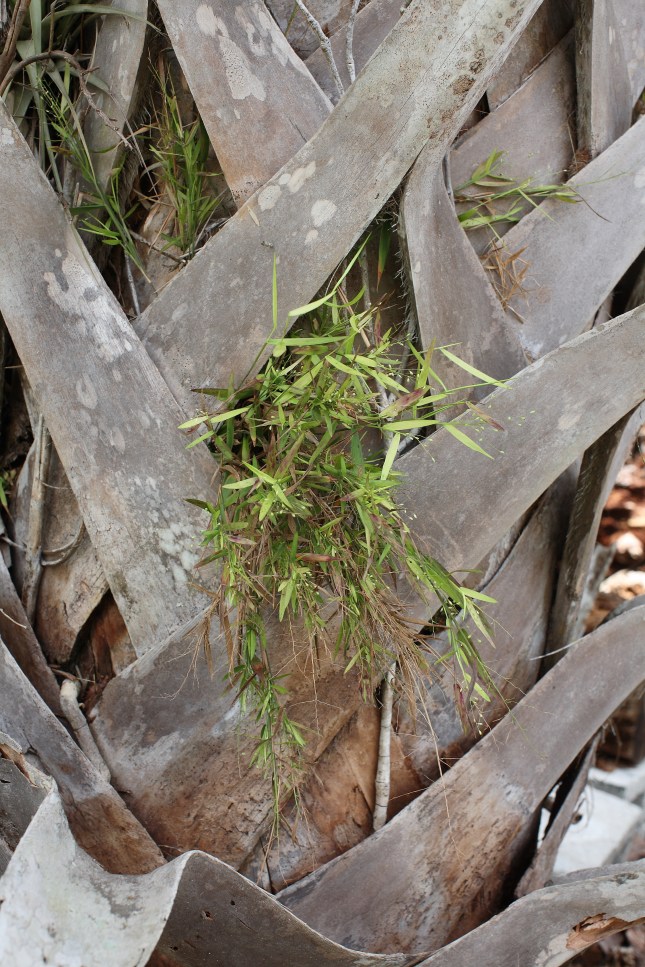
Dichanthelium chamaelonche. All photos by John Bradford.
Today is all about a super-powered grass formerly classified as belonging to our local D. acuminatum.
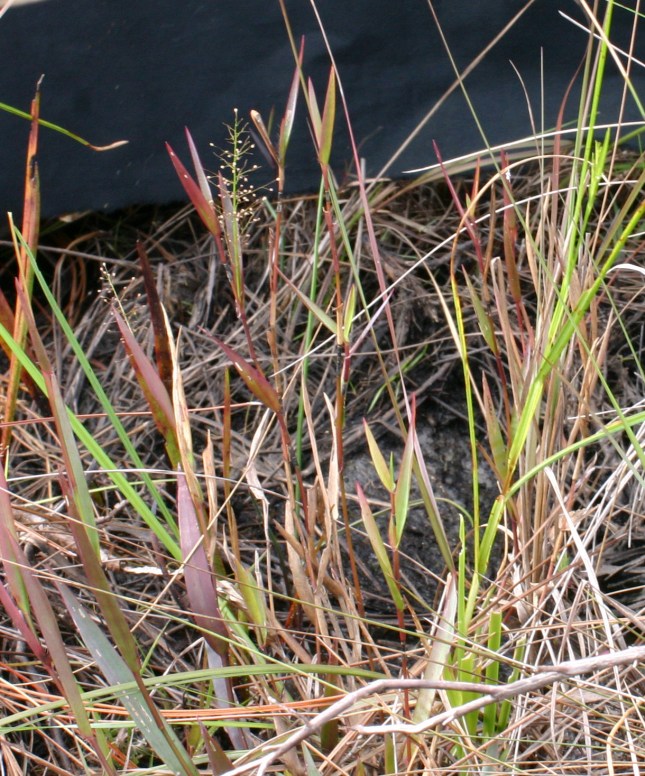
D. acuminatum
Dichantheliums are notoriously tough to classify. In any case the variants of interest are not known in Florida, but rather at scattered hot springs over a large area of western North America. A recent and credible classification interprets the hot-springs-inhabiting populations as a species in its own right, D. thermale. A grass at home in hot water? Really hot.
Recently studied in Yellowstone Park the witch powers of Witch Grass are proven where it bubbles bubbles toils and troubles in natural cauldrons as steamy as 65 degrees C (149 degrees Fahrenheit). For comparison, hot tap water is typically around 50 degrees C (122 degrees F).
The super-grass hosts a symbiotic fungus called Curvularia protuberata, at first glance a suspect responsible for the empowerment. But infecting the grass with the fungus doesn’t help. UNLESS a third player is tossed into the brew, not eye of newt, but a newly discovered virus. The virus plus the fungus jointly confer heat resistance on the grass.
A big problem with symbiosis is that the codependent species must have coordinated reproduction and dispersal. Our hotfoot grass turns up in small isolated populations at hot springs sprinkled over hundreds of miles. Do the Three Musketeers all travel together? How? One component is known…the virus moves generation to generation in the fungus within the fungal clonal spores. Then do those virus-bearing spores ride along somehow in the grass’s seeds? Unknown, but don’t they have to? How did the three species hop from Yellowstone to northern California and far beyond?
There may be more similar fungal-viral-grassy unions to discover, because our fungal genus Curvularia is large, often plant-pathogenic, and frequently consorting with grasses. The same fungal species in the Witch Grass, Curvularia protuberata, is also a pathogen on rice, so who knows, maybe it helps the rice sometimes? And if in rice, it must infect additional grasses. Could the empowering fungus-virus duo help concoct super-powered rice?
![DichantheliumerectifoliumJWTOct.[1]](https://treasurecoastnatives.com/wp-content/uploads/2017/09/dichanthelium20erectifolium20jwt20oct-1.jpg?w=645)
The mechanisms of all this are poorly known so far, but researchers understand a few things. When the virus infects the fungus, the fungus accumulates mannitol, a sugar-alcohol common in plant defense mechanisms, and also a human medicine, such as a laxative. Does the viral infection put the fungus into a defensive mannitol-making posture, and then the grass exploits the fungal protective arsenal? Probably much more complicated than that simplistic first notion.
The grass, fungus, and virus have drawn the active attention of researchers interested in heat tolerant crops. That’s a big deal in a world where hot conditions limit crop options, and where climate change will boost the mercury. Experiments have already created heat-tolerant tomatoes by infecting them with the Dichanthelium fungus-virus sidekicks.
———————————————————————————-
For those who wish to dig deeper: CLICK
 John Bradford
 George Rogers
 George Rogers
 Dee Staley
 Treasure Coast Natives
Annie Hite
September 7, 2017 at 10:00 pm
As you thought might happen, this post was so fascinating, it did take my mind off Irma. Instead I’m thinking about the incredible workings of the botanical world. Mannitol rang a bell for me. I think it was used (may still be used) to cut cocaine ???
George Rogers
September 8, 2017 at 1:24 am
Not sure on the cocaine thing but sounds plausible. Mannitol serves medicinally to help drugs cross the blood-brain barrier by opening passages between capillary cells,