Spermacoce verticillata
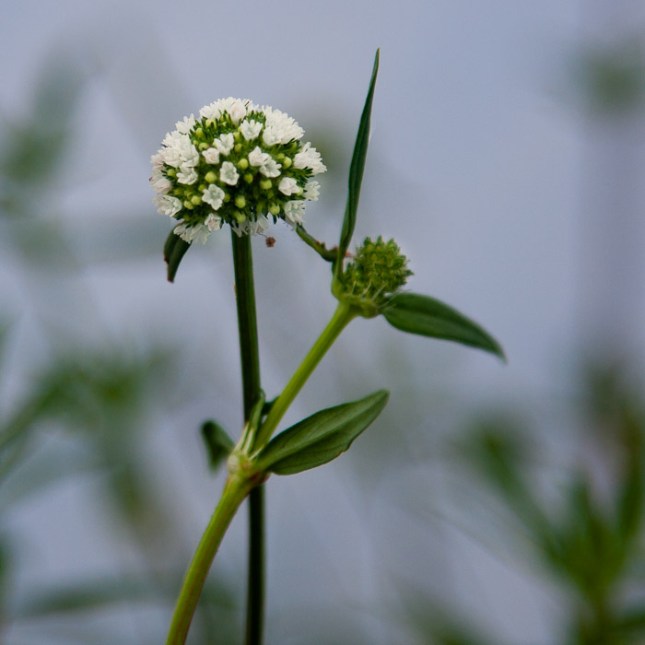
(Spermacoce means seed-point, because the little dry fruits have four points. Verticillata presumably refers to whorls (verticils) of flowers and young leaves.)
Rubiaceae (Coffee Family)
Common plants interest me more than the rare species, because the common ones are everyday friends. There’s so much to discover right under our noses. Today’s plant is literally everyday in parking lots, asphalt cracks, roadside weeds, pastures, and lawns. Spermacoce verticillata is an exotic invader from the Coffee Family as well as one of the most abundant and toughest weeds in South Florida. If you live here and want to see it, step out the door. The plants can rise five feet tall, or lie low and spread into a patch where grazed or mowed. On top of overall immortality, the plants re-root where they touch the ground, and the tiny seedlike fruit segments boast a 50 percent germination rate. There’s no stopping it.
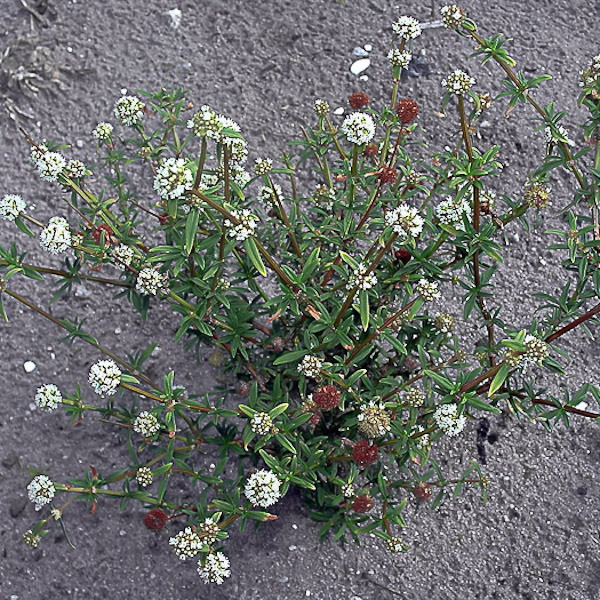
Buttonweed on dismal soil. It doesn’t care. Today’s photos by John Bradford.
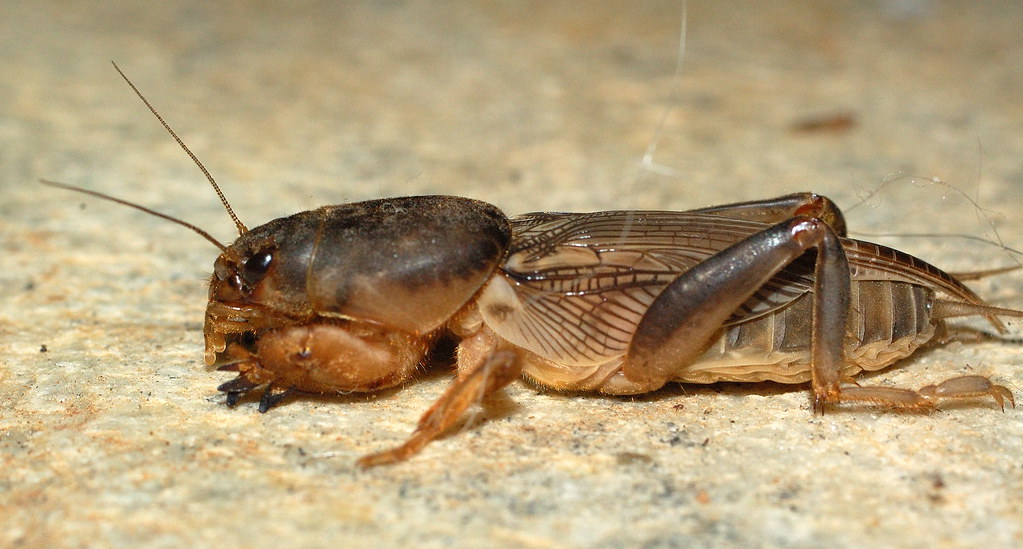
That is good news is you dislike mole crickets. The holy grail of pest control is a natural approach using pests of the pests, although that has been known to backfire when the attackers spread to native relatives of the target enemies.
Evil pests of Florida lawn-lovers are invasive mole crickets, multiple species. Their arch enemy is a parasitoid wasp Larra bicolor, introduced from South America, as is today’s weed, the wasp’s favorite nectar plant. The wasp lays an egg on the mole cricket, where the resulting larva sucks life from its host, terminally. All natural cricket control! Buttonweed is available commercially to foster the cricket-killing wasps. In that context call it “Larra Flower” echoing the Latin name of the wasp, although somehow I don’t think market-driven neo-naming will stick any better than “Freedom Fries.”
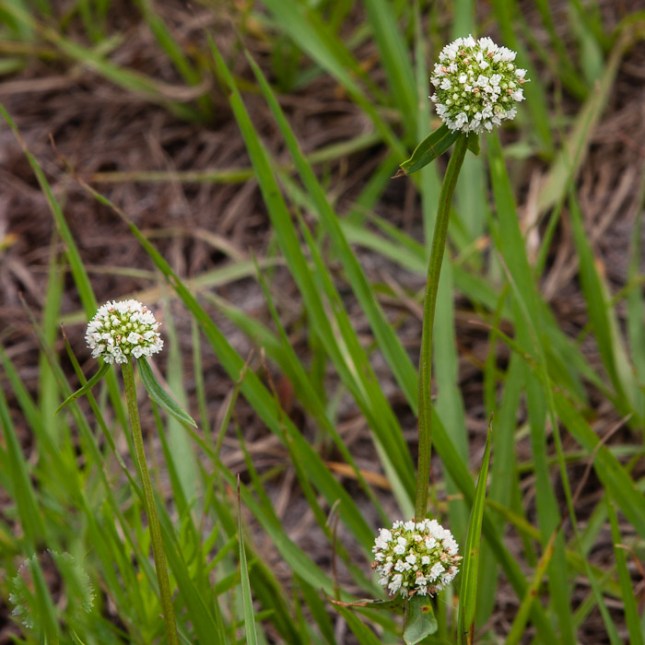
Here we have a case of cultivating one invasive exotic to feed another introduced exotic to encourage it to kill still another invader, an exotic ménage à trois. All three species have native Florida relatives. I have scant idea if that implies risk. From a standpoint of general principles, ignorance, and neurotic personality, it worries me a little, especially with respect to native mole crickets, although studies do show them to resist the wasp, so that risk is probably, if not certainly, low. Spermacoce verticillata is so ubiquitous already that cultivating more is not likely to cause additional harm.
——————————————————————————
Relevant link for extra info
 John Bradford
 George Rogers
 George Rogers
 Dee Staley
 Treasure Coast Natives
theshrubqueen
August 26, 2017 at 5:24 pm
This sort of ”let’s bring another bug” stuff makes me think of Cane Toads. I agree, worrisome. A wicked weed!
George Rogers
August 26, 2017 at 6:08 pm
Haven’t I seen it in a floral arrangement?
theshrubqueen
August 26, 2017 at 8:33 pm
I think so! With Spanish Needles and Crotlaria.
Suellen Granberry-Hager
August 27, 2017 at 5:01 pm
It sounds like the native Larra wasp specifically attacks the native mole cricket while the non-native one sticks with the non-native mole cricket. Now if the non-native buttonweed would just confine itself to intentionally planted areas, everything would be ok, I suppose. I noticed the ad for “Larra Flower” said it grows like a weed and is non-invasive, quite a contradiction or the result of wishful thinking!
Steve
August 28, 2017 at 9:01 am
In 2015 Shrubby false buttonweed was added to the FLEPPC list as a category II invasive. George, do you think this species has potential to greatly impact our natural areas?
CK
January 24, 2020 at 4:04 pm
So I read there’s this one, Spermacoce verticillata, is an invasive plant that is non-native. However, it has a relative that looks very similar called Spermacoce neoterminalis, which can ONLY be found in Florida. How can I tell the difference? I want to get rid of the non-natives and keep the endemic species.