Sesuvium portulacastrum
(Sesuvium references an ancient Gallic tribe. Portulacastrum notes false similarity to Portulaca.)
Aizoaceae
A romantic stroll on the beach in Florida or throughout much of the warm climate world may reveal a trailing succulent with showy purple-violet flowers. The fruit opens like the lid of a Weber Kettle to allow seeds to splash out, much like the pod of its namesake Portulaca.
Sea-Purslane sometimes goes by the name Sea-Pickle. Plant munchers eat the salty succulent leaves. Perhaps not a grand idea, however, as the tissues are powerful mercury (and probably lead) accumulators, not to mention producers of steroid hormones. A few words on those:
Twenty-hydroxyecdysone is a steroid touted for boosting testosterone for virile body builders. I think the claim is spurious, and who wants to go around ingesting hormones? If John and I become more manly we’ll be dangerous.
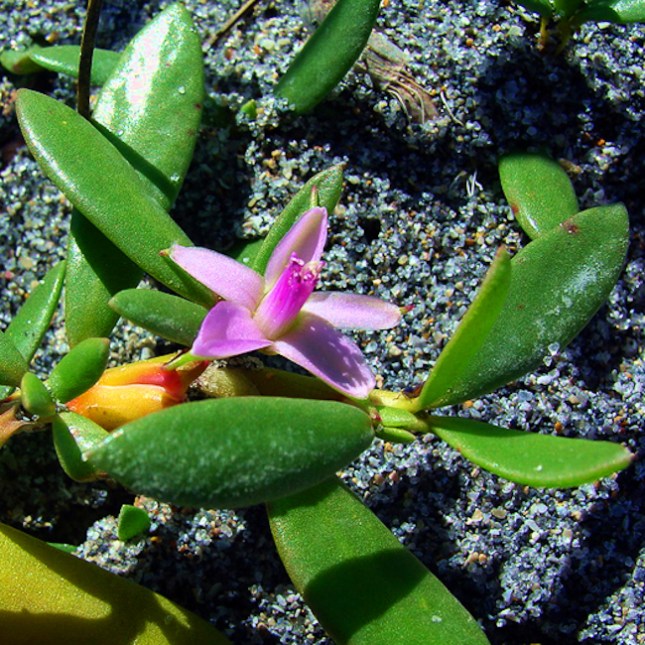
Photo by John Bradford.
Why would a plant make animal-active steroids? Twenty-hydroxyecdysone is an insect molting hormone, serving to disrupt insect development, thus perhaps a future natural insecticide crop.
Insect damage to Sea-Purslane was the object of a hurricane recovery study in the Bahamas where hungry moth larvae undaunted by hormones stifled hurricane recovery by eating the pickles faster than they regrew. What saved the day was a population of Brown Anole lizards, native in the Bahamas and introduced and established abundantly in Florida. They had the fever for the flavor of a caterpillar.
It is always curious how plants of salty places cope with all the salt. Some secrete it one way or another. But Sea Purslane stores it! Exposure to salt, in fact, up-regulates hundreds of known genes and enhances growth. The plants sequester extreme salt concentrations within the thick leaves, in the vacuoles to be exact. A vacuole is sort of a bag inside a plant cell, and stashing the salt there may cut down its damage to basic cell functions.
The “purpose” of the stash however is not to place the salt out of harm’s way, but rather it seems using it in a “fight fire with fire” strategy. The beach sand is highly salty of course, and that draws water out of the roots by osmosis. You might say “salt sucks.” People have long known that salt in the soil kills plants. To smite the Sichemites, sow salt on their fields and dehydrate the crops.
Sea-Purslane fights salt with salt. If a high soil salt concentration forces a tug-o-war for water, the way to win is to have even more sucky salt in the leaves. A thick stand of Sea-Purslane can take up enough salt to diminish meaningfully the salt concentrations in the soil, an observation not overlooked in soil reclamation.
 John Bradford
 George Rogers
 George Rogers
 Dee Staley
 Treasure Coast Natives
donald filipiak Sr.
August 18, 2017 at 9:09 pm
Fascinating
theshrubqueen
August 18, 2017 at 9:19 pm
Going to ponder the suckiness of this purslane!
Mark Prynoski
August 19, 2017 at 7:46 am
Very interesting article. Do saltwort and glasswort use the same strategy? And are their leaves also heavy metal accumulators?
FlowerAlley
August 19, 2017 at 9:23 am
This was very informative and funny. Thanks. (Hi Queen, above)