Fridays with three meetings don’t leave much time for field trips, so today’s exploration was a potted windowsill luffa during the proceedings. Not native, but it’ll help keep you clean and exfoliated. And it leads quickly to natives.
Luffa has magnificent tendrils, as my colleague Maura Merkal suggested photographing. And we did. Tendrils are the little twist-tie “wires” you see plants use to cling and grab. They don’t get much attention, probably because they are boring. But boring doesn’t stop me.
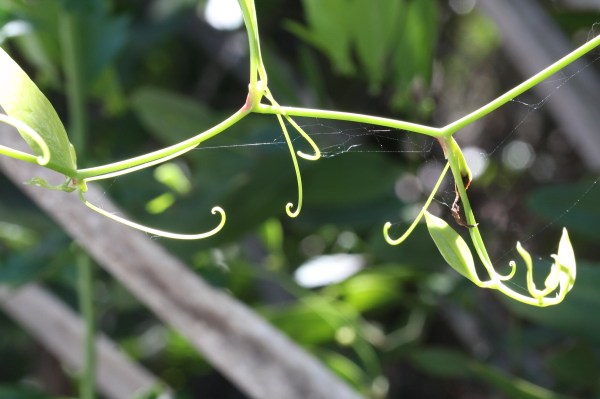
Smilax tendrils. All photos except the final four (below the diagram) by John Bradford.
Tendrils tend to look alike, but here is the cool part (if you have a low threshold for cool): they evolved separately and repeatedly in plants utterly unrelated to each other, and from different organs. The same but not the same. Is that remarkable? The same need to cling and climb forced organs of divergent origins to the same outcome. Shall we now tie into native tendril examples, featuring (mostly) native plants:
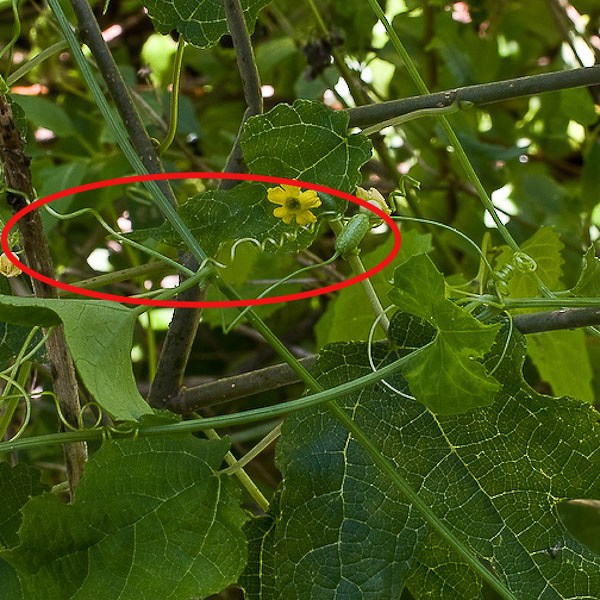
In some plants the tendrils are branches, for instance:
Creeping-Cucumber (Melothia pendula and other members of the Cucurbit Family)
and
Passionflower (Passiflora species)
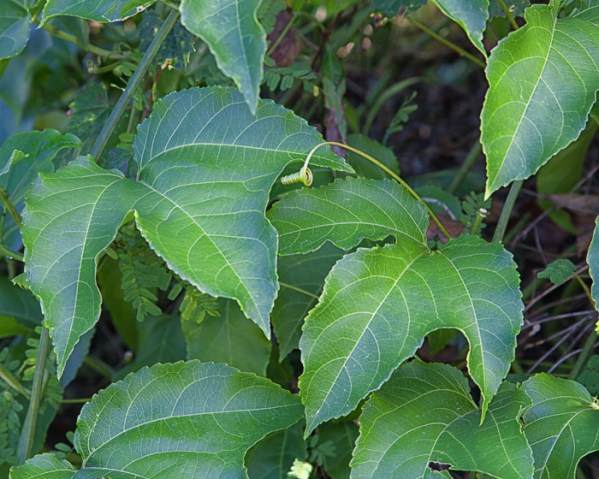
Passiflora edulis (not native, escaped). The curly tendril is a delicate branch rising above the leaf.
In others the tendril is the tip of a (compound) leaf, for example:
Four-Leaf Vetch (Vicia acutiflora, and other legumes). The rare native Tiny Peavine (Lathyrus pusillus) farther north in Florida offers a great example of a tendril as part of a leaf. CLICK (So does a regular garden pea.)
Tendrils can be stipules (paired outgrowths at leaf base), with a case in point being:
Smilax (Smilax species)
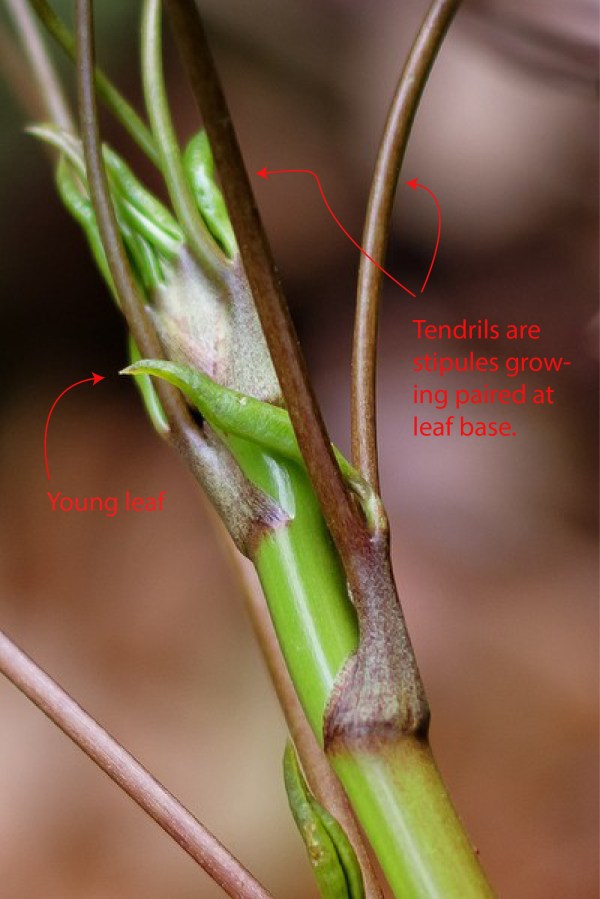
The two tendrils in this Smilax are growing from both sides of the leaf attachment. They are stipular tendrils.
And tendrils can be stem tips, probably modified inflorescences, with the prime example being:
Grapes and their relatives. Interpreting tendrils in the Grape Family involves a little guesswork. The tendrils are opposite the leaves. Most botanists interpret the tendril as the branch tip, and the growth continuing beyond the leaf-tendril to be a branch, even though the branch looks like the main stem. That new branch ends with its own tendril, and so on and so forth.
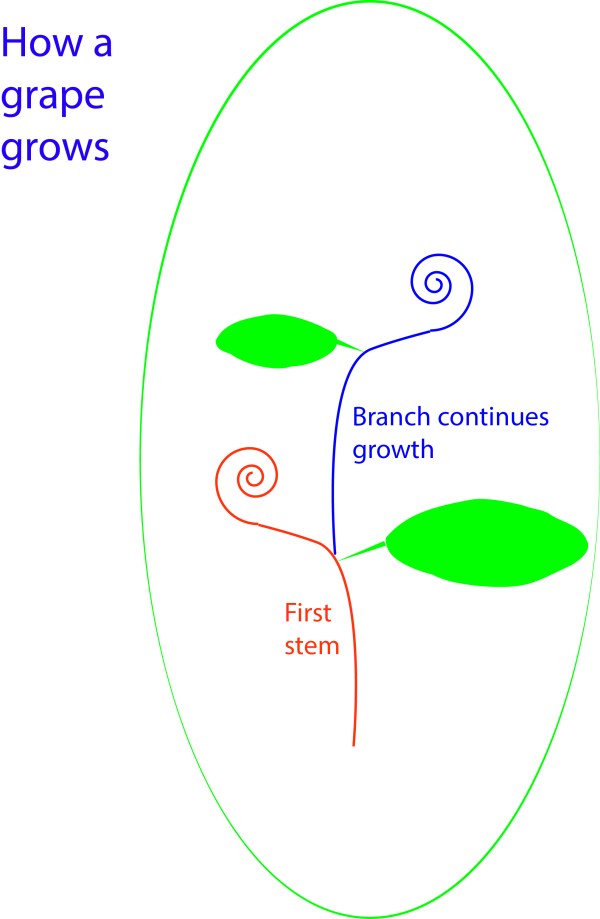
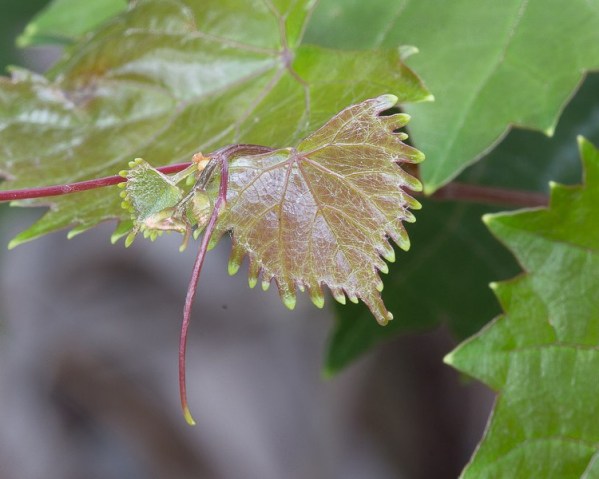
Grape
Grape Family tendrils have a rare or unique (?) ability. They secrete water and salts from their tips. This secretion may underlie the ability of Virginia Creeper (Parthenocissus quinquefolia) to form clinging sticky pads at its tendril tips.
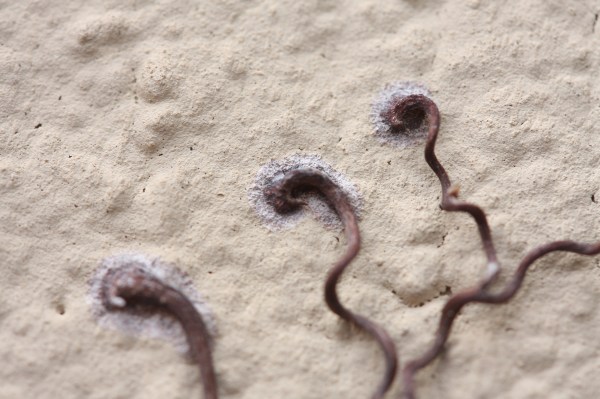
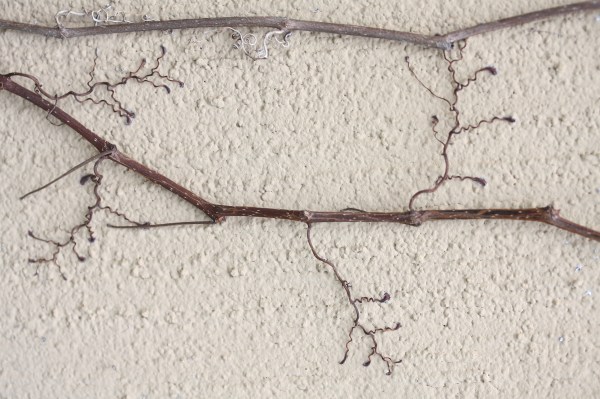
But what about the luffa? CLICK to see its tendril in action (6 hours condensed to a few seconds).
 John Bradford
 George Rogers
 George Rogers
 Dee Staley
 Treasure Coast Natives

theshrubqueen
February 13, 2016 at 8:42 am
Cool video – any idea what causes the helicopter effect?
J
February 14, 2016 at 5:56 pm
I’m not sure exactly in the case of the Luffa, but I’ll give my educated guess. Also, just as a disclaimer, I’m struggling not to anthropomorphise the plant while providing a clear answer.
It is in all likelihood the mechanical reaction to movement and processing of enzymes/hormones within the plant. Basically stretching and contracting the fibrous tissue of the tendril until it meets resistance (I.e a wall or a tree, just something the tendril can grasp onto). Once it meets this resistance, the helicopter effect will continue but eventually aligning itself with the plane of the surface it will climb on. This effect causes the tight curls you see in some of the above pictures. Because I’m not specifically familiar with the chemical reactions going on inside the Luffa and, as the article said, tendrils can come from different parts of the plant, this is just an educated guess.
Hope this makes things clearer than mud!
George Rogers
February 14, 2016 at 8:44 pm
Thank you…yes that moves us in the right direction. Some tendrils actually have little pressure-sensitive pads to help get a grip…
George Rogers
February 13, 2016 at 9:15 am
Only in a general sense…it has to do with changing water pressure in the tendril base area, twirling it to grasp for something to cling to. The deeper physiology is pretty mysterious. Plants “do” a lot.
theshrubqueen
February 13, 2016 at 5:47 pm
Wow, that is cool – my dogs reacted to the sound! Curious.
George Rogers
February 13, 2016 at 8:06 pm
Mine does too. It is the kitchen can opener. Canned dog food?
theshrubqueen
February 14, 2016 at 5:43 pm
Yes, the cans have pop tops, however, I think the can opener sound may be in their DNA.
George Rogers
February 14, 2016 at 5:45 pm
funny!—probably so
Uma Bhatti
February 16, 2016 at 9:03 am
Luffa climbs on everything,I had a on my mango tree.Its a Indian vegetables we cook many different ways. Indian people growing Luffa in their yard.
George Rogers
February 16, 2016 at 9:31 am
And it could be used for dental floss.