Gopher Apple
Licania michauxii
Chrysobalanaceae
To set the stage, enjoy a trip to Jonathan Dickinson State Park and cyber-visit the Gopher Apple in John’s Gigapan Image. You can zoom in and out, and move around. This shows GA’s at their correct size, 1 foot tall.
Do Gopher tortoises really eat Gopher Apples? Yes, although the tortoises do have a broader varied diet, and the “apples” have a broader varied consumership. Perhaps significantly, however, the range of the plant and the range of its armored namesake are similar. Do the “seeds” (endocarps) have to pass through a tortoise to sprout? UF Prof. Sandra Wilson and collaborators report good germination after mere extended soaking in water. Kinda disappointing in a fashion.
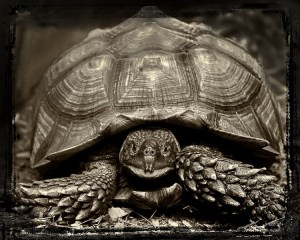
GA-eater, photo by JB
When you see a Gopher Apple you often see a few hundred in a mass, as in John’s Gigapan. Those are probably all one big clone, spreading by thickened subterranean stems, the perfect way to survive in the fire-prone habitats favored by the species.
What would happen if there were no fires to keep knocking the GA’s down? Recently John and I noticed a 5-foot shrub in Jonathan Dickenson Park near the RR tacks close to the site of the Gigapan, and from the distance the species seemed unfamiliar. Upon closer examination, it turned out to be a shrub-sized GA on steroids with a trunk. There’s a population there of numerous individuals of mixed sizes, from knee-high to eye-level plus.
At the time our conversation drifted to ascribing the freak size to RR herbicide spray. (The common herbicide 2,4-D is a hormone mimic and causes funny things to happen.) Another thought, perhaps proximity to the tracks saved the shrubs from burning, or perhaps not. We’re not sure. Further investigation showed us not to be alone we were not alone in our encounter with gigantism. Daniel Ward and Walter Taylor reported similar unburned oversized Gopher Apples on Merritt Island. (Castanea 64: 263-265. 1999.)
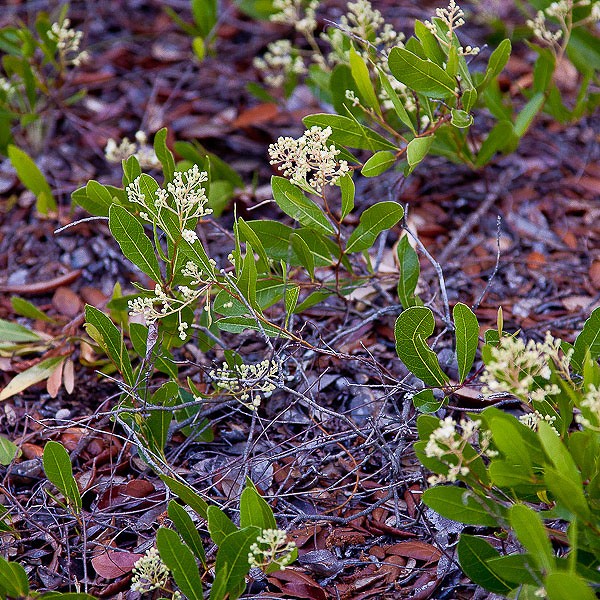
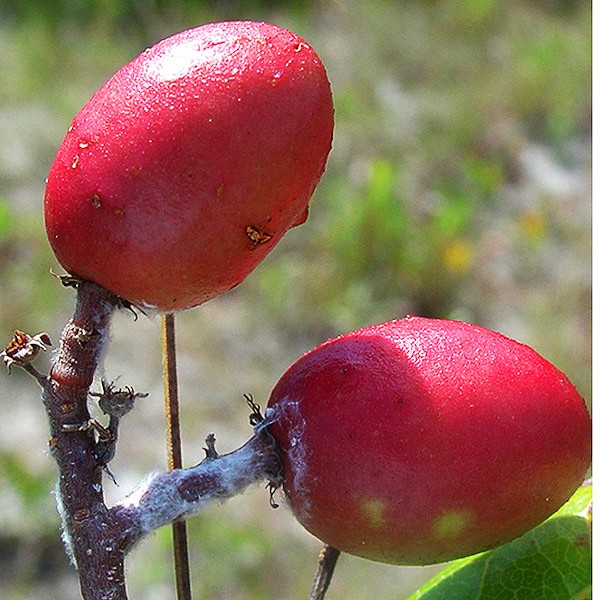
Flowers and fruits by JB
Big Gopher Apples are nice, but what would really get the camera clicking would be the matching 4-foot gopher tortoises. But seriously now, Licania is a large tropical genus with shrubs and trees, so our little fire-adapted species probably has “grow-big” genes in its DNA, suppressed but not that suppressed (according to my unsubstantiated speculation). Sort of like people have grow-a-tail genes in our DNA, suppressed, but not always.
Look at the picture of the GA fruit. Does it resemble the Cocoplum hedge outside your house? The two are closely related, and earlier taxonomists joined them as the same genus. Gopher Apples and Cocoplums are our two local reps of the large tropical family Chrysobalanaceae, which is traditionally regarded as related to the Rose Family, hints of which you can see in the pretty white Gopher Apple flowers. DNA study shows the relationship not to be so close, however.
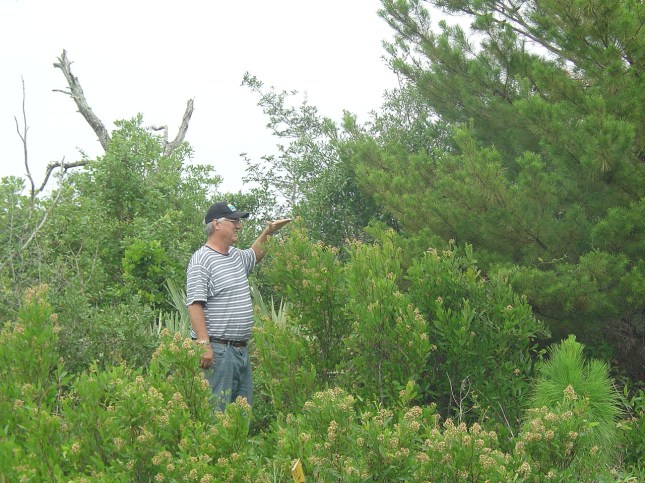
The Big Apple. These Gopher Apples are up to about 5 feet tall in full bloom, just steps away from the Gigapan site, but a different clump.
 John Bradford
 George Rogers
 George Rogers
 Dee Staley
 Treasure Coast Natives
Mary Hart
May 17, 2012 at 4:10 am
Fascinating reading – there are still so many unanswered questions in botan!
George Rogers
May 17, 2012 at 12:02 pm
Hello Mary, sure are! Which is why it’s so much fun to poke around and see what you uncover! What’s blooming in your neck of the woods in mid May?
Erin Derwitz
February 10, 2014 at 11:19 pm
Recently our Native Plant ID class we ventured out to Blowing Rocks Preserve on Jupiter Island in Palm Beach County, Florida. What an incredible day of sunshine and just seeing the beach and waves were a treat! There were quite a few Gopher Apples lining the walkway from the beach along with sea grapes, seastars, etc.
We mentioned in class – that the fruit is an edible for wildlife such as the gopher tortoises, and it also provides nectar for butterflies! Gopher apples can handle the salt environment and drier conditions that most plants because once it is established the plants really do not require a lot of water. I also learned an interesting fact that even though Gopher Apples can tolerate salty air, they cannot tolerate actually “being in saltwater” or even brackish water as for flooding for long periods of time like mangroves can. Great day!
Erin Derwitz
George Rogers
February 10, 2014 at 11:59 pm
Hey Erin, I wonder if the tortoise gnawing on te “seed” promotes germination.
Shane James
February 20, 2014 at 1:15 pm
I did see these when we were inventorying the Gopher Tortoise burrows at Johnathan Dickinson State Park, but they were hard to find through the thick Palmettos.
George Rogers
February 20, 2014 at 1:55 pm
Be fun to know if there is any special “ecology” linking Gopher Apple to Goper Tortoises.