Tropical Soda Apple
Solanum viarum
Solanaceae
In Allapattah Flats Natural Area yesterday John and George were struck by the conspicuous autumn beauty of a detested invasive weed, Tropical Soda Apple.
Find Tropical Soda Apple in this Gigapan taken by John 11/11 at Allapattah Flats. (Hint: look near the white posts.) You can pan around and zoom in and out: Click
Beyond wicked thorns, why is this South American Category I invasive weed the bane of all that’s good? Those little ”tomato” fruits bear oodles of hyperviable seeds and are experts at animal dispersal, reportedly moved around by cattle, feral hogs, deer, raccoons, and other animals, and possibly by birds, as well as in feed, sod, manure, and other agricultural products, The spot where we photographed the plant was decorated with raccoon (?) scat.
The weed loves and invades pastures, degrading over a million acres in Florida alone, quite a feat for a South American species unknown in the U.S. prior to the 80s. There are ongoing efforts to control it with insect biocontrols, hopefully ones not interested in tomatoes, potatoes, eggplants, and many native Solanaceae species.
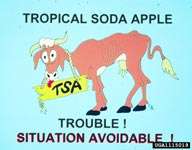
Cow + TSA = dispersal (and sick cow?)
Tropical Soda Apple differs from other Solanum species in our area by having the young fruits colored like mini-water melons, straight thorns, and petiolate leaves.
Solanaceae are in large part a druggy toxic bunch, despite the edible species, so what about Tropical Soda Apple? Livestock beware! Illness occurs, including brain damage visible upon autopsy. Cattle do not read veterinary journals; they eat the fruits and scatter the seeds with abandon. One of the toxins, solasodine, serves commercially as a precursor for steroidal drugs. It is amazing how little attention there is to human poisoning from such a tempting berry. The berries are said to be disgusting, which probably has saved children.
The thorns are just plain evil, yet animals do harvest the fruit. And this ties in with the beauty we beheld yesterday. The plants were devoid of leaves, no longer very thorny, and festooned with beautiful cherry-tomato-sized golden berries glowing in the late afternoon sun. They could serve as fanciful holiday trees at the mall, and are eye-catching at a hundred yards. This otherwise forbidding species apparently lowers its leafy-prickly guard and gooses up its tooty-fruit advertising at seed-dispersal time. The berries probably become less toxic upon ripening.
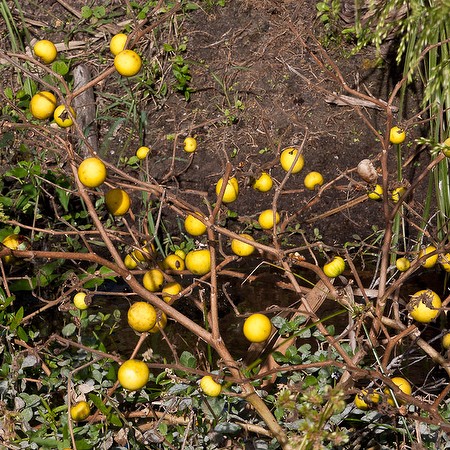
The thorny leaves are gone and the golden orbs are ripe for the plucking (but don't) (Photo by JB)
Let’s go a little deeper on that. Ripening fruits, of which there are many, produce the hormone ethylene. Ethylene is involved in leafdrop, which is dramatic in the present case. Bear with us a moment on an academic yet relevant quote from the 1943 Botanical Gazette concerning Soda Apple’s cousin, the tomato. The title says it all: “Defoliation of the Tomato Plant as a Response to Gaseous Emanations from the Fruit.” Plant physiologist John Skok, from the University of Illinois (which Michigan beat yesterday in an ugly contest), tackled a horto-headache with tomato plants: they drop their leaves late in the growth cycle.
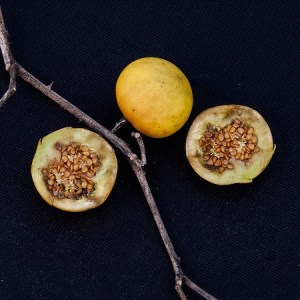
The berry opened (photo by JB)
Like Hercule Poirot, he first dismissed some red herrings, diseases and nutritional problems. Then he revealed the true culprit, in his words, “defoliation is in part a response to emanations of ethylene or a combination of ethylene and other unsaturated hydrocarbon gases from ripe fruits…”
OK then, ethylene functioning as a hormone induces leafdrop in a species closely related to Tropical Soda Apple. (In modern agriculture artificially applied ethylene defoliates crops for mechanical harvesting.) The phenomenon serves a positive purpose in Tropical Soda Apple by removing the thorny leaves while flashing the showy fruits. Here we have an apparent case of a pre-existing hormonal mechanism enhanced through eons of evolution to become a specific adaptation for seed-dispersal in TSA. Not bad for a debased weed!
 John Bradford
 George Rogers
 George Rogers
 Dee Staley
 Treasure Coast Natives