Helmet Skullcap
Scutellaria integrifolia
Lamiaceae
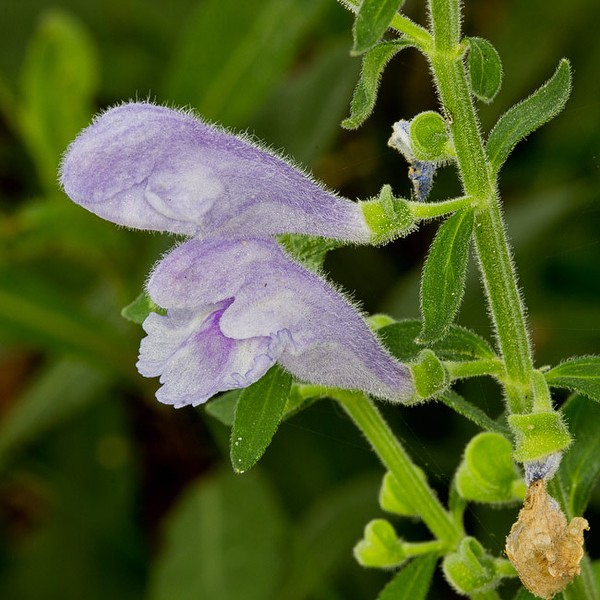
Skullcap 3/28. Today’s photos by John Bradford.
In Halpatioke Park in Stuart today (CLICK) John and George encountered a mighty fine mint, Helmet Skullcap, Scutellaria integrifolia. The species ranges from New England through Florida as one of 350 Skullcap species all over the world.
Try to find a genus more steeped in medicinal history, homeopathy, alternative remedies, herbal products, and expensive little bottles, right up to modern scientific medical research. Skullcaps have served against so many ailments in so many cultures for so many centuries to make a list is as pointless as listing awards won by Elizabeth Taylor. Just name your favorite malady. But maybe to curb the fervor for “ingest every wild plant,” Scutellaria extracts cause liver damage, impair membrane functions, and suppress enzymes.
Why name a pretty little wildflower Skullcap? That stems from the same source as the botanical name Scutellaria. Let me explain: The sepals in this and other mints are fused edge-to-edge to make a cup at the flower base. The proper name for the little cup is the calyx tube. In this useful link, the tube is labeled, “sepals fused.” CLICK
The defining feature of Scutellaria is that on the outer upper surface of those fused sepals (calyx tube) rises a bowl-shaped shield, or scute (plate). The scute often looks like a beanie, hence the plant name.
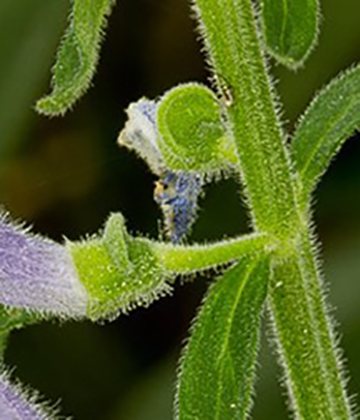
The scutes at the flower bases. Little green “beanies” jutting up from the green cup formed by the fused sepals, the calyx tube.
But why should that wacky scute exist? To answer that we need a little general background on the Mint Family flower and fruit structure. We’ve already met the fused sepals, the calyx tube. As the flower transitions from the flowering phase to the fruiting phase, the petals fall away, the calyx tube remains in place, its scute enlarges, and the fruits remain as four tiny dry “seeds” inside the calyx tube, which is usually more or less horizontal on the old flower spike. The sepal cup is spring-loaded at the base, so picture a nearly horizontal cup with four ping pong balls inside, attached to a vertical pole by a spring. When raindrops strike the scute on the top side of the tipped cup, let’s call it now a splash-cup, the falling drops bounce the cup. The bounce pops the “seeds” out for dispersal. That’s hydroballochory, dude. This link shows four seeds ready to bounce. CLICK
 John Bradford
 George Rogers
 George Rogers
 Dee Staley
 Treasure Coast Natives
