Yesterday John and George went wildflower-hunting in the Allapattah Flats Management Area in Martin County west of Palm City, and found bugs. Not just mosquitoes, but also good interesting types.
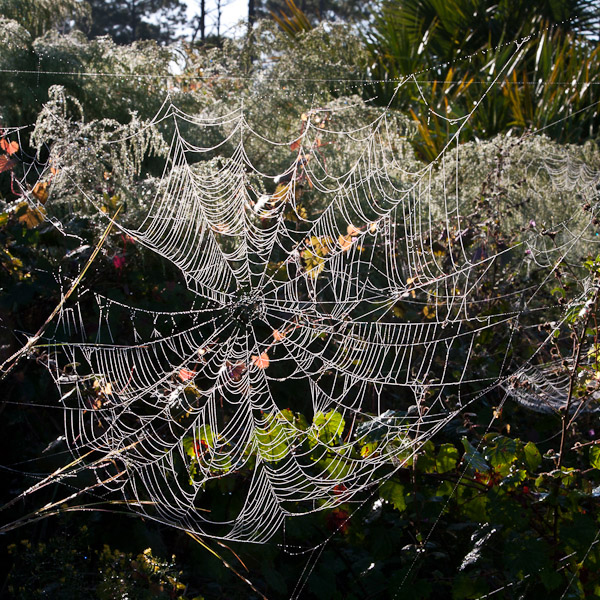
Web in the morning sun (by JB)
Although not arthropod experts, we can match pictures with the best of them, and our creature identifications come from highly scientific picture-book flipping. Do not bet excessively on them. We learned that the Female Golden Silk Orb Weaver Spider makes mighty strong silk (which we experienced), is larger than her puny male, and has only a minor bite (which we did not experience) despite her arachnophobia appearance.
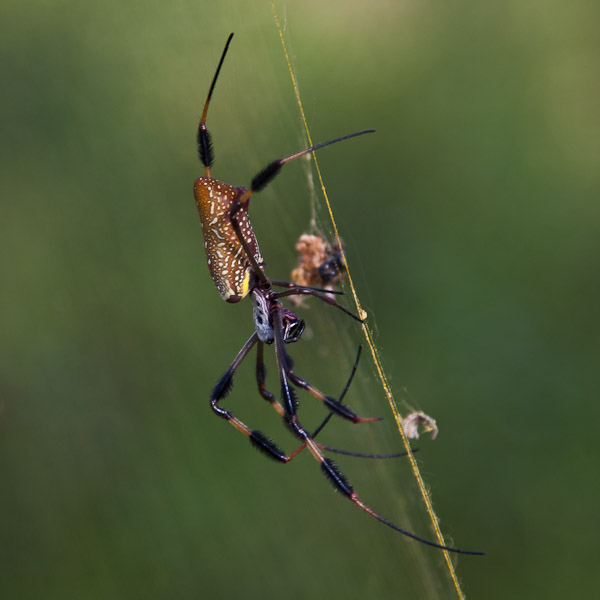
Female Golden Silk Orb Weaver (by JB)
We learned further that the Salt Marsh Moth Caterpillar may occupy Dogfennel (Eupatorium capillifolium) in abundance. It reportedly extracts toxic alkaloids from Eupatorium, one of its favorite host genera. (Eupatorium toxins killed Abraham Lincoln’s mother, although she probably did not eat caterpillars, and that topic is for another day.) The caterpillar wiggles nervously when approached, then drops abruptly from its branch in clear annoyance. How does the caterpillar scatter across a large meadow of Eupatorium? The species can wind-sail on a silky “parachute” when small, and when older they disperse overland.
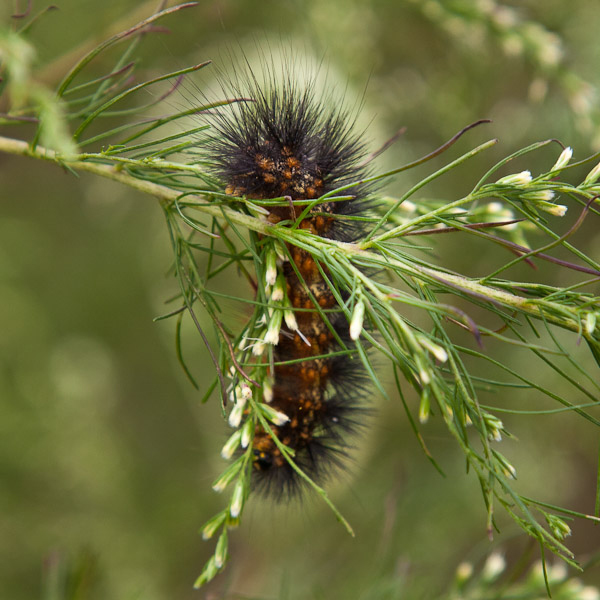
Salt Marsh Moth Caterpillar on Eupatorium before dropping (by JB)
The adult Salt Marsh Moth is white with dark spots, having some yellow coloration in the male. It is not particularly a salt marsh dweller.
Let’s get to a plant. One of the more striking species at Allapattah this week was White Pinebarren Aster (Oclemena reticulata, aka Aster reticulatus), a species distributed mostly to the north of our haunts, and not found much south of Lake Okeechobee. A quick look at the flowering dates on herbarium specimens shows most flowering is in the Spring or early Summer, then blossoms seem to wane in Summer, with a second blooming period in the Autumn.
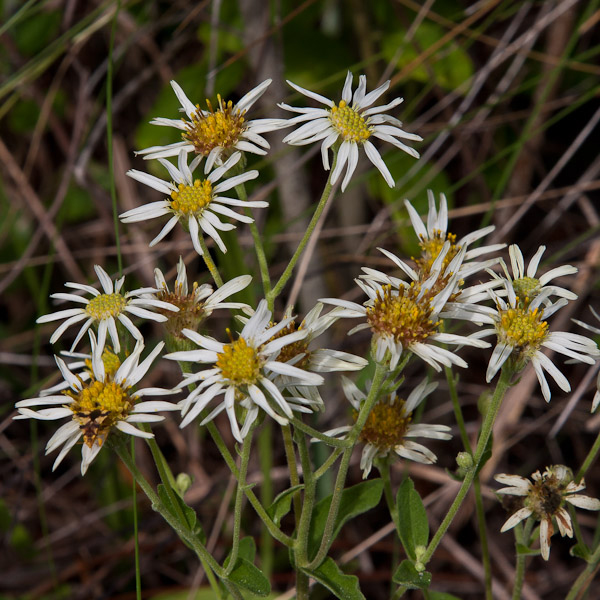
Oclemena, yellow phase (by JB)
Here is a perfect example of a species whose flowers change color, placing it in the company of Mahoe Hibiscus, Rangoon Creeper, other “Aster” species, and scores of additional examples in many families. Flower-color-changers seem typically to go from a light coloration, often yellow, to reddish.
This occurs in Oclemena in the disk flowers, the small flowers packed together at the center of this Composite flower head, that is, the eye changes from yellow to burgundy. This is not likely to be mere decline with age, but rather a signal to pollinators of a change in floral status. Many flowers signal reward availability to pollinators with changing color. That color change accompanies diminished pollen or nectar availability is well demonstrated. Moreover, presumably innate preference for “reward now” coloration occurs in bees, butterflies, and additional insects. Even more remarkable, researchers have trained butterflies to alter their behavior based on color in relation to rewards. Pavlov’s Swallowtails. Yellow is a pervasive bee-advertising color while reddish tones are not.
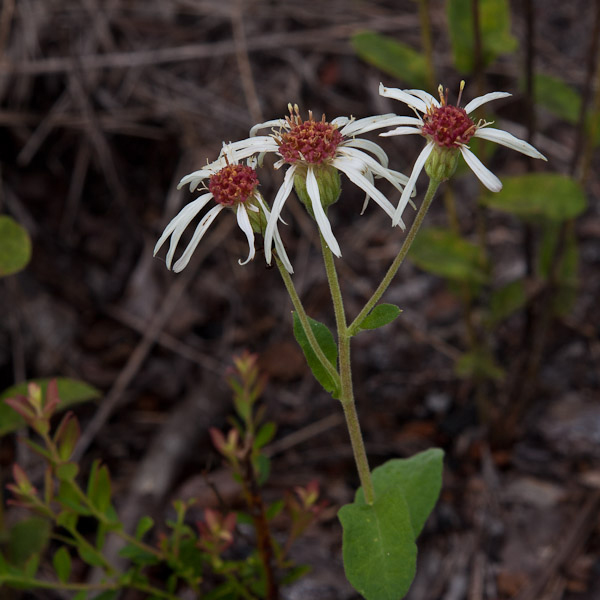
The "we're closed" phase (by JB)
 John Bradford
 George Rogers
 George Rogers
 Dee Staley
 Treasure Coast Natives