Cinchweed
Pectis glaucescens
Asteraceae
Friday John and George invaded the historic site of the demolished LORAN station at Jupiter Inlet, now known as Jupiter Inlet Natural Area, a beautiful and botanically rich scrub moonscape extending down from the sugar sand dunes to the Intracoastal Waterway, with the Jupiter Lighthouse rising above the distant trees. The best-smelling species in full bloom was the Willow-Bustic buzzing with bees. Its flowers are curious, but for another day. More subtle and underfoot, likewise in full bloom in a mat on the sand was Cinchweed, Pectis glaucescens, a curious tiny representative of the Aster Family. This little wildflower may tower to an inch tall with a golden flower head a quarter-inch in diameter.
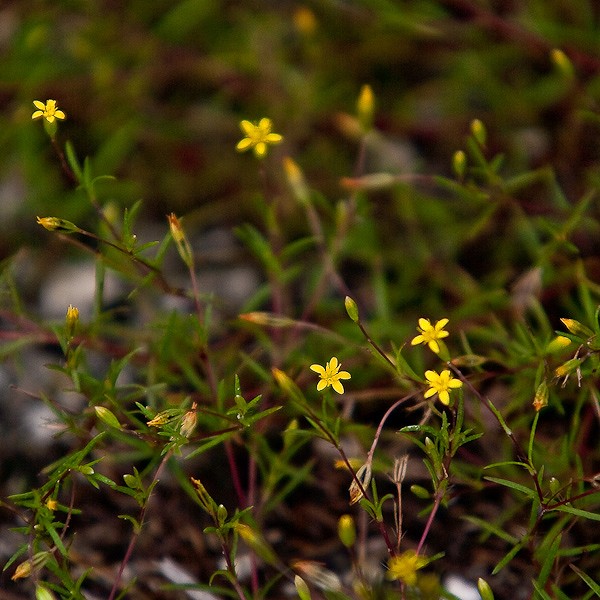
Pectis flowers (by JB)
When not in flower you might notice Pectis by its fragrance as you crush it underfoot, pungent and pleasant (to my nose). Some folks compare it to Citrus, although to me it smells like “Asteraceae.” Hold the leaves up to the light and see the oil glands big and translucent, in this way reminiscent of Citrus in appearance as well as aroma. In at least one species of Pectis the fragrant oils are apparently the same as those derived commercially from cumin, caraway, and dill seed, and thus of potential commercial interest. Anything that smelly has had medicinal uses, and Pectis has served against ailments ranging from fevers to eye ailment. They’ve also been used as food flavorings, and even as perfumes.
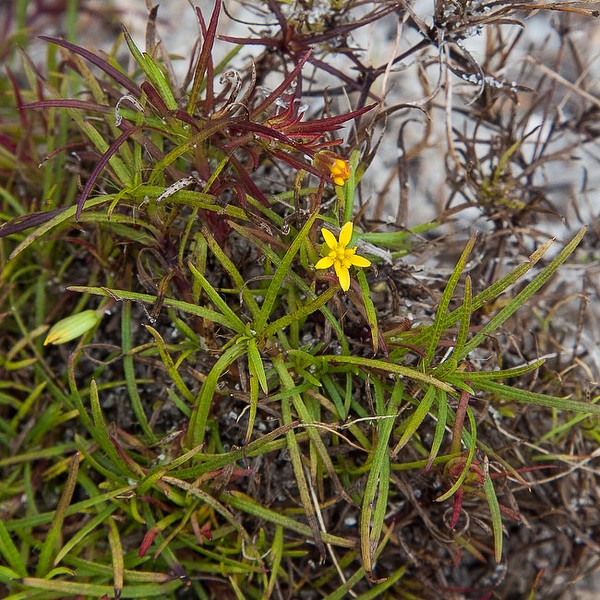
Pectis on the sand (by JB). See how the colony spreads.
The leaves give the genus its name, because they are “pectinate,” meaning resembling a comb, or a fish skeleton in outline. (Not always conspicuous on P. glaucescens.)
This sand-dweller has specializations worth mentioning. Certain plants of hot sunny places have what’s called “C4 Photosynthesis.” Setting the biochemical physiology aside, this is a mechanism with associated cellular anatomy to overcome photosynthetic impairment most plants suffer under hot conditions. Most C4 species are hot-climate grasses, such as Sugar Cane. The adaptation is uncommon in broadleaf plants, but here we have an example, encountered fittingly in hot sunbaked habitats. Some Pectis species live in deserts.
Uproot a Pectis mat and it has a curious structure, shaped like a big green tack. The top of the tack is the green spreading foliage mat almost flat against the sand. The pointy part of the tack is a single (or few) taproot(s) at the center of the mat and drilling down into the sand. The outer fringes of the mat spawn little satellite colonies able to root and take hold on their own. Clone-colonization is significant in the sterile Pectis Xfloridana mentioned below. Stay tuned a moment.
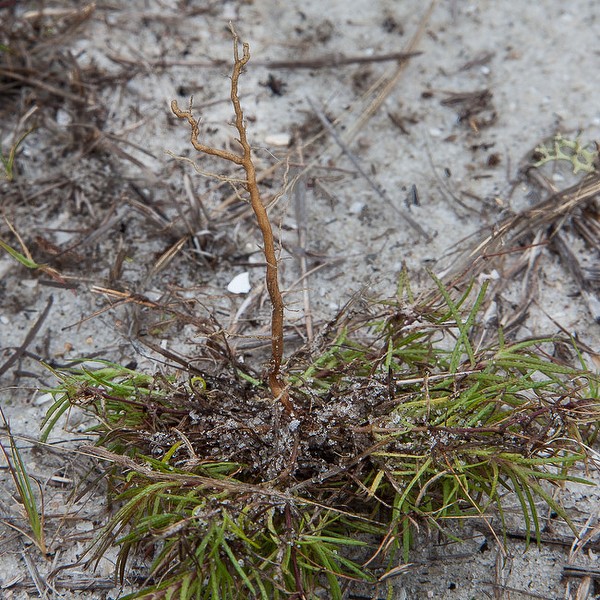
Upside down Pectis. Check out that taproot! (By JB)
Florida is home to multiple Pectis species, one of which has a special relationship with today’s Pectis. Pectis prostrata (flower heads not on a stalk, vs. the long stalk in P. glaucescens) hybridizes with P. glaucescens to make a sterile hybrid with abnormal chromosomes called Pectis Xfloridana. Pectis prostrata gets around, being an invasive weed in China.
 John Bradford
 George Rogers
 George Rogers
 Dee Staley
 Treasure Coast Natives