Commelina erecta
Commelinaceae
Yesterday John and George said phooey to 90 degrees and hoofed across the burning sands to warm up even more at a literally burning prescribed fire to examine the effect of heat stress on foliage (relevant to my plant physiology class), and to wonder how red widow spiders repopulate after fire. (The red widow is one of John’s “pet” projects.) It was hotter, spideryer, and smokier than Jerry Falwell’s preview for sinners.
I’ll bet Hell doesn’t have the super-cool blue blossoms of erect dayflower, so refreshing like a sky blue popsicle on a blazing July day.
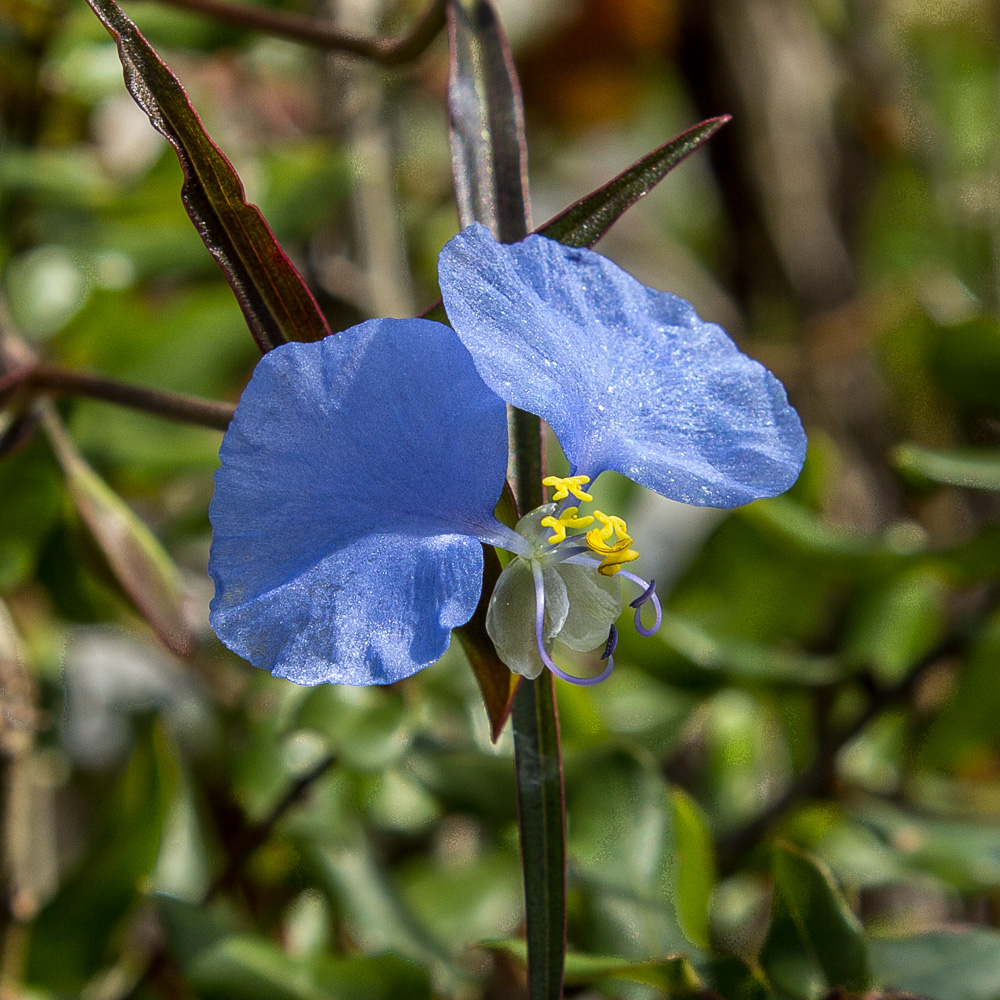
Commelina erecta yesterday. Note the abortive 3rd petal, and that half the stamens are pollen-making while the others are pollenless and bright yellow. (By John Bradford)
The Spiderwort Family, Commelinaceae (com-ah-lynn-ACE-ee-ee), combines the world’s most ephermal flowers with the world’s toughest foliage. Everybody encounters Commelinaceae. Gardeners know, for example, oyster plant (Tradescantia spathacea), basket plant (Callisia fragrans), and small leaf spiderwort (Tradescantia fluminensis). Persons concerned with invasive exotics know, for example, oyster plant (Tradescantia spathacea), basket plant (Callisia fragrans), and small leaf spiderwort (Tradescantia fluminensis).
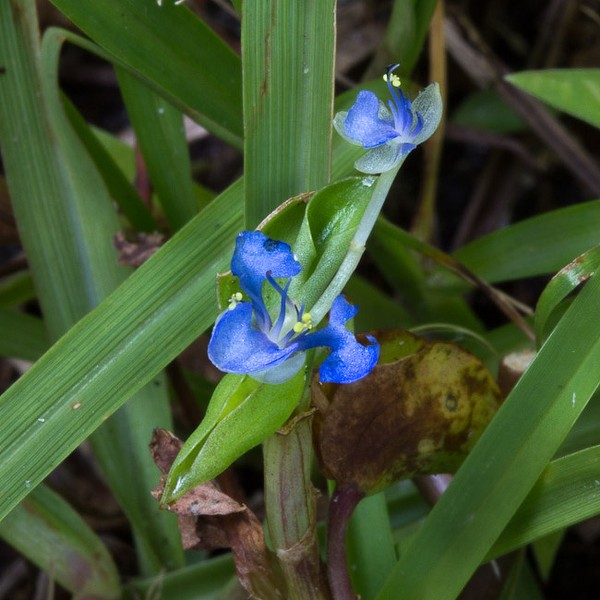
Commelina diffusa, superweed
Neglectful yard owners are intimate with spreading dayflower (Commelina diffusa), a worldwide weed with an impressive claim to fame, having evolved herbicide resistance in the 1950s before resistance was cool.
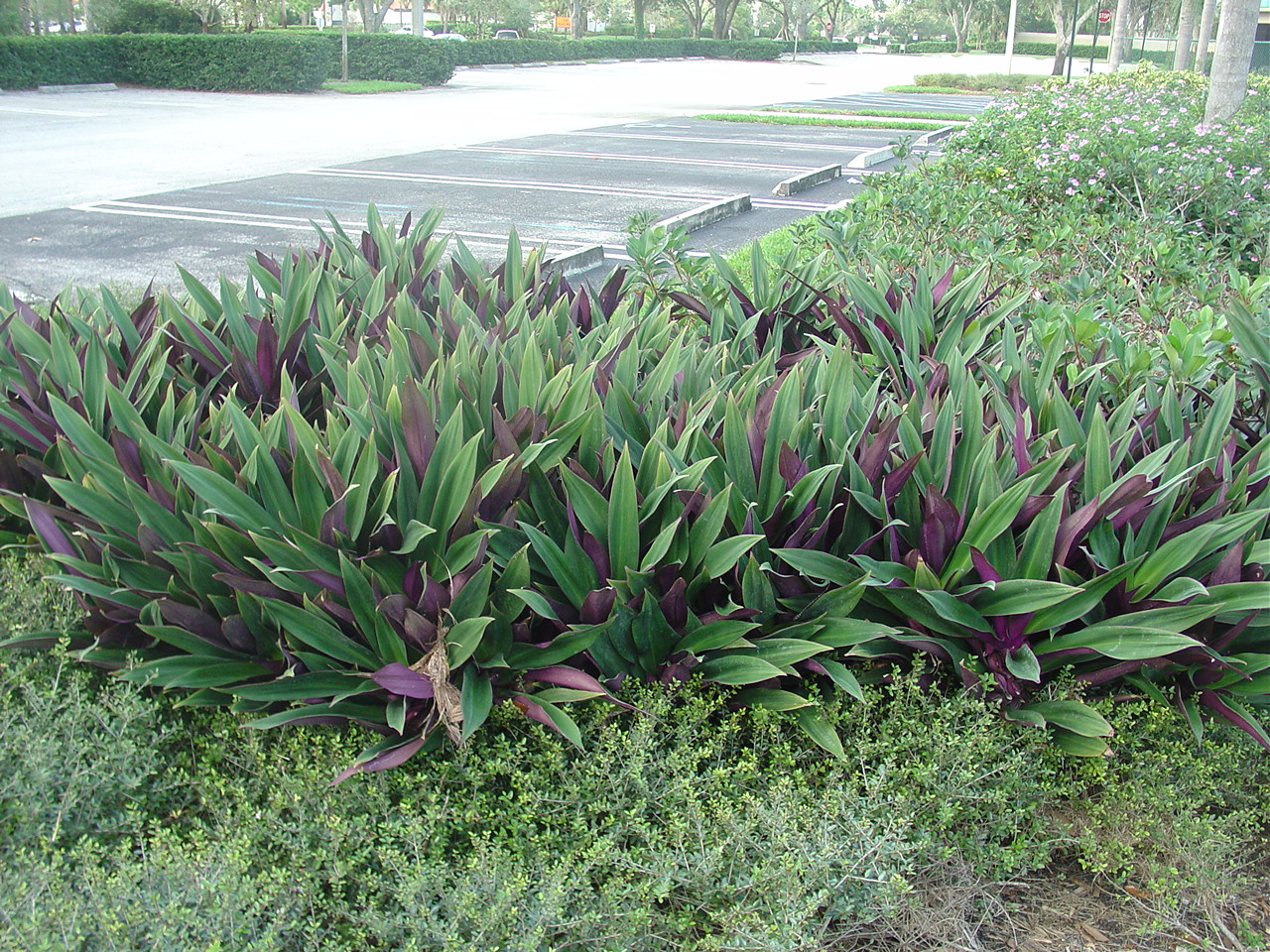
Oyster plant
Commelina brings us to yesterday’s item of beauty: erect dayflower. How many true blue wildflowers are there? Commelina demonstrates in multiple ways how things don’t always amount to their original potential, beginning with the genus name itself. The genus is named for a Dutch family of the late 1600s and early 1700s, Jan and Caspar Commelin were prominent botanists, but Caspar’s son died young. Most Commelina species have two large petals representing Jan and Caspar. The third petal is usually abortive, standing for the son’s premature death.
The third petal is not the only abortive organ. Although you’ll never notice it, Commelinas fundamentally have two inflorescences per stem, but one often fails to mature, it is “vestigial,” that is, left over and no longer amounting to anything, like my appendix and canine teeth.
To keep going with lost functions, Commelina has six stamens but only two make pollen. The others quit making pollen, and became bright yellow flags attractive to pollinators. Among these, one is larger than the others and even seems (?) maybe to make a little pollen.
Growing among the erect dayflowers yesterday was another species with its own odd vestigial parts. Cacti evolved from “normal” leafy plants. They still carry genes for making leaves. The leaf-making genes are usually suppressed. But not 100%. As prickly pear stems first emerge, they have cute little leaves on them, soon to fall off leaving behind the familiar prickly pads.
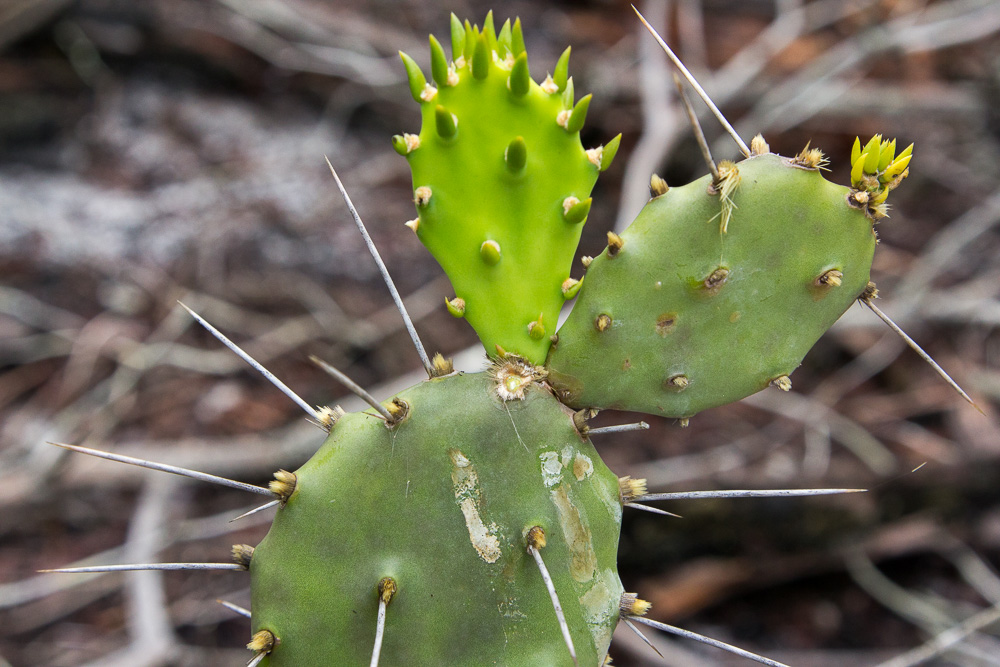
Prickly pear with leaves (by JB)
Now back to Commelina. This week my biology teacher wife Donna shared with me an internet report (there exist several) showing purportedly mutated flowers from the Fukushima nuclear disaster. (Yes, we all know there could be other explanations, so please no condescending e-mails pointing out alternative possibilities.)
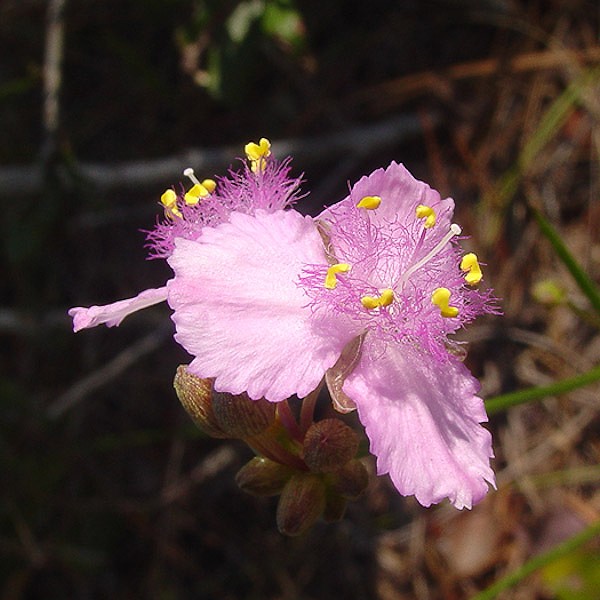
Roseling (Callisia ornata) showing delicate Commelinaceae radiation-sensitive hairs (by John Bradford)
How does this tie to Commelina? The name “dayflower” comes from the ability of the flowers in Commelinaceae to turn to mush at the end of the day interpretably as an adaptation to recover nutrients if pollination fails. Perhaps the most delicate part of Commelina and other Commelinaceae flowers is a tuft of ultra-fine hairs on the stamens. The hairs are so fragile they mutate especially readily, sometimes visibly to the naked eye, with low radiation exposure. The mutating hairs helped monitor radiation following the Chernobyl and Fukushima disasters. I wonder if a few dayflowers in the gardens around town near a power plant work as a cheap early warning system. Or maybe try a Geiger-tree.

 John Bradford
 George Rogers
 George Rogers
 Dee Staley
 Treasure Coast Natives