Rare treat today. John, Dee Staley, and I joined the Friday tour of Barley Barber Swamp near Indiantown, Florida, led by Treasured Lands Foundation Director Chuck Barrowclough. So much to see and learn there, from an ultra-modern solar-gas power plant to an ultra-ancient Seminole fish-catching canal.
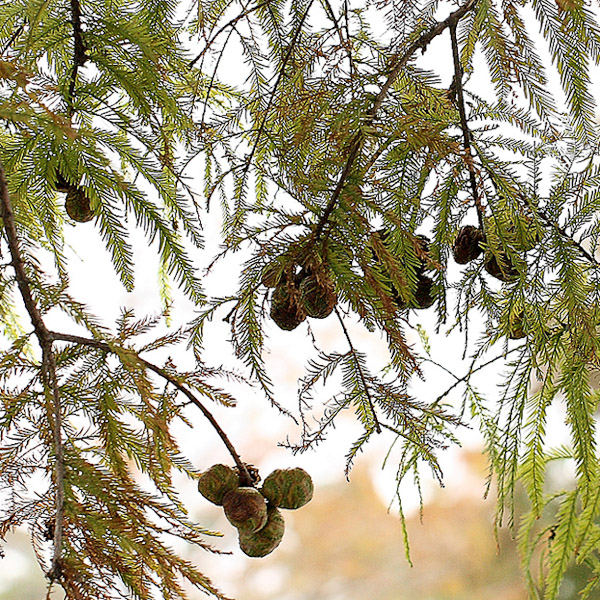
Cypress cones, by John Bradford.
Anyone can register for a tour through the Foundation’s web site, then don’t skip the best lunch in town at the historic Seminole Inn in Indiantown, former equestrian home of Davy Jones of the Monkees.
The swamp has unique attributes:
- It occupies a specially preserved peninsula jutting into the immense cooling pond for the Florida Power and Light Martin Power Plant, where they prefer solar by day and natural gas by night.
- There is a U-shaped Seminole “mound” apparently constructed to detain fluctuating waters from Lake Okeechobee, trapping the seafood catch of the day.
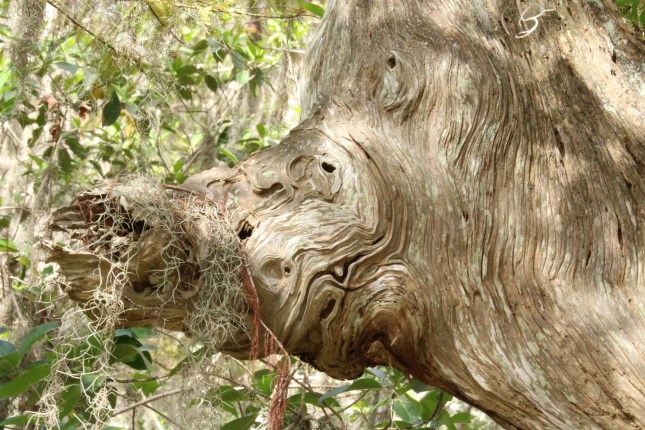
- Some Bald Cypress trees there are 700-1000 years old. I looked up other things dating back so far. Such as, about that time the Byzantines did not get along with Bulgarians, so they blinded 24,000 of them.
Being a blog on native plants the responsible Barley Barber Swamp subject is Bald Cypress, famous for those conical woody knees poking up from the mud. Because the knees already have a history in the blog, they get only a short review now, with details here.
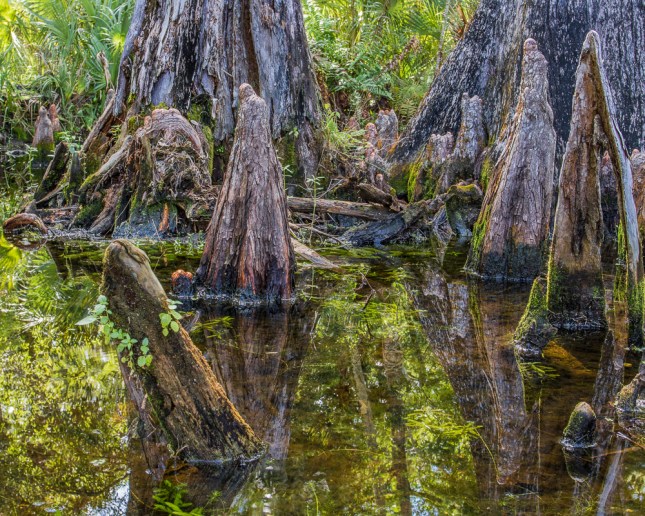
The tree’s knees, by John Bradford.
I do not believe Cypress knees to have anything to do with serving as air snorkels to aerate the roots, or for propping up the trees. I believe their actual function is boringly obvious, that these root outgrowths rise above suffocating water and mud to permit the basic metabolism required to pump sugars, not air (there are no air canals), outward into the underwater roots. Sort of like the pumping stations situated serially aboveground to propel buried sewage lines. All tree roots metabolize and pump sugars, but those in better circumstances do not have to come up for air. Well, that’s how I see it.
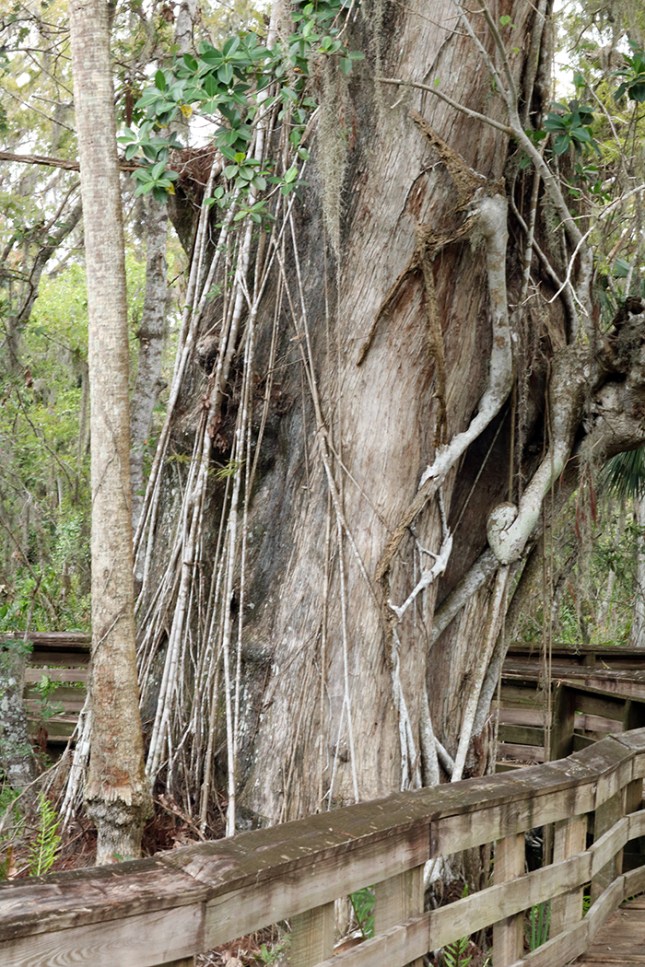
Around 800 years old.
So then a new topic for tonight. I encountered “pecky cypress” several years ago, not in a biological context, but rather decoratively. Today its biology stared us in the face. Pecky cypress wood is riddled with isolated vertically elongate cavities.
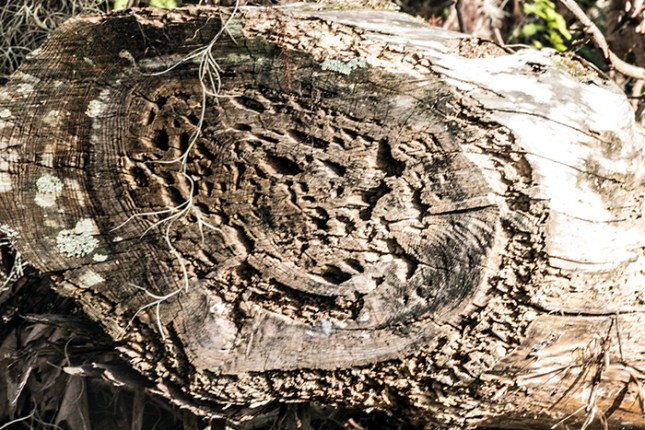
Pecky cypress in the swamp.
The cavities are the work of wood-rotting shelf fungi, probably best referred to as Laurilia taxodii (Stereum taxodi). Their identity, classification, and nomenclature is a tangled web beyond the scope of tonight’s good times. More interesting than their classification is a glaring matter of decay:
Why does the fungus not decompose the wood evenly? It carves well defined scattered hollows leaving the wood between strong, healthy, and uninfected. Not a new question. Back in 1900, before the Wright Brothers, botanist Hermann von Schrenk in St. Louis probed the question for 54 pages in painful anatomical detail. Anyone reading this would quickly dismiss the notion held by some that the tree and fungus have a symbiotic relationship where the fungus provides water-storage pecky chambers. There is nothing in von Schrenk’s research, or any clear basis in plant anatomy or physiology for that.
Instead, Hermann found something more remarkable, which it would be a joy to see re-examined with modern techniques. To make a long investigation short, he found the cavities free of water and to contain brownish dusty material resembling humus in the soil. By this he meant dark-colored organic acid compounds, not the compost many gardeners refer to as “humus.” Noting that humus can prevent decay, and citing human remains mummified for centuries in it, von Schrenk thought the fungus transforms wood to humus-like material that coats and kills the fungal strands, thus stopping the infection before it expands far. The decay holes remain small because they spawn their own termination.
Who knows, and this is utter unabashed speculation, maybe the tree benefits from the peckiness because it lightens the weight of a thousand-year-old top-heavy shallow-rooted giant whose biggest risk to life and limb is toppling.
 John Bradford
 George Rogers
 George Rogers
 Dee Staley
 Treasure Coast Natives
