Commelina erecta, C. diffusa
Commelinaceae
Today’s trip to Jonathon Dickinson State Park by John and George was to hear Ranger Barry Richardson recount the first life of the park as U.S. Army Camp Murphy around 1942-43. CLICK The camp is lost and almost gone, with some leavings left to encounter. CLICK CAREFULLY
While Ranger Richardson described personnel assigned here from the north, I wondered if any military nature-buffs noticed the unique flora. The answer came forth when we heard about recruits on their tender bellies under machine gun bullets discovering sand spurs in their navels. Maybe some also enjoyed little blue wildflowers with the scent of gunsmoke…dayflowers to brighten the outing.
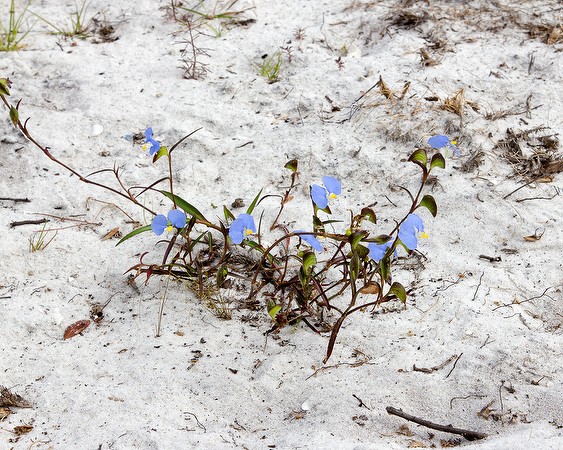
Observed while dodging hot lead. All photos today by John Bradford.
We have two locally, the non-native Commelina diffusa (all three petals blue), and the native Commelina erecta (one petal white). (Also lurking about, C. gambiae from Africa has all petals white.) Additional native and non-native species live elsewhere in Florida.
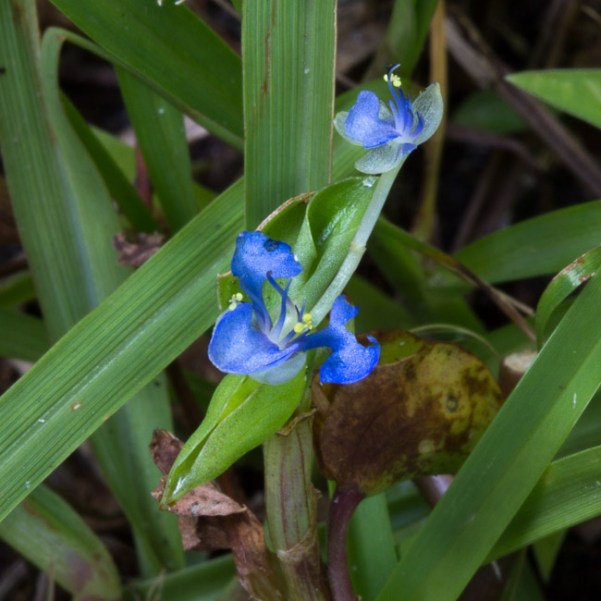
C. diffusa
Dayflowers are known for many wonderful things. Such as:
- How Commelina got its name. Linnaeus named the genus for the prominent Dutch botanists Jan and Kaspar Commelijn represented as the two prominent petals, the abbreviated third petal representing a third Commelijn who died young.
- Skyblue petals give blue dyes, once useful for paper and printing.
- False advertising. There are two types of anthers, bright yellow ones to attract pollinating bees despite having no real pollen, and smaller less conspicuous anthers to dust pollen onto the bees preoccupied with the exciting yellow anthers.
- Big easily observed stomates. Wig wup…right? Well if any reader teaches biology and needs to demonstrate stomates, this plant probably grows near the back door.
- Day-flowers. The flowers open and self-destruct, all in a day, to be replaced tomorrow by another blue blossom.
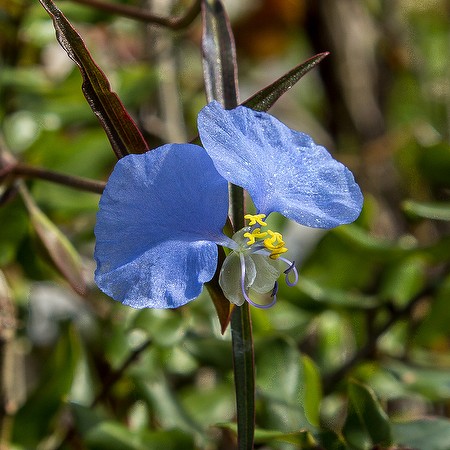
Big yellow come-on anthers, above small purple business anthers.
They don’t call it dayflower for nothing!. CLICK
That brings us back to Linnaeus in a different connection: He created a floral clock. Few species flower like “clockwork. Let’s say you take a 4-pm bloomer from Linnaeus’s clock to Boston, what time does it flower there? I don’t know—not 4 pm Sweden time. Flowering time is context-specific, responding to different combinations of internal rhythm, light and dark, night length, temperature, water relations, relative humidity (rare), hormonal status, and more.
When a flower opens at 11 AM, can we say “this flower is wired to open 5 hours after dawn” or is it merely responding to a set of conditions happening around 11 am, say a threshold light intensity or temperature? Most research seems to show light and temperature as the main factors beyond built-in rhythms.
All that said, dandelions on our campus seem simple: open when warm and bright, otherwise closed. The Portulaca pilosa in a pot on my patio opens briefly when the sun shines and closes upon shading (or in response to heat?), its fleeting flirtation behind the name Kiss-Me-Quick. Also on the porch is the Yellow-Alder (Turnera ulmifolia). It opens some days with a known contingency: daytime flowering depends on the length of the prior night.
Certain species open some flowers while others await their moment in reserve. A local example is Sacramento Burrbark, Triumfetta semitriloba. It can have some flowers open freshly all day long.
It is useful to recognize flowers that open/close just once with overnight replacement, as opposed to those with same-flower encores. Species where the same blossoms open and close repeatedly include Bluets (Houstonia, Hedyotis), Cacti, Mentzelia, Oxalis, Poppy-Mallows (Callirhoe), some Portulacas, some Water-Lilies, and diverse Asteraceae.
Watch closely this Oxalis time-lapsed over three nights. The same flowers open and close, out of sync with the leaves. CLICK
Many ephemeral flowers, by contrast, are replaced the next morning by identical blossoms. Here is Puncture-Vine caught in the overnight flower replacement act. CLICK
As many (most?) flowers fade, the plant takes back nutrients. That is why cut flowers can last longer in a vase freed of the parent-plant’s back-pumping nutrients from aging blossoms.
Perhaps a little different in behavior is Mexican-Clover carpeting the ground in pink blooms by day with each blossom dropping to earth by night. Ashes to ashes dust to dust. Not lost altogether though, upon decay they must recycle their nutrients back into their mother plant? Not studied. Maybe all those falling flowers are allelopathic, suppressing competition, or maybe they somehow improve the soil for Mexican-Clover seedlings. Just idle speculation.
The main reasons for intricately controlled openings and closings are easy to fathom, presumably to be open for business when conditions are healthy and the correct pollinators are active (or were active in the place and time the species evolved). A flower when not in service these need protection. Wet flowers have trouble from rain and dew. Many stay are clenched during the early morning dew hours, and night flowers may close before dawn for the same reason. Once a flower is pollinated, it no longer needs to stay open, giving cases of pollination prompting closure.
Flipping that statement around, flower closure can cause pollination. A lot of flowers have a self-pollination “Plan-B” in case the birds and the bees fail. Their closure forces pollen-making anthers, or petals with pollen on them, against the pollen-receiving stigma.
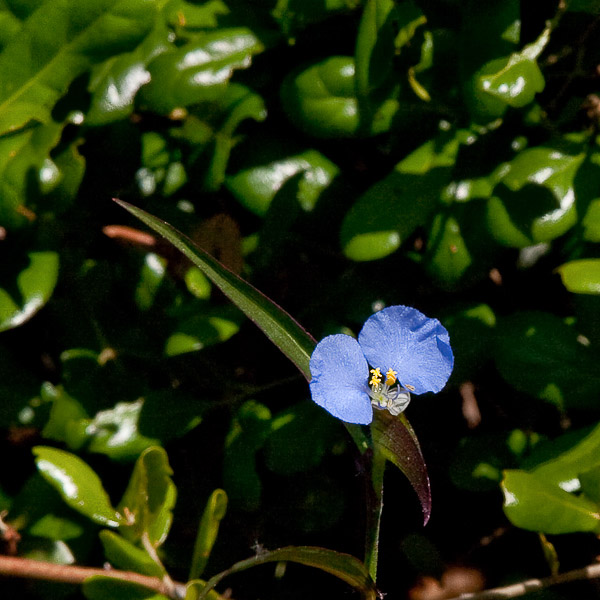
What does Dayflower have in common with Camp Murphy?
 John Bradford
 George Rogers
 George Rogers
 Dee Staley
 Treasure Coast Natives