Sea Blite
Suaeda linearis
Amaranthaceae (Chenopodiaceae)
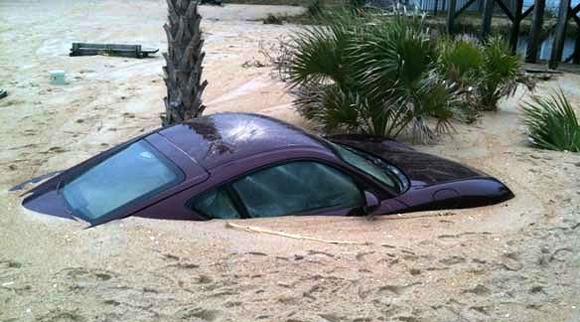
John, I TOLD you to turn right.
Yesterday John and George mired the car hopelessly in the seaside sand lost in the remote reaches of the Hobe Sound National Refuge, all in a day’s work for fearless adventurers. It happened right as I said, “that sand looks firm.” We became stranded castaways deep in a mangrove jungle unvisited by humans since Jonathan Dickinson. While we stressed over who might find our buzzard-picked remains, we kept our spirits up by exploring the salty-marly mangrove lowland behind the dunes and singing marching songs from the Boer War. We looked for esculent native plants to mitigate our stranded plight. There wasn’t much to hunt and gather, but Black Mangrove was lovely in flower, and no, that wasn’t a skunk, it was White Stopper.
Our destitution gave us time to ponder convergent evolution. (That is when unrelated species develop similarities due to similar adaptations. Sharks and Porpoises are not related but they look similar.) We saw no sharks nor porpoises, but we did see how salty-place plants have a convergent tendency toward succulent leaves that look like fingers. The fat-finger-foliage species include Batis maritima (Saltwort, Batidaceae), Salsola kali (Amaranthaceae), Sesuvium portulacastrum (Sea-Purslane, Aizoaceae), Salicornia bigelovii (Glasswort, Amaranthaceae), and Suaeda linearis (Sea Blite, Amaranthaceae).
Yes, the foliar similarities can confuse identification. And yes, they confuse common names. The common names for these species are intertwined and contrived. For example, Batis maritima and Salsola kali (and undoubtedly others) get called “Saltwort,” hence the silly misleading name “Russian Thistle” to differentiate Salsola. My personal outlook—never get too fixated on the English names for non-prominent plants.
The main succulent finger species yesterday was Suaeda linearis, representing the mostly saline genus Suaeda which has over 100 species. As is often true of coastal species, the distribution is wider than you think. Suaeda linearis extends from Maine to Mexico and southward. Such species keep us from getting too hung up on latitude.
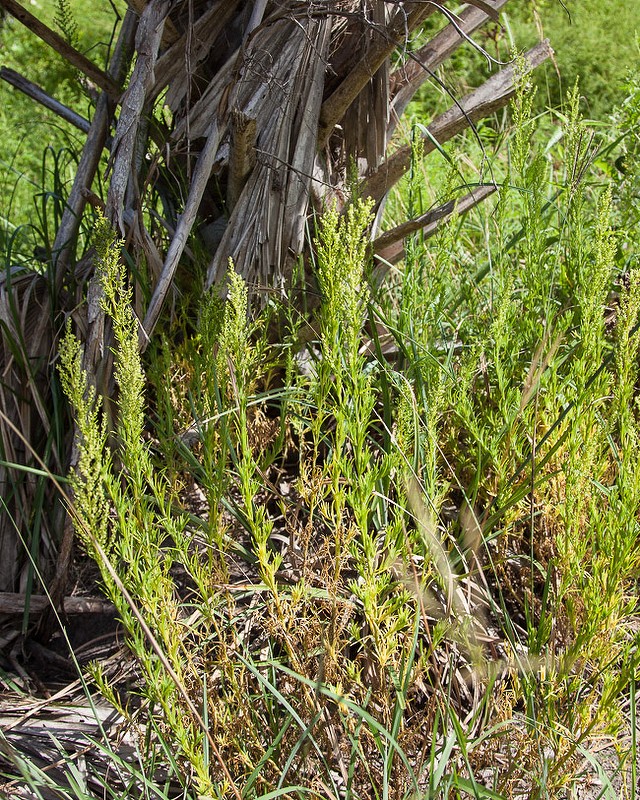
Suaeda linearis (JB)
Suaedas inhabit saline desert areas in North Africa, where Beduins burn the foliage to obtain soda-ash (sodium carbonate) for laundering, dying clothing, and fine-tuning the pH in their pools. And speaking of burning Suaeda, North Africans burn the plants also to generate smoke for asthma relief. Suaeda is an ancient Arabic name.
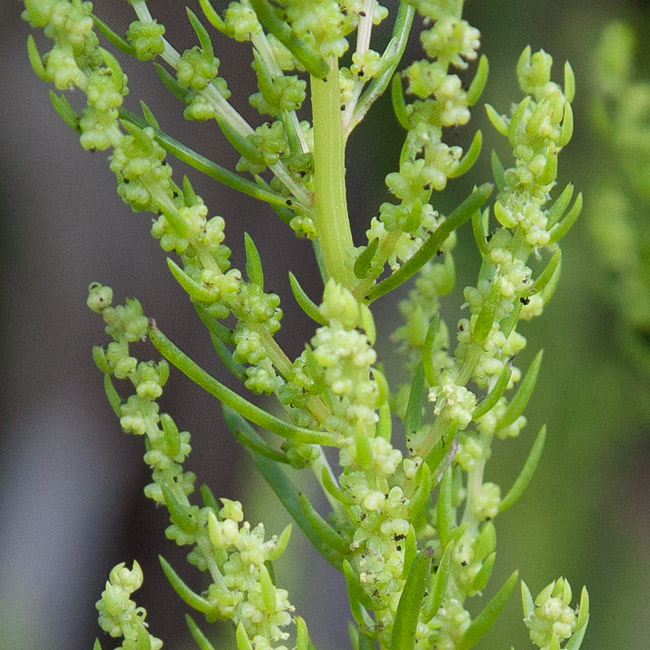
Close-up (JB)
Closer to home, Native North Americans appreciated the seeds as a staple grain, which was a comfort to John and me as we despaired of rescue yesterday. As we roasted fiddler crabs on burning Suaeda and tried to invent a solar desalination still using our shoes, John suddenly remembered we had cell phones. The miracle of Verizon brought a nice man named Bill with a big truck to yank us out of our sandy Hell to explore and blog another day.
[Note—that isn’t really John’s car. His car isn’t that cool. But we did get quagmired and rescued deep in the jungle.]
 John Bradford
 George Rogers
 George Rogers
 Dee Staley
 Treasure Coast Natives