RSS

Mighty Oaks from Little Toxic Acorns Grow

Quercus virginiana

Fagaceae
quercus virginiana 1

Live Oak by John Bradford

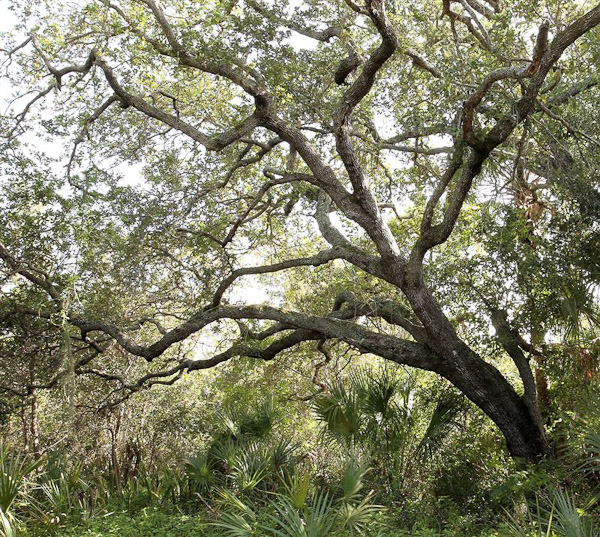
Today John and George explored Halpatioke Park along the South Fork of the St. Lucie River.  We experienced botanico-diversity, witnessing mighty Live Oak Trees supporting a dozen species of epiphytes from liverworts to orchids, mostly southern needleleaf bromeliads.   Nothing like mighty oaks to get a person thinking about little acorns.   Today’s blog required collusion.  Doing much of the research, John started it.  Or to step back further, Dee (see the blog authorship) was the ringleader.  Dee studies Scrub Jays.  Scrub Jays fancy acorns.  Dee and John started looking into acorn species preferences among the jays.   They’re the brains of this oaky operation.

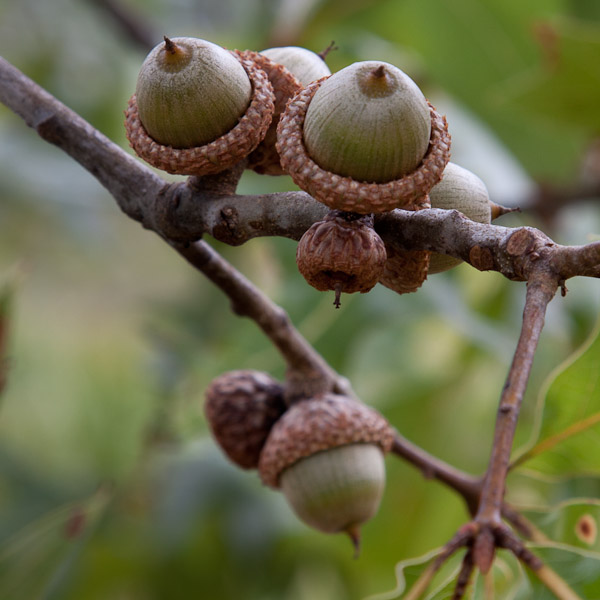
An acorn is a wonderful little space capsule for an oak embryo.  Hard on the outside, loaded with food on the inside, and with self-defense.  It is the oak fruit, containing one lonesome seed.   The cute little cap is a cluster of tiny modified leaves, bracts,  not part of the fruit.
quercus laevis 4

Acorns by JB. The cap is a leaf cluster.  The pointy tip is the style from the female flower whose ovary became the the acorn.

Acorns are loaded with nutrition appreciated by weevils, by birds especially jays, and by rodents, especially squirrels.    Weevils alone can destroy a substantial portion of an acorn crop.   Jays and squirrels feast on acorns, but there’s a tradeoff, the animals disperse surviving acorns in the process.

If everybody wants to eat you, you need protection.  The main anti-nibbling ingredient in acorns is tannin, as in tan your hide.   Tannins bind up the salivary proteins in the mouth and digestive systems of herbivores and they suppress microbes.   We exploit that ability to preserve leather.

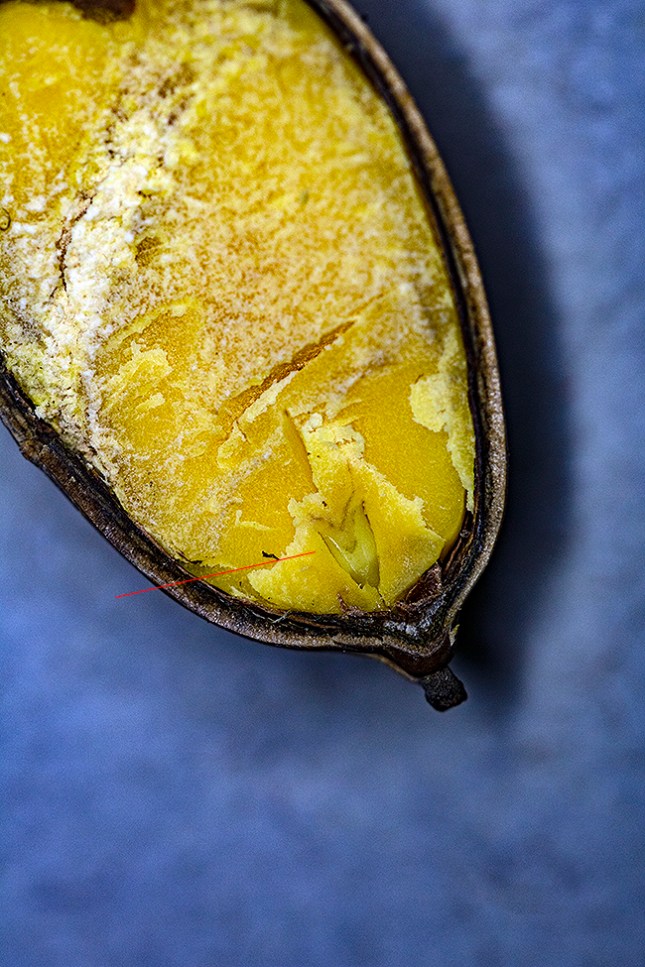
The interesting thing John and Dee discovered is that tannin distribution is not even throughout the acorn,   especially in the Red Oak Group, defined below.   The critical vital portion of the embryo is toward the acorn’s pointy tip where the acorn concentrates tannins.    The more expendable portion is the cap end.    Creatures eating such acorns tend to reject, relocate, and maybe even bury, the nasty part which retains the ability to sprout.
quercus virginiana radicle

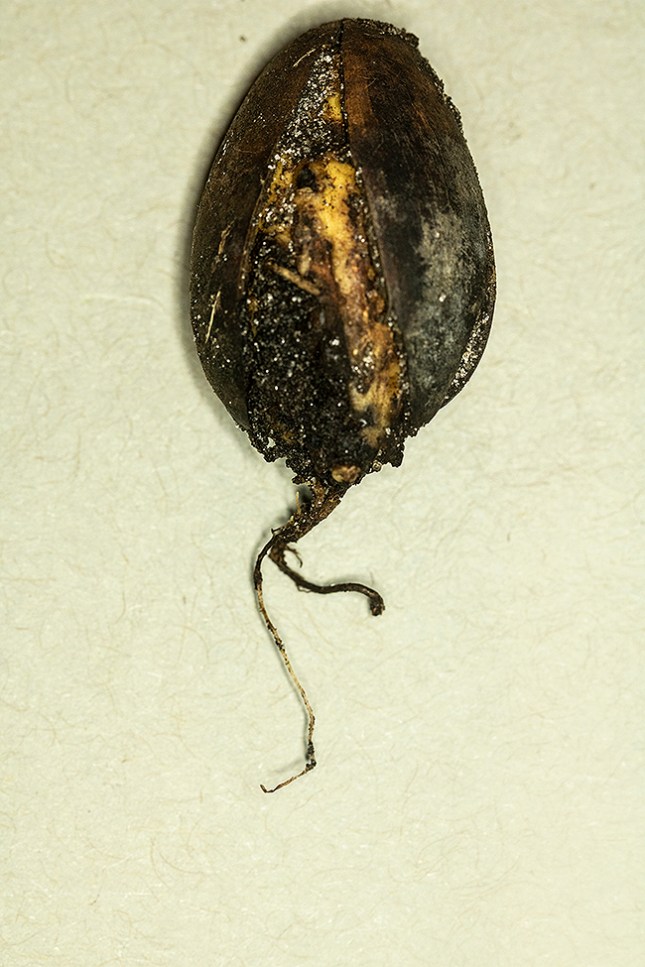
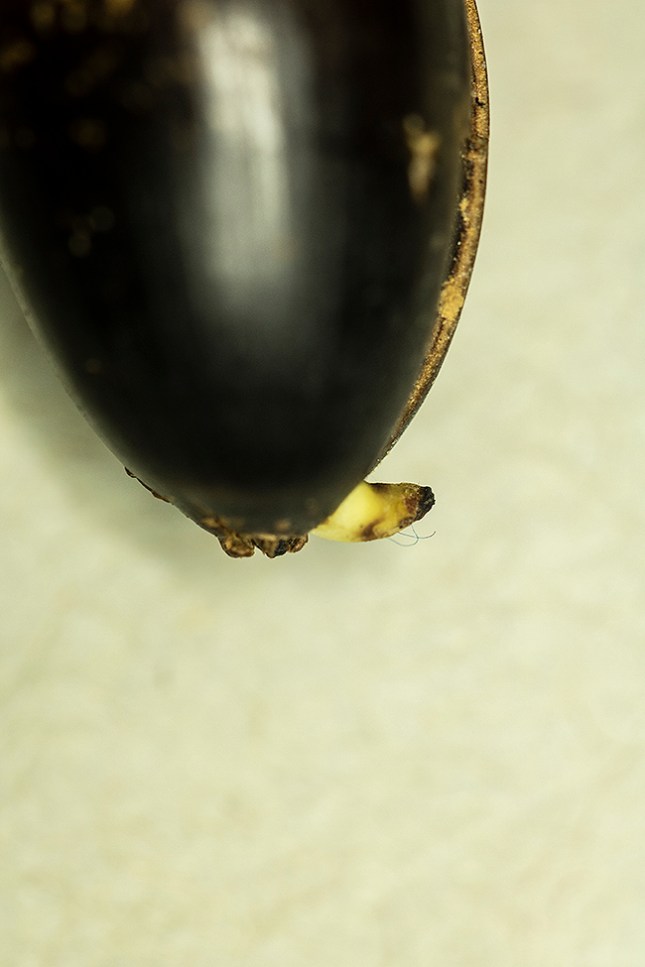
The vital part of the embryo is toward the pointy tip.  In this photo see the base of the embryo, the future root, near the acorn tip.  It will pop forth soon, as shown in the following three photos.
quercus virginiana first peek

Peek-a-boo

quercus virginiana half inch root

quercus virginiana cracked and large root

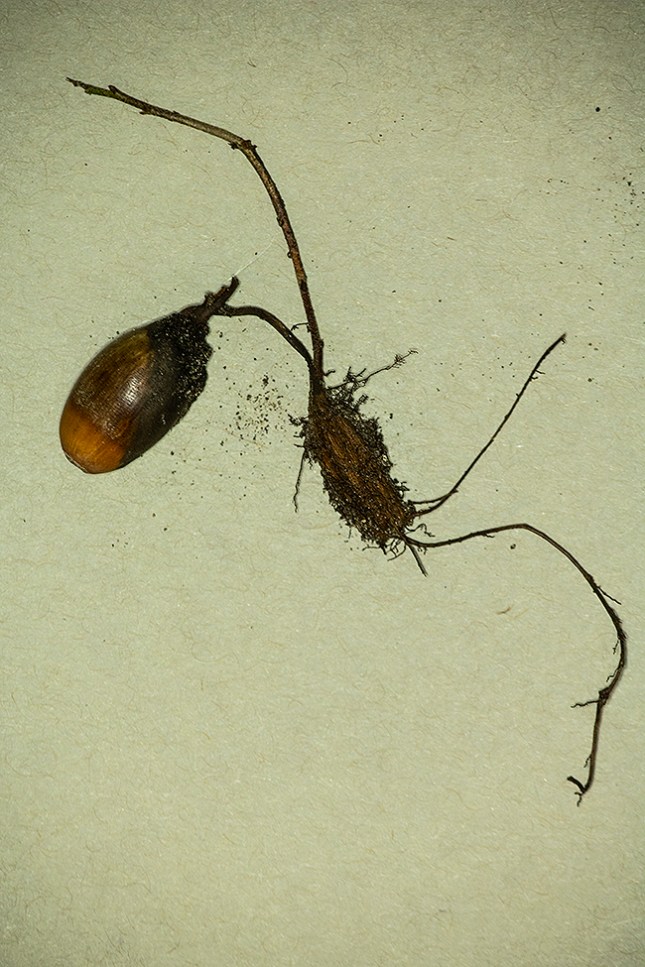
As germination progresses, the young root headed down and the young shoot headed up become displaced from the acorn with the food-rich seed leaves (cotyledons) remaining inside the acorn and continuing to feed the baby, as visible below.
quercus virginiana with corm

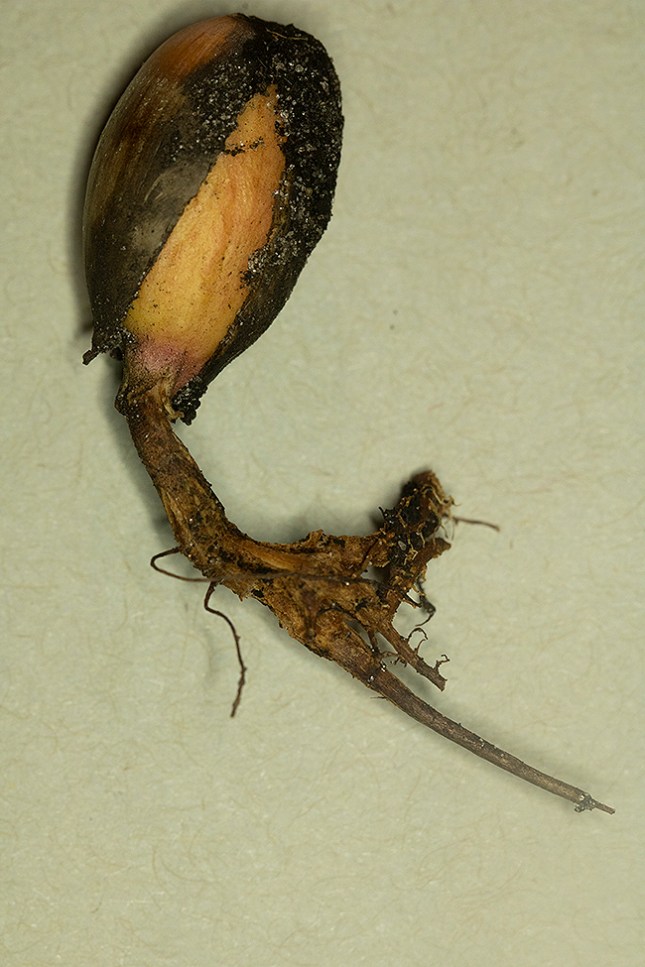
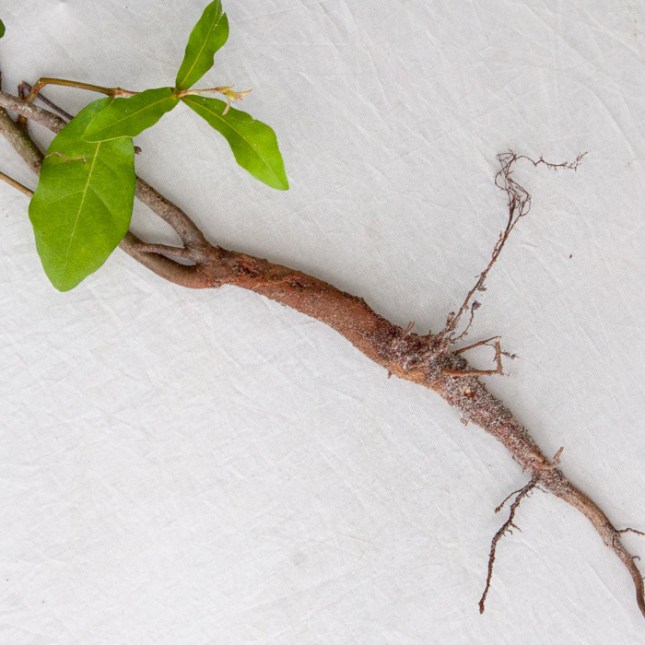
The acorn with the cotyledons inside is to the left.  The young shoot rises toward the top left corner.  The young root in Live Oak develops a thickening, pointing to the lower right, presumably protecting the young tree from fire or other aboveground peril.
quercus tuber 1

Much later, the root thickening enlarged. By JB.

Tannin is not evenly distributed among species.   The species in the Red Oak Group, locally including Myrtle Oak and Sandhill Oak, tend to have especially bitter acorns especially repugnant to distributors yet more likely to be only partially eaten non-fatally.   When animals bury acorns they are more often from the Red Oak Group.   Such acorns surviving storage are effectively relocated and planted.   They correspondingly tend to be slow to germinate.   Scrub Jays reportedly prefer such high-tannin acorns for caching, spotting them because they have less insect damage than the low-tannin alternatives.

The White Oak Group, including today’s Live Oaks as well as Chapman’s Oak and Sand Live Oak, tend  to have more-edible acorns probably more attractive to distributors yet also more susceptible to destruction.  These acorns tend to be dispersed less than the Red Oak acorns, staying nearer the parent tree, and germinating quickly.  Some years, mast years, the trees make acorns in such massive quantities that overmatch the nibblers.

Low tannin is why deer and humans prefer White Oak acorns.  Don’t try it.  Tannins are bad for you, and who knows what else is present.  Yet if you belonged to any of many acorn-eating cultures around the world you might have enjoyed acorns most often ground to flour, leached, and made into mushes, porridges, cakes, and breads.
quercus germinata 3

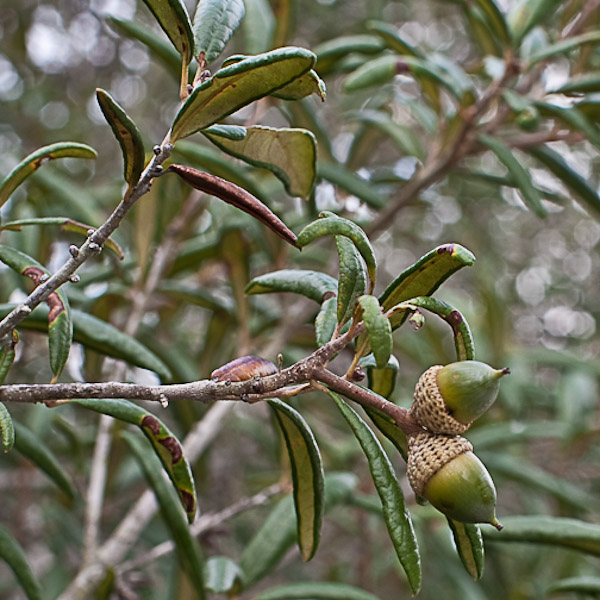
Quercus geminata…the twins as in Gemini.  By JB.

Dig deeper:

https://www.sciencedaily.com/releases/1998/11/981126102802.htm


3 Comments

Posted by on January 25, 2019 in Acorns, Uncategorized


Why Does the Slash Pine Prune Itself?

Pinus elliottii

Pinaceae

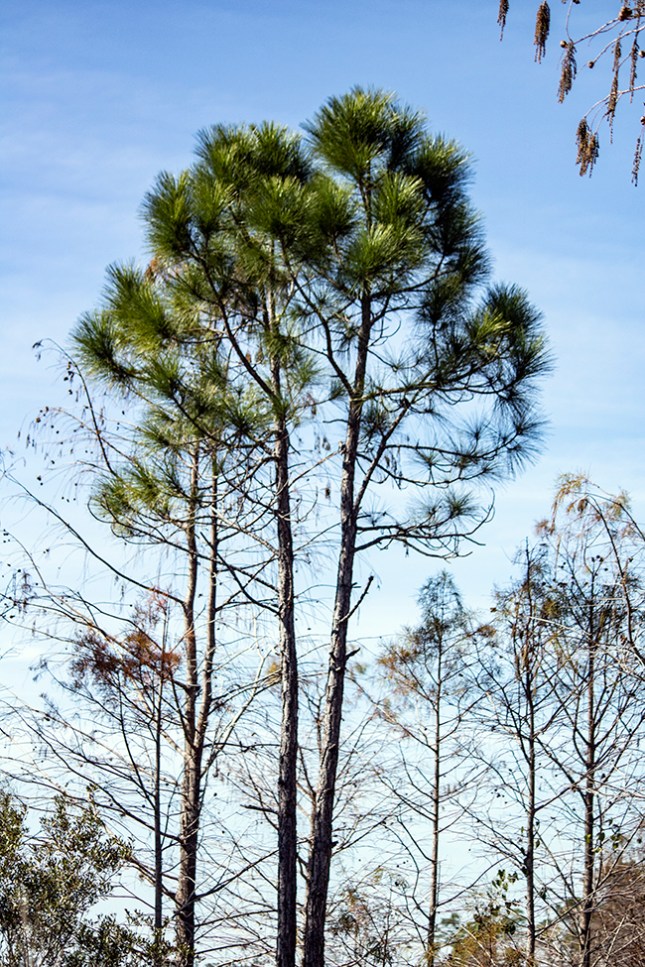
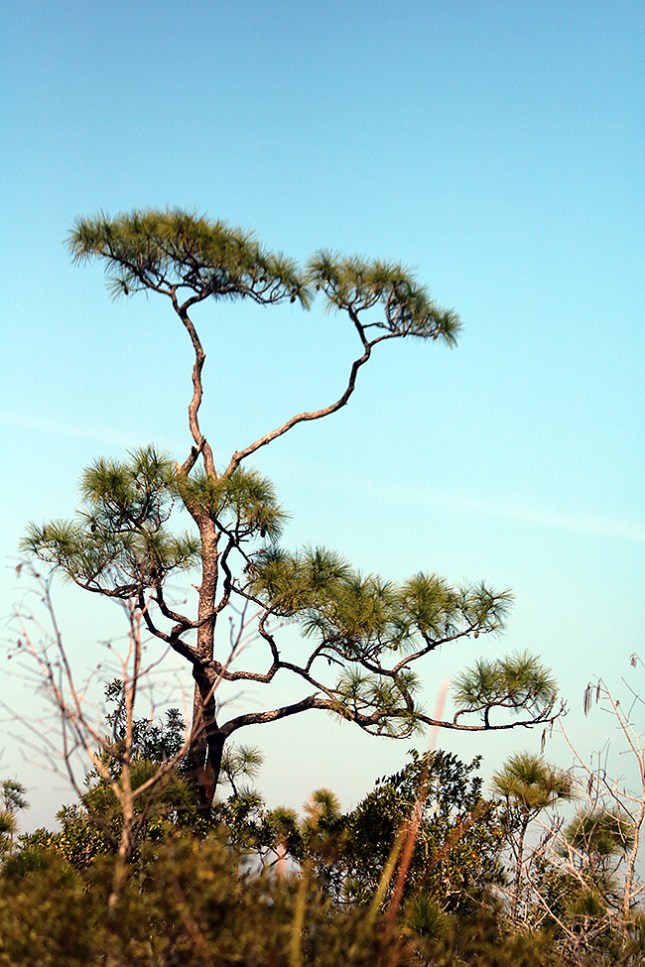
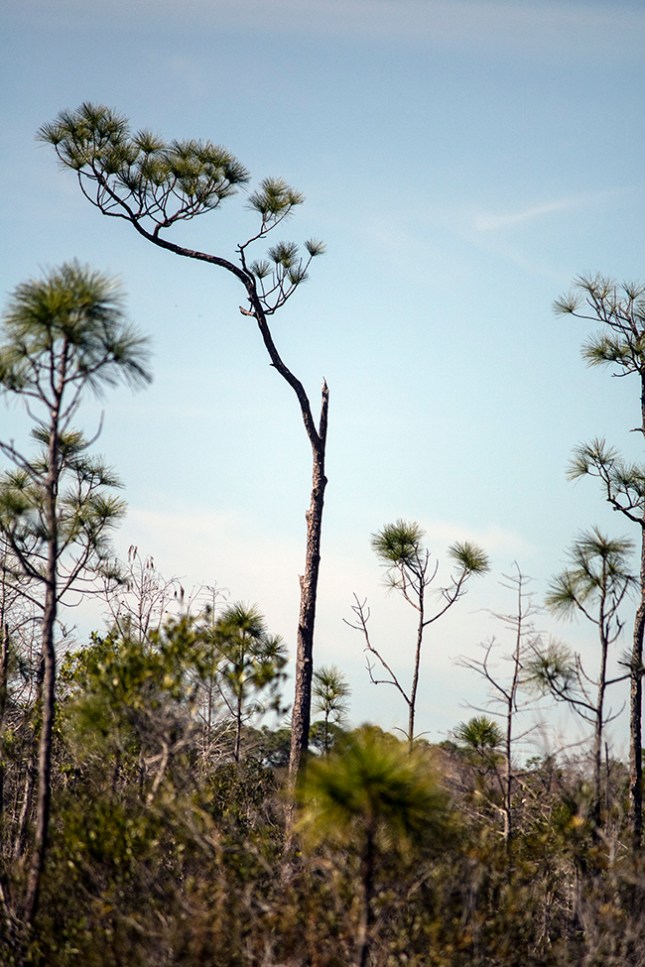
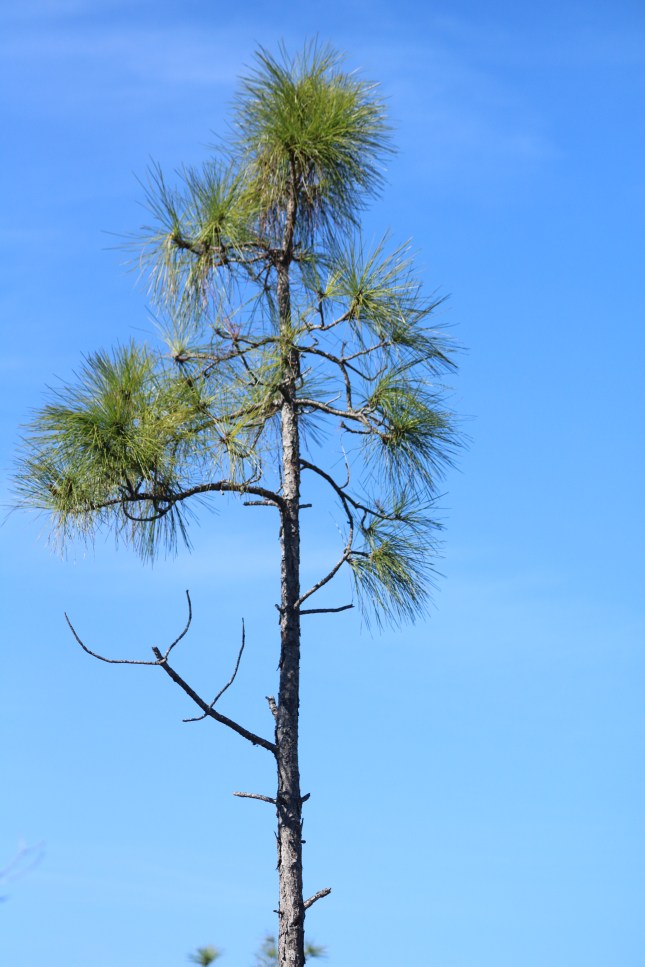
John and I botanized and photographed today at Halpatioke Park in Stuart, Florida.  Great place for pines, and for thinking about why they shed their lower limbs.   Such self-pruning is not limited to  Slash Pines, but they are mighty good at it.  The trunk becomes bare below the crown as the crown rises.

img_1814

The standard explanation is that discarding those flammable lower branches is protection from ground fires.    Ain’t sayn’ it ain’t so, but then again,  the party line strikes me as more intuitively easy to surmise than based on data.
I’ve heard other related notions, such as the lower limbs being too costly to maintain relative to their contribution to overall photosynthesis.   Also I’ve heard speculation that symbiotic fungi may facilitate severance.  Again, maybe, but those untested ideas don’t rock my world.

One more thought:  have you ever noticed how loaded with vines Slash Pines become?  Smilax, Grapes, Poison Ivy, Virginia Creeper, and more.  Those vines must sometimes weight a ton, especially when wet, and snag thunderstorms and hurricanes.  And they shade branches.  I wonder if branch shedding might help with de-vining.

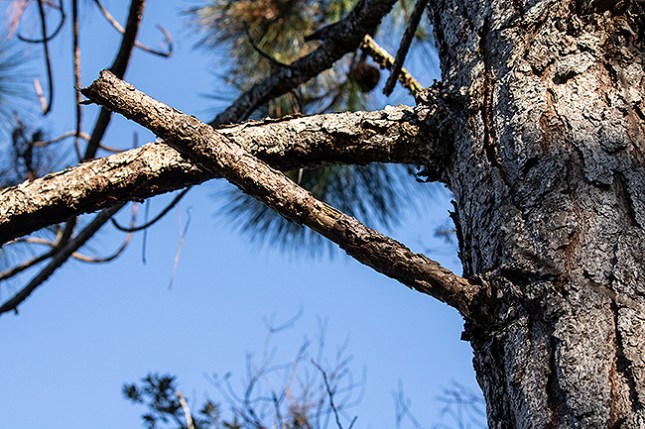
When leaves, and in some species twigs,  fall from trees they break off cleanly at a preset fracture point called an abscission zone.   Not so in Slash Pines.  The doomed branches seem to die slowly and decay on the parent tree, until they are sufficiently rotten to fall, blow, fragment, or be knocked off.  The breakage point can be anywhere from the trunk to 5 or 6 feet out.

pine brabches decaying

Instead of worrying why the tree discards branches from a standpoint of what good it may do the tree, let’s shift our gaze to how it happens, and how a Slash Pine is vastly more prone to it than its broad-leaved neighbors.  Time for comparison.

Before we dare to compare, a useful fact:  as a woody stem ages its central region loses functionality, and the outer younger wood and associated tissues are where the vital action is. Remember that, inner regions kaput, outer layers lively.

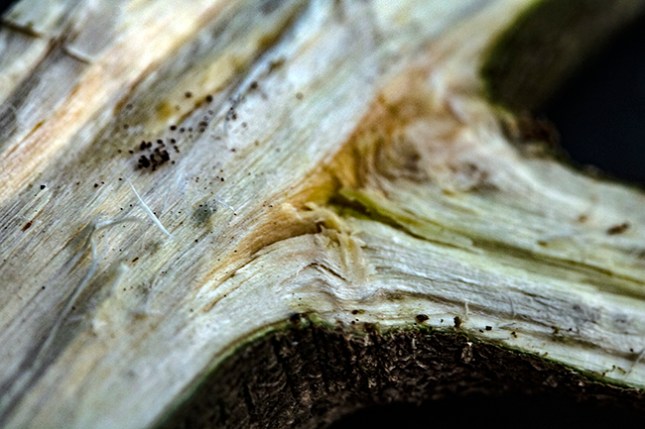
Now  look closely in the photos below at the broadleaf Florida Privet disinclined to self-pruning.    The two photos show the main stem (left) with a branch diverging to the right, split open down the middle.     Notice that the  white fibrous wood of the branch is continuous with the young outer material of the parent main  stem.   The branch and the active wood of the main stem are the same wood.  Wood from the main stem arches out into the branch and sustains its life.

privet twig cut

Florida-Privet keeps its branches.  The wood extending into the cut-off branch on the right is a continuation of the wood of its parent.  When one stops and the other starts is not clear.

privet twig close

Florida-Privet closeup showing the parent stem outer wood bending out and becoming one with the branch.

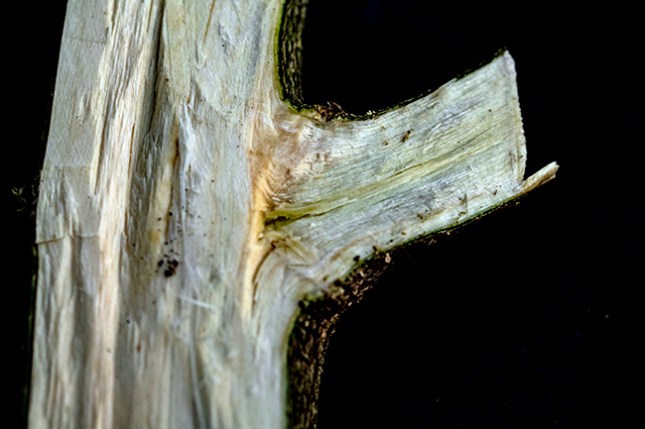
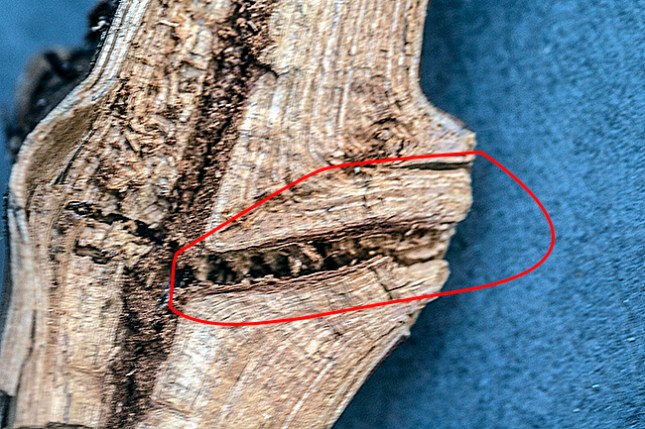
Now, by contrast, look below at the pine main branch and its side-branch, likewise split open.  The side-branch is mostly separate from the outer layers of the parent stem.   The side-branch resembles a spike driven into the core of the parent.  Its main connection to the parent is the parent’s aging inner tissues, declining and  choked by the expanding girth of the parent.    The hollow center of the parent stem is contiguous with the decaying center of the side branch.     Anchored in decline, choked,  and mostly independent from the lively outer layers of its parent,  the side-branch fails.

pine stem base circledl

The pine side-branch, circled, plunges to the center of the parent-stem whose outer layers are not much integrated into the branch.   The parent is becoming hollow at the core (the dark regions) showing insect damage…the  death tunnel extends directly into the side branch. In the upper right corner the branch is separating from the outer layers of the parent-stem. In the lower right, the outer parental layers narrow down and mostly stop short of becoming a major component of the branch, looking like their expansion may even help gag the branch base.

If the increasing diameter of the parent stem helps doom the side branch,  in cases of all else being equal, such as two adjacent trees or two forks of one tree, you’d expect the branches to fail at about the same parent-stem diameters.   Notice that in the two photos below.

pine twins

pine pom poms

If the parent-stem dies and thus quits thickening, a side-branch below the damage  may then be spared and live on.  Examine the photo below.

pine branch did not die

Looks like the death of the parent stem gave the side-branch a stay of execution.

Let’s come back now to the notion that the self-pruning is an adaptation to rise safely above ground fires.  Having branches rot because of an anatomical quirk seems a roundabout way to achieve fire avoidance.   But we could turn the beat around…maybe pines thrive in places with ground fires because they lose their lower branches.   Perhaps the chicken came before the egg.

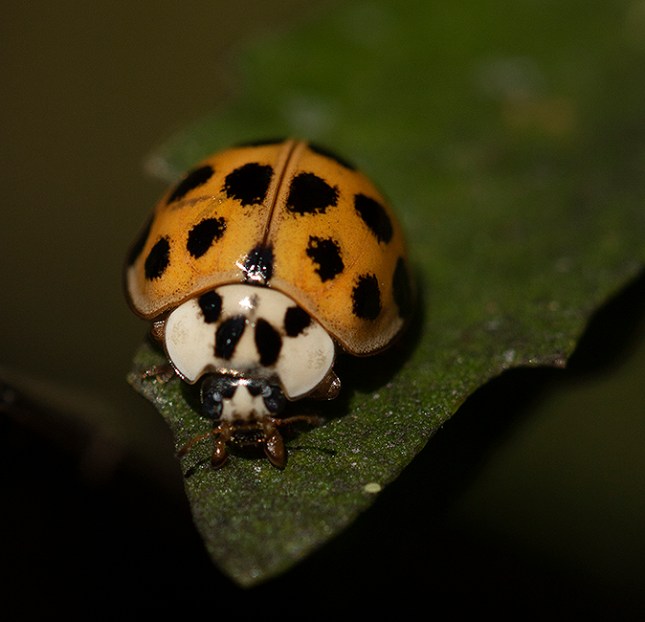
ladybug2

 
7 Comments

Posted by on January 18, 2019 in Slash Pine branch loss, Uncategorized


Why Do the Sunflowers Bend?

That plants position themselves relative to each other is obvious.  Every gardener has seen plants under the shade of larger plants leans out toward the light, and that seedlings germinated under the shade of taller seedlings grow extra tall and skinny in an “effort” to breach the lethal gloom.

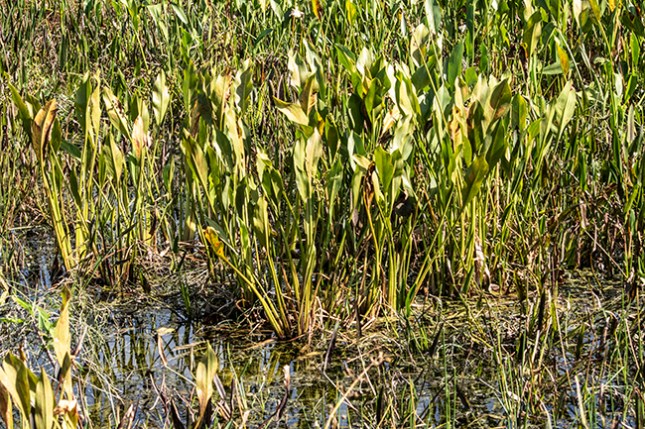
Walk in a marsh where single species can blanket an entire area under a monoculture.  Most of the “plants” in the blanket are merely the emergent portions of single or few huge sprawling rhizomes, just as a vine covering a tree can be one big spreading sprawling individual.  In any case,  the rising stems or clumps in a marsh seem to me to space themselves into an optimal pattern,  sufficiently crowded to suppress competitors yet  open enough to allow the individual rising stems to thrive.

sagittaria

These Sagittaria clumps are nicely self-spaced, not random it seems.  Crowded but not “too” crowded.

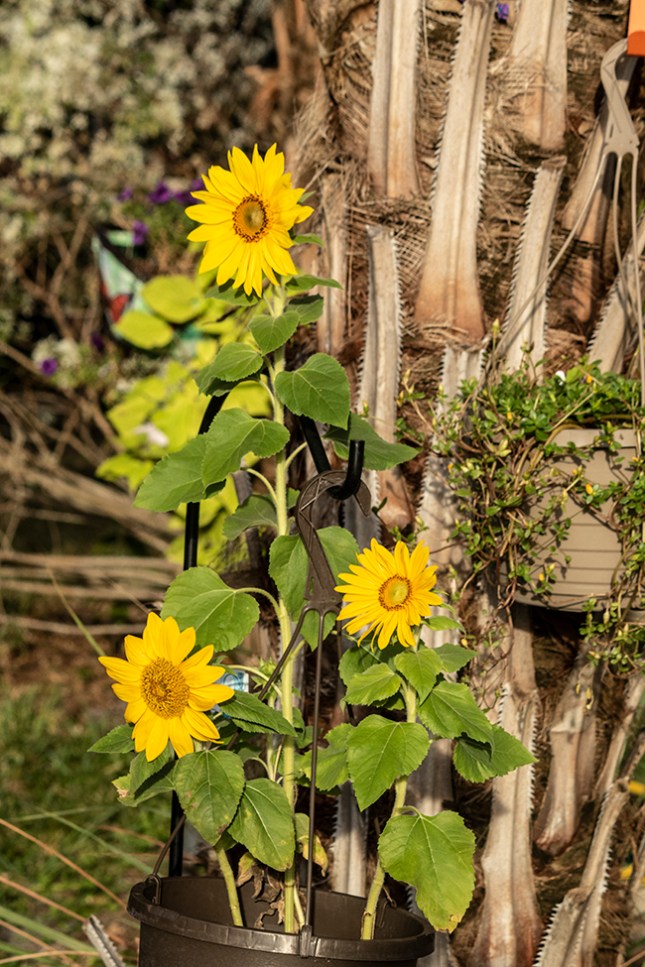
Sunflower plants lean away from each other.    The inclination cuts down on competition, allowing each sunflower to grow more than if not tilted.   This mutual accommodation is strong enough to impact crop yields.

helianthus front view

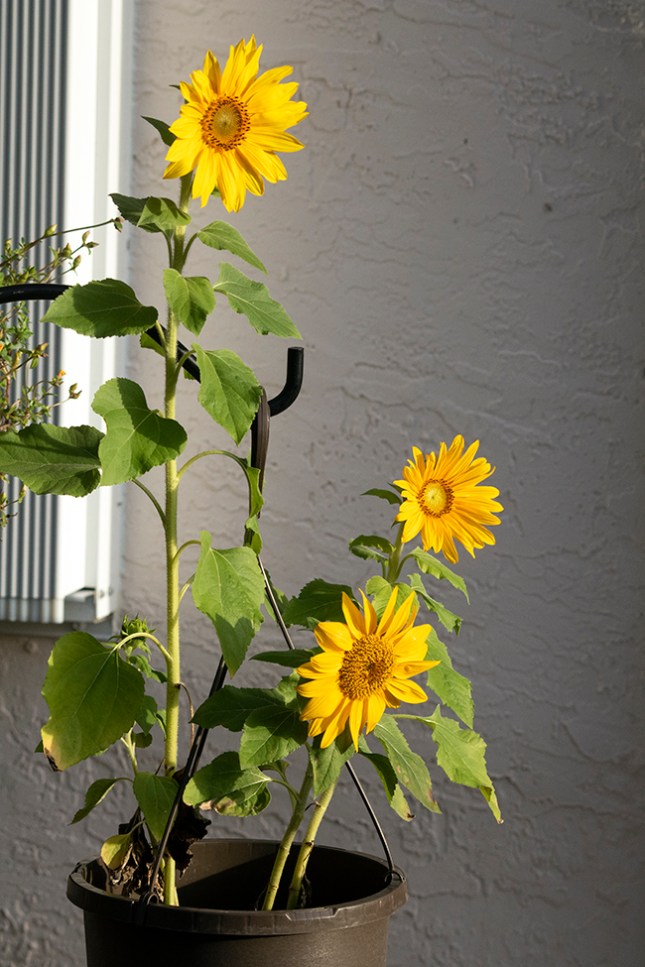
The two smaller sunflowers tilt away from their big brother, inclined left and right at the same angle.


helianthus side view

Side view of same flowers.  The two little ones also lean forward, again at the same angle.

How does one sunflower recognize the existence and position of a neighbor?   At first blush, research shows the main mechanism to be a subtle manifestation of a pervasive fact…that plants tend to grow toward light having strong red hues, and away from light rich in far-red coloration.   Strong reds are characteristic of bright sunshine.    Far-reds are typical of shade, competing vegetation, and light reflected from other leaves.    The side of a sunflower facing a neighbor is experiencing more far-red than the other side where red is stronger.  The neighborly side with more far-red grows a little faster, bending you away from your neighbor.

In recent years there has been a growing interest in “cooperation” among genetically related plants, something already well established in the animal kingdom.  Such “kin selection” has generated a good bit of interest in the botanical world with respect to root spacings, communication via fungal interconnections, and shading.   In short, one plant may “help” another plant if it is a close relative.  No, it has nothing to do with plant “will,”  “spirit,” or  “intelligence.”

Botanist Jorge Casal and collaborators showed members of a species in the mustard family to “cooperate” in minimizing mutual shading if they are are close relatives.   Related individuals produce leaves at the same height which enhances the light reflections onto each other, and thus the competition-avoidance signal mechanism reminiscent of that in sunflowers.   Dr. Casals and associates then experimented on sunflowers finding that kinship may likewise influence their tendency to lean and give each other some space.

If you want to dig deeper:

https://www.pnas.org/content/pnas/114/30/7975.full.pdf

https://www.sciencemag.org/news/2019/01/once-considered-outlandish-idea-plants-help-their-relatives-taking-root?utm_campaign=news_daily_2019-01-03&et_rid=333916853&et_cid=2581485

 
5 Comments

Posted by on January 4, 2019 in Uncategorized


Swamp Fern has Three Tricks Up Its Stipe

Blechnum serrulatum (Telmatoblechnum serrulatum)

(Blechnon is  Greek for fern.  Serrulatum refers to tiny toothlets on the leaf margins. Telmato denotes wet habitats.)

Blechnaceae

Blechnum serrulatum 5.jpg

Swamp fern by John Bradford

There’s nothing more enchanted than bright morning in a cypress swamp during the dry season.   The habitat is open, easy to navigate, bugless, and decorated with colorful lichens from rose to battleship gray, asters in bloom, and mossy hues a Leprechaun might recognize.

Taxodium above water line

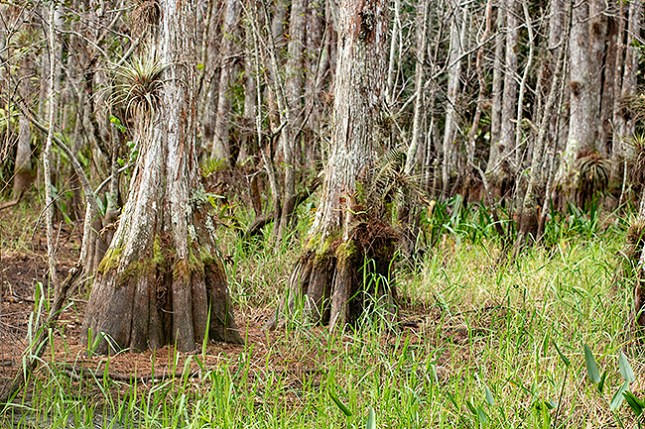
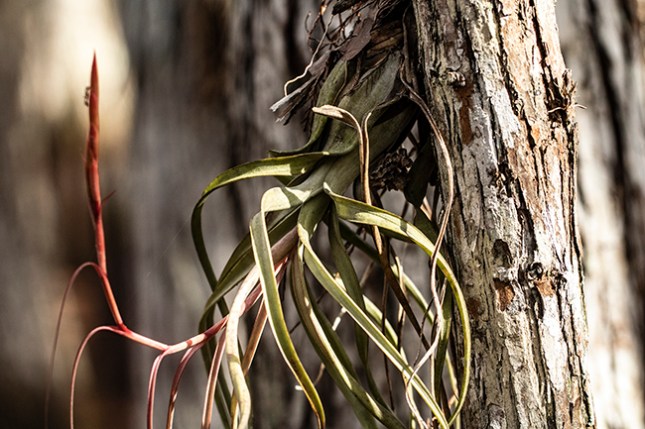
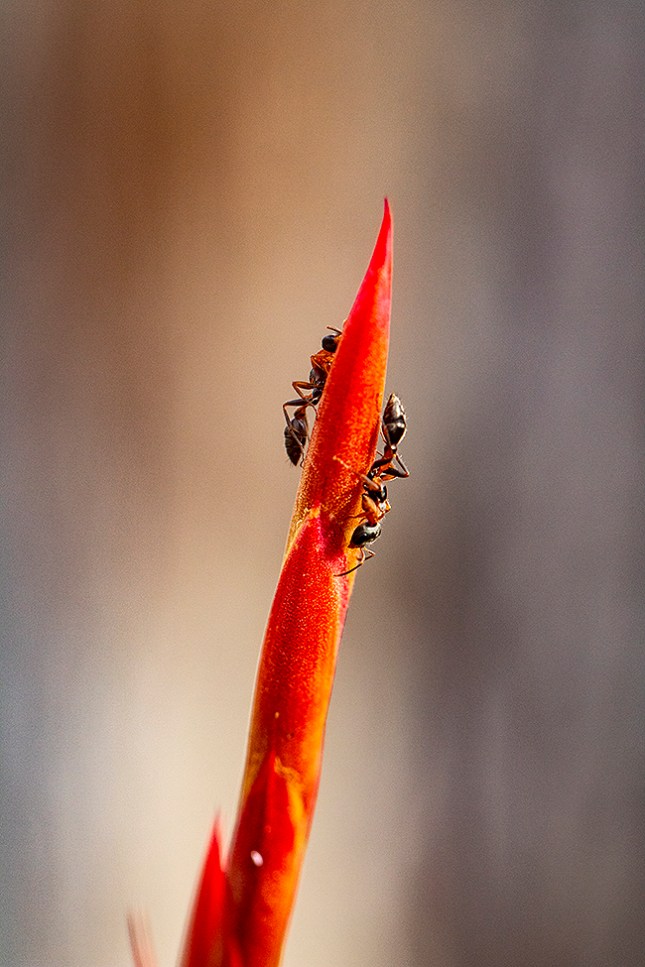
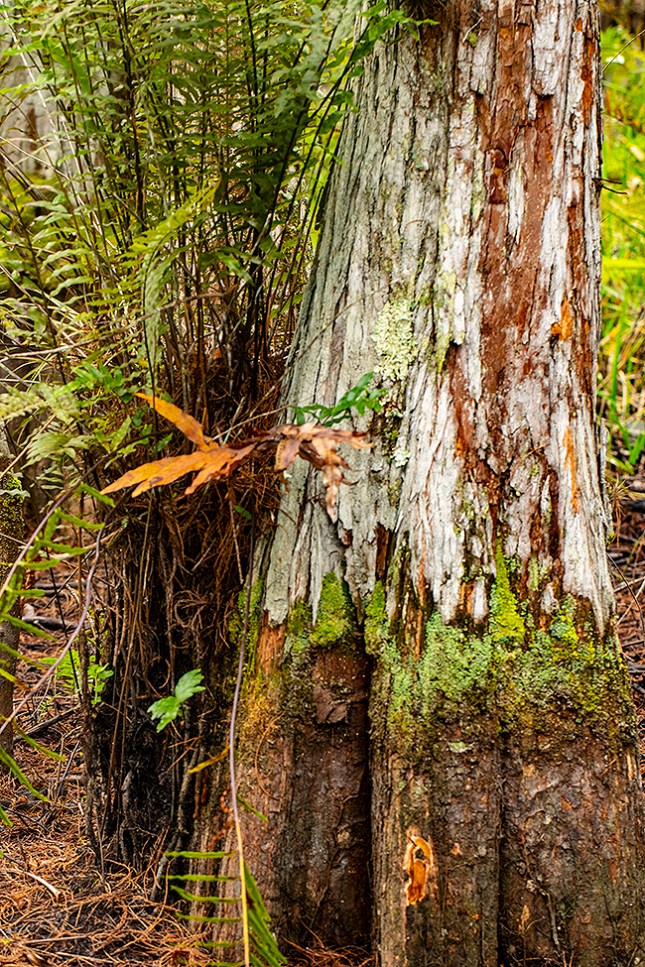
The biology is enchanting too, seeing cypress knees with spongy growing tips; seedlings seizing the day under the leafless canopy; northern needleleaf with ants; and a dozen plant species huddled on the bald cypress above the highwater line.

Tillandsia albisiana plant

Northern needleleaf with ant

Tillandsia balbisiana ants

So many wonders, yet time and space force a choice.  Swamp fern looks like “any old” fern, so what’s swampy about it?   The fern shows at least three curious adaptations to life with its roots submerged some months and desert-dry other months.   Being equipped for both extremes give the species a competitive edge, in charge where purely aquatic plants would fry and where purely dry-land plants would drown. Sun or shade just fine.

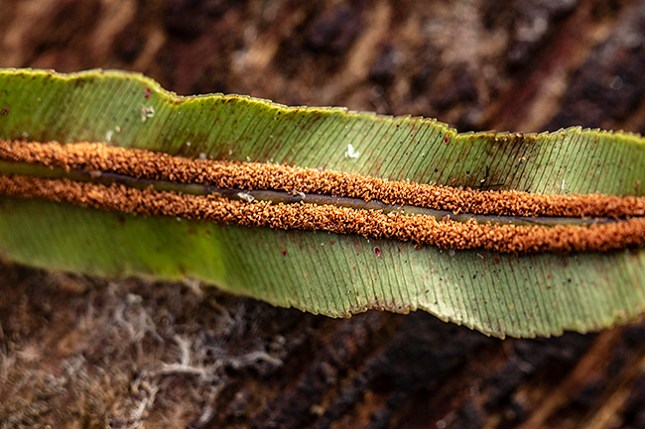
Blechnum sori

Swamp fern. Two rows of spore cases beneath the toothy leaflets.

Wet and Dry Adaptation 1.   The leaf stalks have veins embedded among air pipes extending from the high dry leaves down into the intermittently submerged regions.

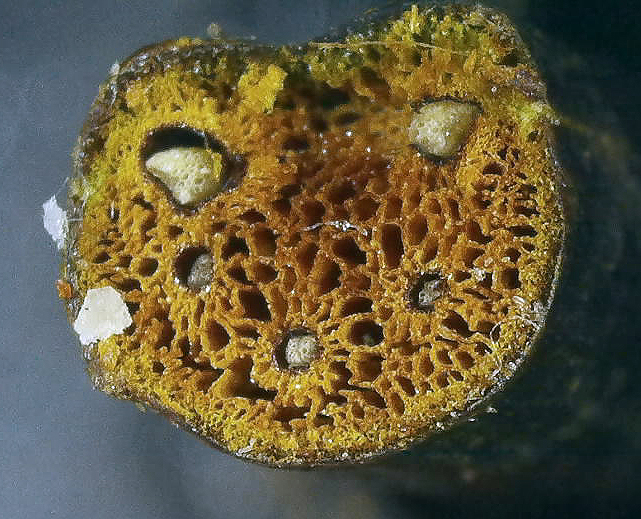
Blechum stipe section magnified

The leaf stalk cut and magnified.  The well protected veins are white, surrounded by the air pipes.

Wet and Dry Adaptation 2. When the fern perches on a bald cypress above the high-water line, the plant is not permanently an epiphyte unable to reach the earth.  Look closely…like a little banyan, it drops rhizomes and roots from its elevated base down along the cypress trunk and into the soil at the host tree’s base.

Blechnum on bald cypress

Swamp fern hanging on bald cypress.  The fern’s rhizomes and roots descend from the attachment point to the ground.  Some months they would be largely submerged.

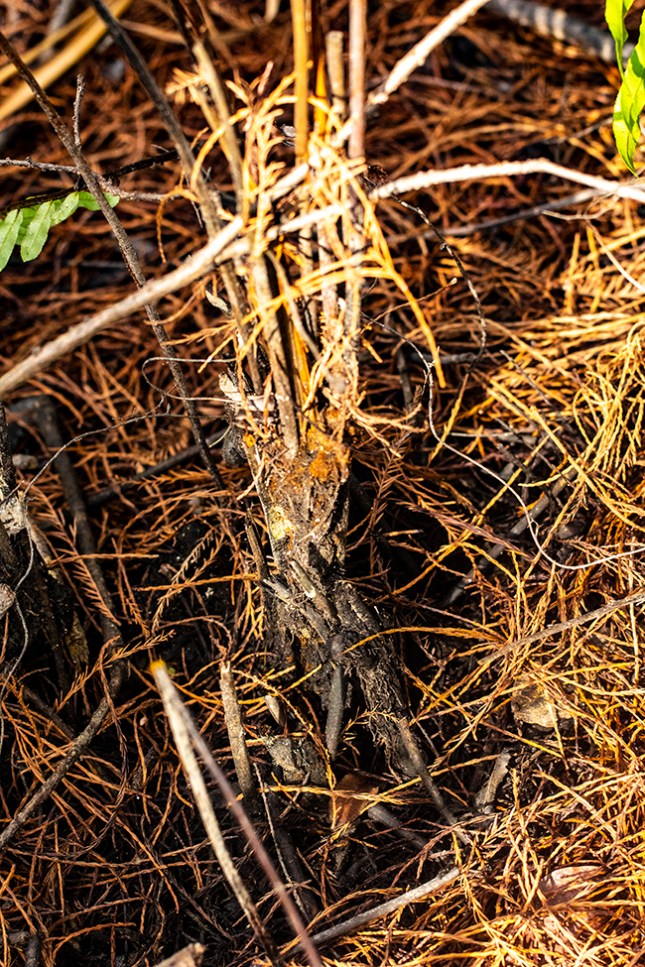
Wet and Dry Adaptation 3.  This one requires speculative interpretation.  When the fern sits directly on periodically flooded mud it can build itself a pedestal made of a vertical cluster of slender rhizomes bound together into a spongy fascicle by a fibrous meshwork of roots.

Blechnum trunk on ground 1.jpg

Base of the fern (leaf stalks on top) rising from the black pedestal.

The pedestal lifts the fern above the flood when necessary, and looks like it collects debris and microbes in its network of nooks and crannies.  When the water is low, the pedestal becomes a reservoir of moisture and nutrients.

Blechnum trunk mid distance

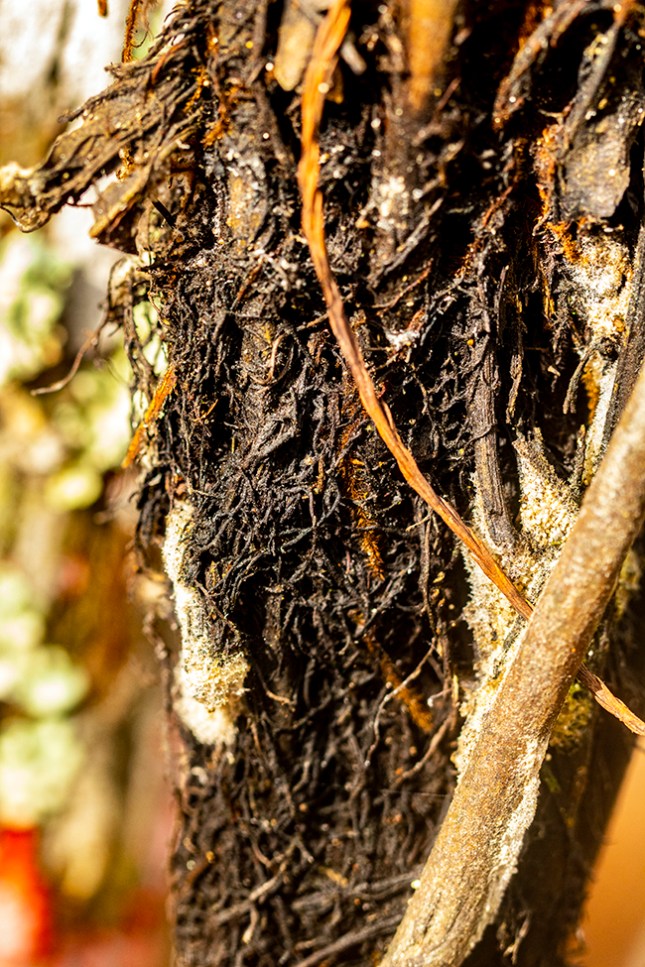
The pedestal is a mass of vertical rhizomes and roots all tangled together to make a tall sturdy sponge.

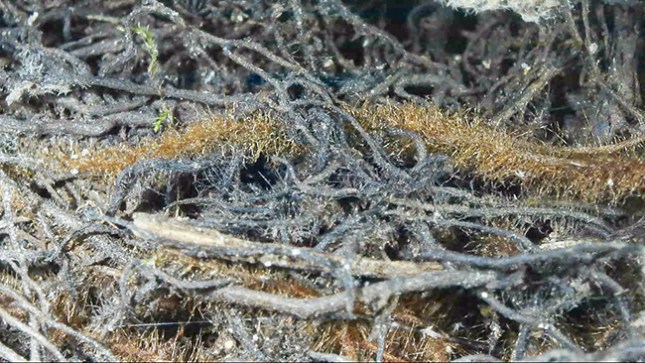
Among the blackened dead yet fibrous roots are living roots looking like they harvest water and nutrients from the spongy pedestal through which they creep.

Blechum living root magnified

Magnified view of living root creeping through the blackened spongy matrix of the pedestal.

 
5 Comments

Posted by on December 28, 2018 in Swamp Fern, Uncategorized


Tags: , ,

Pink Redstem

Ammannia latifolia

(Johannes Ammann was an 18th Century botanist.  Latiflolia means wide leaves.)

Lythraceae

John and I worked at Haney Creek Natural Area near Jensen Beach, Florida, this week.  Much to my delight as a lover of things in wet places, we saw an old wetland oddball plantfrind, always under-appreciated.   The sort of plant you step on looking for something “interesting.”    It is all interesting if you look closely, or if you read research by other people, especially other people with an electron microscope.   Today I’m paraphrasing an eye-opening paper by Dr. Shirley Graham (in the Journal of the Arnold Arboretum, vol. 66).  Because the work dates to 1985, I’m confident Dr. Graham and the Journal would have no objection to reappearance in a 2019 blog, and I sent her an e-mail to make certain.

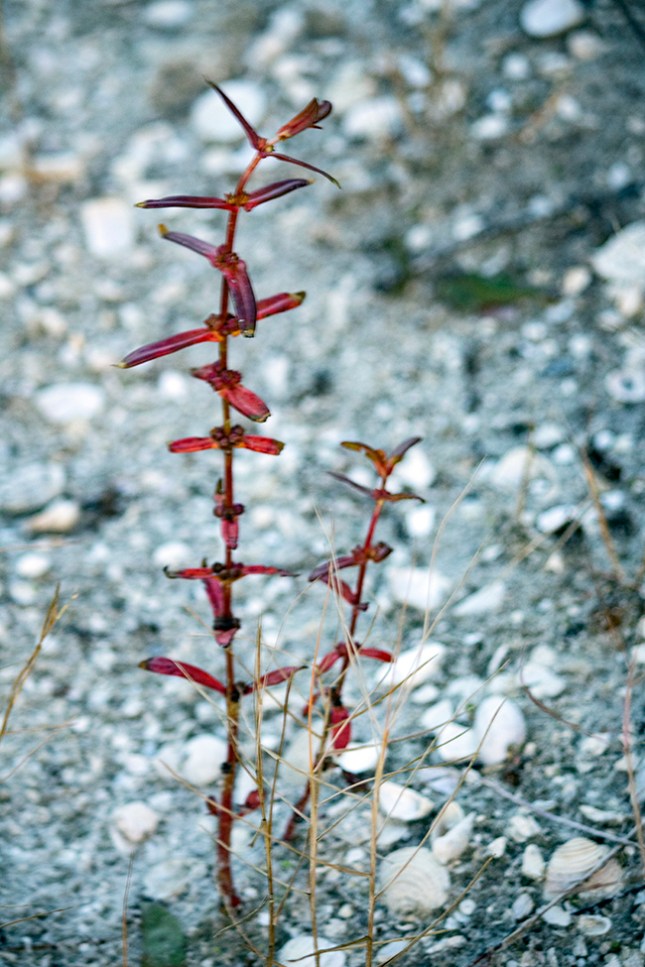
Today I was doing what I like to do, walking along the dried out shore of a nearby stream-canal where only two living things were visible on the barren mud, one a green alga, the other, as at Haney Creek previously, scattered individuals of Ammannia latifolia livin’ the vida sola.  Just desolate mud, a little algae, and big red Ammannias.

Ammannia on mud

What dis the Ammannia and I have in common?  We were alone on the  lifeless mud.

Life “on mars” takes a fairly special plant.  Ammannia has some obvious advantages for places that alternate between flooding and drought, with suffocating soil.    It is a wee bit succulent, has rugged leaves, has red coloration which may be sunscreen,  and has padded little pea-sized capsular toothcup fruits.   The flowers may or may not have petals, that’s odd, and it can sometimes, or perhaps predominantly, set seeds without benefit of outside pollination, a handy trait in a lonely pioneer.  The pollen-making anthers can break off and adhere to the pollen-receptive stigmas in the same flower assuring self-pollination emphatically.  The roots tolerate saturated mud.

Ammannia close

That is all well and good, although perhaps unthrilling.  The magic is in the seeds, as Dr. Graham related.  The electron microscope photos below are from her 1985 publication.

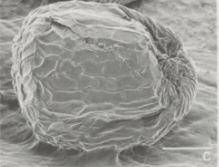
The seeds are  packed a couple hundred per fruit.   They float, and have a special mechanism to do it well:  On one side of the seed there appears a small puffed up beer belly, a flotation device, which collapses when the seed dries.

Ammannia latifolia seeds dry and wet

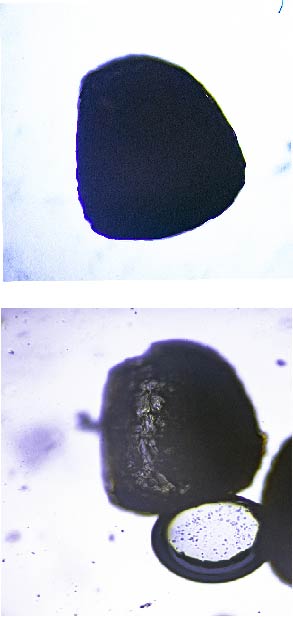
Seeds photographed today.  The one on top is dry.  The one on the bottom is moist,  the puffed out float on the left. with light shining through.   As the seeds take on water out pops a bubble as seen lower right.

Ammannia coccinea seed with flaot

Ammannia seed showing the pufferbelly.  Photo from sources noted in text.

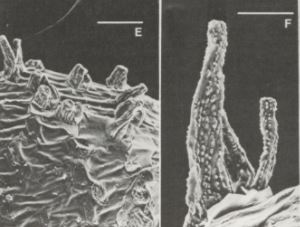
Even weirder, there are hairs on the inside of the seed coat, wrongside-in.  When the coat is moistened the hairs pop outward to become spikes like the antennae on Sputnik, where they may help water enter the seed.

Ammannia coccinea evaginated hairs

Seed hairs moistened and sticking out.  Photo source mentioned in text.

The moistened seeds become a little sticky, which may help them grab hold to a final sprouting site, or may help them cling to a bird’s leg en route to the next aquatic environment.    The seeds are willing to germinate in a few days under favorable circumstances,  and if things aren’t optimal some are patient and tough, reportedly germinating from dried museum specimens 27 years old.

 
7 Comments

Posted by on December 21, 2018 in Uncategorized


A Sabal Palm Tree is a Universe — From a Sap Beetle Standpoint

Sabal palmetto

Arecaceae, the Palm Family

Sap Beetle  Brachypeplus glaber

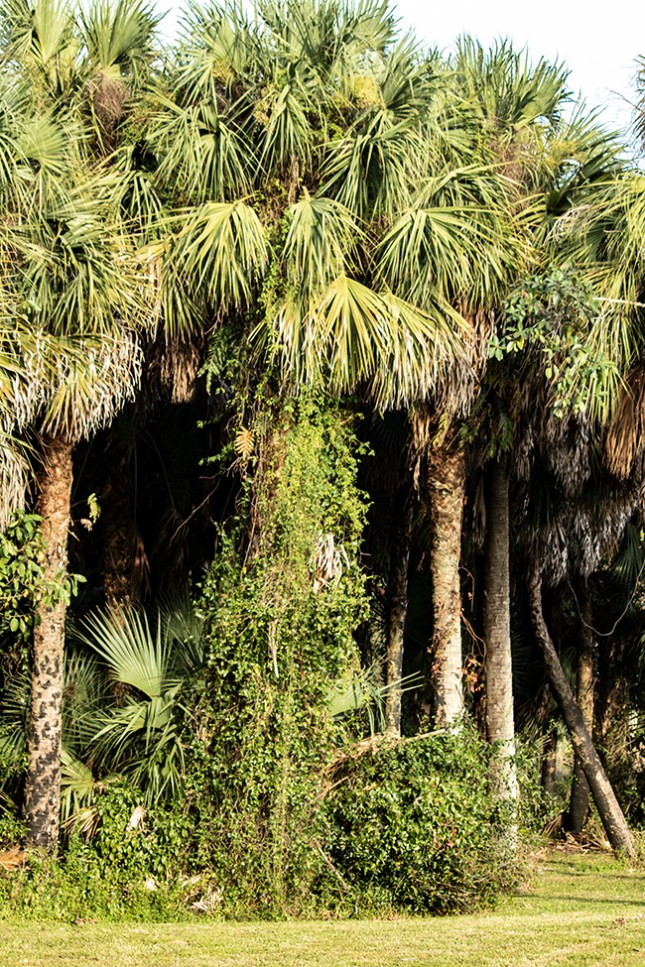
In the horticultural world vertical gardens became faddish a few years ago.   Nothing new there:   Cabbage Palms invented the concept, some of their trunks being vertical jungles, although other individuals can be bare and clean.   Many Cabbage Palms retain  broken-off leaf bases which turn into hundreds of little natural flower pots filled with spongy detritus.  Somewhere I read a list of around 60 plant species occupying Cabbage Palms, merely in one locality.  Some of the hangers-on are rooted on the ground and climb; others root on the palm itself, especially in those fertile leaf bases.

Cabbage Palm

It is fun to walk and gawk at Cabbage Palms to see who is hanging around, and far more fun to wonder about the interactions among the species.   What nutrients, or toxins,  or hormones from the plants perched up high  wash down the trunk and suppress, or favor, species lower on the totem pole.  Some species may use allelopathy (natural herbicides) drizzling down the trunk to discourage competitors taking hold below.  The nutrient cycling patterns would probably amaze, if only we knew.

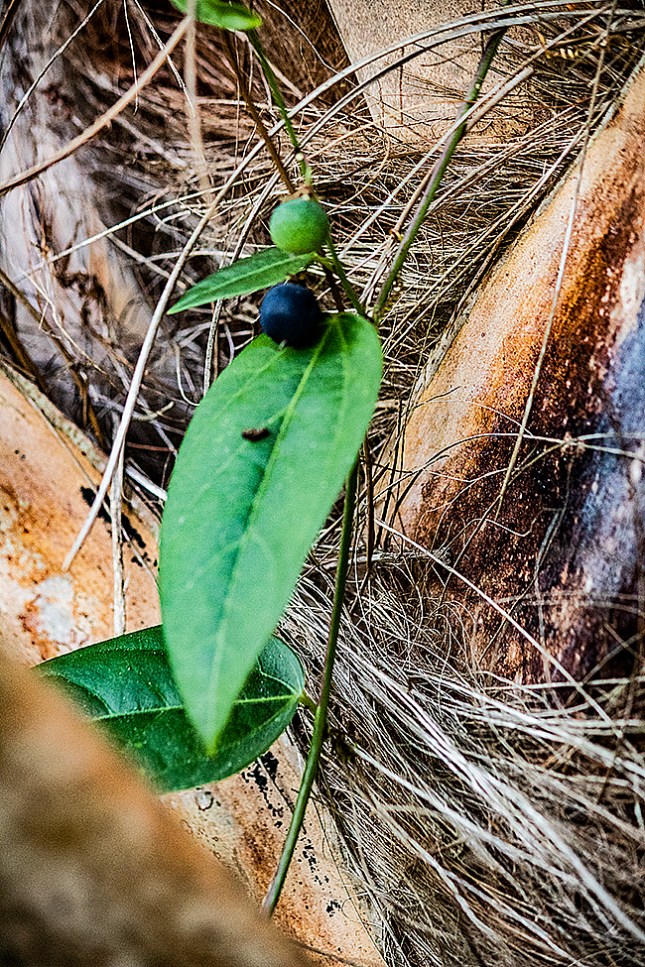
Passiflora suberosa fruit

Corkystem Passionvine enjoying the palm trunk.

The species distributions up and down the trunks do not seem random, although unraveling suspected patterns may be complex or subtle.  Cabbage Palm ecology runs deeper than meets the eye.  The tree has a lot of hidey-holes, and its microscopic life is no doubt a realm of secrets.   The micro-hideaways are where we are headed now, thanks to a team of entomologists.

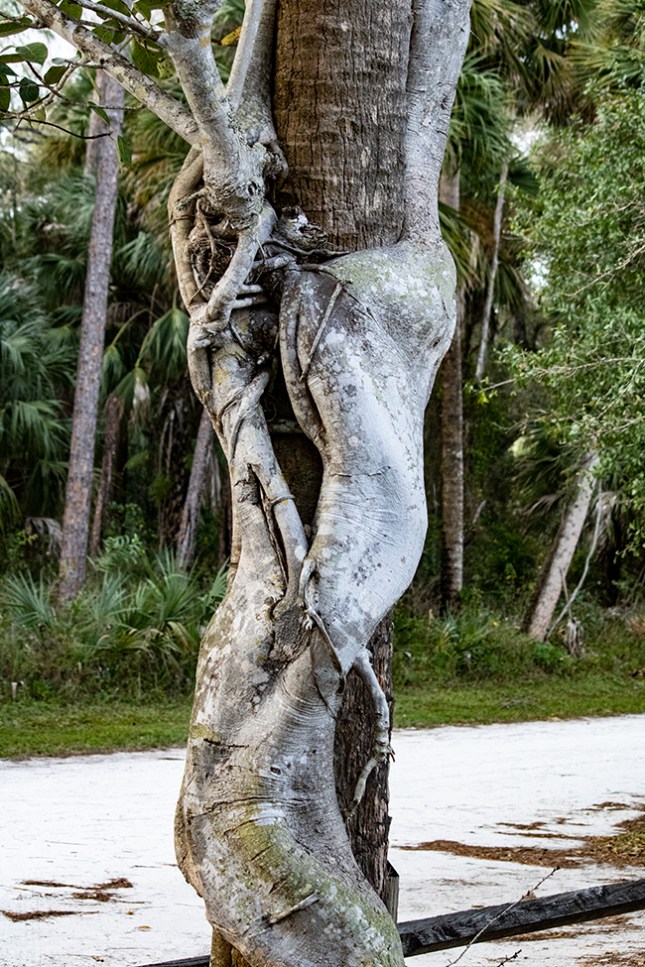
Cabbage Palm with Strangler

Honkin’ big hanger-on…Strangler Fig on the Cabbage Palm.

In 2014 Andrew Cline and collaborators explored a remarkable multi-species ecological web on Cabbage Palms.   Virtually everything I’m about to relate comes from their research, linked below.

Join me now at the senescent flower stalk bases still held on the tree.  Any suburban homeowner dragging the fallen inflorescences from their St. Augustine lawn can see layering around the stalk bases.  During yard cleanup however, we may miss all the fun in the layers, the lair of a sap beetle, Brachypeplus glaber, found in this niche essentially exclusively.  Oh-no, a “sap” beetle!   Does it suck sap and disrespect  our state tree?  No, apparently not, its diet is more complex, and the beetle perhaps even benefits its palm host whose flower stalks are the insect’s entire life-bringing universe.

CLICK to see the beetle

Enter a third species into the plot:   The palmetto scale insect Comstockiella sabalis sheds its skins.   Our sap beetle eats the skins in a handy act of recycling.   Great , now move on:

Now come the fungi.   The beetle has a tight relationship with a yeast, Meyerozyma caribbica.   The beetle, including its larval stages,  lives among the yeasts, eats them, and apparently hosts them as internal symbionts.   The same yeast is a known digestive helper in other insects. The entomologists suspected the yeast to be so potently antifungal  as to be of potential medical interest.

Yeasts are not the only important fungi in the story. The main diet of our sap beetle is filamentous fungi, particularly from the genus Fusarium.  Somehow the yeasts seem to help the beetle deal with the Fusarium.  Maybe they constrain it to a dietary level rather than allowing the pathogenic fungus to overwhelm the inflorescence too rapidly, destroying house and home, although that is 100% my speculation.

Fusarium fungi are plant pathogens, and anything that eats the Fusarium or suppresses Fusarium  might be defenders of the palm.

The tale of the sap beetle et al. can lead to just one “sappy” conclusion.  You guessed it.  Here we have a case where an insect and its yeast associates could protect the tree at its vulnerable growing crown right where infective fungi are most unwelcome.   Would residential applications of insecticides and fungicides disturb an intricate and possibly valuable beete-scale insect-yeast-palm-Fusarium microcosm?    And, by the way, where does that little ecoweb go when you “hurricane prune” a Cabbage Palm’s crown down to just a few leaves?

 ———————————————————————————————-

A few species hanging around on Cabbage Palms

Algae and Cyanobacteria

Asian Sword Fern

Balsam-Pear

Boston Fern

Cowpea

Creeping Cucumber

Golden Polypody Fern

Grapes

Laurel Fig

Leafy liverworts

Lichens

Mosses of various species

Passionvines

Poison Ivy

Shoestring Fern usually with the moss Octoblepharum

Smilax

Strangler Fig

Tuberous Sword Fern

Virginia Creeper

Whisk-Fern (Psilotum)


Today’s primary source:  CLICK


6 Comments

Posted by on December 14, 2018 in Uncategorized


Mud Dwellers are a Little Different

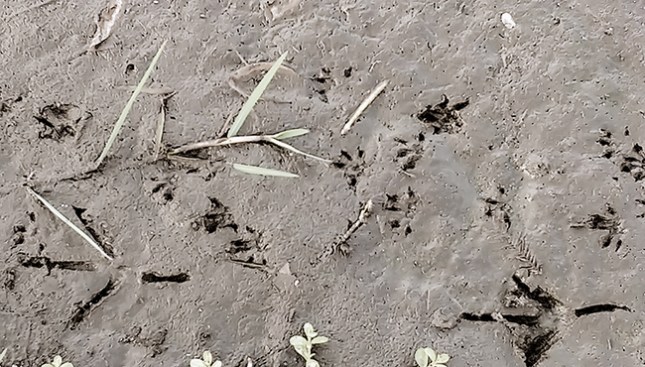
mud prints

Nature abhors a vacuum, including  muddy shores freshly exposed by the seasonal retreat of erstwhile shallow ponds.  Exposed barrens spell opportunity for ambitious pioneer species.   Colonization happens fast.  To meet plants you otherwise seldom encounter, don your boots and don’t sink in chin-deep.

There are no pre-existing competitors on new mud.  All newcomers can stake a claim.  Nobody is competitively excluded, so diversity abounds.  Let’s see, in the postage stamp mudhole I explored today I recall seeing (running out of fingers and toes) over 20 plant species.

shell

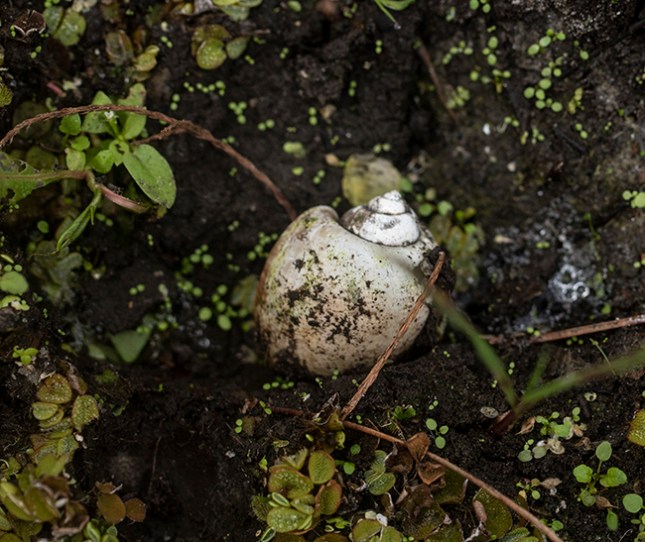
Seedlings rising with no competition yet.  The last owner of that marine seashell was probably 15,000 years ago.

Who’s first to settle?  Floating plants carpet the receding water and are the first settlers, although the species composition shifts substantially.   The pudding-dwellers arrive for the most part floating as whole plants, or as little breakaway pups, or as fragments, or as seeds or spores.  The mud community is far more diverse than the species readily spotted afloat.

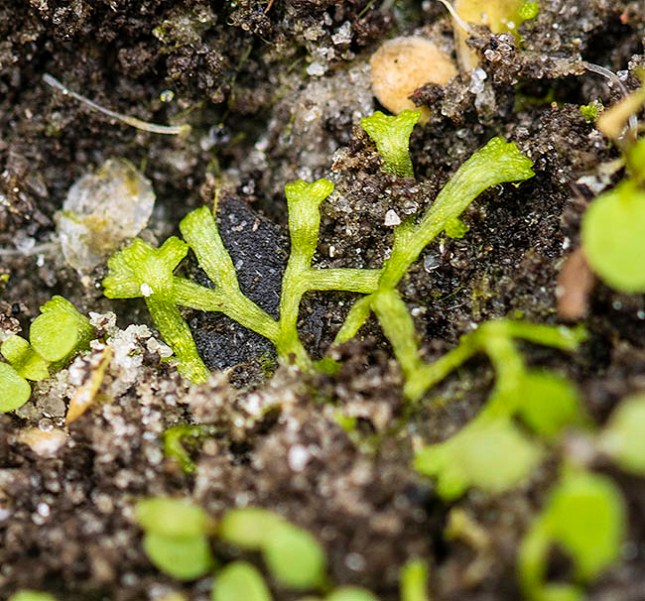
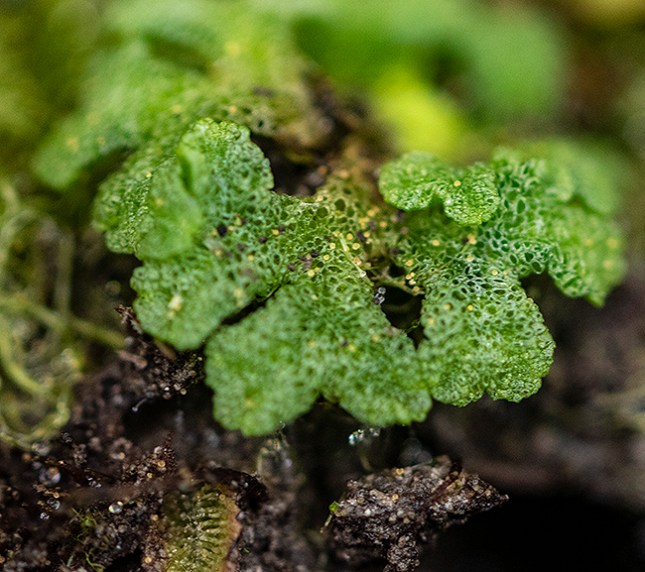
Green lowlifes on smelly mud take me back 470 million years to when plants originally strode forth from water to land.  Standing on the mud today was a window into pre-pre-history.  Look who we find, at least two examples of the most primitive still-existing plants, liverworts, straight out of a museum diorama.   I’ll bet today’s liverworts are almost unchanged from the first terrestrial plants, not counting bacteria and algae.

liverwort 1

Liverwort Riccia fluitans. Welcome to the time machine.  Bet it looked the same in the Ordovician Period.

liverwort2

Liverwort Riccia cavernosa.  Do the cavities facilitate gas exchange?  Any symbionts in there?   I’ve seen a lot of diatoms on/around this liverwort, but have no idea if that means anything.

The real fun is seeing who the castaways are and their adaptations to the mud world.  What are the facts of life on quicksand?  It is sopping wet, unless the sun bakes the surface dry.    The habitat is too suffocatingly soggy to invite extensive roots.    It smells like sulfur.   Nutrient acquisition must be a challenge.

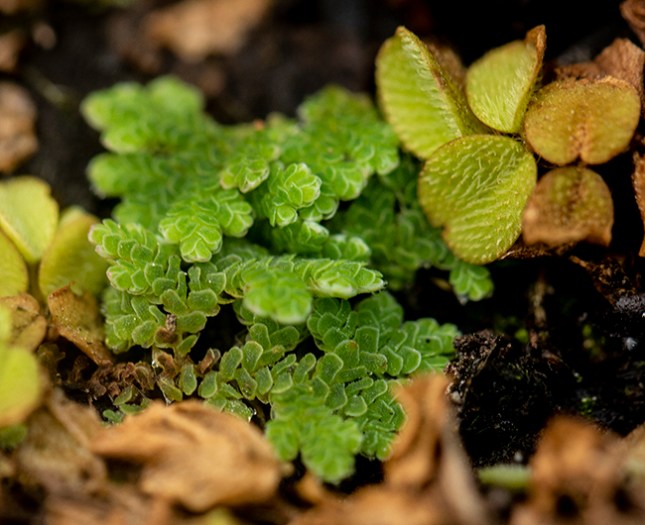
At least one resident brings its own nutritional assistance.  The floating fern Azolla has folded into its leaves symbiotic nitrogen fixing Cyanobacteria, microbial fertilizer factories.   It can have all the nitrogen it wants.   The other floater in the photo below, Salvinia, has every third leaf modified into a big nutrient mop no doubt able to help with the fertilizer problem in its own fashion.

floating fern

Floating ferns love this stuff!  Salvinia with the big hairs on the right.  Azolla is on the left, with its internal Cyanobacteria.

The next rain spells doomsday for these precarious species, although each is ready for rainageddon in its own way.  They arrived floating, and can depart the same way, no problem?  What about those who came by seed and need to make new seeds?  They work fast.  The Pentodon in the photo below can bloom and fruit while still mere baby seedlings, not a moment to waste.   After that safe start,  the longer they live the bigger and more fecund they can be.

Pentodon pentandrus

Precocious Pentodon, flowering as a seedling.

The Ceratopteris ferns, water sprites, can float and make bulbils to disperse as clones, and even better, they mature from spores to reproducing adults in as little as three months to complete their sexual cycle.

Returning to seeds, one way to win a race is speed, as we just discussed, but there’s another way… a head start like the Nebraska Sooners.  Barnyard Grass, Echinochloa crus-galli,   jumps the gun by having the rare ability for its seeds to germinate in the absence of oxygen still submerged or buried in stinking mud.  That is why this grass is a pest in rice paddies.

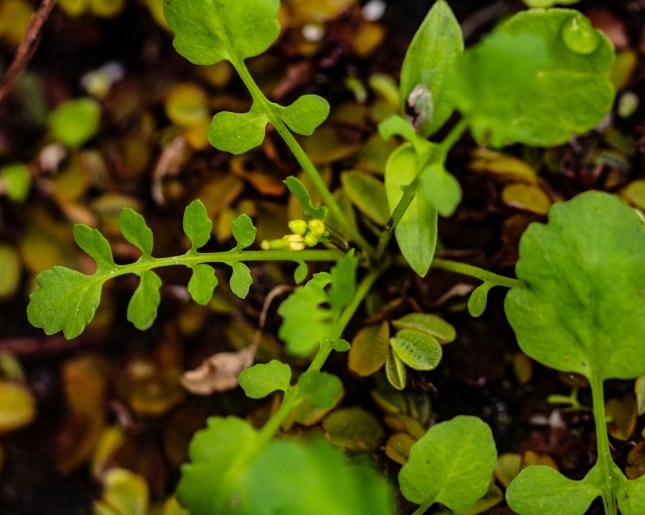
Another response to re-rising water is to live with it. The Southern Marsh Yellow Cress, Rorippa teres,  sprouts all over the mud.  Not only does it flower and set seeds early in life, it can probably also live submerged if its relatives are a good measure.  Although I do not have data on this species per se, some of its close kin have survived and grown during underwater tests as long as three months.  Let it rain!

Rorippa

Rorippa

 
9 Comments

Posted by on December 8, 2018 in Uncategorized


What’s Cup Grass Have In Its Cup?

Eriochloa michauxii and related species

(Eriochloa is Latin for “woolly grass.”  Andre Michaux, 1746-1802, was a French  botanical explorer in the U.S., and elsewhere.)

Poaceae

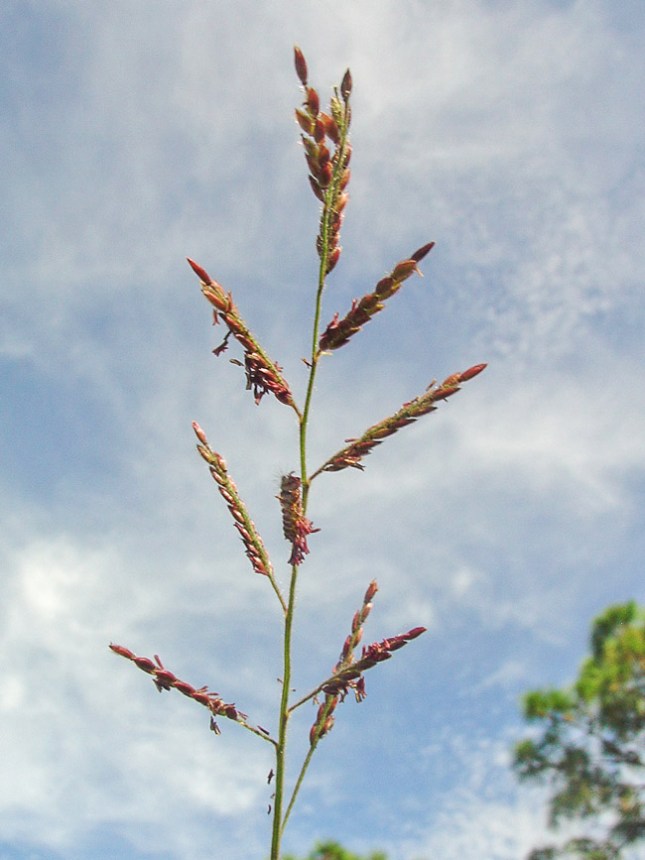
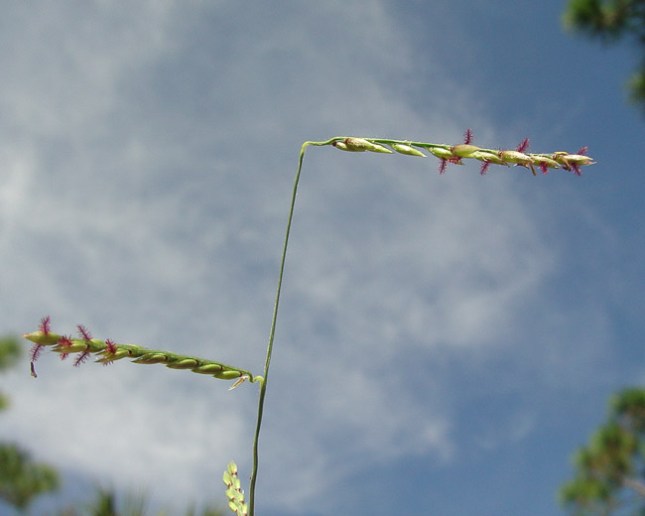
A genus of grasses a treat to encounter around here, not that often, are the Cup Grasses, in the genus  Eriochloa.   Eriochloa michauxii is native, joined by a couple of uncommon non-native or marginal species in Florida.

Er_michauxii3

Eriochloa michauxii by John Bradford

Overall, the genus is known for its adaptation to salty habitats, especially by possession of salt removal glands in some species, but that is not the main point of interest today.    Here’s the thing:

Why are they called “Cup Grasses”?

Each flower-fruit unit (spikelet) sits atop a little cup, like an egg in an egg cup.

And that being so, what good is that cup beyond helping with identification?

Er_michauxii4

By JB

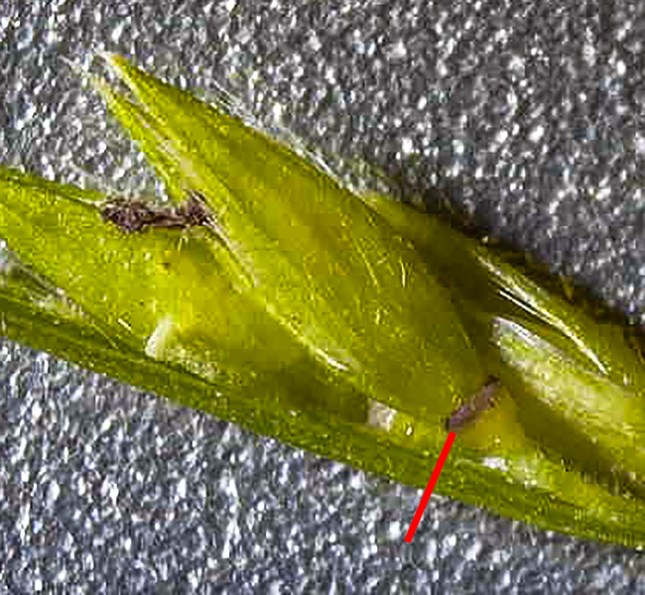
Botanists of yore thought the cup represented a modified leaf associated with grass spikelets (the lower glume), but no, the cup has emerged via fine research as an entity of its own,  curiously with a thin membrane around the rim.

Eriochloa cup

Microscope view of the cup and its rim (red bar).  The spikelet (containing flower, fruit) is the big green speartip rising from the cup diagonally across the image.

A cup, especially one with a thin extra lip around the rim must hold something.  It does…bits of fatty material, lipids, the membrane edge probably protecting the greasy contents during the collection phase.  I’m not sure exactly where the lipids originate to wind up in the cup.   Either the chalice makes the fatty deposits, or they drop in from above.   In any case, the enriched cup falls away with the spikelet at dispersal time and seems to be a goodie basket for hungry ants enticed by a fatty  treat to drag the spikelet with benefits back to their nests, thus dispersing the grass species.

 
7 Comments

Posted by on November 30, 2018 in Cup Grass, Uncategorized


Tags:

Middle Aged Meadows and the Middle-Loving Plants

I’ve always loved sunshine, butterflies, goldenrods, and fragrances in cheerful meadows evocative of childhood memories.

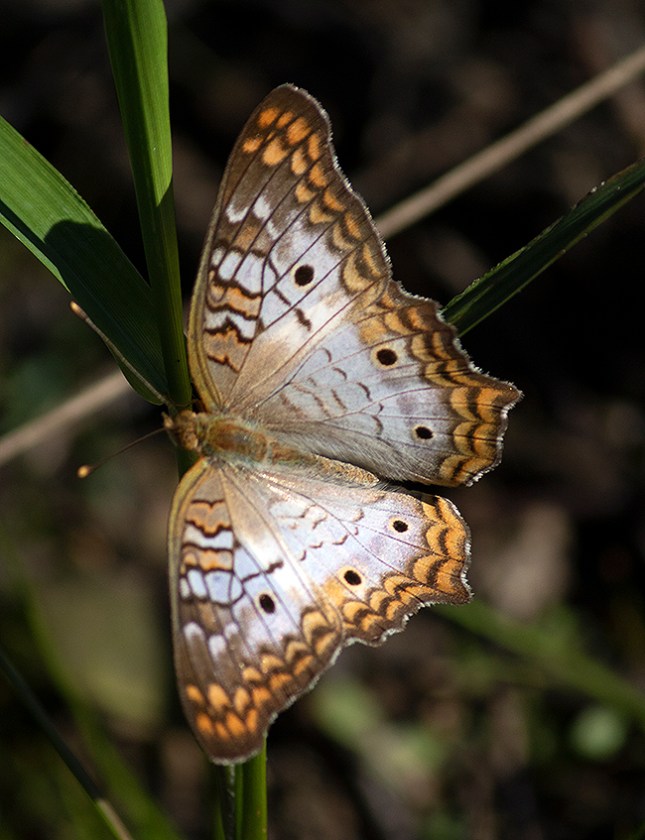
Meadow Peacock

Meadows and butterflies, it’s only natural!

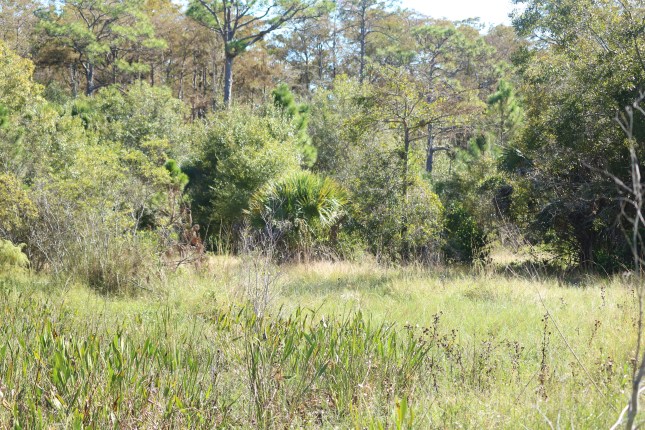
Attractive meadows in the Cypress Creek Natural Area near Jupiter, Florida, reflect several years of recovery after clearing and abandonment.   They represent a middle-successional stage.   Let me explain:

A textbook topic in Ecology is succession. Setting aside a couple controversies, the concept of ecological succession traces the history of a cleared area from its recolonization by annual pioneer weeds through a series of  plant communities onward and upward stepwise to a stable “climax” forest.      The stages and “final” outcome depend on the starting conditions, the basic habitat, and events.   The general trend with passing decades is from small and ephemeral toward large, heavy, and long-lived.

IMG_0582.JPG

Today’s meadows represent a middle stage in succession.  A fairly predictable clique of species dominates such a mid-successional moist meadow.  What do the middlers have in common?    They are not just midway in successional time, but also in structure,  not exactly weeds,  pretty big, but not exactly hunky woody shrubs or trees either.   Tweeners adapted to life in the middle, just like 8th graders in Middle School.

As succession begins the pioneer weedy species compete mostly simply to arrive, persist briefly, and disperse seeds.   But conditions change, becoming more crowded with the incoming  species being ever-taller and broader.  Mid-succession competition becomes a fight for the light, the winners rising above those who came before.    Then still later at the climax community the competition shifts again, to bearing  youngsters able to cope with the canopy shade.

Let’s go back to mid-succession and that contest to rise into the life-giving light.  The perennial weeds in our meadow are fairly tall:   goldenrods, musk-mints, and bluestem grasses as tall as I am.    The species able to surpass those perennials often are bare toward the base where the sun don’t shine,  the foliage held at 4-10 feet as required to overtop the big weeds.   Achieving comes to require some degree of woodiness.

Meadow fennel

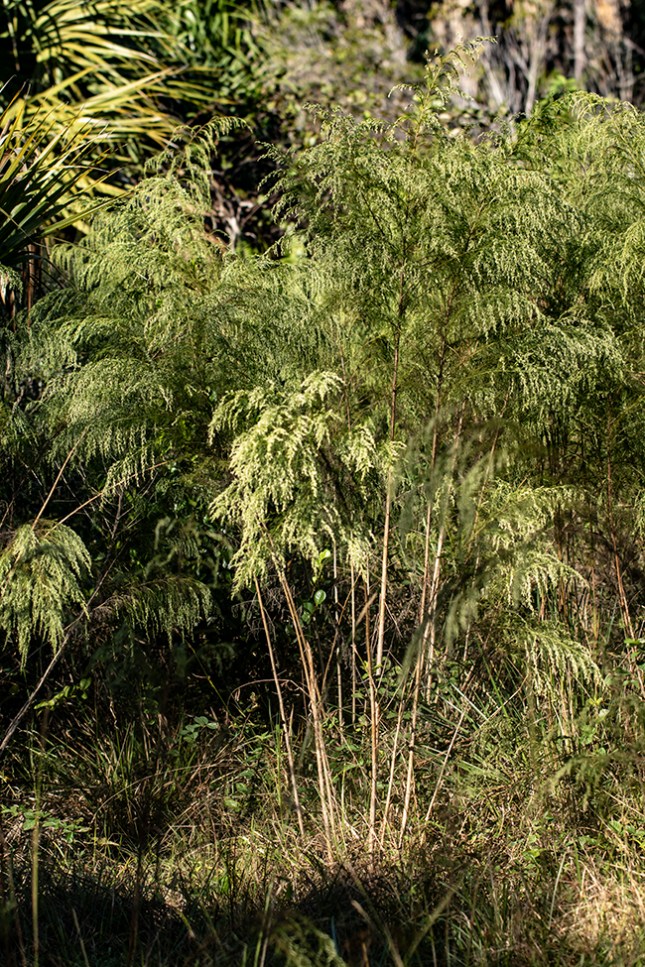
Dog Fennell with bare “bamboo” stems lifting the foliage above competitors.

The “beginner” of woodiness is Dog Fennel,  often with stems resembling bamboo, even by having “tubular” construction the stem becoming a slightly woody cylinder around a soft pithy core.   The stems live just one season yet become just woody enough to carry the canopy aloft.   The perfect balance between “fast cheap expendable growth” and height.  It can’t decide if it is a pioneering weed or a woody shrub, a little of both.

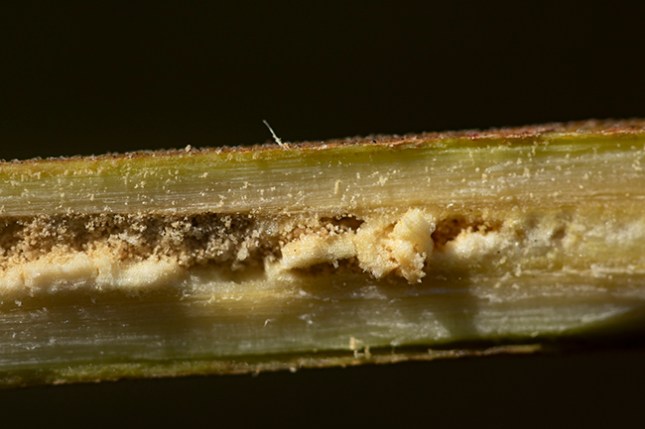
Meadow fennel pith

Dog Fennell almost hollow.

Also dominant are Saltbushes.   Along with Dog Fennell they represent the Aster Family which is usually non-woody, yet these Baccharis species have just enough woodiness to stand up and fight.    Relevantly, biologist P.B. Tomlinson, in his “The Biology of Trees Native to Tropical Florida” noted how  despite having a woody trunk, Saltbushes “more resembles an herb.”  He observed further that, “most of the woody branches are short-lived so that older plants are characterized by a mass of dead twigs.”

Meadow Baccharis

Saltbush, alive up high, shedding dead branches down low.

That tendency toward dead twigs sounds like abandoning crowded older growth in favor of new growth where sunlight is plentiful.   Saltbushes are not alone in tending to go bare down low.   Slash Pines appear as saplings early in succession, growing with the successional stages.  As they rise, the pines have an early bare base, and then begin a lifelong habit of shedding lower branches.  Observers usually interpret this as protection from ground fires, but that does not rule out a secondary benefit of lifting the leafy crown above rising competitors (which could fuel a ground fire).

Meadow pine

Another species sometimes prone to die down low  and  renew with tufts of leaves up high is Wax Myrtle, one of the dominant mid-successionists.   It and Saltbush have separate male and female individuals.

Meadow Wax Myrtle older

Wax Myrtle can dare to be bare below, with tufts above.

Wax Myrtle is one of the select few plants other than Legumes to have nitrogen-fixing root nodules,  giving it a competitive advantage on the terrible soils underlying the entire meadow.

Meadow nodule

On the Wax Myrtle root.

 
8 Comments

Posted by on November 16, 2018 in Meadow Succession, Uncategorized


Cypress Twig Gall Midges Make Big Blue Galls

Taxodiomyia cupressiananassa

Cecidomyiidae

What family has the most species in the animal world?   Here is a contender, observers estimate up to a million species in the Gall Midge Family, with over 1000 named in North America alone.  They are micro-flies able to induce galls on plants as larval homes.   Many arthropods make galls, and today’s galls are the big waxy-blue eye-grabbers of the Cypress Twig Gall Midge.

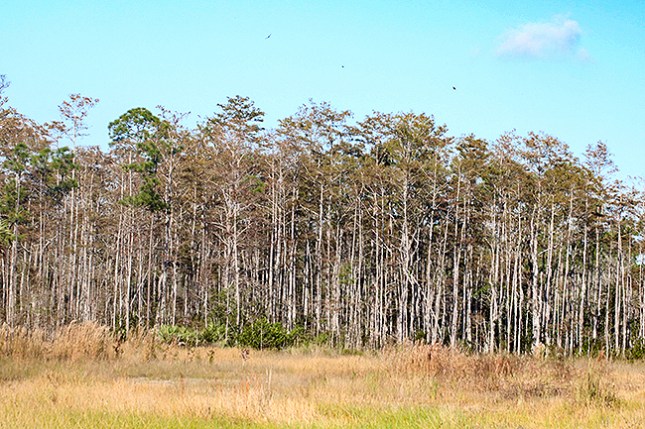
Taxodium stand

Bald Cypress

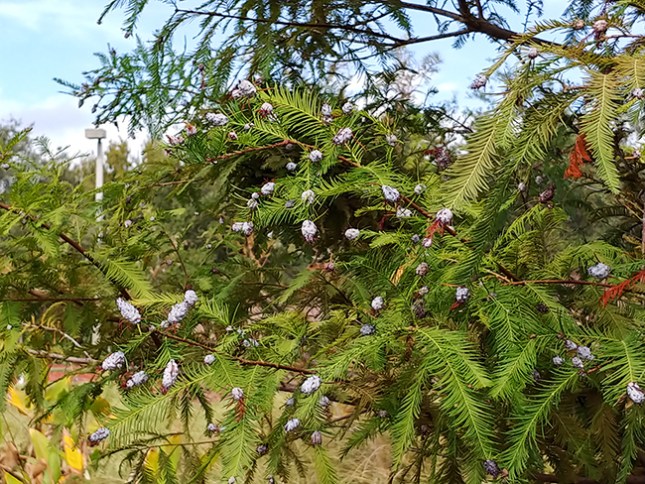
John and I were working yesterday in the aptly named Cypress Creek Natural Area, walking along the edge of a compelling Bald Cypress population.  This species has the most intriguing quirks, for instance some of the most “ornamental” galls I’ve ever seen.  The galls can be numerous, on the  tips of its twigs, looking from the distance like some ripening fruit.  They are the work of the Cypress Twig Gall Midge (and maybe sometimes a second related species).  It decorates Bald Cypress, Pond Cypress, and the Montezuma Cypress native to Mexico.

Taxodium branch galls

The galls look like Juniper “Berries”

Members of the Gall Midge Family in a general sense can be pests and parasites on plant pests, that is, they can seem to protect their host tree, a benefit employed in horticulture for natural biocontrol.  I don’t know if the Cypress Twig Gall Midge (CTGM) bugs other pests, probably not, but it does suffer its own parasitoids…parasites on the parasite.    The structure of the gall therefore no doubt serves to protect the CTGM larvae cowering within from parasitoids, and from larger predators.

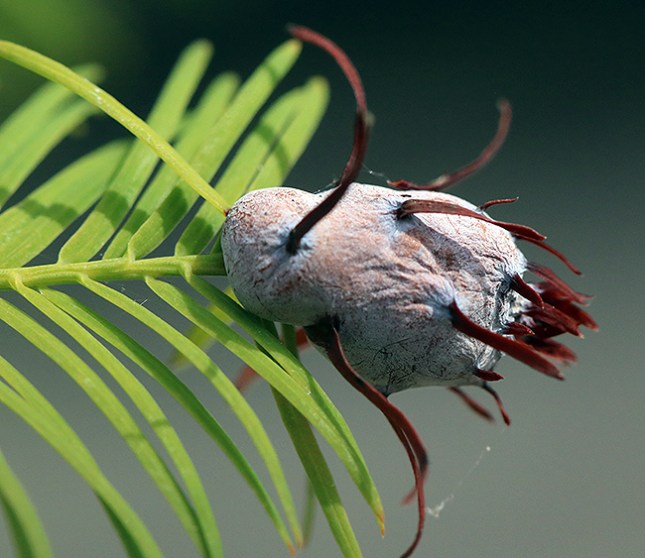
Taxodium gall whole

What is the gall’s structure?  It is soft, spongy, surprisingly large, to over an inch long, and coated with a blue-white powdery material suggestive of ripening fruit.   Larvae embedded in it may be nestled safely away from most parasitoids and predators.   But there could be more to the gall structure.

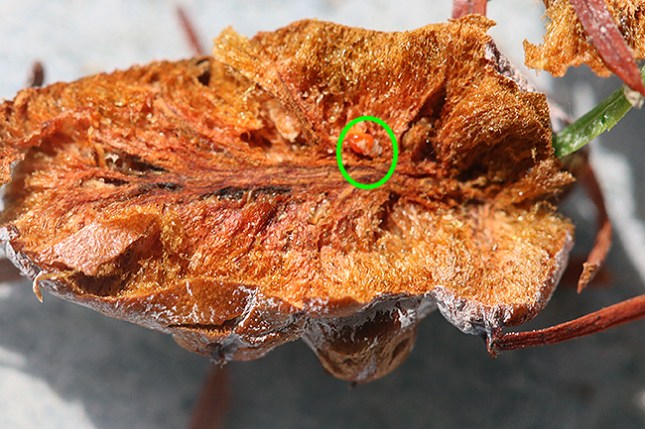
taxodium gall open

Gall opened.  There are many tiny midge larvae per gall.

And with that, we enter the speculation zone.  Beyond protecting the larvae, are there additional reasons why the galls are big, lightweight and spongy, and colorful?   How about helping to disperse the midges?   Not just storage…but moving and storage.

Bird Dispersal

The galls are the color of juniper “berries” and suggest bird-dispersed fruits.   I don’t know if birds peck them, but there a hint of plausibility hidden in a small literature on insect larvae dispersing via a bird’s guthttps://www.ncbi.nlm.nih.gov/pmc/articles/PMC1617192/

Dispersal could occur even if a bird merely pecks at the soft gall or rips part of it free and drops an uneaten fragment elsewhere.   The midges reportedly mate upon emerging from the gall, so a gall chunk with even two of the average reported 16 larvae per gall could relocate potential mates together.

Rodent Help

The galls occupy  the twig tips.  The twigs are deciduous, so the galls land on the ground. Rodents and ground-dwelling birds, even large insects, could move them or fragments hither and thither.

Floating Around

The galls bob like corks, remaining dry and waterproof.    The twigs and galls drop more or less during the relatively dry season, but then again, it does rain during their “on ground” time, some places such as creek banks have  water year-round, and we don’t know the entire temporal-spatial history of the galls anyhow.  Maybe that waxy coating has to do with flotation,  water-proofing, and decay delay.

Final Mystery

As a closing note,  biologists George Washburn and Sunshine Bael last year found a connection between midge success and fungal diversity within the gall.  The galls are little fungus gardens.   Who knows why? Do the fungi help sustain or protect the midges?   Or do midge larvae in the gall promote fungi? Or both?  Neither?  Are larger galls merely better habitats for larvae and fungi?  Does the mother midge inject fungi during oviposition, and if so, why?