Eugenia axillaris
(Eugenia honors Prince Eugene of Savoy. Axillaris no doubt refers to the axillary flowers and fruits. The axil is the place where leaf base meets stem.)
Myrtaceae, Eucalyptus Family
This week’s back-to-school frenetic frenzy prevented John’s and my usual leisurely Friday fieldtrip, but no problem, my native plants class launched a new semester yesterday, and one of the species we learned is a species of mystery. Today’s attempt may have more questions than answers.
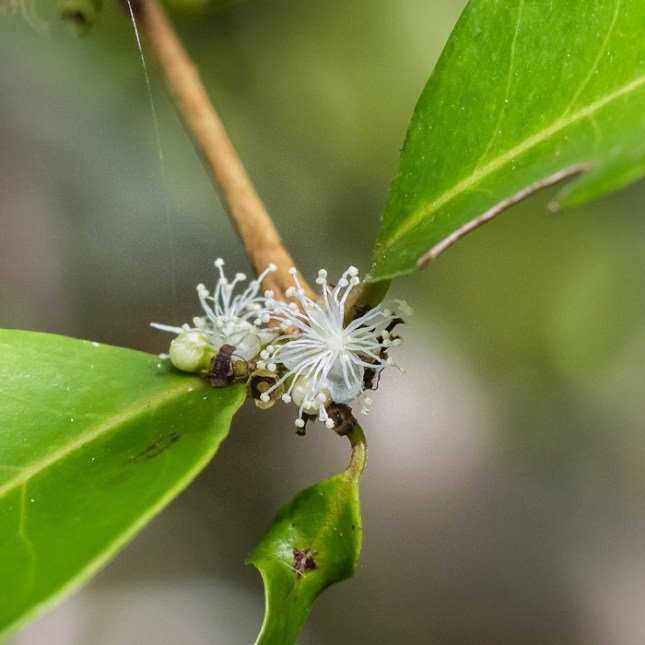
Today’s photos by John Bradford, some taken in Kiplinger Preserve.
White Stopper is one of several stoppers native to Florida, representing one of the world’s largest plant genera, Eugenia, if interpreted broadly.
White Stopper is a fine fixture in hammocks and native plant gardens around here, and is lovely with deep green leaves having purple petioles, and potentially massive displays of white frilly flowers followed by red-then-black birdfood fruits.
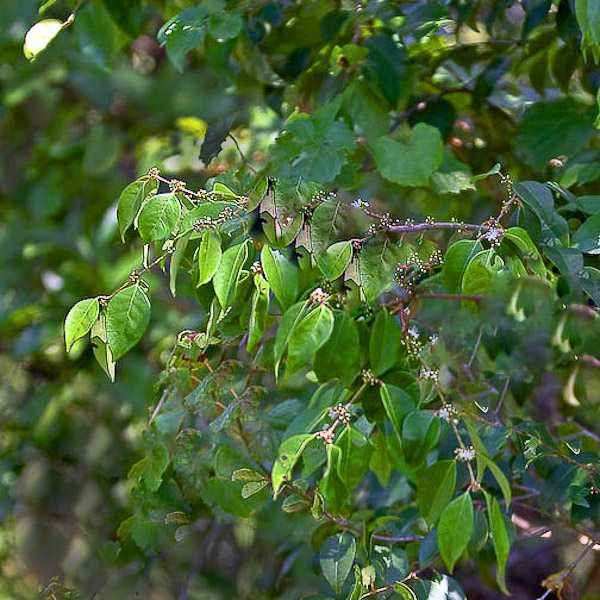
Stop and look at those fruits a moment, they vary weirdly. Most are smooth and “normal,” reasonable looking glossy berries. CLICK for normal. Some are lumpy, warty, and mis-shaped. Compare the ones below with the “normal” photo.
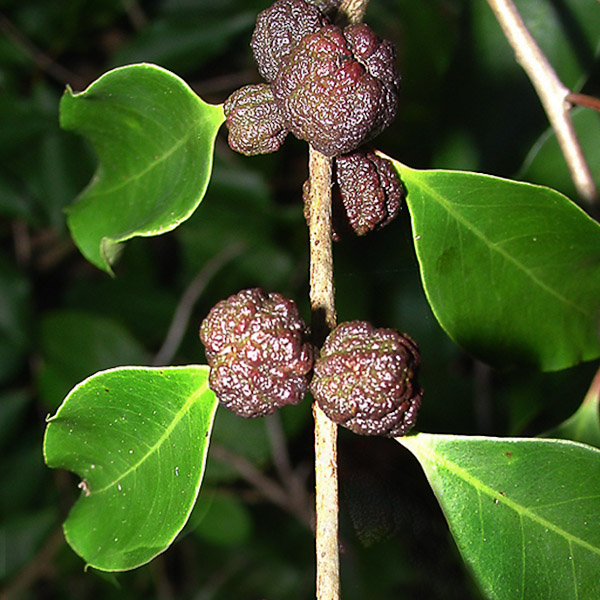
Raisins? Or under the influence of gall-makers?
That could be a matter of age or of growth conditions, but the deviations can be extreme. Some of the fruits are off-the-charts, grotesque, and sometimes hard and dry.
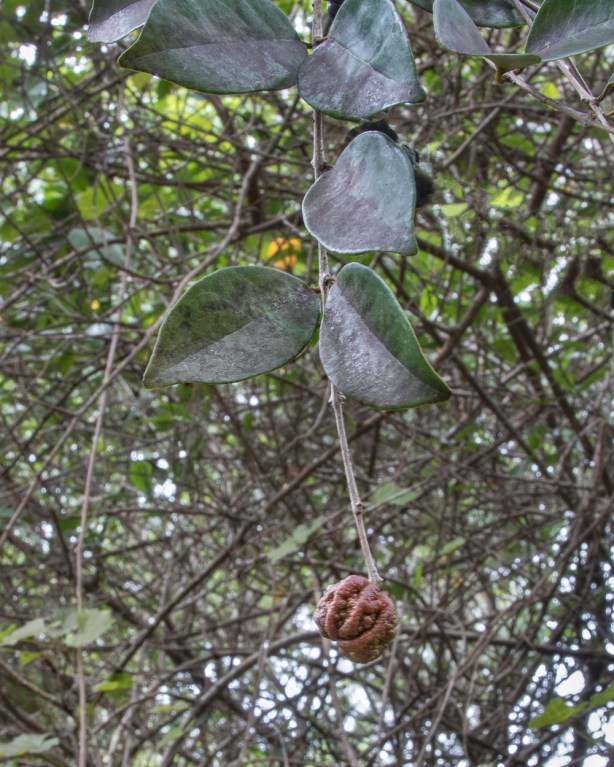
See what I mean? The fruits can be seriously deviant.
Although I’m not sure where age and conditions end and gall-inducing pests start, Eugenias and relatives in general suffer from insect-induced fruit galls. Anyone who habitually eats the related Surinam-Cherry may spit tiny larvae from between the teeth.
The abnormal WS fruits bothered Miami botanist Walter Buswell back in 1946, who said of today’s stopper: “often with few or many woody galls in place of the fruit.” It will be interesting to slice open the berries from now on, especially the weird ones, and see if they are merely raisins, or if somebody’s home within. There’s a poorly told story hiding here.
Another White-Stopper oddity is their fragrance. Crush the leaves, and the smell isn’t powerful, despite membership in the Eucalyptus Family. Stand next to one, and your sniff may disappoint. But stroll on a hot day through a hammock where the species hangs out, and you may whiff a vague “skunky,” or “earthy” aroma, not unpleasant. Reminds me of the fox cage at the zoo combined with freshly tilled soil.
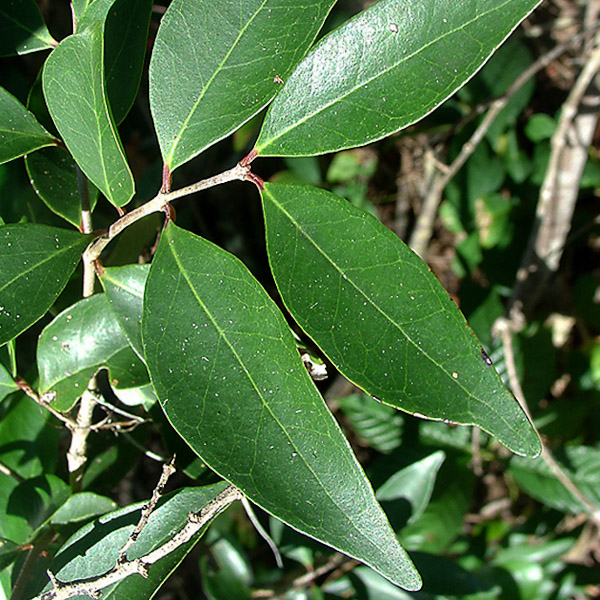
Purple petioles
Why would a plant smell sort of musky, or earthy? The perfume industry is grateful for plant musks. Much easier to obtain than civets, and we want cruelty-free cosmetics! What’s musk anyhow? There’s no single definition, sort of like pornography, it is vaguely defined but you know it when you smell it. So alluring. Put it in the perfume and stand back! To over-simplify in the interest of you continuing to read, plant musks are blends of volatile (easily evaporated) large organic molecules. OK that is enough chemistry.
Cuban chemist Jorge Pino and collaborators in 2003 identified 42, count ‘em, named volatile molecules released from the leaves of Eugenia axillaris. Repeat, 42. Holy stinkpot! And even more adrift after release when they meet the sun, air, and each other. Among the 42 are compounds used as fixative in perfume, as fragrance in marijuana, as medicines, as giving beer its hoppy essence. Some are described as smelling “musty” and “earthy.” That smelly arsenal exists to counter infections, infestations, and miscellaneous pestilence.
The reason some people smell the shrubs and others fail is probably in part a matter of when the foliage unleashes its chemical warfare. True enough when warm, but there may be more to it than heat. In this connection, the leaves have tiny translucent dots underneath, reasonably guessed to be hotspots where the P.U. sequesters.
 John Bradford
 George Rogers
 George Rogers
 Dee Staley
 Treasure Coast Natives
