Where Did Our Locally Endemic Wetland Species Come From?
South Florida has extreme geologic history. High dry habitats have been exposed above water for eons. The opposite is today’s topic, wetlands. Freshwater lowlands are South Florida trademarks. Our present-day swamps, marshes, depression ponds, wet prairies, soggy pinewoods, and the Everglades hid beneath salty seas as recently as 15,000 years ago speaking very roughly, a teensie winky blink in evolutionary time. If their habitats were blue lagoons until just yesterday, where did our wetland-loving plant species come from?
For species widespread beyond our region, duh, they migrated here from afar when conditions permitted. But what about species limited to (endemic to) South Florida? Yes, they could have shown up here from somewhere else and then disappeared there, but unlikely and arbitrarily rejected. Ground rule—we will trust locally confined species to have originated locally. Yes, it is all speculation. We’re just having fun here.
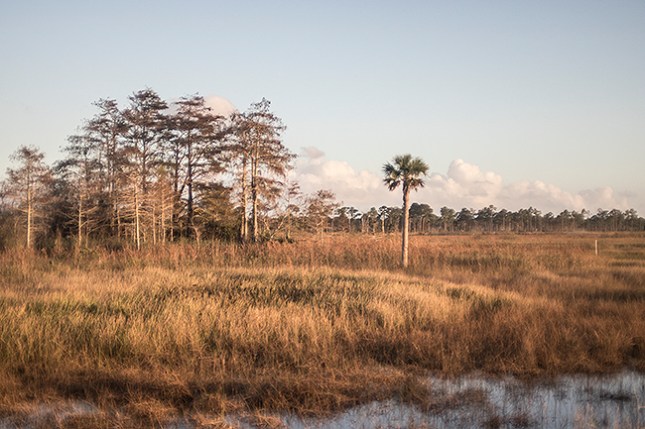
Even though most of our present-day lowland areas were beneath saltwater, the exposed elevated uplands were not 100% dry. Those raised islands must have had rain-fed depressions, ponds, and marshes where freshwater life could take refuge, freshwater Noah’s Arks ready to repopulate the vast lowlands when the salty seas subsided.
Even acknowledging spotty refuges, a massive new start defined soggy South Florida just a few millennia ago. Huge upheaval, huge abrupt changes. And that makes it fun to wonder how our locally endemic wetfoot species might have popped up. Each of those species has to have an oddball story. Odd circumstances generate odd histories.
Here are three as I see it:
Coleataenia abscissa (Panicum abscissum), Cutthroat Grass, and the Running Rhizomes
Cutthroat Grass may be an example of a localized “species” originating as a regional spin-off from a widespread northern species. Cutthroat grass is so incompletely separated from its ancestral species, its classification as a species is dubious. Some taxonomists demote it from species status to a subspecies as Coleataenia longifolia subsp. abscissa, you might say a mere local variant of Coleataenia longifoia.
Coleataenia longifolia ranges across much of North America with additional spinoffs in other places. Confusing? Yes. Species is a human concept…the plants do not read textbooks. These grasses represent a big messy dynamic splintery complex where “species” are not defined crisply.
Even as a mere splinter group, Cutthroat Grass must have had some way of expanding its new brand while not merging back into its parental species. Cutthroat Grass is aggressively rhizomatous. South Florida is filled with rhizome-making plants able to colonize large areas clonally, thus spreading into what some botanists call “microspecies.”
This rhizome-ish microspecie-ish situation with Cutthroat Grass is reminiscent of another local wetland grass limited to Florida, Aristida rhizomophora, named for its prominent rhizomes. It seems to be a wet foot Florida derivative of the generally more upland Aristida stricta which has no rhizome or just a little, especially in South Florida. It looks like A. rhizomophora took that little ancestral rhizome and ran with it bigtime, spreading like Cutthroat Grass to become a microspecies or whatever you choose to call it. The designation matters less than an understanding of what happened. (And I could be wrong.)
Polygala smallii, Small’s Milkwort. A Pollination Introvert?
A third local twig branched off from a widespread northern species is Small’s Milkwort. DNA shows it to be a chip off of Candyroot, Polygala nana. The two are a challenge to distinguish. Because Small’s Milkwort is often encountered in upland habitats, it may be a stretch in today’s wetland context, but even in uplands it likes relatively moist depressions, and is a facultative (part-time) wetland species. Also, its parent species Candyroot prefers moisture. The taste for uplands while retaining a love for moisture makes Small’s Milkwort a candidate for those refugia mentioned above.
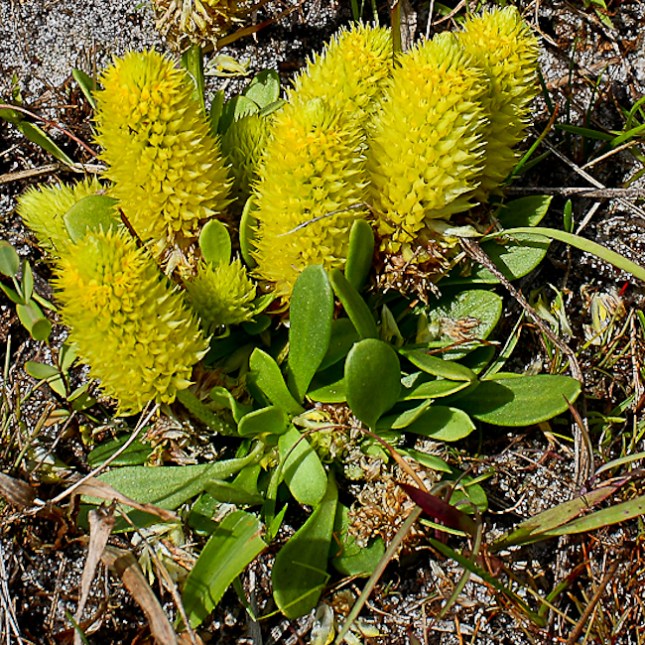
Candyroot, Polygala nana, by John Bradford
A subtle and overlapping difference in flower color helps distinguish the two, with Candyroot brighter yellow than Small’s Milkwort’s slightly-greenish yellow.
This yellow flower business echoes a second Milkwort pair. The Florida endemic Polygala rugelii has bright yellow flowers. The similar Polygala lutea favors orange. Thus we have two Polygala pairs, each with one member restricted to Florida and the other widespread and more northern, separated in part by the yellowness of the flowers. Pollinator color preferences matter.
But then again maybe not always. What forced Small’s Milkwort to cleave unto its mother Milkwort? Geographic separation long ago is possible, remember those refugia, but there is a possible second isolation factor. Small’s Milkwort reportedly appears to be self-pollinating. That would prevent it from mixing genes with its parent species, thereby allowing a separate new “species” to diverge. If you want to keep bloodhounds and boxers separate, don’t let them interbreed. Same with Polygalas.
Did the Small’s Milkwort flowers evolve from bright yellow to yellow-green because they don’t need to attract pollinators, and does their green tinge add photosynthetic ability? Objection Your Honor!—that question has no evidentiary basis. Question withdrawn.
Litrisa carnosa (Carphephorus carnosus), Pineland Chaffhead. Not a Splinter, But a Merger
This case is weirder than the previous two. If our Cutthroat Grass and Milkwort split off of raggedy bigger northern parent species and stopped interbreeding with them, Pineland Chaffhead is the other side of the coin, a merger. It originated as a hybrid, reproductively a loner which somehow managed to spread.
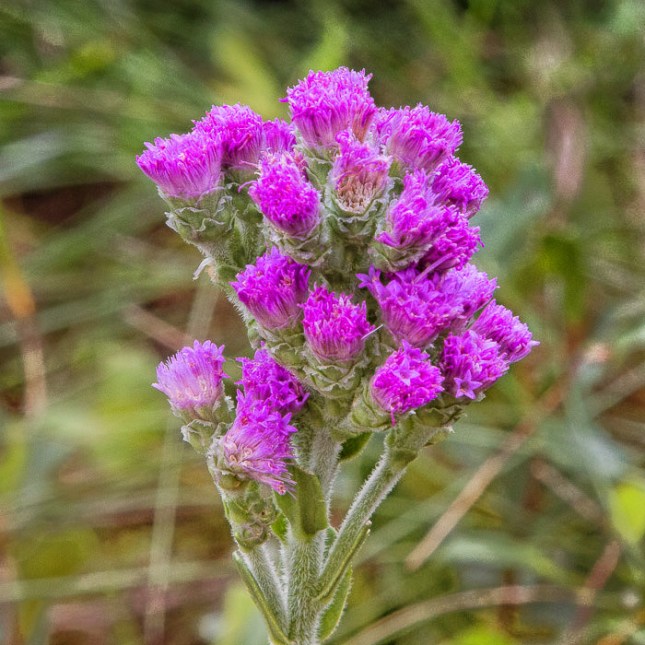
Pineland Chaffhead, Litrisa carnosa, by John Bradford
Tennessee botanist Edward Schilling seems to have finally nailed this misfit. The genus Carphephorus where Pineland Chaffhead resided turned out to be a bad genus in the sense that it did not represent a single branch on the tree of life, and had to be dismembered. Pineland Chaffhead became reassigned to a genus of its own, Litrisa, presciently first proposed by John Kunkel Small two generations before Dr. Schilling’s DNA confirmation in 2011. That’s the same Small as in Small’s Milkwort. DNA revealed Pineland Chaffhead to be a probable hybrid bridging two different genera, Carphephorus as newly redefined, and Trilisa.
How might the hybrid Chaffhead have propagated and spread? Many members of the Aster Family have asexual clonal seeds, with no data for the species in question. One thing is clear, it makes babies in spades around its feet, removing any questions about its basic ability to go forth and multiply, somehow.
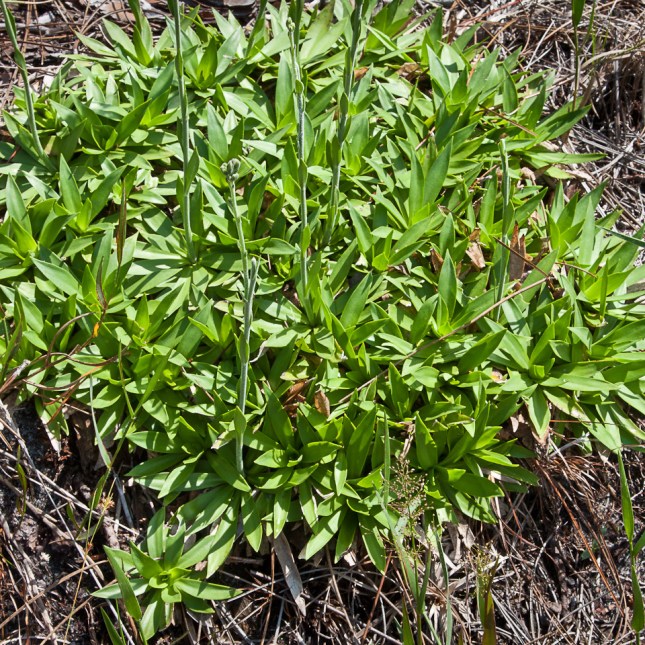
Despite being an apparent hybrid, Pineland Chaffhead makes plenty of babies, by John Bradford.
——————————————————————————————————
For readers who want to dig in: CLICK
 John Bradford
 George Rogers
 George Rogers
 Dee Staley
 Treasure Coast Natives