Vittaria lineata
Pteridaceae (or Vittariaceae)
(Vitt is Latin for ribbon. Lineata refers likewise to the ribbon-shaped leaves.)
No fieldtrip today thanks to that killjoy flu epidemic afflicting the building where I work. Trapped at home today recuperating, I’m stepping back to my native plants class earlier this week where Shoe String Fern entertained the troops
The ferns do look like shoestrings or flattened pine needles. (Or in old Native American names, a giant’s whiskers.) Many unrelated plants have long ribbon-shaped grassy leaves. Why would a fern go grassy? I think it has to do with its lifestyle dangling from high dry tree trunks, almost always a cabbage palm.
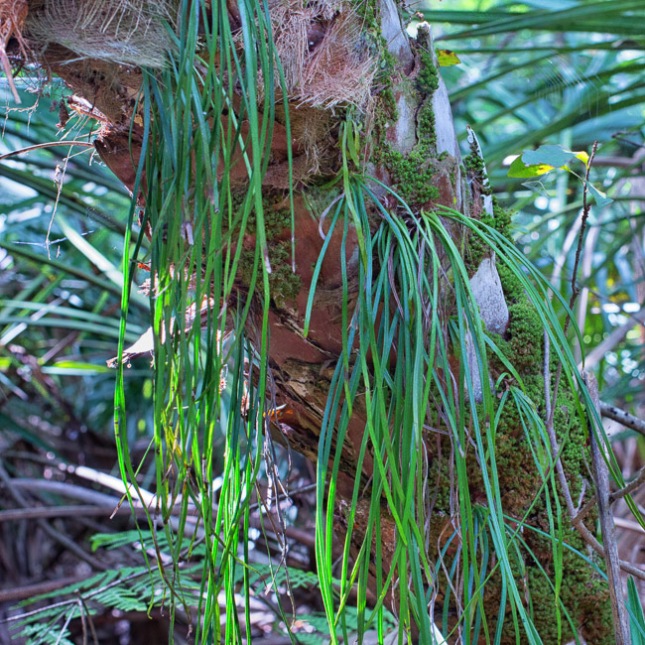
Hanging from a Cabbage Palm trunk, by John Bradford.
Most plants open little leaf valves called stomates by day during photosynthesis, allowing gas exchange, incuding watter loss. Call it plant-breath. Shoestring Fern can behave in this normal fashion when water is plentiful. Unfortunately, up on a trunk with no roots in the ground, the fern can suffer a water shortage.
When that hapens, signaled by a stress hormone, SSF can switch to a water-saving alternative system called C4 photosynthesis, an adaptation most often seen in desert plants. A palm trunk can be a desert at times.
When they are in their water-saving C4 mode, the ferns close their stomates when the sun shines, and open them ony at night, with two consequences:
- Closed stomates block evaporative cooling. This problem might explain the narrow leaves, being natural heat-radiators with a huge collective surface area waving in the cooling breeze. If you can’t cool by evaporation, switch to letting the wind blow through all those strings.

Natural heat radiators. By JB.
- The second consequence of day-closed stomates is that carbon dioxed needed for photosynthesis must be sequestered for use the next day when the stomates open at night. Inside the fern leaf is porous material where the carbon dioxide probably collects to await the morning sun..
The stomates hide in two protective grooves under the leaf, where the fern also hides its delicate spore-making organs, explaining why you seldom see spores on Shoestring Fern.
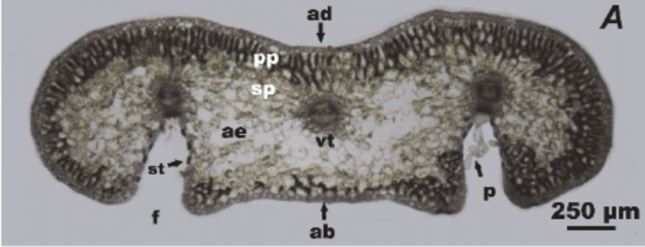
Shoestring sliced like salami. The stomates (st) are in the grooves. The presumed carbon dioxide spongy storing area is labeled ae. Photo by B. D. Minardi and collaborators. Photosynthetica 22: 404. 2014.
Moving to another funny ferny feature requires explanation of the fern life cycle. Ferns alternate between two body forms from generation to generation. The big normal fern, called the sporophyte, spawns as the next generation tiny green plants you might mistake for moss or algae, called gametophytes. And when those reproduce, they re-generate a new sporophyte. Round and round: sporophytes beget gametophytes which beget sporophytes and so on. Chicken and egg.
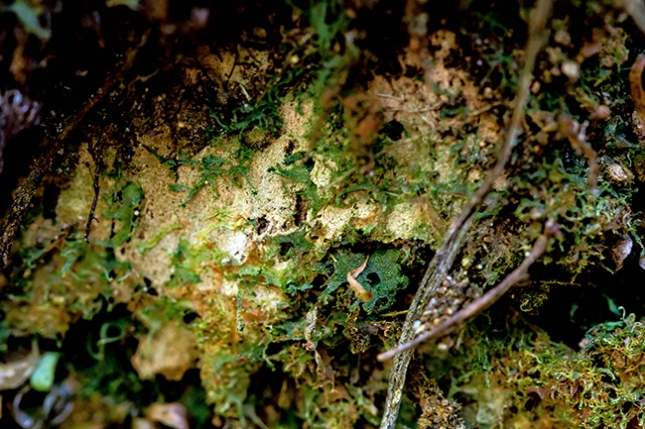
Shoestring Fern gametophytes in dry weather on Cabbage Palm Trunk, highly magnified. New sporophytes grow from these.

Close up and personal green gematophyte. Circled area possibly forms gemmae.
All very interesting today’s species, and much more so in its close relative, the Appalachian Vittaria appalachiana.
Vittaria appalachiana lost its sporophyte. What? How can a fern lose one of its flip-flopping generations? It happened. This species is known only as gametophytes. But then you ask, if you need a sporophyte to make a gametophyte, who makes those gametophytes? Answer: in the genus Vittaria the gametophytes have little breakaway pieces called gemmae (GEM-ee), which can break off, wash away, and allow non-sexual clonal reproduction.
DNA evidence has helped find the missing sporophyte, revealing that the lonely Appalachian gametophyte comes from a tropical American species called Vittaria graminifolia which still has its sporophyte in its tropical habitat in the West Indies and southward. How its gametophyte, or very close relative, got loose all alone and far away in North America would be fun to know. The case of the runaway gametophyte.
Our local Shoestring Fern has gemmae on its gametophytes too, and appears to use them to mulitply its gametophyte population tucked among old leaf base zones on Cabbage Palms or on the moist palm trunk bases. Good gametophyte habitat seems to be part of the reason Shoestring Fern hangs around on Cabbage Palm.
There may be a second reason. We think of epiphytes, airplants, as sitting politely on their hosts, perhaps with white knuckles on windy days. Out fern does more than grip: its roots burrow into the palm penetrating its outer layers to a depth of at least half an inch.

Outer layer of Cabbage Palm “bark” removed from tree and viewed from its inner surface (aboout 1/2 inch deep). The “worms” are SSF roots that have burrowed into the soft decaying palm tissue and spread aggressively within it.
Palms do not have “bark” in the sense of a woody tree, but they can have similar spongy more or less dead outer layers. I do not know if the fern roots ever poke in deep enough to steal sap from the palm, very unlikely, and unknown to occur, but they are not shy about running through the outer layers, possibly deriving nutritional benefit from the palm’s decay, and/or whatever soaks in from rain water and stem wash. The ferns finds a natural “potting medium” handy for its gametophyte and sporophyte’s roots.
 John Bradford
 George Rogers
 George Rogers
 Dee Staley
 Treasure Coast Natives