Quercus myrtifolia
Fagaceae
—————————————————–
Scrubby shrubby Oaks helpful pre-info (and see photos below)
Myrtle Oak (Quercus myrtifolia). Usually small and shrubby, seldom over 15 (30) feet tall, leave almost hairless, shaped like the business end of a spoon, evergreen.
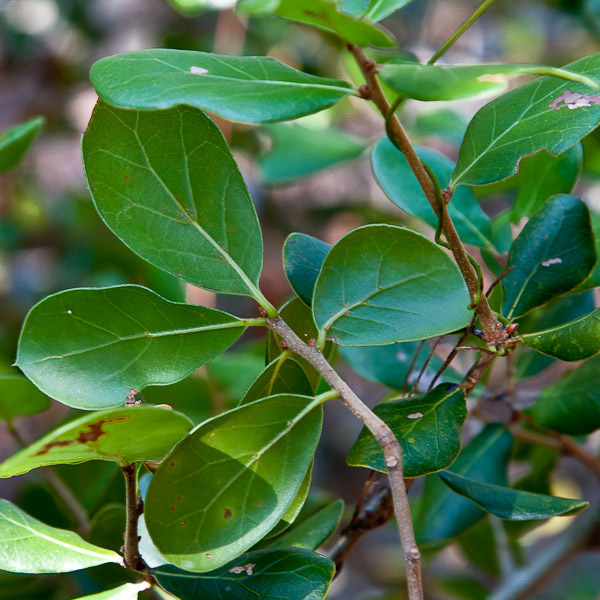
Myrtle Oak leaves look like spoons.
Sand-Live Oak (Q. geminata). Usually small and shrubby as encountered in early scrub, although potentially to over 70 feet tall as a full-sized tree. Leaves long and narrow with the margins rolled under, fuzzy beneath, semi-evergreen.
Chapman’s Oak (Q. chapmanii). Shrubby or often a small tree to about 30 feet tall, often encountered taller than Myrtle Oak. Leaves variable, sometimes 3-lobed, nearly flat, a little hairy beneath, larger than the other two, dark green and glossy-reflective above, deciduous.
——————————————————-
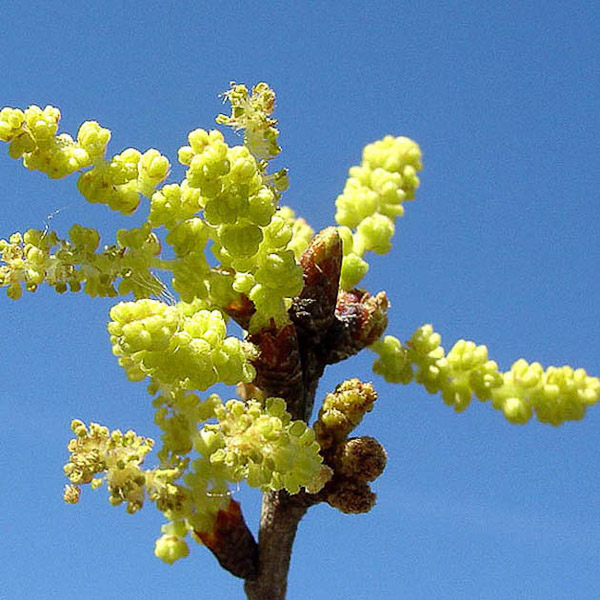
Myrtle Oak male flower clusters. (All photos today except the burned scrub by John Bradford.)
Today John and George climbed the Hobe Mountain (dune) tower in Jonathan Dickinson State Park near Hobe Sound, Florida. We were up there for a photo project, with the botanical benefit of the best view in Martin County. The vista sweeps across scrublands subjected to prescribed burns. The botanical take-home lesson is that Myrtle Oak is the early come-back kid after scrub fire. Where all else seems disappeared, stressed, laying low, or charred, the Myrtle Oak is green, vital, and in charge.
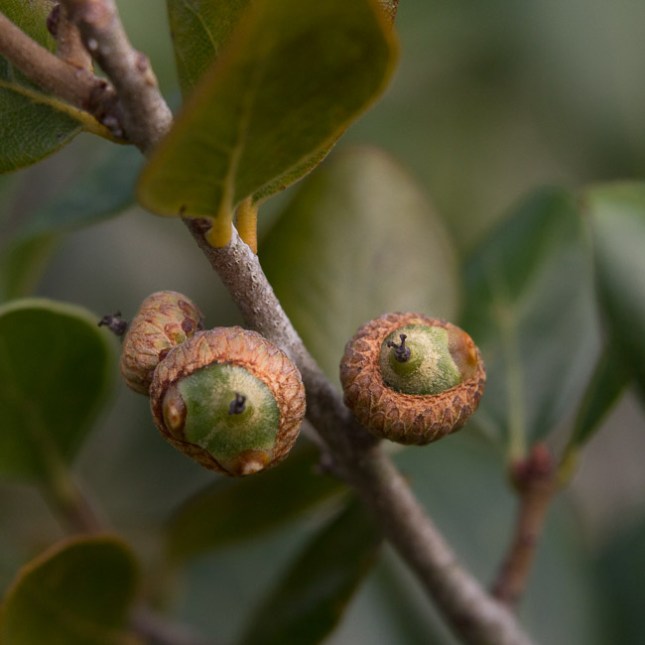
Myrtle Oak acorns
Around here there are three main mostly shrubby scrub oaks, predominantly Myrtle (Q. myrtifolia), Chapman’s Oak (Q. chapmanii), and Sand Live Oak (Q. geminata). Sometimes additional species make cameo roles, but we’ll focus on the main trio.
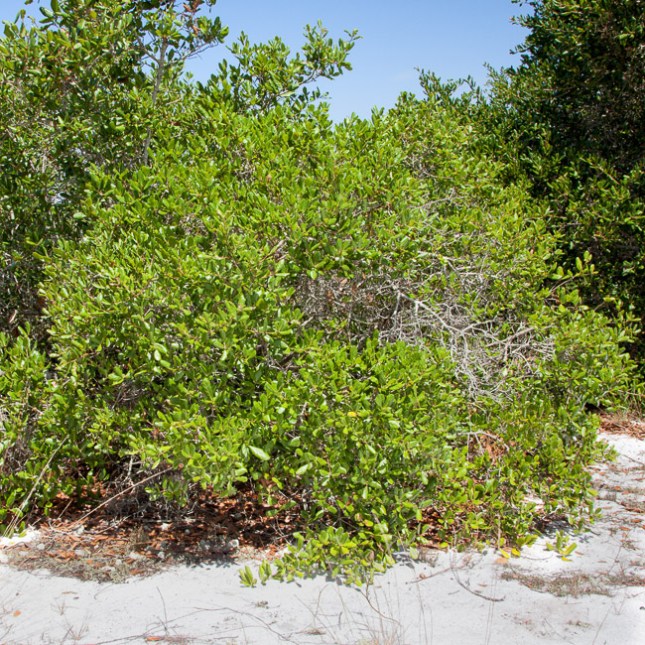
Myrtle Oak on sugar sand
Ecologists have long been interested in succession, which is the parade of communities to occupy a site after disturbance such as flames. Just like human settlements, pioneer ecological communities alter the conditions paving away for the next stage. Succession following fire is a special case, because many species have diverse mechanisms to survive the blaze and bounce back, and then compete at different phases of succession, some winners early, others winner later. These are important management questions, many species of conversation interest are best in early-successional environments, scrub jays, as a prominent example.
J.E. Freeman and collaborators at the University of Florida recently studied post-fire succession with reference to oaks. Their data showed that, “Myrtle Oak was the most aggressive colonizer of postfire open space.” So does the photo below taken this morning.
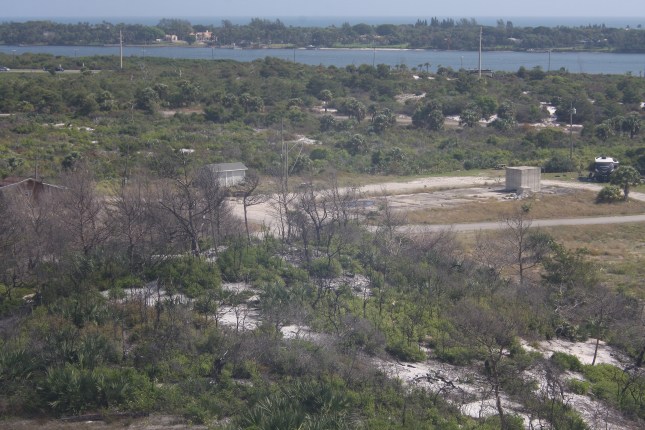
Burned scrub. Most of the light green is Myrtle Oak.
Freeman showed dominance to shift toward Sand-Live Oak at later stages. Sand-Live Oaks, with their tendency to take over later, can grow into substantial trees to 70 feet tall, far larger than Myrtle Oak or Chapman’s. Chapman’s seems at its best after the initial Myrtle Oak surge but well before late succession.
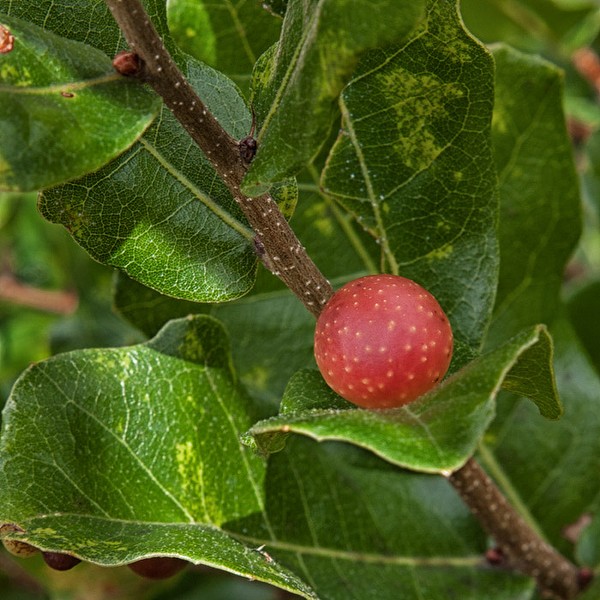
Chapman’s Oak. Reflective leaves. Red globe is a gall.
Having three oaks (plus sometimes others) commonly found mixed in an extreme habitat begs the question of how they co-exist without one “winner” with the others outcompeted to oblivion. We have one hint already, they hit their strides at different point in succession. Botanists have pointed out moreover, that within the world of oaks, they are not close relatives, and thus differ in demands and tolerances, although not often in any conspicuous fashion. Tammy Foster in a 2014 doctoral dissertation looked into this and found some teaser surprises. Echoing interests of Florida scrub ecologist Herman Kurz a century earlier, Foster investigated small elevational differences, finding that of our three scrub oaks all preferred high dry habitats. But wait, one was a little different, Sand-Live Oak, grew also at lower elevations where it showed sensitivity to drought due to extending to a different soil type, underscoring what we already knew…that Sand-Live Oak is the least tied to early succession scrub.
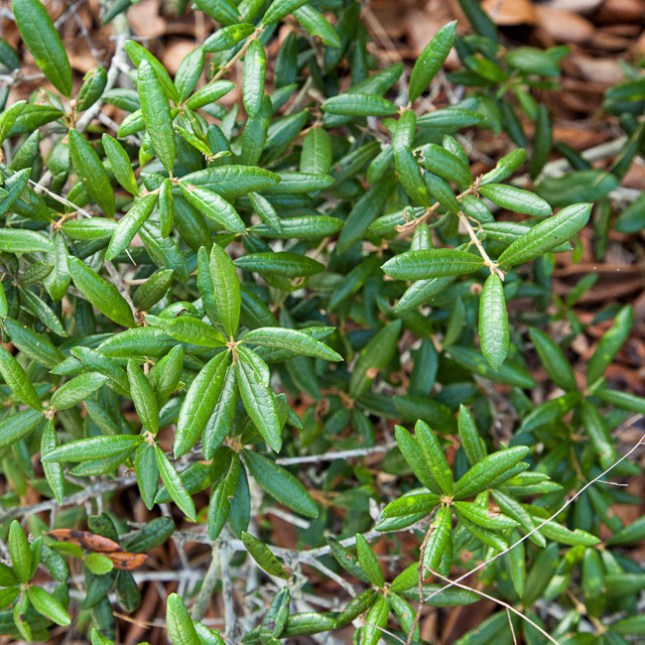
Sand Live Oak. Narrow rolled leaves.
Foster found also that Chapman’s Oak bravely maintained normal photosynthetic ability during drought when the others closed up shop, a superpower perhaps permitted by its reflective leaves able to shed damaging light and heat. So it is apparently out-photosynthesizing the others at dry times, but then, as the only deciduous species, concedes the rest of the year.
Tough to draw any big conclusions from all this, and yet eye-opening to catch glimpses of how three inevitable competitors carve out specialized coexistences with a little elbow room for each other.
 John Bradford
 George Rogers
 George Rogers
 Dee Staley
 Treasure Coast Natives