Arisaema triphyllum
(Aris is an ancient plant name. Haima is Greek for blood, alluding to blood stains on the leaves of certain species. Triphyllum refers to the three-lobed leaf.)
Araceae
John and I experience botanical addiction to the hinterlands of Kiplinger Nature Preserve, where this morning we tiptoed across the impenetrable Red-Maple-Poison Ivy Swamp and explored a vast isolated scrubby pine woods beyond the pale of human visitation…really. Guarded on all sides by a formidable moat of water, mud, fallen trees, vines, and swamp. Where can you go in Florida and see no sign whatsoever of human activity?
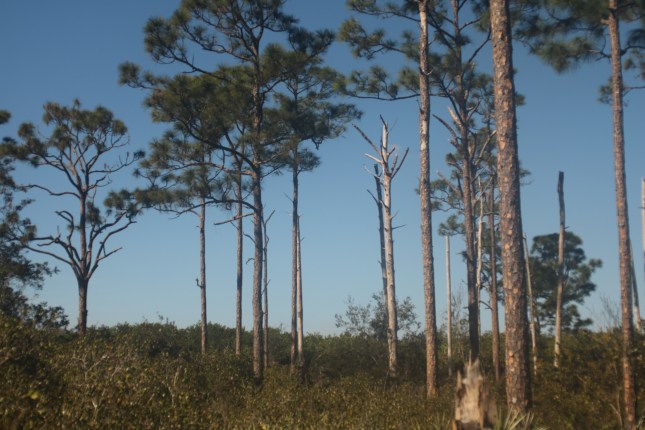
Desolation
Red Maples suggest swampy woods farther north, where a favorite spring wildflower is Jack in the Pulpit, an oddball ranging from Canada southward to our area. Isolated patches in Martin and Palm Beach counties are among its southernmost outliers. We encountered Jack preaching in the Kiplinger mud. Almost every wildflower fancier in the eastern U.S. and Canada fancies this species, and so do many gardeners.
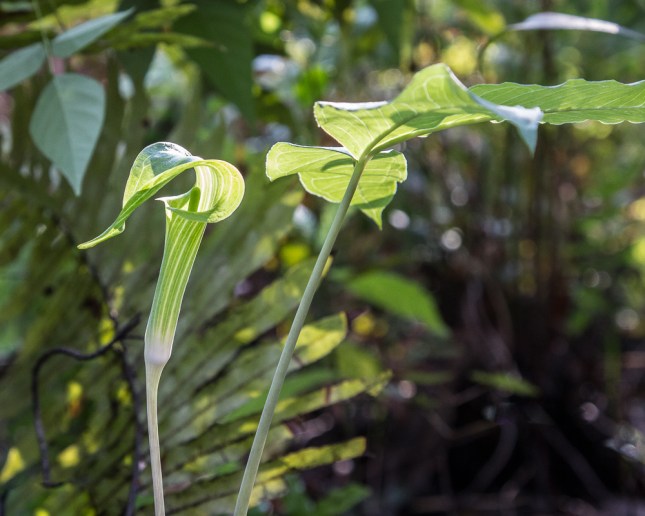
The pulpit is a specialized leaf called a spathe. It wraps around Jack very much like an old fashioned covered pulpit in some churches.
Jack is a spadix, that is, a vertical spike dotted at its base with many tiny flowers. Having a spathe and spadix is characteristic of the Aroid plant family, containing such favorites as Anthuriums, Calla “Lilies,” and Spathiphyllums.
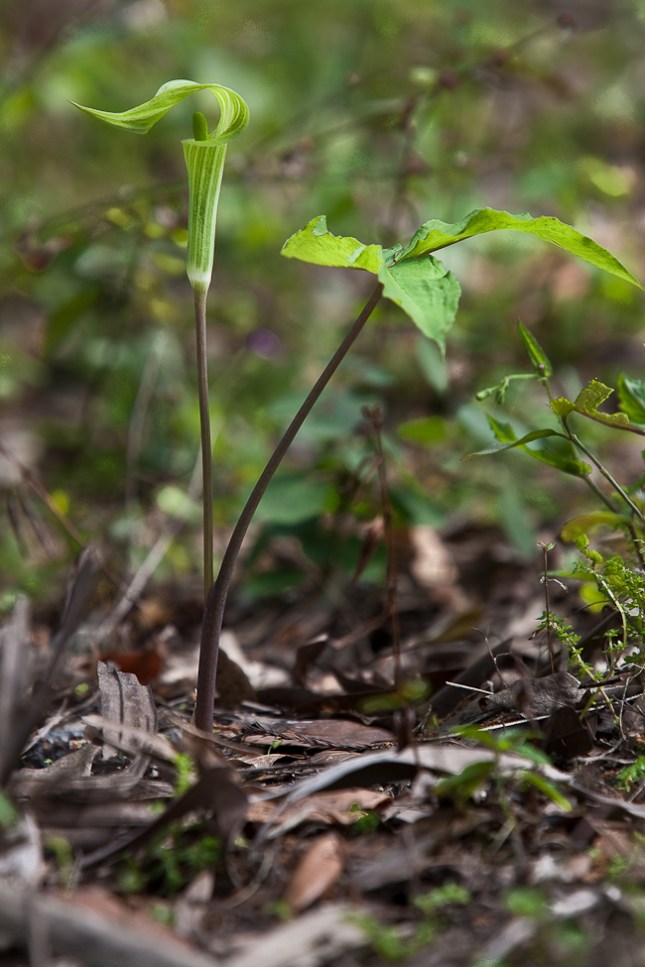
By John Bradford
The flowers on any given spadix are usually either all male, or all female, although occasionally mixed. To make it weird, the individual plant’s sex can change from year to year. What determines the “sex of the year” remains murky despite repeated studies. Bigger plants tend to be female in contrast with smaller male plants, although there is environmental influence beyond mere size. At least one researcher suggested that a female plant depletes its stored nutritional reserves by making fruits, so the following year it switches to the less demanding male role.
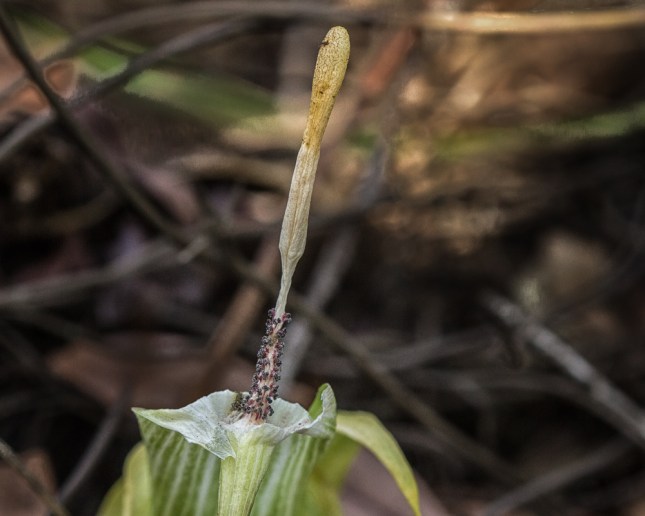
Jack exposed! Male flowers at bottom.
What comes next needs more research. The narrative is based on today’s species plus additional Arisaema species. Not all researchers agree 100%. So the following account is a semi-consensus likely to be accurate, still…no guarantees.
Although various floral visitors are on record, the plants seem adapted primarily to fungus gnats as pollinators. Fungus gnats feed on fungi, so why hang around Jack in the Pulpit? Jack has B.O. and smells like fungus. The bare upper spadix emits a false-fungus gnat-lure fragrance. Jack is a false prophet.
Gnats come looking for fungus. If they enter the pulpit (spathe) surrounding a male spadix, they drop to the floor where pollen collects and get pollen-dusted. At the base of the spathe is an exit door to let the gnats fly away bearing that dusty pollen.
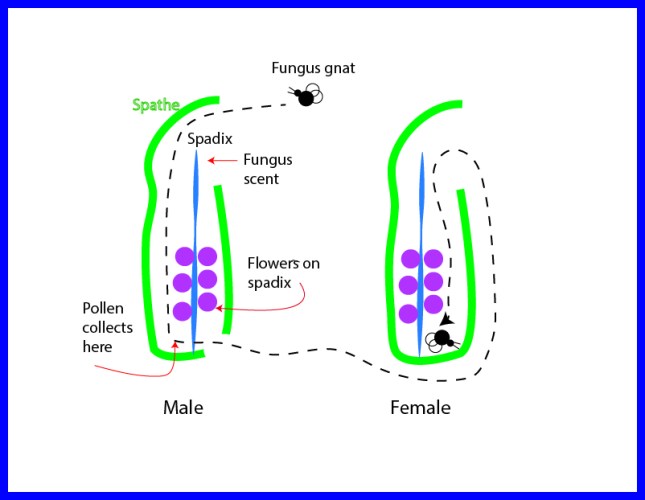
Male pulpit, stage left. Female on the right. Follow the gnat drawn to the false fungal fragrance. The gnat escapes the male spathe through the door on the floor, and moves on to the female spathe, where it meets its end after delivering its pollen load.
When the gnats enter the spathe around a female spadix they fall in again, this time brushing their pollen onto the female flowers deep in the spathe. The gnats yet again drop to the floor, but this time there’s no back door. They give their lives to complete the flower’s sexual cycle.
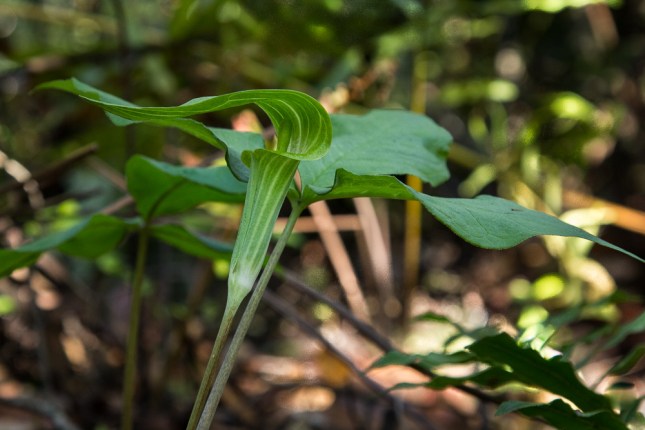
You can see the exit hole on the bottom left of the pulpit.
Is the plant carnivorous, benefitting nutritionally from its decaying victims? If so, nobody has shown it so far.
 John Bradford
 George Rogers
 George Rogers
 Dee Staley
 Treasure Coast Natives

